
Development of Fuel Gas Production Technology Using Waste Materials from the Bamboo Rice Production Process
Article Sidebar
Main Article Content
Abstract
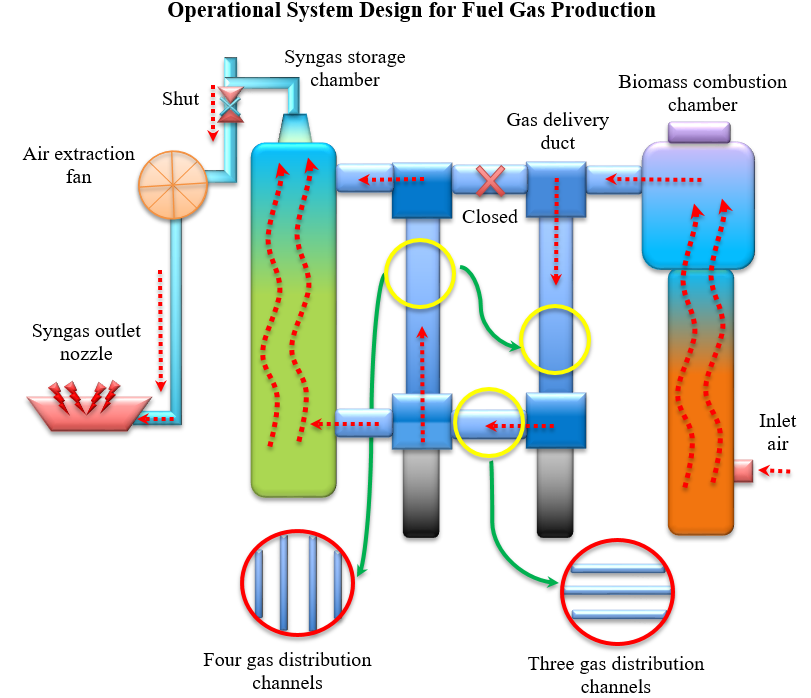
Traditional bamboo rice production generates substantial biomass residues that frequently remain underutilized, posing significant environmental challenges within community-based production systems. To address this, the current study integrates Computational Fluid Dynamics (CFD) simulations with experimental validation to develop a tailored fuel gas production technology utilizing bamboo-derived charcoal. The research evaluates thermo-fluid characteristics and syngas composition while assessing economic feasibility relative to liquefied petroleum gas (LPG). Findings demonstrate a peak combustion temperature of 706°C, with gas delivery temperatures stabilized between 250–300°C along distribution ducts. Technical analysis reveals a maximum gas velocity of 34.22 m/s in narrow sections, optimizing the flow of syngas comprising 15.14% hydrogen, 25% carbon monoxide, and 2.31% methane. From an economic perspective, bamboo-derived gas provides a superior cost-benefit profile; while LPG offers higher energy density, the waste-derived alternative reduces energy expenses by approximately two-thirds, costing 1.1 THB/kWh compared to 3.9 THB/kWh for LPG. These results confirm that transforming bamboo residues into renewable energy is technically viable and economically advantageous for community-scale thermal applications. By fostering a circular economy and enhancing energy self-reliance, this technology provides a sustainable framework for localized waste management and the transition toward clean energy in community enterprises.
Downloads
Article Details

This work is licensed under a Creative Commons Attribution 4.0 International License.
Copyright Notice
The copyright of research articles published in the VRU Research and Development Journal Science and Technology Journal belongs to the Research and Development Institute, Valaya Alongkorn Rajabhat University under the Royal Patronage. Reproduction of the content, in whole or in part, is prohibited without prior written permission from the university.
Responsibility
The content published in the VRU Research and Development Journal Science and Technology Journal is the sole responsibility of the author(s). The journal does not assume responsibility for errors arising from the printing process.
References
Al-Busoul, M. (2017). Design of fruits solar energy dryer under climatic condition in Jordan. Journal of Power and Energy Engineering, 5, 123–137.
Basu, P. (2013). Biomass gasification, pyrolysis and torrefaction: Practical design and theory. Academic Press.
Brantley, K. E., Brye, K. R., Savin, M. C., & Longer, D. E. (2015). Biochar source and application rate effects on soil water retention determined using wetting curves. Open Journal of Soil Science, 5(1), 1–10.
Brown, R. C. (2011). Introduction to thermochemical processing of biomass into fuels, chemicals, and power. John Wiley & Sons, Ltd.
Chai-ngam, R. (2024). Development and study on bamboo charcoal production. Community University Engagement Journal, 2(1), 1–10.
Chatterjee, R., Sajjadi, B., Chen, W. Y., Mattern, D. L., Hammer, N., Raman, V., & Dorris, A. (2020). Effect of pyrolysis temperature on physicochemical properties and acoustic-based amination of biochar for efficient CO₂ adsorption. Frontiers in Energy Research, 8, 85.
Chonlaphan, S. (2023). Studying produce rate of biomass gas from community gasifier. Srinakharinwirot University Journal of Sciences and Technology, 15(29), 1–12.
Da, J., Mendes, S., Helena, L., Chaves, G., Chaves, I. de B., Silva, F. de A. S. e, & Fernandes, J. D. (2015). Using poultry litter biochar and rock dust MB-4 on release available phosphorus to soils. Agricultural Sciences, 6(11), 1367–1374.
Eiamsa-ard, P., & Tantipanathip, W. (2023). Optimization of Congo red dye adsorption onto water hyacinth biomass adsorbent. VRU Research and Development Journal Science and Technology, 18(1), 73–88.
Esteves, B., Sen, U., & Pereira, H. (2023). Influence of chemical composition on heating value of biomass: A review and bibliometric analysis. Energies, 16(10), 4226.
Ferziger, J. H., Perić, M., & Street, R. L. (2020). Computational methods for fluid dynamics. Springer International Publishing.
Groover, M. P. (2018). Automation, production systems, and computer-integrated manufacturing (5th ed.). Pearson.
Harari, Z. (2024). Investigating the mathematical foundations of the Euler and Navier–Stokes equations. Open Journal of Fluid Dynamics, 14, 242–258.
Khaled, A. (2011). Enhancement of heat transfer using pins swimming in non-isothermal fluidic systems: Exact solutions. Journal of Electronics Cooling and Thermal Control, 1, 1–13.
Li, Y., Shao, J., Wang, X., Deng, Y., Yang, H., & Chen, H. (2014). Characterization of modified biochars derived from bamboo pyrolysis and their utilization for target component (furfural) adsorption. Energy & Fuels, 28(8), 5119–5127.
Mason, P. E., Darvell, L. I., Jones, J. M., & Williams, A. (2016). Comparative study of the thermal conductivity of solid biomass fuels. Energy & Fuels, 30(3), 2158–2163.
McKendry, P. (2002). Energy production from biomass (part 1): Overview of biomass. Bioresource Technology, 83(1), 37–46.
Moran, M. J., Shapiro, H. N., Boettner, D. D., & Bailey, M. B. (2014). Fundamentals of engineering thermodynamics (8th ed.). John Wiley & Sons, Inc.
Munson, B. R., Young, D. F., & Okiishi, T. H. (2013). Fundamentals of fluid mechanics (7th ed.). Wiley.
Nsamba, H., Hale, S., Cornelissen, G., & Bachmann, R. (2015). Sustainable technologies for small-scale biochar production—A review. Journal of Sustainable Bioenergy Systems, 5, 10–31.
Otani, M., Takahashi, T., Habuka, H., Ishida, Y., Ikeda, S.-I., & Hara, S. (2020). Quartz crystal microbalances for evaluating gas motion differences between dichlorosilane and trichlorosilane in ambient hydrogen in a slim vertical cold wall chemical vapor deposition reactor. Advances in Chemical Engineering and Science, 10(3), 190–200.
Prestipino, M., Famoso, F., Iannitti, L., & Galvagno, A. (2026). From residual biomass to bioenergy and biochar: A techno-economic and environmental analysis of pistachio-shell gasification–cogeneration. Energies, 19, 2–19.
Reed, T. B., & Das, A. (1988). Handbook of biomass downdraft gasifier engine systems. Biomass Energy Foundation.
Sasujit, K., Buachum, S., & Pinthong, W. (2021). Experimental investigation of gasification of densified agricultural biomass in a downdraft gasifier. AIP Conference Proceedings, 2681(1), 020009.
SolidWorks. (2024). What’s new in SOLIDWORKS 2024: Load SOLIDWORKS Flow Simulation Modules. Retrieved from https://help.solidworks.com/2024/English/WhatsNew/c_wn_flow.htm
Unchaisri, T., Chayawattana, T., Poosri, J., Dechsatian, A., & Chaivatamaset, P. (2025). Characteristics of biochar production derived from bamboo in a drum pyrolyzer. The Journal of Industrial Technology, 21(1), 116–160.
Versteeg, H. K., & Malalasekera, W. (2007). An introduction to computational fluid dynamics: The finite volume method (2nd ed.). Pearson Education.
White, F. M. (2019). Fluid mechanics (7th ed.). McGraw-Hill.
