
Chemical Components, Antioxidant and Tyrosinase Inhibitory Activities of Dried Aloe vera Rind Extract under Different Drying Methods
Article Sidebar
Main Article Content
Abstract
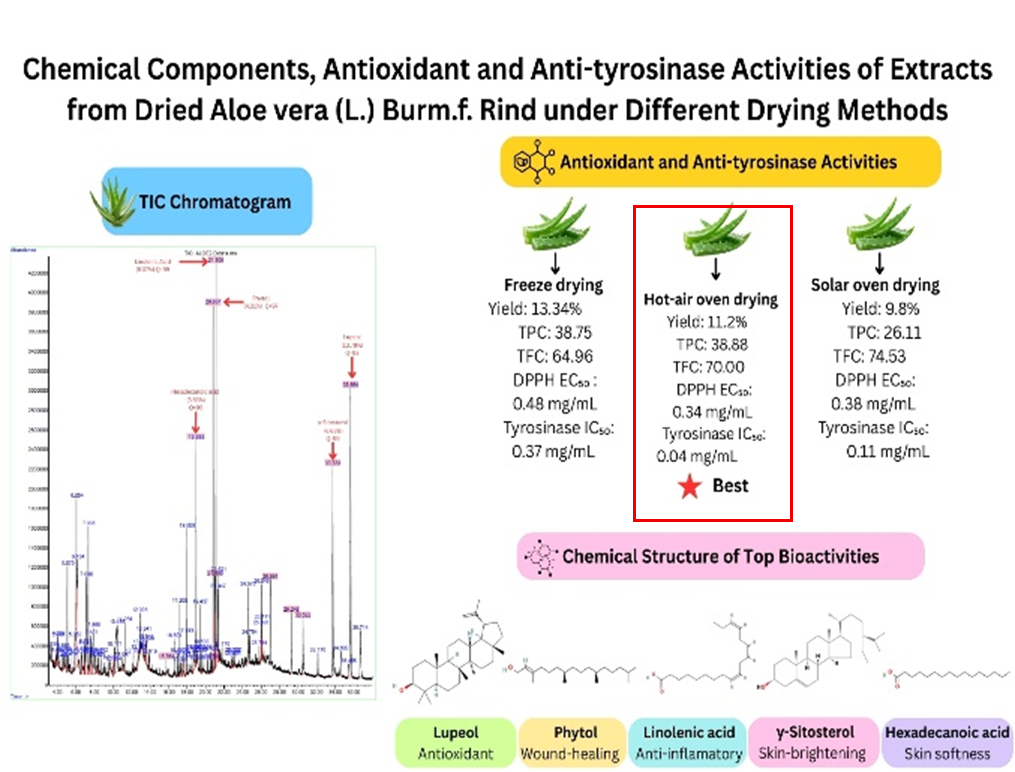
Aloe vera (L.) Burm.f. is a widely used medicinal plant, primarily valued for its gel in food, cosmetics, and pharmaceuticals, while the rind is usually discarded as waste. This study investigated the phytochemical composition and bioactivities of Aloe vera rind extracts prepared by three different drying methods: freeze drying, hot- air oven drying, and solar oven drying. The dried rind powders were extracted and analyzed for total phenolic and flavonoid contents, as well as antioxidant and tyrosinase inhibitory activities. The freeze-drying method provided the highest extraction yield (13.34 ± 0.50%). Total phenolic contents were 38.75 ± 0.11, 38.88 ± 0.59, and 26.11 ± 0.49 mg gallic acid equivalents (GAE)/g for the freeze-, hot-air-oven-, and solar-oven-dried extracts, respectively, while flavonoid contents were 64.96 ± 1.45, 70.00 ± 4.55, and 74.53 ± 2.49 mg rutin equivalents (RE)/g. Antioxidant activities, assessed by DPPH and FRAP assays, revealed EC₅₀ values of 0.48 ± 0.09, 0.34 ± 0.01, and 0.38 ± 0.01 mg/mL (DPPH), and 45.27 ± 0.56, 44.40 ± 1.09, and 42.99 ± 0.03 mg FeSO₄ equivalents/g (FRAP), respectively. Tyrosinase inhibition showed IC₅₀ values of 0.37 ± 0.00, 0.04 ± 0.00, and 0.11 ± 0.00 mg/mL, indicating the superior inhibitory activity of the hot-air-oven-dried extract. GC–MS analysis of this extract identified bioactive compounds including lupeol, linolenic acid, γ-sitosterol, phytol, tocopherols, squalene, and other fatty acids, which are associated with antioxidant, anti-inflammatory, UV-protective, and tyrosinase-inhibitory properties. These findings suggest
that Aloe vera rind, particularly when processed by hot-air oven drying, is a promising resource for value-added applications in skincare and cosmetic development.
Downloads
Article Details

This work is licensed under a Creative Commons Attribution 4.0 International License.
Copyright Notice
The copyright of research articles published in the VRU Research and Development Journal Science and Technology Journal belongs to the Research and Development Institute, Valaya Alongkorn Rajabhat University under the Royal Patronage. Reproduction of the content, in whole or in part, is prohibited without prior written permission from the university.
Responsibility
The content published in the VRU Research and Development Journal Science and Technology Journal is the sole responsibility of the author(s). The journal does not assume responsibility for errors arising from the printing process.
References
Ahl, L. I., Al-Husseini, N., Al-Helle, S., Staerk, D., Grace, O. M., Willats, W. G. T., Mravec, J., Jørgensen, B., & Rønsted, N. (2019). Detection of seasonal variation in Aloe polysaccharides using carbohydrate detecting microarrays. Frontiers in Plant Science, 10, Article 512.
Añibarro-Ortega, M., Pinela, J., Barros, L., Ćirić, A., Silva, S. P., Coelho, E., Mocan, A., Calhelha, R. C., Soković, M., Coimbra, M. A., & Ferreira, I. C. F. R. (2019). Compositional features and bioactive properties of Aloe vera leaf (Fillet, Mucilage, and Rind) and flower. Antioxidants, 8(10), 444.
Antal, T. (2015). Comparative study of three drying methods: Freeze, hot air-assisted freeze, and infrared-assisted freeze modes. Agronomy Research, 13(4), 863–878.
Apak, R., Özyürek, M., Güçlü, K., & Çapanoğlu, E. (2016). Antioxidant activity/capacity measurement. 1. Classification, physicochemical principles, mechanisms, and electron transfer (ET)-based assays. Journal of Agricultural and Food Chemistry, 64(5), 997–1027.
Ayala-Aponte, A. A., Cárdenas-Nieto, J. D., & Tirado, D. F. (2021). Aloe vera gel drying by Refractance Window®: Drying kinetics and high-quality retention. Foods, 10(7), 1445.
Ariza, O., Casallas, I., & Fajardo, A. (2024). Innovative solar dryer for sustainable Aloe vera gel preservation in Colombia. Sustainability, 16(8), 3392.
Belwal, T., Cravotto, C., Prieto, M. A., Venskutonis, P. R., Daglia, M., Devkota, H. P., Baldi, A., Ezzat, S. M., Gómez-Gómez, L., Salama, M. M., Campone, L., Rastrelli, L., Echave, J., Jafari, S. M., & Cravotto, G. (2022). Effects of different drying techniques on the quality and bioactive compounds of plant-based products: a critical review on current trends. Drying Technology, 40(8), 1539–1561.
Benzie, I. F. F., & Strain, J. J. (1996). The ferric reducing ability of plasma (FRAP) as a measure of “antioxidant power”: The FRAP assay. Analytical Biochemistry, 239(1), 70–76.
Benzidia, B., Barbouchi, M., Hammouch, H., Belahbib, N., Zouarhi, M., Erramli, H., Daoud, N. A., Badrane, N., & Hajjaji, N. (2019). Chemical composition and antioxidant activity of tannins extract from green rind of Aloe vera (L.) Burm. F. Journal of King Saud University - Science, 31(4), 1175–1181.
Buntham, S., Yongphet, P., Boonwittaya, W., & Tongcom, N. (2024). The development of Mon's shrimp paste products with solar dryer cabinet “HLANG TAO MODEL” innovation to promote the foundation economy for Chiang Rak Noi Subdistrict, Sam Khok District, Pathum Thani Province. Journal of Roi Kaensarn Academi, 9(12), 1295–1310.
Chailap, B., & Nuanyai, T. (2022). Aging effect of Aloe vera (L.) Burm. f. on tyrosinase inhibitory and antioxidant activities. Journal of Science and Technology Huachiew Chalermprakiet University, 8(1), 20–27.
Chang, X. L., Feng, Y. M., & Shao, Q. (2011). Thermal stability of Aloe vera gel. Journal of Thermal Analysis and Calorimetry, 104(3), 1141–1146.
Chaudhary, H. R., Patel, S. K., & Gandhi, T. R. (2023). Pharmacognostic evaluation of Momordica dioica fruit. Biological Forum – An International Journal, 15(6), 79–85.
Chaudhary, P., Janmeda, P., Docea, A. O., Yeskaliyeva, B., Abdull Razis, A. F., Modu, B., et al. (2023). Oxidative stress, free radicals and antioxidants: Potential crosstalk in the pathophysiology of human diseases. Frontiers in Chemistry, 11, Article 1158198.
Cheekham, P., Suksri, A., & Suksri, T. (2023). Effects of drying temperature on physicochemical properties, bioactive compounds, antioxidant, and antibacterial activities of three sweet potato cultivars. Journal of Food Health and Bioenvironmental Science, 16(2), 1–12.
Elchemy. (2025, May 9). Palmitic Acid Benefits for Skincare & Haircare: What Cosmetic Formulators Should Know. https://elchemy.com/blogs/personal-care/palmitic-acid-benefits-for-skincare-haircare-what-cosmetic-formulators-should-know
Eshun, K., & He, Q. (2004). Aloe vera: A valuable ingredient for food, pharmaceuticals, and cosmetics. Critical Reviews in Food Science and Nutrition, 44(2), 91–96.
Femenia, A., Sánchez, E. S., Simal, S., & Rosselló, C. (1999). Effects of heat treatment and dehydration on Aloe vera gel. Journal of Agricultural and Food Chemistry, 47(2), 550–555.
Fernández, A., et al. (2001). Lupeol: A triterpenoid with anti-inflammatory and skin-protective properties. Phytomedicine, 8(5), 396–400.
Gamage, D., Dharmadasa, R., Abeysinghe, D., Wijesekara, R., Prathapasinghe, G., & Someya, T. (2021). Assessment of Phytochemical Contents and Total Antioxidant Capacity of Five Medicinal Plants with Cosmetic Potential under Three Different Drying Methods. World Journal of Agricultural Research, 9(1), 24–28.
González-Delgado, M., Minjares-Fuentes, R., Mota-Ituarte, M., Pedroza-Sandoval, A., Comas-Serra, F., Quezada-Rivera, J. J., Sáenz-Esqueda, Á., & Femenia, A. (2023). Joint water and salinity stresses increase the bioactive compounds of Aloe vera (Aloe barbadensis Miller) gel enhancing its related functional properties. Agricultural Water Management, 285, 108374.
Guancha-Chalapud, M. A., Rodríguez-Restrepo, J. A., & Zapata-Puentes, L. A. (2022). Development of Aloe vera rind hydrogel: Physicochemical characterization and potential applications. Journal of Applied Polymer Science, 139(12), e52345.
Hamman, J. H. (2008). Composition and applications of Aloe vera leaf gel. Molecules, 13(8), 1599–1616.
Hossen, M. M., Hossain, M. L., Mitra, K., Hossain, B., Bithi, U. H., & Uddin, M. N. (2022). Phytochemicals and in-vitro antioxidant activity analysis of Aloe vera by-products (skin) in different solvent extract. Journal of Agriculture and Food Research, 10, 100460.
Huang, Z. R., et al. (2009). Biological and pharmacological activities of squalene and related compounds. Medicinal Research Reviews, 29(5), 751–782.
Huang, Y. C., et al. (2023). Omega-3 fatty acids in skin biology. Nutrients, 15(4), 876.
Islam, M. T., et al. (2018). Phytol: A review of biomedical activities. Food and Chemical Toxicology, 121, 82–94.
Itsarasook, K., Chaiwong, N., & Suksri, T. (2023). In vitro antioxidant, anti-inflammatory, and wound healing properties of Aloe vera infused with canola oil. Journal of Food Health and Bioenvironmental Science, 16(2), 13–22.
Kaur, P., Kaur, A., & Kumar, N. (2017). Optimization of spray drying conditions for production of Aloe-vera powder. Chemical Science Review and Letters, 6(21), 525–532.
Kim, J. H., et al. (2023). Phytol as a potential skin-whitening agent. Biomolecules & Therapeutics, 31(2), 189–197.
Kim, J. H., Yoon, J. Y., Yang, S. Y., Choi, S. K., Kwon, S. J., Cho, I. S., Jeong, M. H., Kim, Y. H., & Choi, G. S. (2017). Tyrosinase inhibitory components from Aloe vera and their antiviral activity. Journal of Enzyme Inhibition and Medicinal Chemistry, 32(1), 78–83.
Khaomek, P. & Jantanu, W. (2016). Antioxidant activity and tyrosinase inhibition activity from fresh and dried leaves and fruits and nourishing cream production. In (Eds.), RSU National Research Conference 2016.
Kumar, S., Yadav, M., Yadav, A., Rohilla, P., & Singh, K. (2017). Effect of climate change on phytochemical diversity, total phenolic content and in vitro antioxidant activity of Aloe vera (L.) Burm.f. BMC Research Notes, 10(1), Article 60.
Kushwaha, P., Shrivastava, M., Pandey, D., Verma, K., & Dwivedi, L. (2023). The phytochemical profiling of Aloe vera through GC-MS and compounds activity validation at NCBI for industrial value addition of the plant. South Asian Journal of Experimental Biology, 13(1), 20–32.
Labconco Corporation. (n.d.). Freeze drying principles and equipment guide. Labconco. Retrieved from https://www.labconco.com
Lakshmi, P. T. V., & Rajalakshmi, P. (2011). Identification of phyto-components and its biological activities of Aloe vera through gas chromatography-mass spectrometry. International Research Journal of Pharmacy, 2(5), 247–249.
Mahadi, S. B., Handayani, R. a. S., Widowati, W., Wilsen, W., Dewani, Y., Fachrial, E., & Lister, I. N. E. (2019). Antioxidant and anti-tyrosinase activities of Aloe vera rind and gel extracts. Global Medical & Health Communication (GMHC), 7(3), 170–176.
Mali, A. R., & Swami, S. B. (2024). Convective hot air drying of Aloe vera slices and its quality evaluation. International Journal of Food Fermentation Technology, 14(1), 311–324.
Manye, S. J., Saleh, J. S., Ishaya, H. B., Chiroma, S. M., Attah, M. O. O., & Dibal, N. I. (2023). Phytochemical screening and in-vitro antioxidant activities of aqueous and methanol extracts of Aloe vera. Pharmacological Research - Modern Chinese Medicine, 8, 100291.
Memmert GmbH + Co. KG. (n.d.). Operator manual for drying ovens UM 200–800, ULM 400–800, and sterilizers SM/SLM series.
Miladi, S., & Damak, M. (2008). In vitro antioxidant activities of Aloe vera leaf skin extracts. Journal De La Société Chimique De Tunisie, 10, 101–109.
Minjares-Fuentes, R., Femenia, A., Comas-Serra, F., Rosselló, C., Rodríguez-González, V. M., González-Laredo, R. F., Gallegos-Infante, J. A., & Medina-Torres, L. (2016). Effect of different drying procedures on physicochemical properties and flow behavior of Aloe vera (Aloe barbadensis Miller) gel. LWT - Food Science and Technology, 74, 378–386.
Moghaddasi M, S., & Kumar Verma, S. (2011). Aloe vera their chemicals composition and applications: A review. International Journal of Biological & Medical Research, 2(1), 466–471.
Nachbar, F., & Korting, H. C. (1995). The role of vitamin E in normal and damaged skin. Journal of Molecular Medicine, 73(1), 7–17.
Nalimu, F., Oloro, J., Kahwa, I., & Engeu Ogwang, P. (2021). Review on the phytochemistry and toxicological profiles of Aloe vera and aloe ferox. Future Journal of Pharmaceutical Sciences, 145, 1–21.
Nejatzadeh-Barandozi, F. (2013). Antibacterial activities and antioxidant capacity of Aloe vera. Organic and Medicinal Chemistry Letters, 3(1), 5.
Pawar, H. M., Shirke, G. D., Yadav, V. B., & Kadam, J. H. (2023). Preparation of Aloe vera pulp powder by using different drying methods with studying changes in the physical quality parameters during drying and storage. The Pharma Innovation Journal, 12(10), 802–810.
Pękal, A., & Pyrzynska, K. (2014). Evaluation of aluminium complexation reaction for flavonoid content assay. Food Analytical Methods, 7, 1776–1782.
Pérez, M., Dominguez-López, I., & Lamuela-Raventós, R. M. (2023). The chemistry behind the Folin–Ciocalteu method for the estimation of (poly)phenol content in food. Journal of Agricultural and Food Chemistry, 71, 17543–17553.
Prior, R. L., Wu, X., & Schaich, K. (2005). Standardized methods for the determination of antioxidant capacity and phenolics in foods and dietary supplements. Journal of Agricultural and Food Chemistry, 53(10), 4290–4302.
Pukumpuang, W., & Seansrimon, J. (2023). Antioxidant activity, total phenolic content and anti-tyrosinase activity of Thai colored rice cultivar extracts. Journal of Food Health and Bioenvironmental Science, 16(2), 23–31.
Quispe, C., Villalobos, M., Bórquez, J., & Simirgiotis, M. (2018). Chemical Composition and Antioxidant Activity of Aloe vera from the Pica Oasis (Tarapacá, Chile) by UHPLC-Q/Orbitrap/MS/MS. Journal of Chemistry, 2018, 1–12.
Rodríguez, E. R., et al. (2010). Aloe vera rind: Phytochemical and functional characterization. Journal of Agricultural and Food Chemistry, 58(11), 6973–6979. 63.
Sacan, Ö., Akev, N., & Yanardağ, R. (2024). Inhibitory effects of Aloe vera extracts on anti-tyrosinase, anti-collagenase and anti-elastase potential. Bangladesh Journal of Botany, 53(3), 597–603.
Sánchez, M., González-Burgos, E., Iglesias, I., & Gómez-Serranillos, M. P. (2020). Pharmacological Update Properties of Aloe vera and its Major Active Constituents. Molecules, 25(6), 1324.
Senajuk, W., Phasuk, S., Nilsang, P., & Takolpuckdee, P. (2020). Free radical scavenging activity of riceberry and Pathum Thani rice extracts for developing face powder. Journal of Food Health and Bioenvironmental Science, 13(3), 9-15.
Settharaksa, S., Songsangsirisak, C., & Monton, C. (2018). Computer-based estimation of antioxidant activity of Caesalpinia sappan L. Thai Journal of Pharmaceutical Sciences, 42(Supplement Issue), 102–106.
Simard, M., et al. (2021). α-Linolenic acid and linoleic acid modulate the lipidome and the skin barrier. Acta Biomaterialia, 140, 261–274.
Sirikhansaeng, P., et al. (2017). Major phytochemical as γ-sitosterol disclosing and toxicity testing in Lagerstroemia species. Evidence-Based Complementary and Alternative Medicine, 2017, 4633639.
Sirivibulkovit, K., Nouanthavong, S., & Sameenoi, Y. (2018). Paper-based DPPH assay for antioxidant activity analysis. Analytical Sciences, 34(7), 795–800.
Sitthikariya T. & Chokdeesamrit W. (2019). A study of the effectiveness of Aloe vera gel application in treating wrinkles around the eyes. School of Anti-Aging and Regenerative Medicine, Mae Fah Luang University. Journal of Medicine and Health Sciences, 26(3), 113–124.
Soncharoen, P., & Jongitt, K. (2024). The study of total phenolic compounds and antioxidant activity of asparagus racemosus Willd extracts. SciTech Research Journal, 7(2), 79–94.
Stein, S. E. (2012). Mass spectral reference libraries: An ever-expanding resource for chemical identification. Analytical Chemistry, 84(17), 7274–7282.
Surjushe, A., Vasani, R., & Saple, D. (2008). Aloe vera: A short review. Indian Journal of Dermatology, 53(4), 163-166.
Thamkaew, G., Sjöholm, I., & Galindo, F. G. (2020). A review of drying methods for improving the quality of dried herbs. Critical Reviews in Food Science and Nutrition, 61(11), 1763–1786.
Vonpian, K. (2025, October 2). Analysis report on Aloe vera. Department of Botany, Faculty of Science, Chulalongkorn University.
Wattanuruk, D., Phasuk, S., Nilsang, P., & Takolpuckdee, P. (2020). Total phenolics, flavonoids, anthocyanins and antioxidant activities of Khaow-Mak extracts from various colored rice. Journal of Food Health and Bioenvironmental Science, 13(1), 10-18.
Wattanarak, D. (2021). Development of nanoserum for facial skin care from the extract of colored rice bark (Doctoral dissertation). Valaya Alongkorn Rajabhat University under the Royal Patronage.
Yoruk, N. G., & Paksoy, Ö. I. (2024). GC/MS evaluation of the composition of the Aloe vera gel and extract. Food Chemistry X, 23, 101536.
