
Effects of AMINOSA on PR2 and PR3 Enzyme Activities in Marigold (Tagetes erecta) Seedlings
Article Sidebar
Main Article Content
Abstract
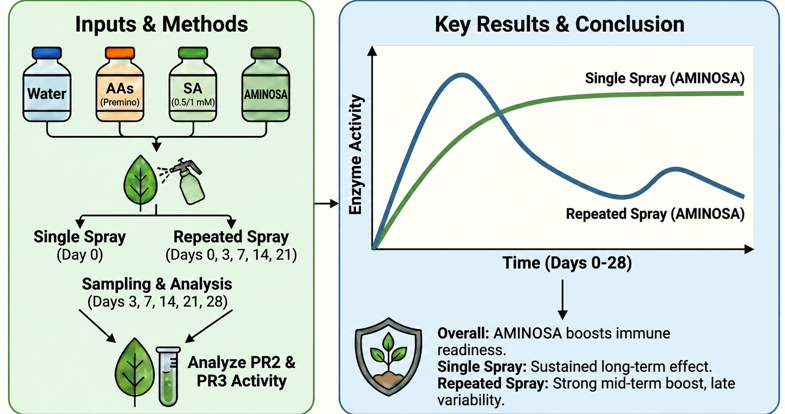
This preliminary biochemical screening study assessed whether AMINOSA, a combined formulation of amino acids (27% w/v; AAs) and salicylic acid (SA), alters PR2 (β-1,3-glucanase) and PR3 (chitinase) activity trends in marigold seedlings. Twenty-one-day-old Tagetes erecta L. cv. ‘Cana Yellow’ seedlings were foliar-sprayed with water, AAs, SA (0.5 or 1 mM), or AMINOSA at the corresponding SA concentrations under either a single-spray program (sampling at 3, 7, 14, 21, and 28 days) or a repeated-spray program (sprays at 0, 3, 7, 14, and 21 days; sampling at 7, 14, 21, and 28 days), giving 46 treatment combinations. Leaves from 10 plants per treatment were pooled into one composite sample at each time point. The total protein content was quantified by BCA assay, and PR2 and PR3 activities were measured colorimetrically and expressed as U/mg protein. AMINOSA, especially with 0.5 mM SA, tended to produce higher PR2 and PR3 activity trends than AAs alone and water. Repeated spraying produced stronger mid-term PR2 peaks but greater late-stage variability. As each treatment-timepoint was represented by a single pooled composite sample without independent replicated means, the data were interpreted descriptively as trend-level biochemical profiling and were not subjected to inferential statistical analysis. AMINOSA with 0.5 mM SA under single spraying emerged as a promising option for sustaining later-stage PR2/PR3 trends, whereas repeated spraying may be further evaluated for a stronger mid-term PR2 response. These findings suggested that time-course PR2/PR3 profiling may help select candidate formulations and spray programs. The next step is replicated pathogen-challenge validation, followed by greenhouse or field confirmation.
Downloads
Article Details

This work is licensed under a Creative Commons Attribution 4.0 International License.
Copyright Notice
The copyright of research articles published in the VRU Research and Development Journal Science and Technology Journal belongs to the Research and Development Institute, Valaya Alongkorn Rajabhat University under the Royal Patronage. Reproduction of the content, in whole or in part, is prohibited without prior written permission from the university.
Responsibility
The content published in the VRU Research and Development Journal Science and Technology Journal is the sole responsibility of the author(s). The journal does not assume responsibility for errors arising from the printing process.
References
Abdel-Wahed, G. A., & Abdel-Rahman, T. F. M. (2022). Evaluation the activities of wood vinegar and some commercial bio-products in management of soil-borne fungi of two Tagetes varieties. Egyptian Journal of Phytopathology, 50(2), 104–123. https://doi.org/10.21608/ejp.2022.173645.1075
Ali, S., Ganai, B. A., Kamili, A. N., Bhat, A. A., Mir, Z. A., Bhat, J. A., Tyagi, A., Islam, S. T., Mushtaq, M., Yadav, P., Rawat, S., & Grover, A. (2018). Pathogenesis-related proteins and peptides as promising tools for engineering plants with multiple stress tolerance. Microbiological Research, 212–213, 29–37. https://doi.org/10.1016/j.micres.2018.04.008
Corkley, I., Fraaije, B., & Hawkins, N. (2022). Fungicide resistance management: Maximizing the effective life of plant protection products. Plant Pathology, 71(1), 150–169. https://doi.org/10.1111/ppa.13467
Ding, P., & Ding, Y. (2020). Stories of salicylic acid: A plant defense hormone. Trends in Plant Science, 25(6), 549–565. https://doi.org/10.1016/j.tplants.2020.01.004
dos Santos, C., & Franco, O. L. (2023). Pathogenesis-related proteins (PRs) with enzyme activity activating plant defense responses. Plants, 12(11), 2226. https://doi.org/10.3390/plants12112226
Hönig, M., Roeber, V. M., Schmülling, T., & Cortleven, A. (2023). Chemical priming of plant defense responses to pathogen attacks. Frontiers in Plant Science, 14, 1146577. https://doi.org/10.3389/fpls.2023.1146577
Hou, J., Ai, M., Li, J., Cui, X., Liu, Y., & Yang, Q. (2024). Exogenous salicylic acid treatment enhances the disease resistance of Panax vietnamensis by regulating secondary metabolite production. Frontiers in Plant Science, 15, 1428272. https://doi.org/10.3389/fpls.2024.1428272
Mauch-Mani, B., Baccelli, I., Luna, E., & Flors, V. (2017). Defense priming: An adaptive part of induced resistance. Annual Review of Plant Biology, 68, 485–512. https://doi.org/10.1146/annurev-arplant-042916-041132
Navarro-León, E., López-Moreno, F. J., Borda, E., Marín, C., Sierras, N., Blasco, B., & Ruiz, J. M. (2022). Effect of L-amino acid-based biostimulants on nitrogen use efficiency (NUE) in lettuce plants. Journal of the Science of Food and Agriculture, 102(15), 7098–7106. https://doi.org/10.1002/jsfa.12071
Reglinski, T., Havis, N., Rees, H. J., & de Jong, H. (2023). The practical role of induced resistance for crop protection. Phytopathology, 113(4), 719–731. https://doi.org/10.1094/PHYTO-10-22-0400-IA
Rouphael, Y., & Colla, G. (2020). Editorial: Biostimulants in agriculture. Frontiers in Plant Science, 11, 40. https://doi.org/10.3389/fpls.2020.00040
Salinas, P., Velozo, S., & Herrera-Vásquez, A. (2025). Salicylic acid accumulation: Emerging molecular players and novel perspectives on plant development and nutrition. Journal of Experimental Botany, 76(7), 1950–1969. https://doi.org/10.1093/jxb/erae309
Sharma, S., Das, A., Bharti, Singh, K. P., Panwar, S., Talukdar, A., Arzoo, E., Singh, A., Bisht, P., & Bhatia, R. (2025). Assessing resistance against Alternaria leaf spot in marigold genotypes (Tagetes spp.): A comprehensive in vitro and in vivo study. Journal of Horticultural Sciences, 20(2). https://doi.org/10.24154/jhs.v20i2.3846
Sible, C. N., Seebauer, J. R., & Below, F. E. (2021). Plant biostimulants: A categorical review, their implications for row crop production, and relation to soil health indicators. Agronomy, 11(7), 1297. https://doi.org/10.3390/agronomy11071297
Spoel, S. H., & Dong, X. (2024). Salicylic acid in plant immunity and beyond. The Plant Cell, 36(5), 1451–1464. https://doi.org/10.1093/plcell/koad329
Sun, W., Shahrajabian, M. H., Kuang, Y., & Wang, N. (2024). Amino acids biostimulants and protein hydrolysates in agricultural sciences. Plants, 13(2), 210. https://doi.org/10.3390/plants13020210
Thepbandit, W., Srisuwan, A., & Athinuwat, D. (2024). Priming of exogenous salicylic acid under field conditions enhances crop yield through resistance to Magnaporthe oryzae by modulating phytohormones and antioxidant enzymes. Antioxidants, 13(9), 1055. https://doi.org/10.3390/antiox13091055
van Butselaar, T., & Van den Ackerveken, G. (2020). Salicylic acid steers the growth–immunity tradeoff. Trends in Plant Science, 25(6), 566–576. https://doi.org/10.1016/j.tplants.2020.02.002
