
Effect of Sodium Chloride Concentrations on Germination Quality and Seed Vigor of Three Aromatic Rice Varieties
Article Sidebar
Main Article Content
Abstract
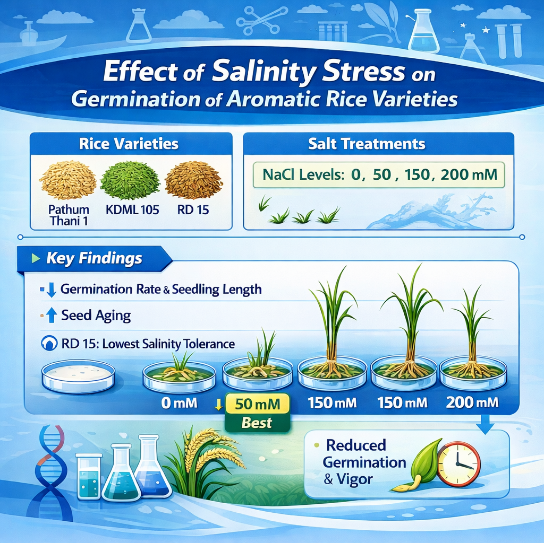
linity stress is a significant factor affecting the seed quality and growth of rice. Understanding the specific responses of different aromatic rice varieties to varying sodium chloride concentrations is crucial for improving germination quality and seed vigor in laboratory settings. The objective of this study was to investigate the effect of different concentrations of sodium chloride solution on the germinating quality of three varieties of aromatic rice seed. The experimental design was conducted using a 3x5 factorial in a Completely Randomized Design (CRD) with four replicates. The first factor consisted of three varieties of aromatic rice seeds: Pathum Thani 1, Khao Dawk Mali 105 (KDML 105), and RD 15. The second factor was the concentration of sodium chloride solution, utilizing levels of 0, 50,100, 150, and 200 mM. The study found that both rice variety and sodium chloride solution concentration had statistically significant effects on the germination quality and seed vigor of the aromatic rice seeds. Specifically, RD 15 rice demonstrated higher salinity tolerance than the other two varieties. Furthermore, as salinity increased, the germination index and time required for germination were significantly reduced, resulting in accelerated seed aging and shorter rice seedling length. A key finding was that all varieties of aromatic rice seed germinated best at the 50 mM sodium chloride solution concentration.
Downloads
Article Details

This work is licensed under a Creative Commons Attribution 4.0 International License.
Copyright Notice
The copyright of research articles published in the VRU Research and Development Journal Science and Technology Journal belongs to the Research and Development Institute, Valaya Alongkorn Rajabhat University under the Royal Patronage. Reproduction of the content, in whole or in part, is prohibited without prior written permission from the university.
Responsibility
The content published in the VRU Research and Development Journal Science and Technology Journal is the sole responsibility of the author(s). The journal does not assume responsibility for errors arising from the printing process.
References
APSASEED. (2023). Thai Seed Trade Association issues standard shelf-life recommendations for 34 types of seeds, https://web.apsaseed.org/thai-seed-trade-association-issues-standard-shelf-life-recommendations-types-seeds
Cha-um, S., Trakulyingcharoen, T., Smitamana, P., & Kirdmanee, C. (2009). Salt tolerance in two rice cultivars differing salt tolerant abilities in responses to iso-osmotic stress. Australian Journal of Crop Science, 3(4), 221–230.
Clermont-Dauphin, C., Suwannang, N., Grünberger, O., Hammecker, C., & Maeght, J. L. (2010). Yield of rice under water and soil salinity risks in farmers’ fields in northeast Thailand. Field Crops Research, 118(3), 289–296.
Cordero-Lara, K. I. (2020). Temperate japonica rice (Oryza sativa L.) breeding: History, present and future challenges. Chilean Journal of Agricultural Research, 80(2), 303–314.
Ellis, R. H., & Roberts, E. H. (1980). Improved equations for the prediction of seed longevity. Annals of Botany, 45(1), 13–30.
Farid, M., Anshori, M. F., Musa, Y., Iswoyo, H., & Sakinah, A. I. (2021). Interaction of rice salinity screening in germination and seedling phase through selection index based on principal components. Chilean Journal of Agricultural Research, 81(3), 367–377.
Fogliatto, S., Serra, F., Patrucco, L., Milan, M., & Vidotto, F. (2019). Effect of different water salinity levels on the germination of imazamox-resistant and sensitive weedy rice and cultivated rice. Agronomy, 9, Article 658.
Hakim, M. A., Juraimi, A. S., Begum, M., Hanafi, M. M., Ismail, M. R., & Selamat, A. (2010). Effect of salt stress on germination and early seedling growth of rice (Oryza sativa L.). African Journal of Biotechnology, 9(13), 1911–1918.
Hasanuzzaman, M., Fujita, M., Islam, M. N., Ahamed, K. U., & Nahar, K. (2009). Performance of four irrigated rice varieties under different levels of salinity stress. International Journal of Integrative Biology, 6(2), 85–90.
International Seed Testing Association (ISTA). (1999). International rules for seed testing: Supplement rules. Seed Science and Technology, 27, 25–30.
Kongpun, A., Jaisiri, P., Rerkasem, B., & Prom-u-thai, C. (2020). Impact of soil salinity on grain yield and aromatic compound in Thai Hom Mali rice cv. Khao Dawk Mali 105. Agriculture and Natural Resources, 54, 74–78.
Linares, O. F. (2002). African rice (Oryza glaberrima): History and future potential. Proceedings of the National Academy of Sciences of the United States of America, 99(25), 16360–16365.
Liu, L., Xia, W., Li, H., Zeng, H., Wei, B., Han, S., & Yin, C. (2018). Salinity inhibits rice seed germination by reducing α-amylase activity via decreased bioactive gibberellin content. Frontiers in Plant Science, 9, Article 275.
Liu, Z., Ma, C., Hou, L., Wu, X., Wang, D., Zhang, L., & Liu, P. (2022). Exogenous salicylic acid affects rice seed germination under salt stress by regulating Na⁺/K⁺ balance and endogenous gibberellins and abscisic acid homeostasis. International Journal of Molecular Sciences, 23, Article 3293.
Maki, M., Sritumboon, S., Srisutham, M., Yoshida, K., Homma, K., & Sukchan, S. (2022). Impact of changes in the relationship between salinity and soil moisture on remote sensing data usage in northeast Thailand. Hydrological Research Letters, 16, 54–58.
Momayezi, M. R., Zaharah, A. R., Hanafi, M. M., & Razi, I. M. (2009). Seed germination and proline accumulation in rice (Oryza sativa L.) as affected by salt concentrations. Pertanika Journal of Tropical Agricultural Science, 32(2), 247–259.
Ologundudu, A. F., Adelusi, A. A., & Akinwale, R. O. (2014). Effect of salt stress on germination and growth parameters of rice (Oryza sativa L.). Notulae Scientia Biologicae, 6(2), 237–243.
Pereira, L. C. R. (2021). Effect of proline on rice seed germination (Oryza sativa L.) under salinity condition, (Master’s thesis, Silpakorn University, Bangkok, Thailand).
Pongprayoon, W., Tisarum, R., Theerawittaya, C., & Cha-um, S. (2019). Evaluation and clustering on salt-tolerant ability in rice genotypes (Oryza sativa L. subsp. indica) using multivariate physiological indices. Physiology and Molecular Biology of Plants, 25(2), 473–483.
Saengsanga, T., Aukaew, C., & Rodsanthia, K. (2017). Effects of salt stress on the germination and early seedling growth of rice (Oryza sativa L.). Naresuan University Journal: Science and Technology, 25(1), 92–101.
Sen, R., Chakraborty, P., & Kalita, P. (2020). Rice—not just a staple food: A comprehensive review on its phytochemicals and therapeutic potential. Trends in Food Science & Technology, 97, 265–285.
Sreethong, T., Prom-u-thai, C., Rerkasem, B., Dell, B., & Jamjod, S. (2018). Variation of milling and grain physical quality of dry season Pathum Thani 1 in Thailand. Chiang Mai University Journal of Natural Sciences, 17(3), 191–202.
Taratima, W., Chomarsa, T., & Maneerattanarungroj, P. (2022). Salinity stress response of rice (Oryza sativa L. cv. Luem Pua) calli and seedlings. Scientifica, Article 5616683.
Vanavichit, A., Kamolsukyeunyong, W., Siangli, M., Siangliw, J. L., Traprab, S., Ruengphayak, S., Chaichoompu, E., Saensuk, C., Phuvanartnarubal, E., Toojinda, T., & Tragoonrung, S. (2018). Thai Hom Mali rice: Origin and breeding for subsistence rainfed lowland rice system. Rice, 11, Article 20.
Wang, Z., Wang, J., Bao, Y., Wu, Y., Su, X., & Zhang, H. (2010). Inheritance of rice seed germination ability under salt stress. Rice Science, 17(2), 105–110.
Win, K. M., Korinsak, S., Jantaboon, J., Siangliw, M., Lanceras-Siangliw, J., Sirithunya, P., Vanavichit, A., Pantuwan, G., Jongdee, B., Sidhiwong, N., & Toojinda, T. (2012). Breeding the Thai jasmine rice variety KDML105 for non-age-related broad-spectrum resistance to bacterial blight disease based on combined marker-assisted and phenotypic selection. Field Crops Research, 137, 186–194.
Zhang, R., Hussain, S., Wang, Y., Liu, Y., Li, Q., Chen, Y., Wei, H., Gao, P., & Dai, Q. (2021). Comprehensive evaluation of salt tolerance in rice (Oryza sativa L.) germplasm at the germination stage. Agronomy, 11(8), Article 1569.
