
Effects of Dry Chicken Manure and Fermented Liquid Swine Manure on Growth, Yield, Seed Quality, and Soil Properties in Organic Riceberry Rice Production Systems
Article Sidebar
Main Article Content
Abstract
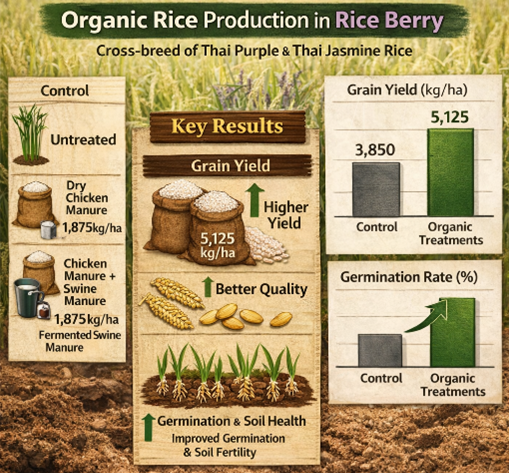
Riceberry is a cross between Thai purple rice and Thai Jasmine rice, combining high nutritional value with desirable eating quality. This study aimed to evaluate the effects of dry chicken manure and fermented liquid swine manure, applied individually and in combination, on rice performance under an organic production system. The experiment was conducted in 2022 at two locations using a randomized complete block design with four replications. Four treatments were applied: (1) untreated control, (2) dry chicken manure at 1,875 kg.ha⁻¹, (3) fermented liquid swine manure at a ratio of 1 kg per 10 L of water, and (4) a combination of dry chicken manure (1,875 kg.ha⁻¹) and fermented liquid swine manure (1 kg per 10 L of water). Soil parameters were evaluated before planting and after harvest. Results showed that grain yield was significantly higher (P<0.05) in all organic fertilizer treatments compared with the untreated control (3,850 kg.ha-1) with the combined application producing the highest yield (5,125 kg.ha-1). All fertilizer treatments also improved 100 - grains weight and grain length compared with the control. However, the untreated control showed significantly higher percentages of head rice and broken kernels than the dry chicken manure treatment. Seed quality parameters, including germination after harvested and growth rate, were significantly improved by the combined application of dry chicken manure and fermented liquid swine manure. Moreover, the application of organic fertilizers enhanced rice productivity and contributed to improved soil fertility under organic production systems.
Downloads
Article Details

This work is licensed under a Creative Commons Attribution 4.0 International License.
Copyright Notice
The copyright of research articles published in the VRU Research and Development Journal Science and Technology Journal belongs to the Research and Development Institute, Valaya Alongkorn Rajabhat University under the Royal Patronage. Reproduction of the content, in whole or in part, is prohibited without prior written permission from the university.
Responsibility
The content published in the VRU Research and Development Journal Science and Technology Journal is the sole responsibility of the author(s). The journal does not assume responsibility for errors arising from the printing process.
References
Aulakh, M. S., Khera, T. S., Doran, J. W., & Bronson, K. F. (2001). Managing crop residue with green manure, urea, and tillage in a rice–wheat rotation. Soil Science Society of America Journal, 65(3), 820–827.
Bákonyi, N., Bott, S., Gajdos, É., Szabó, A., Jakab, A., Tóth, B., Makleit, P., & Veres, S. (2013).
Using biofertilizer to improve seed germination and early development of maize. Polish Journal of Environmental Studies, 22(6), 1595–1599.
Black, C. A. (1965). Methods of soil analysis: Part A. American Society of Agronomy.
Buarach, K., Thongjoo, C., Udomprasert, N., & Amkha, S. (2014). Effects of tillage system and soil organic matter amendment on growth, yield of Pathumthani 80 rice and carbon sequestration in paddy soil. Modern Applied Science, 8(4), 1–7.
Chang, E. H., Chung, R. S., & Wang, F. N. (2008). Effect of different types of organic fertilizers on the chemical properties and enzymatic activities of an Oxisol under intensive cultivation of vegetables for 4 years. Soil Science and Plant Nutrition, 54(4), 587–599.
Chor-unchun, P., & Wongvarodom, V. (2023). Rice (Oryza sativa L.) seed quality after storage in the humid tropics and after accelerated aging. Recent Science and Technology, 17(1), 259351.
Cottenie, A. (1980). Soil and plant testing as a basis of fertilizer recommendations (FAO Soil Bulletin No. 38/2). FAO.
Diacono, M., & Montemurro, F. (2010). Long-term effects of organic amendments on soil fertility: A review. Agronomy for Sustainable Development, 30(2), 401–422.
Dilday, R. H. (1988). Effect of nitrogen fertilizer on milling quality of rice (Oryza sativa). Journal of the Arkansas Academy of Science, 42, 26–27.
Drilon, J. D., Jr. (1980). Standard methods of analysis for soil, plant, water and fertilizer. University of the Philippines Los Baños.
Hariniharishma, V. P., Subrahmaniyan, K., Elamathi, S., Devi, T. S., & Abarajitha, P. (2025). Residual management of sun hemp (Crotalaria juncea) varieties in releasing soil nutrients and their impact on succeeding rice crop. Legume Research, 48(11), 1912-1917.
Hu, Z., Yang, D., Feng, Y., Zhang, S., Wang, A., Wang, Q., Yang, Y., Chen, C., Zhang, Y., & Wang, X. (2024). Green manure combined with reduced nitrogen reduces NH₃ emissions, improves yield and nitrogen use efficiencies of rice. PeerJ, 1–23.
International Seed Testing Association (ISTA). (2022). International Rules for Seed Testing. International Seed Testing Association, Bassersdorf, Switzerland.
Jeon, W. T., Seong, K. Y., Lee, J. K., Oh, I. S., Lee, Y. H., & Ok, Y. S. (2010). Effects of green manure and carbonized rice husk on soil properties and rice growth. Korean Journal of Soil Science and Fertilizer, 43(4), 484–489.
Kaewtaphan, P., Maniin, P., Nilkong, P., Aninbon, C., & Teamkao, P. (2024). Effect of organic fertilizer rates on grain yield and seed qualities of rice. International Journal of Agricultural Technology, 20(3), 1067–1074.
Kammapana, L. (2023). Physical characteristics, phytochemical contents and antioxidant activity of ten organic-pigmented rice varieties from Surin Province. Trends in Sciences, 20(4), 1–14.
Leesawatwong, M., Jamjod, S., Kuo, J., Dell, B., & Rerkasem, B. (2005). Nitrogen fertilizer increases seed protein and milling quality of rice. Cereal Chemistry, 82(5), 588–593.
Leifert, C. (2022). Organic farming provides a blueprint to improve food quality, safety and security. Agronomy, 12(3), 1–4.
Lipiec, J., Usowicz, B., Kłopotek, J., Turski, M., & Frąc, M. (2021). Effects of application of recycled chicken manure and spent mushroom substrate on organic matter, acidity, and hydraulic properties of sandy soils. Materials, 14(14), 4036.
Mohammadi, G., Khah, E. M., Petropoulos, S. A., Yarsi, G., & Vlasakoudis, A. (2013). Effect of fertilizer and drying methods on seed germination of okra (Abelmoschus esculentus L.) cultivars at different harvesting times. Journal of Agricultural Science, 5(4), 1–14.
Murugan, A. V., & Swarnam, T. P. (2013). Nitrogen release pattern from organic manures applied to an acid soil. Journal of Agricultural Science, 5(6), 174–184.
Nduwumuremyi, A. (2013). Soil acidification and lime quality: Sources of soil acidity, effects on plant nutrients, efficiency of lime and liming requirements. Journal of Agriculture and Allied Sciences, 2(4), 26–34.
Pagliarini, E., Gaggia, F., Rossin, M., Franceschi, C., & Gioia, D. D. (2024). High-agronomic value of selected poultry manure valorized through aerobic fermentation: The AFRODITE® process. Journal of Environmental Management, 371, 123184
Pannangrong, W., Wattanathorn, J., Muchimapura, S., Tiamkao, S., & Tong-un, T. (2011). Purple Riceberry is neuroprotective and enhances cognition in a rat model of Alzheimer’s disease. Journal of Medicinal Food, 14(7–8), 688–694.
Perez, C. M., Juliano, B. O., Liboon, S. P., Alcantara, J. M., & Cassman, K. G. (1996). Effects of late nitrogen fertilizer application on head rice yield, protein content, and grain quality of rice. Cereal Chemistry, 73(5), 556–560.
Pitija, K., Nakornriab, M., Sriseadka, T., Vanavichit, A., & Wongpornchai, S. (2012). Anthocyanin content and antioxidant capacity in bran extracts of some Thai black rice varieties. International Journal of Food Science & Technology, 48, 300–308.
Rasool, A., Ghani, A., Nawaz, R., Ahmad, S., Shahzad, K., Rebi, A., Ali, B., Zhou, J., Ahmad, M. I., Tahir, M. F., Alwahibi, M. S., Elshikh, M. S., & Ercisli, S. (2023). Effects of poultry manure on the growth, physiology, yield, and yield-related traits of maize varieties. ACS Omega, 1–14.
Surekha, K., Rao, K. V., Rani, N. S., Latha, P. C., & Kumar, R. M. (2013). Evaluation of organic and conventional rice production systems for their productivity, profitability, grain quality and soil health. Agrotechnology, 11, 1–6.
Suttiarporn, P., Sookwong, P., & Mahatheeranont, S. (2016). Fractionation and identification of antioxidant compounds from bran of Thai black rice cv. Riceberry. International Journal of Chemical Engineering and Applications, 7(2), 109–114.
Tripathi, M. K., Majumdar, B., Bhandari, H. R., Chaudhary, B., Saha, A. R., & Mahapatra, B. S. (2013). Integrated nutrient management in sunn hemp (Crotalaria juncea)–rice cropping sequence in Eastern Uttar Pradesh, India. Indian Journal of Agricultural Research, 47(3), 253–257.
United States Department of Agriculture (USDA). (1980). Report and recommendations on organic farming. USDA.
Way, M. P., Ngwe, K., Soe, Y. M., & Moe, K. (2024). Potential impacts of green manure incorporation on soil fertility enhancement and rice yield. Asian Soil Research Journal, 8(4), 42–53.
Zhang, H., Chen, L., Wang, Y., Xu, M., Qiu, W., Liu, W., Wang, T., Li, S., Fei, Y., Liu, M., Nie, H., Li, Q., Ni, X., & Yi, J. (2025). Straw and green manure return can improve soil fertility and rice yield in long-term cultivation paddy fields with high initial organic matter content. Plants, 14(13), 2–19.
Zhao, N., Ma, J., Wu, L., Li, X., Xu, H., Zhang, J., Wang, X., Wang, Y., Bai, L., & Wang, Z. (2024a). Effect of organic manure on crop yield, soil properties, and economic benefit in wheat–maize–sunflower rotation system, Hetao Irrigation District. Plants, 13(16), 2250.
Zhao, T., He, A., Khan, N. M., Yin, Q., Song, S., & Nie, L. (2024b). Coupling of reduced inorganic fertilizer with plant-based organic fertilizer as a promising fertilizer management strategy for colored rice in tropical regions. Journal of Integrative Agriculture, 23(1), 93–107.
