
Effect of a Non-Perforated Double-Plate Diffuser’s Geometry on Thermocline Thickness in a Stratified Chilled-Water Storage Tank: A CFD-Based Parametric Optimization Study
Article Sidebar
Main Article Content
Abstract
Stratified chilled-water storage tanks are an important form of cool thermal energy storage for large air-conditioning systems. They are used to reduce peak electricity demand and shift chiller operation from high-tariff daytime hours to nighttime periods, when system loads are lower and electricity is generally cheaper. Their effectiveness depends on how sharply the thermocline is maintained. A thin, stable thermocline increases the usable volume of chilled water and limits mixing between the cold and warm layers. In this context, diffuser geometry is a governing factor because it controls the internal flow structure, the level of mixing, and the persistence of the thermocline. While many previous studies have investigated perforated, radial, or hemispherical diffuser concepts, the geometric effect of a non-perforated double-plate diffuser on thermocline thickness in chilled-water storage tanks remains insufficiently documented. This study therefore investigates the influence of the geometric parameters of a non-perforated double-plate diffuser on thermocline thickness during discharge.
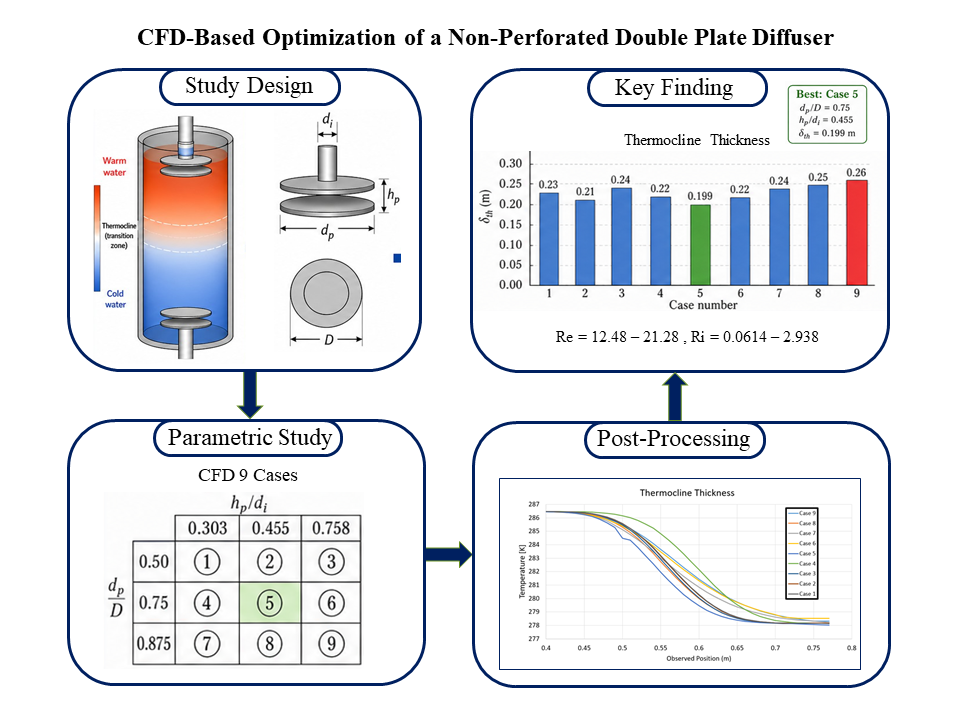
Two-dimensional unsteady CFD simulations were conducted in ANSYS Fluent for a cylindrical tank with a diameter of 0.8 m and a height of 1.2 m. Identical nonperforated double plate diffusers were installed at the top inlet and bottom outlet. Two geometric ratios were investigated: dp/D = 0.50, 0.75, and 0.875, and hp/di ≈ 0.303, 0.455, and 0.758, giving nine cases in total under a constant flow rate of 2.5 L/min. Thermocline thickness was obtained from vertical temperature profiles within the height range 0.40 to 0.77 m measured from the tank top. Reynolds number (Re) and Richardson number (Ri) were also calculated to support interpretation of the flow mechanisms.
The simulations show that diffuser geometry has a marked effect on thermocline thickness. Within the evaluation range, thermocline thickness varied from 0.199 to 0.260 m. The minimum thickness was obtained in Case 5, with dp/D = 0.75 and hp/di = 0.455, while the maximum thickness occurred in Case 9, with dp/D = 0.875 and hp/di ≈ 0.758. Across the nine cases, Re ranged from 12.48 to 21.84 and Ri from 0.0614 to 2.938. The results indicate that thermocline thickness cannot be attributed to Re or Ri alone; instead, it reflects the flow structure imposed by diffuser geometry. Within the investigated parameter range, dp/D = 0.75 and hp/di = 0.455 provides the most favorable outcome and may be used as a practical reference geometry for subsequent diffuser design and further study under different operating conditions.
Downloads
Article Details

This work is licensed under a Creative Commons Attribution 4.0 International License.
Copyright Notice
The copyright of research articles published in the VRU Research and Development Journal Science and Technology Journal belongs to the Research and Development Institute, Valaya Alongkorn Rajabhat University under the Royal Patronage. Reproduction of the content, in whole or in part, is prohibited without prior written permission from the university.
Responsibility
The content published in the VRU Research and Development Journal Science and Technology Journal is the sole responsibility of the author(s). The journal does not assume responsibility for errors arising from the printing process.
References
Abd Majid, M. A., Muhammad, M., Hampo, C. C., & Akmar, A. B. (2020). Analysis of a thermal energy storage tank in a large district cooling system: A case study. Processes, 8(9), 1158.
Alesbe, I., Abdul Wahhab, H. A., & Aljabair, S. (2023). Transient study of thermal stratification of full-scale chilled water storage tank during optimum discharge condition. Journal of Energy Storage, 65, 107236.
Deng, Y., Sun, D., Niu, M., Yu, B., & Bian, R. (2021). Performance assessment of a novel diffuser for stratified thermal energy storage tanks—The nonequal-diameter radial diffuser. Journal of Energy Storage, 35, 102276.
Glazer, J. (2019). ASHRAE design guide for cool thermal storage (2nd ed.). ASHRAE.
Hasan, F. M., & Theeb, M. A. (2021). Effect of diffuser height on thermocline in stratified chilled water storage tank. Journal of Applied Fluid Mechanics, 14(2), 429–438.
Karim, M. A. (2011). Experimental investigation of a stratified chilled-water thermal storage system. Applied Thermal Engineering, 31(11–12), 1853–1860.
Li, P., Van Lew, J., Chan, C., Karaki, W., Stephens, J., & O’Brien, J. E. (2012). Similarity and generalized analysis of efficiencies of thermal energy storage systems. Renewable Energy, 39(1), 388–402.
Li, Q., Lin, W., Huang, X., Tai, Y., Ding, X., Zhang, Y., & Gao, W. (2022). Thermocline dynamics in a thermally stratified water tank under different operation modes. Applied Thermal Engineering, 212, 118560.
Lou, W., Baudin, N., Roux, S., Fan, Y., & Luo, L. (2023). Impact of buoyant jet entrainment on the thermocline behavior in a single-medium thermal energy storage tank. Journal of Energy Storage, 71, 108017.
MacCracken, M. (2004). Thermal energy storage in sustainable buildings. ASHRAE Journal, 46(9), S2–S5.
Moncho-Esteve, I. J., Gasque, M., González-Altozano, P., & Palau-Salvador, G. (2017). Simple inlet devices and their influence on thermal stratification in a hot water storage tank. Energy and Buildings, 150, 625–638.
Parida, D. R., Advaith, S., Dani, N., & Basu, S. (2022). Assessing the impact of a novel hemispherical diffuser on a single-tank sensible thermal energy storage system. Renewable Energy, 183, 202–218.
Senmatic. (n.d.). Energy storage bridges the gap between energy supply and demand, https://senmatic.com/knowledge/sensor/energy-storage-bridges-the-gap-between-energy-supply-and-demand/
Tipasri, W., & Wongwuttanasatian, T. (2019). Effect of height to diameter ratio of chilled water storage tank on temperature gradient during discharging. Energy Procedia, 156, 254–258.
Weiss, J., Ortega-Fernández, I., Müller, R., Bielsa, D., & Fluri, T. (2021). Improved thermocline initialization through optimized inlet design for single-tank thermal energy storage systems. Journal of Energy Storage, 42, 103088.
Xing, Y., Zhang, X., Zhang, Z., & Liu, F. (2024). The impact of inlet structure on stratification performance in thermal storage tanks: A study through simulation and experimental analysis. Applied Sciences, 14(12), 5248.
Xu, C., Liu, M., Jiao, S., Tang, H., & Yan, J. (2022). Experimental study and analytical modeling on the thermocline hot water storage tank with radial plate-type diffuser. International Journal of Heat and Mass Transfer, 186, 122478.
Yaïci, W., Ghorab, M., Entchev, E., & Hayden, S. (2013). Three-dimensional unsteady CFD simulations of a thermal storage tank performance for optimum design. Applied Thermal Engineering, 60(1–2), 152–163.
