
Development of Instant Khanom-Jeen Curry Paste Cube
Article Sidebar
Main Article Content
Abstract
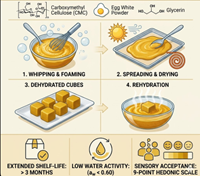
This research aimed to develop an instant Khanom-Jeen curry paste in a cube form using the foam-mat drying technique to meet the demand for convenience and extend the product's shelf life. The study investigated the optimal conditions for foaming agents and stabilizers, as well as the appropriate amount of glycerin for the cubing process. The results indicated that using 5% carboxymethyl cellulose (CMC) combined with 6% egg white powder was the optimal formulation for producing the curry paste powder, yielding the best physical properties, particularly water absorption and water solubility characteristics. For the cube formation, adding 12% glycerin provided the most suitable ratio. At this level, glycerin acted as an effective binder, providing structural strength, resistance to breakage, and good rehydration properties in hot water. Furthermore, the product formulated with 12% glycerin received the highest sensory evaluation scores in all attributes, including color, appearance, texture, and overall acceptability. Regarding microbiological quality and safety, the product maintained a water activity (aw) of less than 0.60 throughout a 3-month storage period at room temperature, which effectively inhibited microbial growth and complied with the Thai Community Product Standard (TCPS 734/2556). These findings demonstrate that this innovation has a high potential for adding value to traditional local foods and can be further developed for commercial production.
Downloads
Article Details

This work is licensed under a Creative Commons Attribution 4.0 International License.
Copyright Notice
The copyright of research articles published in the VRU Research and Development Journal Science and Technology Journal belongs to the Research and Development Institute, Valaya Alongkorn Rajabhat University under the Royal Patronage. Reproduction of the content, in whole or in part, is prohibited without prior written permission from the university.
Responsibility
The content published in the VRU Research and Development Journal Science and Technology Journal is the sole responsibility of the author(s). The journal does not assume responsibility for errors arising from the printing process.
References
Anderson, R. A., Conway, H. F., & Peplinski, A. J. (1970). Gelatinization of corn grits by roll cooking, extrusion cooking and steaming. Starch - Stärke, 22(4), 130–135. https://doi.org/10.1002/star.19700220408
AOAC. (2019). Official methods of analysis of AOAC International (21st ed.). AOAC International.
Azizpour, R., Mohebbi, S., & Khoshtaghaza, M. H. (2016). Effects of foam mat drying temperature on physico-chemical and microstructural properties of shrimp powder. Innovative Food Science & Emerging Technologies, 34, 116-122. https://doi.org/10.1016/j.ifset.2016.01.002
Barbosa-Cánovas, G. V., Ortega-Rivas, E., Juliano, P., & Yan, H. (2005). Food powders: Physical properties, processing, and functionality. Springer.
Beuchat, L. R. (1981). Microbial stability as affected by water activity. Cereal Foods World, 26(7), 345-349.
Biliaderis, C. G. (1991). The structure and interactions of starch with food constituents. Canadian. Journal of Physiology and Pharmacology, 69(1), 60-78. https://doi.org/10.1139/y91-011
Damodaran, S., & Parkin, K. L. (Eds.). (2017). Fennema's food chemistry (5th ed.). CRC Press.
Fellows, P. J. (2017). Food processing technology: Principles and practice (4th ed.). Woodhead Publishing.
Franco, T. S., Perussello, C. A., Ellendersen, L. N., & Masson, M. L. (2015). Foam mat drying of yacon juice: Experimental analysis and mathematical modeling. Journal of Food Engineering, 158, 20-27. https://doi.org/10.1016/j.jfoodeng.2015.02.030
Hao, H. V., Thuy, N. M., Giau, T. N., Van Tai, N., & Minh, V. Q. (2024). Effect of foaming agent and drying temperature on drying rate and quality of foam-mat dried papaya powder. Journal of Microbiology. Biotechnology and Food Sciences, 13(6), e10725. https://doi.org/10.5251/jmbfs.10725
Janowicz, M., Galus, S., Szulc, K., Ciurzyńska, A., & Nowacka, M. (2024). Investigation of the structure-forming potential of protein components in the reformulation of the composition of edible films. Materials, 17(4), 937. https://doi.org/10.3390/ma17040937
Kalambe, S., & Guhe, S. (2026). Foam mat drying of perishable products: A critical review of process parameters, product quality, and sustainable prospects. Sustainable Food Technology, 4, 133-152. https://doi.org/10.1039/D5FB00203F
Kitsawad, K., & Tuntisripreecha, N. (2016). Sensory characterization of instant tom yum soup. KMUTNB International Journal of Applied Science and Technology, 9(2), 145–152. https://doi.org/10.14416/j.ijast.2016.02.001
Maciel, R. M. G., Afonso, M. R. A., da Costa, J. M. C., & Araújo, T. M. R. (2020). Influence of albumin on guava pulp powder obtained by foam-mat drying. Engenharia Agrícola, 40(3), 388-395. https://doi.org/10.1590/1809-4430-eng.agric.v40n3p388-395/2020
Mathlouthi, M. (2001). Water content, water activity, water structure and the stability of foodstuffs. Food Control, 12(7), 409-417. https://doi.org/10.1016/S0956-7135(01)00032-9
Muthukumaran, A., Ratti, C., & Raghavan, V. G. S. (2008). Foam-mat freeze drying of egg white and mathematical modeling part I: Optimization of egg white foam stability. Drying Technology, 26(4), 508–512. https://doi.org/10.1080/07373930801929581
Rana, S., Khaled, B., Khan, M., Jony, M. E., Ahmed, J., Kundu, G., & Sondhi, R. (2025). Effect of foam-mat drying methods on quality attributes of green chili powder. Journal of Food Quality. https://doi.org/10.1155/jfq/9107919
Roos, Y. H. (1995). Phase transitions in foods. Academic Press.
Saragi, K., Monica, M., & Handoko, H. (2026). The effect of carboxymethyl cellulose (CMC) use on the physical quality of rejected chicken egg white powder. International. Journal of Multidisciplinary and Innovative Research, 3(1), 43-49. https://doi.org/10.58806/ijmir.2026.v3i1n04
Shaari, N. A., Sulaiman, R., Rahman, R. A., & Bakar, J. (2018). Production of pineapple fruit (Ananas comosus) powder using foam mat drying: Effect of whipping time and egg albumen concentration. Journal of Food Processing and Preservation, 42, e13467. https://doi.org/10.1111/jfpp.13467
Singkhum, U., & Lapsongphon, N. (2025). Effects of foaming agents on the properties of foam-mat dried spicy seasoning powder from chili placenta. International Journal of Agriculture and Biosciences, 14(6), 1329-1338. https://doi.org/10.47278/journal.ijab/2025.127
Taiba, U., Ali, A., Ali, A., Azam, I., Israr, A., Ilyas, A., Fatima, A., & Hameed, Z. (2022). Development and quality evaluation of dried vegetable soup added with some legumes. International Journal of Health Sciences, 6(S7), 6512–6539.
Tarique, J., Sapuan, S. M., & Khalina, A. (2021). Effect of glycerol plasticizer loading on the physical, mechanical, thermal, and barrier properties of arrowroot (Maranta arundinacea) starch biopolymers. Scientific Reports, 11(1), 13900. https://doi.org/10.1038/s41598-021-93094-y
Thai Industrial Standards Institute. (2016). Thai Community Product Standard: Instant Curry and Instant Curry Paste (TCPS 734/2556). Ministry of Industry.
Thanaratikul, P., & Supaking, J. (2024). The Effect of Foam-mat Drying Parameters on the Quality of Instant Porridge Fortified with Kale as a Calcium source. Journal of Current Science and Technology, 15(1), 82. https://doi.org/10.59796/jcst.V15N1.2025.82
Yousefi, S., Emam-Djomeh, Z., & Mousavi, S. M. (2011). Effect of carrier type and spray drying on the physicochemical properties of powdered and reconstituted pomegranate juice (Punica granatum L.). Journal of Food Science and Technology, 48(6), 677–684. https://doi.org/10.1007/s13197-010-0195-x
Yu, H., Sabato, S. F., D'Aprano, G., & Lacroix, M. (2004). Effect of the addition of CMC on the aggregation behaviour of proteins. Radiation Physics and Chemistry, 71(1-2), 131–135. https://doi.org/10.1016/j.radphyschem.2004.04.003
