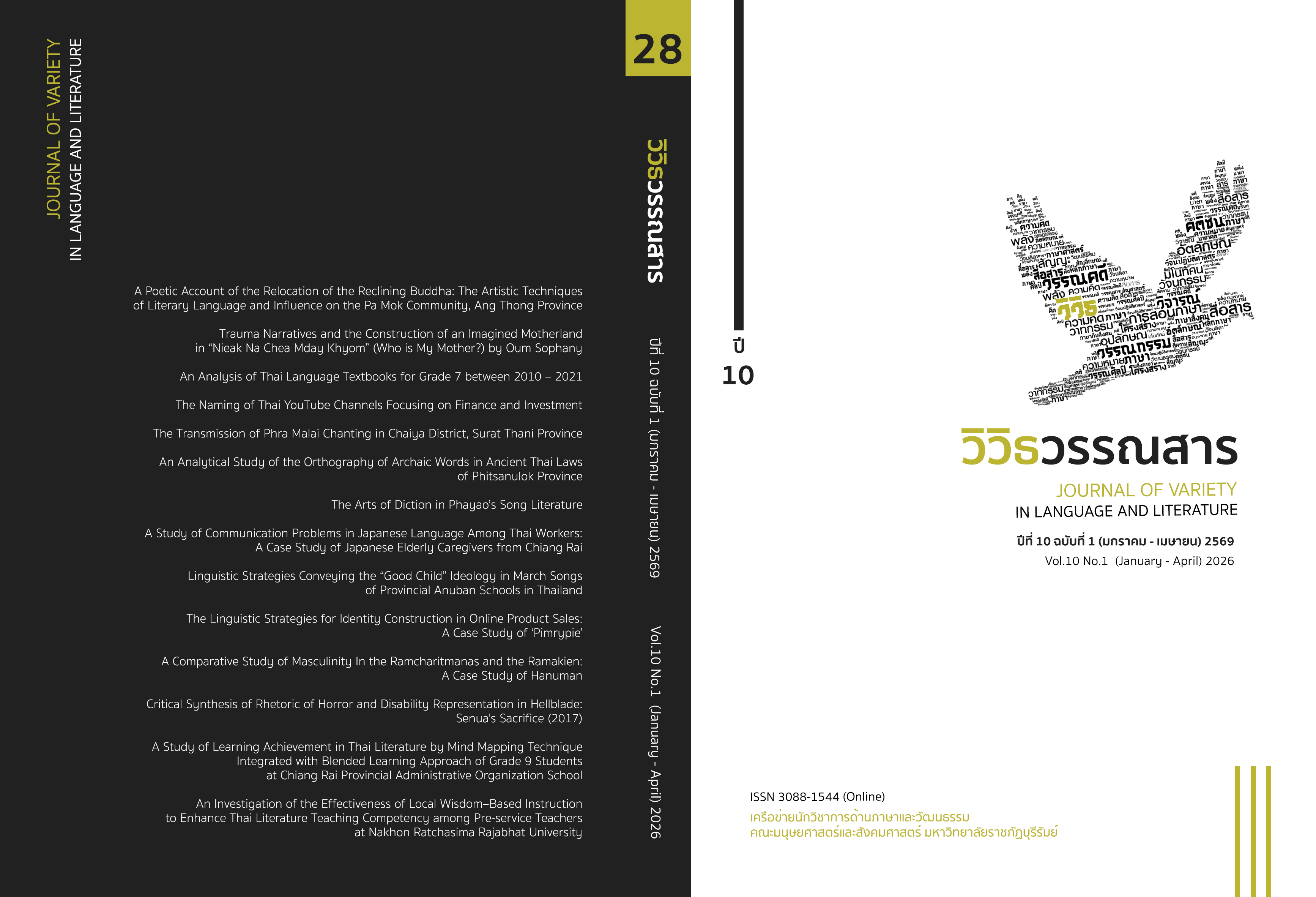
A Study of Communication Problems in Japanese Language Among Thai Workers: A Case Study of Japanese Elderly Caregivers from
Article Sidebar
Main Article Content
Abstract
This study aims to 1) examine the challenges and difficulties in Japanese language communication faced by Thai workers from Chiang Rai who provide elderly care in Japan, and 2) propose the guidelines to address and overcome these communication problems. Samples for this research were 12 Thai caregivers from Chiang Rai with at least six months of elderly care experience in Japan. Data were collected through an online questionnaire consisting of 66 questions, and the analysis employed statistical methods including percentages, mean (), and standard deviation (S.D.). The findings revealed that: 1) The Thai caregivers faced the most significant challenges in reading and writing Japanese for work-related documentation. They expressed the highest need for improvement in listening skills and preferred classroom learning with foreign instructors. 2) Relevant institutions or agencies in Chiang Rai province should plan and organize educational programs or training activities to adequately prepare Thai workers in Japanese writing, reading, and listening skills. These programs should be conducted by instructors to enhance the caregivers’ confidence in using the language. This would enable them to perform their caregiving duties for the elderly in Japan more effectively and seamlessly.
Article Details

This work is licensed under a Creative Commons Attribution-NonCommercial-NoDerivatives 4.0 International License.
Copyright is that of the journal any reproduction must be permitted by the editor of journal
References
Brown, H. D. (2000). Principles of language learning and teaching (4th ed.). Longman.
Chueaphat, R. (2020). Effective internal communication patterns of organizations in Rojana Industrial Estate, Phra Nakhon Si Ayutthaya Province [Master’s thesis]. Phranakhon Si Ayutthaya Rajabhat University. (In Thai)
Department of Employment, Division of Thai Overseas Workers Administration. (2022). Number of Thai workers permitted to work overseas, classified by domicile, destination country, and travel method: Annual summary for 2022 (January–December) (pp. 2,4). https://doe.go.th/prd/overseas/statistic/param/site/149/cat/81/sub/0/pull/ (In Thai)
Department of Employment. (2021). Strategy for the administration of overseas employment placement (2017–2021). Division of Thai Overseas Workers Administration.
https://www.doe.go.th/prd/assets/upload/files/oversea.pdf (In Thai)
Fujimoto, M., & Daibo, I. (2007). ENDCORE: A hierarchical structure theory of communication skills. The Japanese Journal of Personality, 15(3), 347 361. https://doi.org/10.2132/personality.15.347
Heath, R. L., & Bryant, J. (2000). Human communication theory and research: Concepts, contexts, and challenges (2nd ed.). Erlbaum.
Japan Labor Office. (2018). Living conditions of Thai workers in Japan. https://japan.mol.go.th/situation/the-general-problem-of-thai-workers
Kongplanont, W. (2016). Problems and cultural adaptation of Thai workers in Penang State, Malaysia. Journal of Humanities and Social Sciences, Thaksin University, 10 (2), 1–26. (In Thai)
Kulrattanamoniporn, C. (2012). Willing or forced return: Reasons for return migration of Thai workers from Japan. Japanese Studies Journal, 9 (1), 35–46. https://so02.tci- thaijo.org/index.php/japanese/article/view/13735/12390
Kananurak, M. (2004). Psychology and Human Communication. Odeon Store.
Ministry of Health, Labour and Welfare, Japan. (2022). Annual Health, Labour and Welfare Report 2022. Ministry of Health, Labour and Welfare. https://www.mhlw.go.jp/english/wp/wp-hw2022/index.html
Mahakhan, N. (2014). Working under different cultures: Problems and expectations of Japanese companies (Research report). Faculty of Humanities and Social Sciences, Burapha University. (In Thai)
Nishikito, E. M., & Suksamana, C. (2021). Motivation of youth aspiring to work in elderly care occupations in Japan. Journal of the Japanese Studies Association of Thailand, 11(2), 4.
Pickering, M. J., & Garrod, S. (2004). Toward a mechanistic psychology of dialogue. Behavioral and Brain Sciences, 27 (2), 169 226. https://doi.org/10.1017/S0140525X04000056
Shibuya, M. (2018). Japanese retirement migration in Chiang Mai, Thailand. Chiang Mai University Press.
Thaweerat, P. (1997). Research methods in behavioral and social sciences (7th ed.). Srinakharinwirot University, Prasarnmit Campus. (In Thai)
Tindall, W. N., Beardsley, R. S., & Kimberlin, C. L. (1994). Communication skills in pharmacy practice. Lea & Febiger.
Ueno, K. (2005). Socioeconomic research on formation of living activities and living environment. Hyougokenritsu Keizai Keiei Kenkyuujo.
