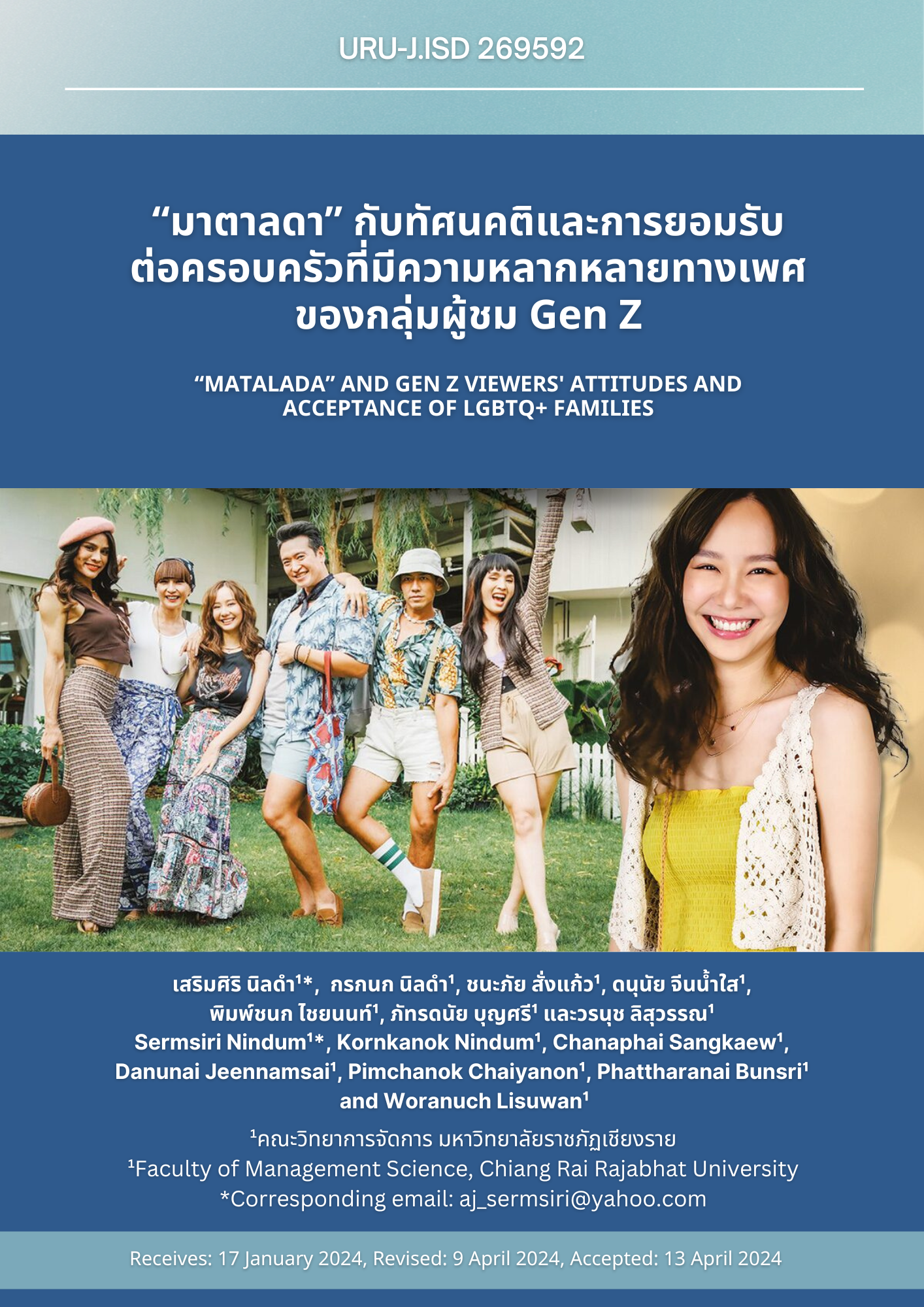
“MATALADA” AND GEN Z VIEWERS' ATTITUDES AND ACCEPTANCE OF LGBTQ+ FAMILIES
Keywords:
ความหลากหลายทางเพศ, ทัศนคติ, การยอมรับAbstract
This research aims to study the attitudes and acceptance of LGBTQ+ families among GEN Z viewers who watch the drama “Matalada”. It is survey research. The sample group in the study consisted of viewers of the television drama “Matalada” who are Gen Z, totaling 413 people. A questionnaire was used as a tool to collect data. Data analysis employed descriptive statistics, one-way ANOVA, and Pearson Correlation analysis.
The results of the study regarding attitudes towards LGBTQ+ families among the sample group who watched the drama "Matalada" were overall at the highest level of agreement. As for acceptance of LGBTQ+ families among GEN Z viewers who watch the drama, it was found that the overall level of acceptance was at the highest level. The results of testing the differences between gender variables and acceptance of LGBTQ+ families among GEN Z viewers who watched the drama found that There is a statistically significant difference at the 0.05 level.
As for the test results of the relationship between attitudes towards LGBTQ+ families and acceptance of LGBTQ+ families among GEN Z viewers who watch the drama, it was found that there was a statistically significant positive relationship with acceptance of LGBTQ+ families. of the GEN Z audience with a correlation coefficient of 0.74
References
กฤตยา อาชวนิจกุล. (2554). เพศวิถีที่กำลังเปลี่ยนแปลงไปในสังคมไทย. วารสารประชากรและสังคม, 15(1), 43-66.
เกศินี จุฑาวิจิตร. (2548). การสื่อสารเพื่อพัฒนาท้องถิ่น. นครปฐม: ภาควิชาการสื่อสารและการประชาสัมพันธ์ มหาวิทยาลัยราชภัฏนครปฐม.
นิภาพร เจริญผ่อง. (2550). การยอมรับของนักศึกษาต่อการประชาสัมพันธ์ของคณะวิศวกรรมศาสตร์สถาบันเทคโนโลยี พระจอมเกล้าเจ้าคุณทหารลาดกระบัง. (วิทยานิพนธ์ปริญญามหาบัณฑิต). มหาวิทยาลัยราชภัฎจันทรเกษม.
ประภาเพ็ญ สุวรรณ. (2540). พฤติกรรมศาสตร์ พฤติกรรมสุขภาพ และสุขศึกษา. กรุงเทพฯ: เจ้าพระยาการพิมพ์
ปารณีย์ จงรักษ์ และอนุชา ทีรคานนท์. (2557). การเปิดรับสื่อ ทัศนคติ การแสดงออกทางสังคมของกลุ่มหญิงรักหญิง. (วิทยานิพนธ์ปริญญามหาบัณฑิต). มหาวิทยาลัยธรรมศาสตร์.
มนัสวี ศรีนนท์. (2561). ทฤษฎีเจนเนอเรชันกับกรอบวิธีคิด. วารสารศึกษาศาสตร์ มมร.คณะศึกษาศาสตร์ มหาวิทยาลัยมหามงกุฎราชวิทยาลัย, 6(1), 364-373.
วิเชียร เกตุสิงห์. (2543). คู่มือการวิจัย: การวิจัยเชิงปฏิบัติ. กรุงเทพฯ: เจริญผล.
สำนักงานเลขาธิการสภาผู้แทนราษฎร. (2565). ความหลากหลายทางเพศ. สืบค้น 30 สิงหาคม 2566, จาก https://www.parliament.go.th/ewtadmin/ewt/elaw_parcy/ewt_dl_link.php?nid=2649
สุรพงษ์ โสธนะเสถียร. (2544). การสื่อสารกับสังคม. กรุงเทพฯ: จุฬาลงกรณ์มหาวิทยาลัย.
อินโฟเควส. (2566). เจาะกระแส “มาตาลดาฟีเวอร์” ละครฟีลกู๊ด Engagement สูงกว่า 14 ล้านครั้ง. สืบค้น 30 สิงหาคม 2566, จาก https://www.dataxet.co/insights/thai-drama-matalada-fever
อัฏฐ์ กู้พงษ์ศักดิ์. (2553). การบริหารจัดรายการของกิจการโทรทัศน์แบบฟรีทีวีเพื่อผลเชิงพาณิชย์. สืบค้น 30 สิงหาคม 2566, จาก http://www.bu.ac.th/knowledgecenter/executive_journal/30_2/pdf/aw3.pdf.
Gonta, G., Hansen, S., Fagin, C., and Fong, J. (2017). Changing Media and Changing Minds: Media Exposure and Viewer Attitudes Toward Homosexuality. Pepperdine Journal of Communication Research, 5, 21-34.
Jerel, P.C., and L. Monique, W. (2009). Media Exposure and Viewers' Attitudes Toward Homosexuality: Evidence for Mainstreaming or Resonance?, Journal of Broadcasting & Electronic Media, 53:2, 280-299, DOI: 10.1080/08838150902908049
Morgan, M. (2009). Cultivation analysis and media effects. The Sage handbook of media processes and effects, 69-82.
Sheharyar, A. (2020) Effects of Television Dramas on Socio Cultural Values: A Case Study of Faisalabad City. (2023). Human Nature Journal of Social Sciences, 1(1), 40-50.
Yan, H. Y. (2019). “The Rippled Perceptions”: The Effects of LGBT-Inclusive TV on Own Attitudes and Perceived Attitudes of Peers Toward Lesbians and Gays. Journalism & Mass Communication Quarterly, 96(3), 848-871.
Downloads
Published
How to Cite
License
Copyright (c) 2024 URU Journal of Integrated Sciences for Development

This work is licensed under a Creative Commons Attribution-NonCommercial-NoDerivatives 4.0 International License.
แนวคิดและทัศนะในบทความเป็นความรับผิดชอบของผู้เขียนบทความ การนำบทความหรือส่วนหนึ่งของบทความไปตีพิมพ์เผยแพร่ ให้อ้างอิงแสดงที่มา และข้อมูลเกี่ยวกับผู้เขียนบทความ