Digital Communication Processes Digital Communication Processes in Promoting Young Smart Farmers to Register Agricultural Products and Goods under the Community Trademark Representing Geographical Indications of Chanthaburi Province
Digital Communication Processes in Promoting Young Smart Farmers to Register Agricultural Products and Goods under the Community Trademark Representing Geographical Indications of Chanthaburi Province
Keywords:
กระบวนการสื่อสารดิจิทัล, การมีส่วนร่วม, เกษตรกรรุ่นใหม่, สิ่งบ่งชี้ทางภูมิศาสตร์Abstract
This research article aims to: (1) examine the essential needs of Young Smart Farmers in Chanthaburi Province regarding the registration of agricultural products for the use of Geographical Indication (GI) community trademarks, and (2) investigate the digital communication processes that promote their participation in the GI registration system. A mixed methods research design was employed. The quantitative phase involved purposive sampling of 331 Young Smart Farmers from the official database of the Chanthaburi Provincial Agricultural Office, all of whom were formally registered and had at least one year of agricultural experience. The qualitative phase consisted of in-depth interviews with 10 Young Smart Farmers participating in the Young Smart Farmer Program, representing all 10 districts of Chanthaburi Province, along with relevant experts. Research instruments included a questionnaire and an interview form. Data were analyzed using percentage, mean, and the Priority Needs Index (PNI Modified).
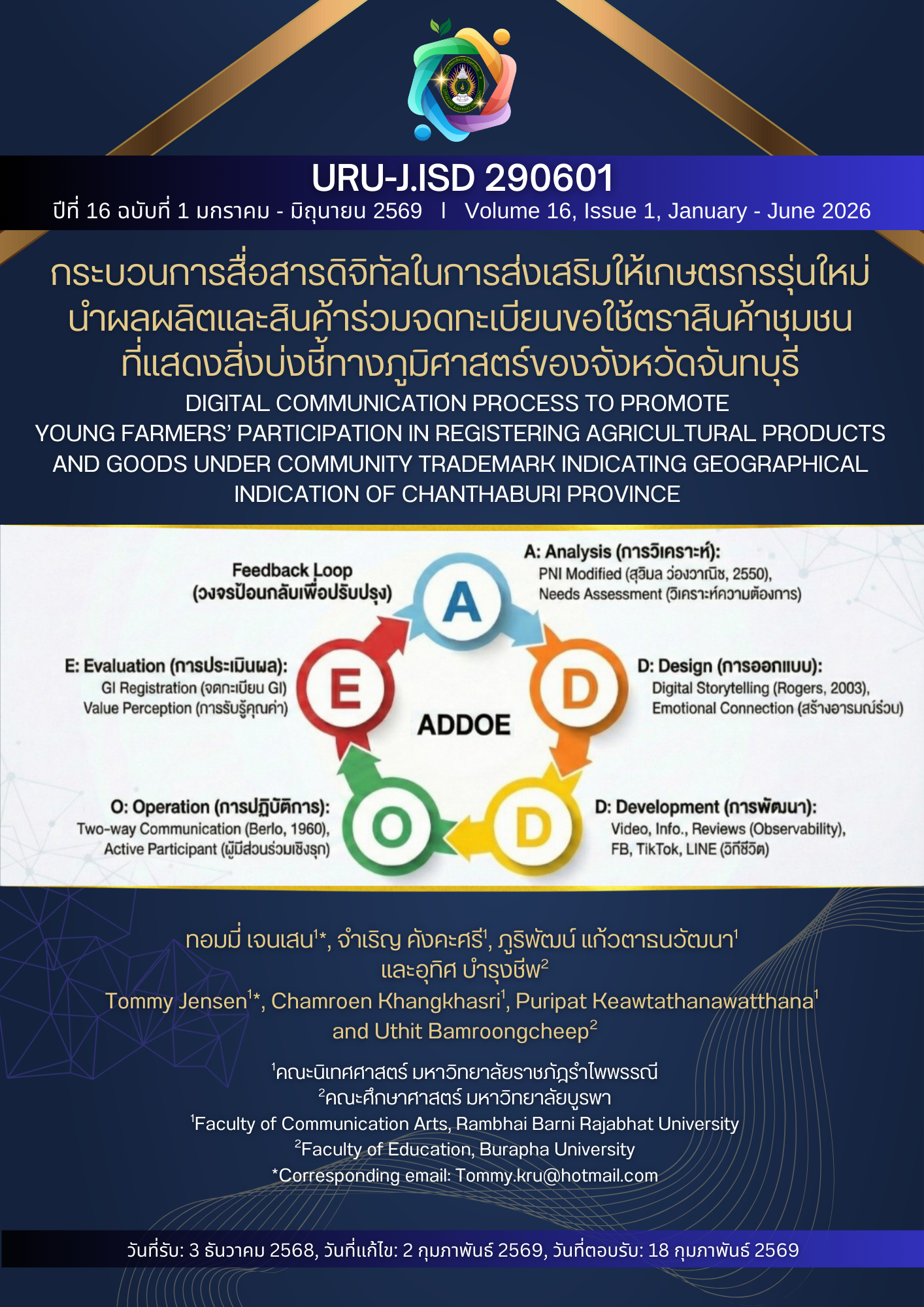
The findings revealed that: (1) the most urgent need among Young Smart Farmers is the organization of integrated proactive activities to transfer knowledge on GI durian processing that reflects local identity while meeting consumer demands (PNI = 1.74). The second priority is training in marketing and online media to enhance skills in developing GI-labeled community products (PNI = 1.67). The third priority is the establishment of a Q&A channel through a Chatbot AI for providing consultation on GI products (PNI = 1.60). (2) The appropriate digital communication process comprises elements of the “DIGI-GI Interaction Process,” including: Senders—government agencies, agricultural leaders, and model farmers; Content—GI product information, storytelling techniques, infographics, and case studies; Communication Channels—Facebook, TikTok, and LINE groups; and Interactivity mechanisms—Q&A bots, live chat, and QR codes.
The results indicate that integrating digital communication strategies with local contexts enhances the engagement of Young Smart Farmers, strengthens the communication capacity of governmental agencies, and contributes to the sustainable value enhancement of GI-certified community products in Chanthaburi Province.
References
กรมทรัพย์สินทางปัญญา. (2565). รายงานประจำปี 2565 กรมทรัพย์สินทางปัญญา. กระทรวงพาณิชย์. https://www.ipthailand.go.th/th/รายงานประจำปี/item/ar_dip_2022.html
กรมทรัพย์สินทางปัญญา. (2566, 24 กรกฎาคม). แผนปฏิบัติราชการระยะ 5 ปี (พ.ศ. 2566-2570) ของกรมทรัพย์สินทางปัญญา. https://www.ipthailand.go.th/images/26669/2566/Plan/Plan%205%20years(2566-2570).pdf
สุวิมล ว่องวาณิช. (2550). การวิจัยประเมินความต้องการจำเป็น. สำนักพิมพ์แห่งจุฬาลงกรณ์มหาวิทยาลัย.
อุทิศ บำรุงชีพ, พักตร์วิภา โพธิ์ศรี และมงคล ยังทนุรัตน์. (2566). กระบวนการสื่อสารดิจิทัลเพื่อการเรียนรู้และสืบสานภูมิปัญญาอาหารสุขภาพของผู้สูงอายุ. วารสารสหวิทยาการเพื่อการพัฒนา มหาวิทยาลัยราชภัฏอุตรดิตถ์, 13(2), 1-16.
Attavanich, W., Chantarat, S., Chenphuengpawn, J., Mahasuweerachai, P., & Thampanishvong, K. (2019). Farms, Farmers and Farming: A Perspective through Data and Behavioral Insights. https://www.pier.or.th/files/conferences/2019/pier_symposium_2019_2_1_paper.pdf
Bandura, A. (1986). Social foundations of thought and action: A social cognitive theory. Prentice-Hall.
Berlo, D. K. (1960). The process of communication: An introduction to theory and practice. Holt, Rinehart and Winston.
Branch, R. M. (2009). Instructional design: The ADDIE approach. Springer.
Chotigo, K., & Thong-ngam, C. (2024). Communication problems and media needs of new generation farmers in Upper Northern Thailand. Journal of Agricultural Extension and Development, 15(2), 45–58. https://li01.tci-thaijo.org/index.php/ japmju/article/view/265193/179140
Kaufman, R. (1988). Planning educational systems: A results-based approach. Technomic.
Kotler, P., Kartajaya, H., & Setiawan, I. (2021). Marketing 5.0: Technology for humanity. Wiley.
Mayer, R. E. (2009). Multimedia learning (2nd ed.). Cambridge University Press.
Robin, B. R. (2008). Digital storytelling: A powerful technology tool for the 21st century classroom. Theory Into Practice, 47(3), 220–228.
Rogers, E. M. (2003). Diffusion of innovations (5th ed.). Free Press.
Stufflebeam, D. L. (2003). The CIPP model for evaluation. In T. Kellaghan & D. L. Stufflebeam (Eds.), International handbook of educational evaluation (pp. 31–62). Kluwer Ac
Downloads
Published
How to Cite
License
Copyright (c) 2026 URU Journal of Integrated Sciences for Development

This work is licensed under a Creative Commons Attribution-NonCommercial-NoDerivatives 4.0 International License.
แนวคิดและทัศนะในบทความเป็นความรับผิดชอบของผู้เขียนบทความ การนำบทความหรือส่วนหนึ่งของบทความไปตีพิมพ์เผยแพร่ ให้อ้างอิงแสดงที่มา และข้อมูลเกี่ยวกับผู้เขียนบทความ