
A Model of Activities in Accordance with Buddhist Principles to Prevent Depressive Disorders of the Elderly in Mueang Khon Kaen
Article Sidebar
Main Article Content
Abstract
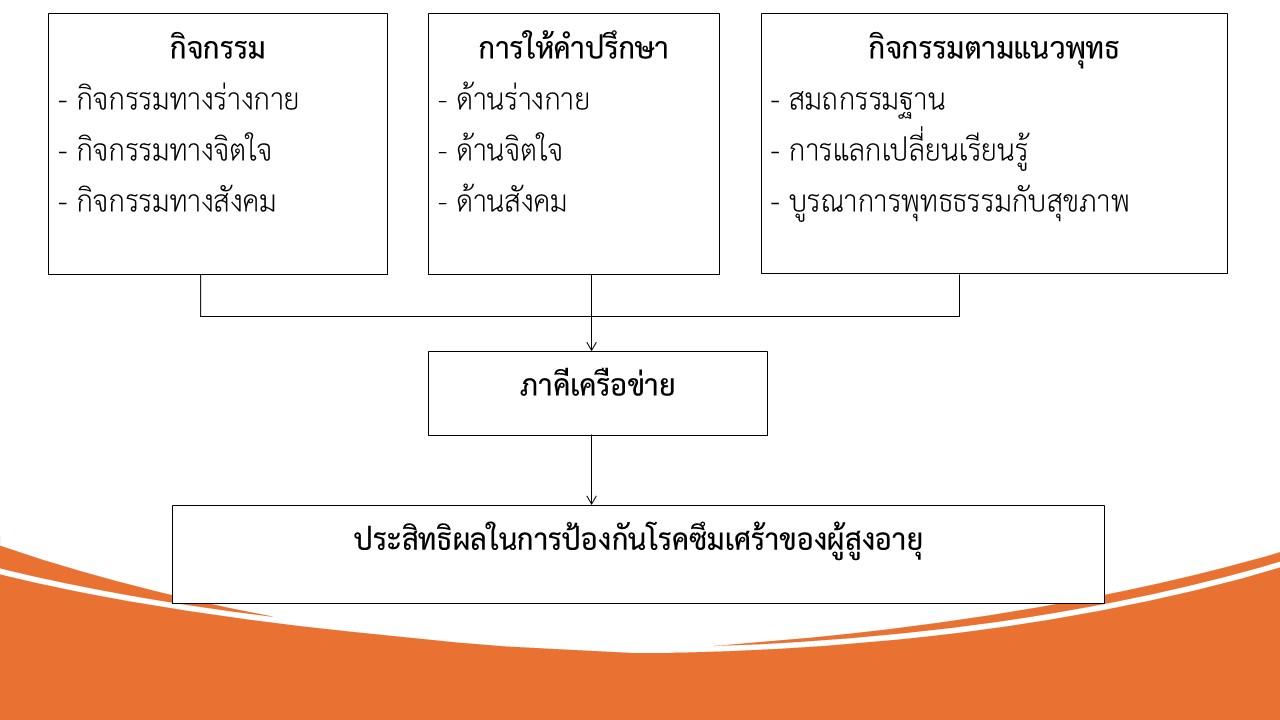
The purpose of this research was to 1) study the organization of activities based on Buddhist principles to address mental health issues, 2) create a Buddhist-based activity model for the elderly in the Muang district of Khon Kaen province, and 3) present a model for organizing Buddhist activities aimed at preventing depression among the elderly in the same district. This was a qualitative study using purposive sampling. The tools for collecting qualitative data included in-depth interviews and descriptive analysis. The research findings indicate that: 1) Activities that enhance both physical and mental health contribute to the overall well-being of the elderly. Promoting physical health means maintaining a sound body that is free from diseases, while promoting mental health entails fostering a positive mindset, cheerfulness, mindfulness, and effective stress management. Moreover, promoting social health involves encouraging active participation to create a suitable physical, mental, and social environment. 2) The Buddhist-based activity model for the elderly emphasizes the importance of resisting materialism in the era of globalization and alleviating depression through Buddhist practices, particularly meditation. 3) The model for organizing Buddhist activities aimed at preventing depression among the elderly is currently supported by various agencies focused on promoting elderly well-being. There is a concerted effort to encourage the formation of clubs for the elderly to enhance social interaction. Initiatives have been launched to restore the health of elderly community members, with these clubs serving as centers for gathering and promoting their physical, mental, and social well-being.
Article Details
References
จันทิมา แสงแพร และพระครูปลัดสุวัฒน์ สุวฑฺฒโน. (2564). หลักธรรมเพื่อการเยียวยาจิตใจต่อภาวะซึมเศร้าในสังคมปัจจุบัน. วารสารพุทธมัคค์ ศูนย์วิจัยธรรมศึกษา สํานักเรียนวัดอาวุธวิกสิตาราม, 6(2), 218-228.
ณัฐหทัย นิรัติศัย. (2562). พุทธธรรมกับการบำบัดโรคซึมเศร้า. วารสารสถาบันวิจัยญาณสังวร, 10(2), 303-317.
มหาจุฬาลงกรณราชวิทยาลัย. (2539). พระไตรปิฎกภาษาไทยฉบับมหาจุฬาลงกรณราชวิทยาลัย. กรุงเทพฯ: มหาจุฬาลงกรณราชวิทยาลัย.
เรณุการ์ ทองคำรอด. (2555). ความสัมพันธ์ระหว่างพฤติกรรมการพัฒนาตนเองของพยาบาลวิชาชีพกับประสิทธิผลของหอผู้ป่วยโรงพยาบาลทั่วไป เขตตรวจราชการสาธารณสุขที่ 17. วารสารพยาบาล, 61(2), 28-32.
พระมหาไพฑูรย์ปนฺตนนฺโท. (2563). การบําบัดโรคซึมเศร้าด้วยการประยุกต์ใช้การปฏิบัติวิปัสสนากัมมัฏฐาน.วารสารสถาบันวิจัยญานสังวร,11(2),99 –110.
สมเด็จพุทธโฆษาจารย์ (ป.อ. ปยุตฺโต). (2559). พจนานุกรมพุทธศาสตร์ ฉบับประมวลธรรม. (พิมพ์ครั้งที่ 38). กรุงเทพฯ: สำนักพิมพ์ผลิธัมม์.
สมพร รุ่งเรืองกลกิจ, สวิตตา ธงยศ, อิงคฏา โคตนารา, และขจรศักดิ์ วรรณทอง. (2557). ประสิทธิผลของการให้การปรึกษาแนวพุทธธรรมต่อการลดอาการซึมเศร้าในผู้ป่วยโรคซึมเศร้า. วารสารสมาคมจิตแพทย์แห่งประเทศไทย, 59(4), 381-393.
สายฝน เอกวรางกูร. (2554). รู้จัก เข้าใจ ดูแลภาวะซึมเศร้า. กรุงเทพฯ: โรงพิมพ์แห่งจุฬาลงกรณ์มหาวิทยาลัย.
อารยา สิงห์สวัสดิ์. (2565). ซึมเศร้าสัญญาณอันตรายฆ่าตัวตาย. http://www.thaihealth.or.th/node/10824
Beekman, A. T., Braam, A. W., Copeland, J. R., Dewey, M. E., Delespaul, P., Fuhrer, R. (2004). Depression among Older People in Europe: the Europe Studies. World Psychiatry, 3, 9-45.
D’Zurilla, T. J., Nezu, A. M., Maydeu-Olivares, A. (2001). Manual for the SocialProblem Solving Inventory-Revised. North Tonawanda, NY: Multi-Health Systems (in press).
Rahula, W. (2021). What the Buddha Taught. https://www.theravada.gr/wp-content/uploads/2021/05/Dr_Walpola_Rahula_What_the_Buddha_Taught.pdf
WHO. (2022). Disability-adjusted life years (DALYs). https://www.who.int/data/gho/ indicator-metadata-registry/imr-details/158 (accessed 17.1.2022)
