
The Needs Assessment to Development English Teachers’ Competency in Schools under Nakhon Phanom Primary Educational Service Area Office 2
Article Sidebar
Main Article Content
Abstract
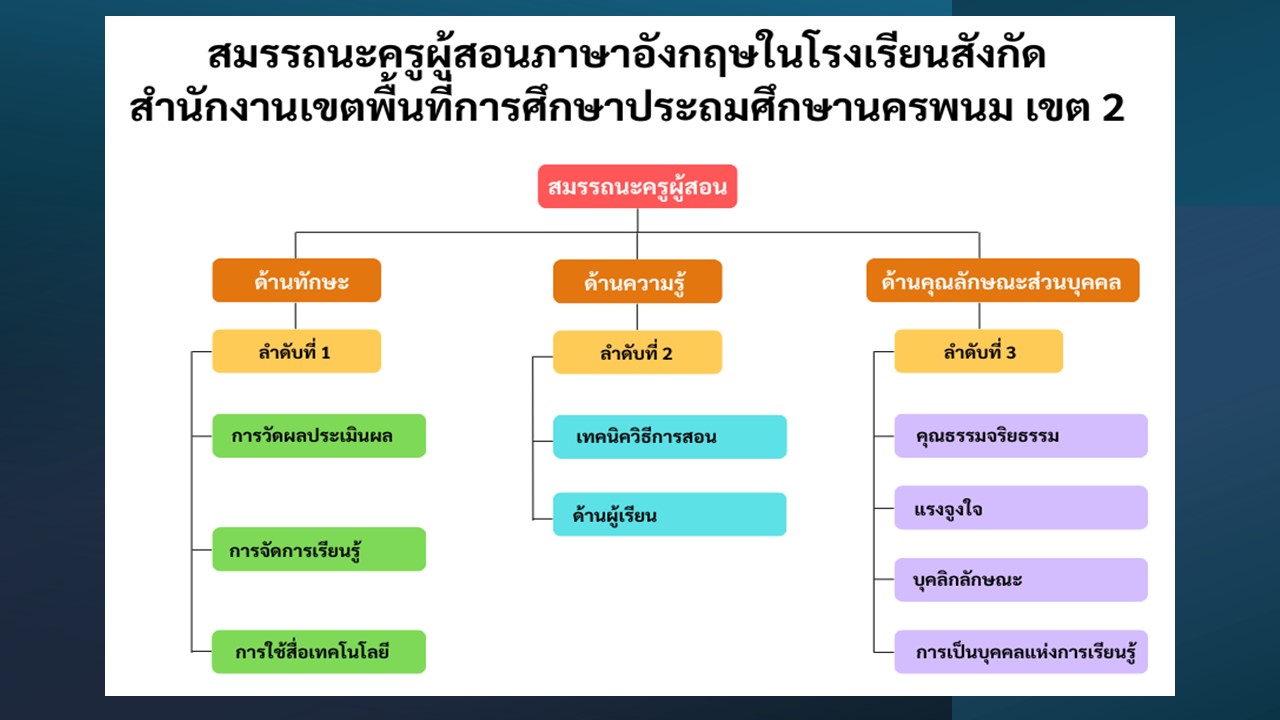
The purpose of this research aimed to 1) study the current and desired state of English Teachers’ competency in schools under Nakhon Phanom primary educational service area office 2, 2) study needs of development English Teachers’ competency in schools under Nakhon Phanom primary educational service area office 2. and 3) propose study guideline to improve of English Teachers’ competency in schools under Nakhon Phanom primary educational service area office 2. This research was a needs assessment for developing English Teachers’ Competency in Schools under Nakhon Phanom Primary Educational Service Area Office 2. The study's samples comprised 226 school administrators and English teachers in schools under Nakhon Phanom Primary Educational Service Area Office 2. The instrument used in data collection was a questionnaire. The statistical methods used in data analysis were frequency, percentage, mean, standard deviation, and Modified Priority Need Index. The findings were as follows. 1. The current state and the desirable state of English Teachers’ competency in schools under Nakhon Phanom primary educational service area office 2, overall, was at high level. 2. The needs of English Teachers’ competency are prioritized as 1) Skills, 2) Knowledge, and 3) Personal Characteristics, respectively. 3. The guideline to improve of English Teachers’ competency in schools under Nakhon Phanom primary educational service area office 2, comprised 1) Skills included 1.1) Measurement and evaluation, 1.2) Learning Management, and 1.3) Use of instructional media and technology, 2) Knowledge included 2.1) Instructional method and 2.2) Students and learner.
Article Details
References
ชัชรีย์ บุนนาค. (2562). ปัญหาการเรียนการสอนภาษาอังกฤษในประเทศไทยและขอเสนอแนะด้านยุทธศาสตร์การพัฒนาการเรียนการสอนภาษาอังกฤษ ป 2564 – 2568. http://journalgrad.ssru.ac.th/index.php/miniconference/article/view/1716
ธัญญลักษณ์ เวชกามา. (2562). รูปแบบการพัฒนาสมรรถนะครูด้านการสอนภาษาอังกฤษของโรงเรียนประถมศึกษาในภาคตะวันออกเฉียงเหนือตอนล่าง. วิทยานิพนธ์ระดับปริญญาดุษฎีบัณฑิต สาขาวิชาการบริหารการศึกษา. มหาวิทยาลัยราชภัฏบุรีรัมย์.
ยวียส มาอยู่. (2566). แนวทางการพัฒนาสมรรถนะครูภาษาอังกฤษระดับประถมศึกษา ในโรงเรียนสังกัด สำนักงานเขตพื้นที่การศึกษาประถมศึกษาพิษณุโลก เขต 1. การค้นคว้าอิสระสาขาวิชาการบริหารการศึกษา มหาวิทยาลัยนเรศวร.
วาโร เพ็งสวัสดิ์. (2551). วิธีวิทยาการวิจัย. กรุงเทพฯ: สุวีริยาสาส์น
สำนักงานเขตพื้นที่การศึกษานครพนม เขต 2. (2566). ข้อมูลสารสนเทศ. https://www.nkp2.go.th/o5-2/
สิริกร ชาลีกัน และ พา อักษรเสือ. (2563). กลยุทธ์การพัฒนาสมรรถนะครูในการจัดการเรียนรู้ภาษาอังกฤษ โรงเรียนประถมศึกษา จังหวัดขอนแก่น. วารสารสังคมศาสตร์และมานุษยวิทยาเชิงพุทธ, 5(6), 232-244.
สุวิมล ว่องวาณิช. (2562). การวิจัยประเมินความต้องการจำเป็น. กรุงเทพฯ: สำนักพิมพ์จุฬาลงกรณ์มหาวิทยาลัย.
อมรรัตน์ ทับทิมทอง และสถิรพร เชาวน์ชัย. (2564). ความต้องการจําเป็นและแนวทางการพัฒนาสมรรถนะด้านทักษะของครูภาษาอังกฤษ สังกัดสํานักงานเขตพื้นที่การศึกษามัธยมศึกษาเขต 39 จังหวัดพิษณุโลก. วารสารมนุษยศาสตร์ มหาวิทยาลัยนเรศวร, 18(3), 129-147.
Bank of Thailand. (2014). Financial Stability Report 2014. https://www.bot.or.th/content/dam/bot/documents/en/research-and-publications/reports/financial-stability-report/FSR2014e.pdf. Retrieved 10 January 2024.
Hariharasudan, A. & Kot, S. (2018). A Scoping Review on Digital English and Education 4.0 for Industry 4.0. Social Sciences. 7(11), 227.
Kirkpatrick, R. (2012). English education in Thailand: 2012. Asian EFL Journal. 61: 24-40.
Kirschenbaum, M. (2010). What is digital humanities and what’s it doing in English Departments? ADE Bulletin. no.150: 55-61
Pennycook, A. (2017). The cultural politics of English as an international language: Routledge.
Prapphal, K. (2003). English proficiency of Thai learners and directions of English teaching and learning in Thailand. Journal of Studies in the English Language. 1: 6-12.
Riemer, M. J. (2002). English and communication skill for the global engineer. Global J. of Engng. Educ. 6(1): 91-100.
Smith, L. E. (2015). English as an international language: No room for linguistic chauvinism. Journal of English as a Lingua Franca. 4(1): 165-171.
