
Development of Indicators for Ecosystem Management towards Sustainability in Secondary Schools in Udon Thani Province
Article Sidebar
Main Article Content
Abstract
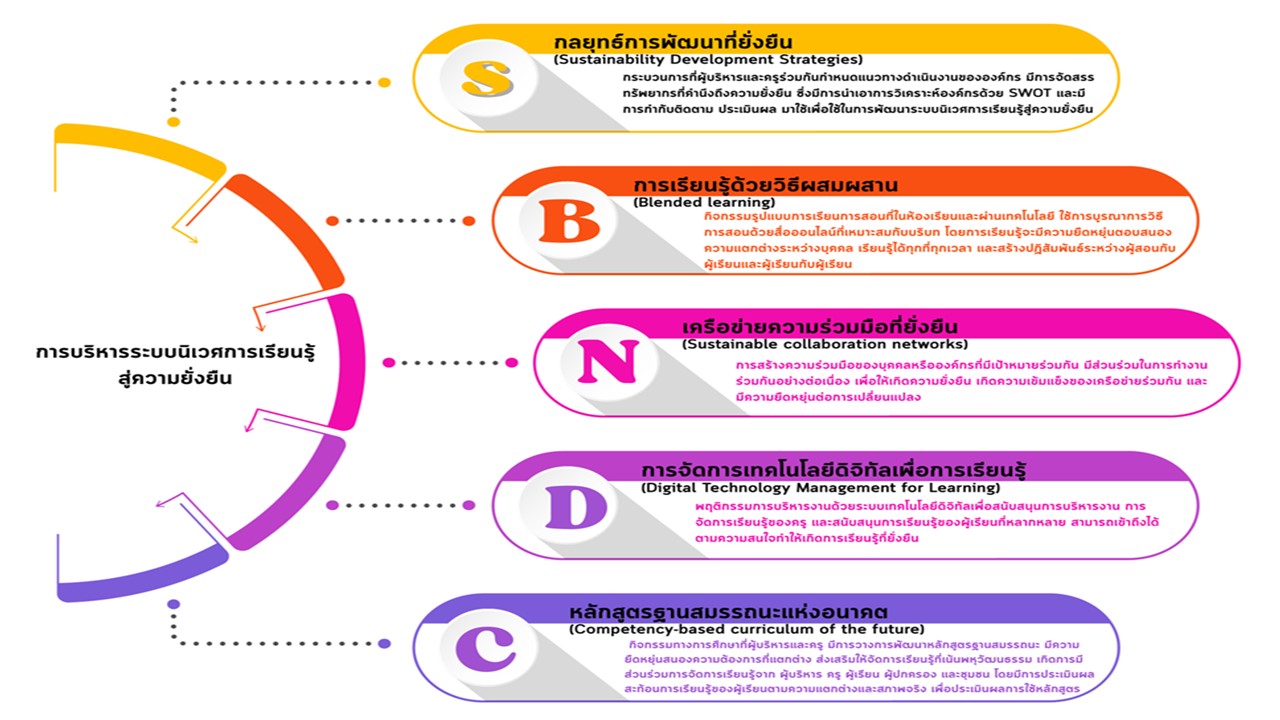
The objectives of this research are as follows: 1) To study the components and indicators of the learning ecosystem for sustainability in secondary schools in Udon Thani province. 2) To examine the fit of the model of indicators for the learning ecosystem for sustainability in secondary schools in Udon Thani province. The sample group consisted of 285 administrators and teachers from secondary schools in Udon Thani province, selected through stratified random sampling. The data collection tool used was a 5-level rating scale questionnaire with a reliability of 0.969. The research findings are as follows: 1. The study of the components and indicators of the learning ecosystem for sustainability in secondary schools in Udon Thani province revealed 5 components and 14 indicators, including: 1) Sustainability development strategies with 3 indicators, 2) Blended learning with 3 indicators, 3) Sustainable collaboration networks with 3 indicators, 4) Digital Technology Management for Learning with 2 indicators, and 5) Competency-based curriculum of the future with 3 indicators. 2. The analysis of the model fit of the learning ecosystem indicators for sustainability in secondary schools in Udon Thani province with empirical data showed that the model developed by the researcher is well-fitting with the empirical data, with χ² = 71.461, df = 64, P-Value = 0.2439, RMSEA = 0.024, SRMR = 0.041, CFI = 0.995, TLI = 0.993.
Article Details

This work is licensed under a Creative Commons Attribution-NonCommercial-NoDerivatives 4.0 International License.
References
สายสุดา ขันธเวช. (2561). การเรียนรู้ด้วยตนเอง (Self-directed learning). สืบค้นวันที่ 20 พฤศจิกายน2567 จาก https://ops.moe.go.th/ทักษะแสวงหาความรู้ด้วย/
กนกอร สมปราชญ์. (2559). ภาวะผู้นำและภาวะผู้นำการเรียนรู้สำหรับผู้บริหารสถานศึกษา. ขอนแก่น : คลังนานาวิทยา.
กระทรวงศึกษาธิการ. (2565). แผนพัฒนาการศึกษาของกระทรวงศึกษาธิการ ฉบับที่ 12 (พ.ศ. 2560 - 2564). สืบค้นจากhttps://www.moe.go.th/moe/th/news/detail.php?News ID=54376&Key=news_act
กัลยา วานิชย์บัญชา. (2559). สถิติสำหรับงานวิจัย: การสุ่มตัวอย่าง. พิมพ์ครั้ง 10. กรุงเทพฯ: โรงพิมพ์แห่งจุฬาลงกรณ์.
กุลธิดา ทุ่งคาใน. (2564). การเรียนรู้แบบผสมผสาน Blended Learning ในวิถีใหม่ New Normal. ครุศาสตร์สาร, 15(1) มกราคม-มิถุนายน 2564, 29-43.
คณะกรรมการอิสระเพื่อการปฏิรูปการศึกษา. (2563). รายงานเฉพาะเรื่องที่ 12 หลักสูตรและการเรียนการสอนฐานสมรรถนะ. กรุงเทพมหานคร: สำนักงานเลขาธิการ คณะกรรมการอิสระเพื่อการปฏิรูปการศึกษา.
ชัชวาล สิงหาทอง. (2561). รูปแบบเครือข่ายความร่วมมือทางการศึกษา. Journal of Multidisciplinary in Humanities and Social Sciences, 1 (3) September – December 2018, 1-12.
ชื่นชนก โควินท์. (2561). การศึกษาเพื่อการพัฒนาที่ยั่งยืน. กรุงเทพฯ: พริกหวานกราฟฟิค.
ประกฤติยา ทักษิโณ. (2559). เอกสารประกอบการอบรม เรื่อง การวิเคราะห์ข้อมูลด้วย LISREL และ MPLUS: ความรู้พื้นฐานก่อนการวิเคราะห์. ขอนแก่น: มหาวิทยาลัยขอนแก่น.
พิสิฐ เทพไกรวัล. 2554. การพัฒนารูปแบบเครือข่ายความร่วมมือเพื่อคุณภาพการจัดการศึกษา ในโรงเรียนมัธยมศึกษาขนาดเล็ก. วิทยานิพนธ์ปริญญาปรัชญาดุษฎีบัณฑิต สาขาวิชา การบริหารการศึกษา บัณฑิตวิทยาลัย มหาวิทยาลัยขอนแก่น.
โรงเรียนสาธิตแห่งมหาวิทยาลัยธรรมศาสตร์. (2564). บรรยากาศการเรียนรู้โรงเรียนสาธิตแห่งมหาวิทยาลัยธรรมศาสตร์. สืบค้นเมื่อ 20 พฤศจิกายน 2567 จาก https://www.facebook.com/thammasatsecondaryschool
ลิสรา จิตรชญาวนิช, นิตยา สุวรรณศรี, อุดม คำขาด, ชลายุทธ์ ครุฑเมือง และ สุมิตรา โรจนนิติ. (2565). การจัดการเรียนรู้ในยุคชีวิตวิถีใหม่สู่การพัฒนาอย่างยั่งยืน. Journal of Modern Learning Development. 7(7) สิงหาคม 2565. 490-503.
วิจารณ์ พานิช. (2566). การสร้างการเรียนรู้สู่ศตวรรษที่ 21. (พิมพ์ครั้งที่ 4). กรุงเทพฯ: มูลนิธิสยามกัมมาจล.
สำนักงานเขตพื้นที่การศึกษามัธยมศึกษาอุดรธานี. (2567). แผนพัฒนาการศึกษาขั้นพื้นฐาน พ.ศ.2566-2570 (ฉบับปรับปรุง พ.ศ.2567). อุดรธานี.
สํานักงานเลขาธิการสภาการศึกษา กระทรวงศึกษาธิการ. (2564). การพัฒนาการศึกษานานาชาติเพื่อการบรรลุเป้าหมายการพัฒนาที่ยั่งยืนของโลก. รายงานวิจัย กรุงเทพฯ: บริษัทพริกหวานกราฟฟิค จำกัด.
สํานักงานเลขาธิการสภาการศึกษา กระทรวงศึกษาธิการ. (2565). สภาพการจัดนิเวศการเรียนรู้ที่เหมาะสมกับบริบทประเทศไทย. กรุงเทพฯ: เอส.บี.เค การพิมพ์.
สำเร็จ นางสีคุณ. (2565). การพัฒนาตัวบ่งชี้ Disruptive Leadership สำหรับผู้บริหารสถานศึกษา. วิทยานิพนธ์ศึกษาศาสตรดุษฎีบัณฑิต. สาขาการบริหารการศึกษา มหาวิทยาลัยขอนแก่น.
สุภารัตน์ วัฒนธรรม. (2566). แนวทางการพัฒนาระบบนิเวศการเรียนรู้ของโรงเรียนวิทยาศาสตร์จุฬาภรณราชวิทยาลัย สังกัดสำนักงานคณะกรรมการการศึกษาขั้นพื้นฐาน. วิทยานิพนธ์หลักสูตรปริญญาศึกษาศาสตรบัณฑิต มหาวิทยาลัยขอนแก่น.
อภิชญา สวัสดี, ศศิธร หาสิน และกัลยารัตน์ สุขนันท์ชนะ. (2565). แนวทางการจัดระบบนิเวศการเรียนรู้ภายในสถานศึกษารองรับการเรียนรู้เชิงรุก. E-journal of Education Studies, Burapha University. Vol.4 No.4, 67-78.
อัจฉรา จุ้ยเจริญ. (2562). Learning Ecosystem. สืบค้นเมื่อ 20 พฤศจิกายน 2567, จากhttps://www.posttoday.com/economy/news/578269.
Eudy, R. (2018). What is a learning ecosystem? And how does it support corporate strategy?. Retrieved form https://hsi.com/blog/what-is-a-learning-ecosystem-and-how-does-it-support-corporate-strategy.
Fadel, C., Bialik, M., & Trilling, B. (2015). Four-Dimensional Education: The Competencies Learners Need to Succeed. Center for Curriculum Redesign.
Hannon, V., Thomas, L., Ward, S., & Beresford, T. (2019). Local learning ecosystems: emerging models. London: Innovation Unit.
Harrell, T.S. (2020). สภาพการจัดนิเวศการเรียนรู้ที่เหมาะสมกับริบทประเทศไทย. สำนักมาตรฐานการศึกษาและพัฒนาการเรียนรู้สำนักงานเลขาธิการสภาการศึกษา กระทรวงศึกษาธิการ. กรุงเทพฯ.
Horn. B.M. and Staker. H. (2011) The Rise of K-12 Blended Learning. Unpublished Paper. : Innosight Institute.
Rasheed, R. A., Kamsin, A., & Abdullah, N. A. (2020). Challenges in the online component of blended learning: A systematic review. Computers & Education, 144, 103701. https://doi.org/10.1016/j.compedu.2019.103701
Spencer-Keyse, J Luksha, P.,. & Cubista, J. (2020). Learning Ecosystems: An Emerging Praxis for Education. Global Education Futures and SKOLKOVO.
United Nations. (2022). Sustainable Development Goals. Retrieved from https://www.un.org/sustainabledevelopment/sustainable-development-goals/
