
Model of Human Relations Life Skills Development Based on Buddhism in the Context of Vocational Education
Article Sidebar
Main Article Content
Abstract
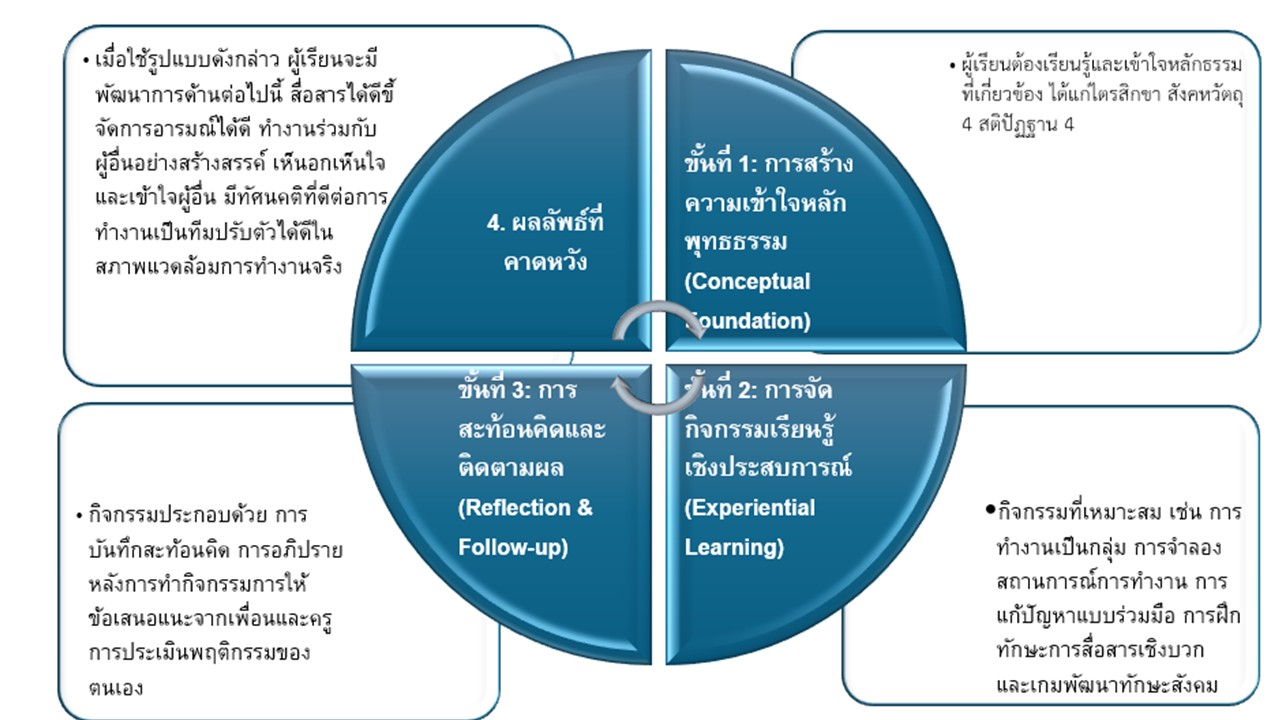
This article aimed to propose a model for developing human relations life skills based on Buddhism for vocational students. This research aimed to collect and analyze documents, theories, research, and related policies both domestically and internationally. The results showed that: Meanwhile, Buddhism, particularly the Threefold Training (Morality, Concentration, Wisdom), the Four Sanghavatthu (Dana, Piyavacā, Atthacariya, Samānatta), mindfulness, and loving-kindness meditation, were aligned with the components of human relations life skills, including self-control, understanding others, positive communication, and peaceful coexistence. From the synthesis, a development model is proposed that consists of four main steps: (1) building a foundation of Buddhism and a supportive attitude towards human relations; (2) training human relations skills through experiential learning processes; (3) integrating Buddhist principles into real situations through group activities, reflection, and mindfulness training; and (4) monitoring and continuous development in learning and internship contexts. This model is expected to enable vocational education institutions to design student development activities or curricula that promote vocational skills, human relations, life skills, and solid ethics, in line with the 20-year national strategy, the national education plan, and the Sustainable Development Goals in education.
Keywords: Development, Life Skills, Human Relations, Buddhism, Vocational Education
Article Details

This work is licensed under a Creative Commons Attribution-NonCommercial-NoDerivatives 4.0 International License.
References
ชนาธิป กุลจิรากูล. (2564). ผลของโปรแกรมการเสริมสร้างความฉลาดทางอารมณ์ในนักเรียนชั้นประถมศึกษา อำเภอชาติตระการ จังหวัดพิษณุโลก. หลักสูตรสาธารณสุขศาสตรมหาบัณฑิต. มหาวิทยาลัยนเรศวร https://nuir.lib.nu.ac.th/dspace/bitstream/123456789/5558/3/ChanatipKulirakul.pdf
ภัสรา คุ้มปรุ. (2568). การพัฒนารูปแบบการเรียนรู้ตามหลักพุทธจิตวิทยาเพื่อเสริมสร้างคุณธรรมจริยธรรม ของนักเรียน. วารสารนวัตกรรมสังคมศาสตร์, 2(5), 1–15. https://doi.org/10.
ปริญญา เรืองทิพย์, และคณะ. (2561). การพัฒนาทักษะชีวิตด้านทักษะทางสังคมและอารมณ์ของนักศึกษาระดับอาชีวศึกษา. วารสารมหาจุฬานาครทรรศน์, 5(3), 706–729. https://so03.tci- thaijo.org/index.php/JMND/article/download/154188/119058/456431
บุญธิดา แก้วทอง. (2565). แนวทางการเสริมสร้างมนุษยสัมพันธ์ของบุคลากรตามหลักสังคหวัตถุ 4 ของผู้บริหารสถานศึกษาโรงเรียนประถมศึกษา อำเภอตากฟ้า จังหวัดนครสวรรค์. วารสารวิจัยวิชาการ, 5(3), 131–146. https://so06.tci-thaijo.org/index.php/jra/article/view/252826
พระธรรมปิฎก (ป.อ. ปยุตฺโต). (2545). พุทธธรรม. กรุงเทพฯ: มูลนิธิพุทธธรรม.
พระปลัดณรงค์ศักดิ์ วิสุทฺธิเมธี. (2562). สังคหวัตถุองค์ธรรมแห่งการสังคมสงเคราะห์. วารสารพุทธมัคค์ ศูนย์วิจัยธรรมศึกษา สำนักงานเรียนวัดอาวุธวิกสิตาราม, 4(2), 10–19. https://so01.tci- thaijo.org/index.php/bdm/article/view/233568
วิระญา กิจรัตน. (2560). การพัฒนาเกณฑ์การประเมินทักษะชีวิตสำหรับนักศึกษาอาชีวศึกษา: การวิเคราะห์โมเดลพหุระดับแบบผสานวิธี (วิทยานิพนธ์ปริญญามหาบัณฑิต). มหาวิทยาลัยบูรพา. https://buuir.buu.ac.th/xmlui/bitstream/handle/1234567890/6215/Fulltext.pdf?isAllow ed=y&sequence=1&utm
วรวุฒิ พลเพชร. (2564). สังคหวัตถุ 4: ภาวะผู้นําทางการศึกษากับทีมงานทางการศึกษาไทย. วารสารนิตยสาร เสียงธรรมจากมหายาน, 7(2), 50–62. https://so09.tci-thaijo.org/index.php/nsc/article/view/1197/485
ศิริ ถีอาสนา. (2565). ผลลัพธ์ที่พึงประสงค์ของผู้เรียนตามนโยบายแห่งรัฐด้านการจัดการอาชีวศึกษา. วารสาร การอาชีวะภาคกลาง, 1–9. https://so06.tci- thaijo.org/index.php/IVECJournal/article/download/256844/173185/950445
สุพรรณี วิชกูล. (2566). ผลของโปรแกรมทักษะชีวิตสำหรับนักเรียนอาชีวศึกษาต่อความฉลาดทางอารมณ์ของ นักเรียนอาชีวศึกษา วิทยาลัยเทคนิคบางแสน จังหวัดชลบุรี. วารสารศูนย์อนามัยที่ 9, 17(3), 868–881. https://he02.tci-thaijo.org/index.php/RHPC9Journal/article/view/262664
เสถียรพงษ์ วรรณปก. (2550). หลักพุทธธรรมและจิตวิทยาเชิงพุทธ. กรุงเทพฯ: สำนักงานพระพุทธศาสนาแห่งชาติ.
