
Confirmatory Factor Analysis of School Administration Towards a Digital Organization
Article Sidebar
Main Article Content
Abstract
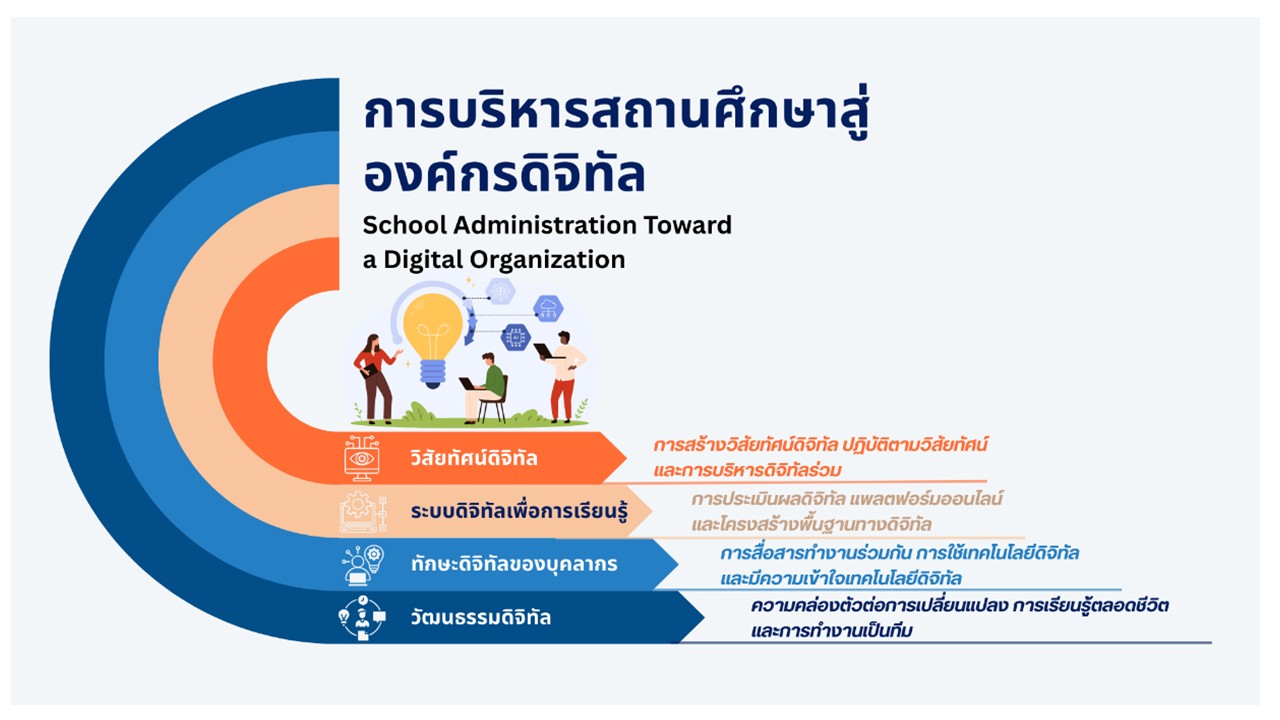
This research aimed to 1) study the components and indicators of school administration toward a digital organization under the Bueng Kan Primary Educational Service Area Office, and 2) examine the congruence of the indicator model of school administration toward a digital organization with empirical data. The research was conducted in two phases: Phase 1 involved studying the components and indicators of school administration toward a digital organization, while Phase 2 focused on examining the congruence of the indicator model with empirical data. The key informants consisted of school administrators and teachers under the Bueng Kan Primary Educational Service Area Office. The research instrument was a five-point rating scale questionnaire validated for content validity (IOC) by three experts, with an overall reliability coefficient of 0.970. Data were analyzed using Confirmatory Factor Analysis (CFA) through a computer software program. The findings revealed that school administration toward a digital organization consisted of four components and twelve indicators: 1) Digital Vision (3 indicators), 2) Digital Learning Systems (3 indicators), 3) Personnel Digital Skills (3 indicators), and 4) Digital Culture (3 indicators). Furthermore, the results indicated that the developed indicator model of school administration toward a digital organization was consistent with the empirical data
Keywords: Confirmatory Factor Analysis, School Administrative Mechanisms, Digital Organization, School Administrators
Article Details

This work is licensed under a Creative Commons Attribution-NonCommercial-NoDerivatives 4.0 International License.
References
กัลยา วานิชย์บัญชา. (2559). การวิเคราะห์สถิติ: สถิติสำหรับการบริหารและวิจัย. กรุงเทพมหานคร: จุฬาลงกรณ์มหาวิทยาลัย.
ประกฤติยา ทักษิโณ. (2559). เอกสารประกอบการอบรม เรื่อง การวิเคราะห์ข้อมูลด้วย LISREL และ MPLUS: ความรู้พื้นฐานก่อนการวิเคราะห์. ขอนแก่น: มหาวิทยาลัยขอนแก่น.
รังสรรค์ โฉมยา, และคณะ. (2565). การพัฒนากลยุทธ์การบริหารเพื่อรองรับการเป็นองค์กรดิจิทัลของสถานศึกษา.วารสารบริหารการศึกษา, 15(2), 45–58.
สุทธิธัช คนกาญจน์. (2547). การพัฒนาตัวบ่งชี้คุณภาพของสถาบันอุดมศึกษาของรัฐ (วิทยานิพนธ์ปริญญา ดุษฎีบัณฑิต). มหาวิทยาลัยศรีนครินทรวิโรฒ.
สุวิมล ติรกานันท์. (2551). การสร้างเครื่องมือวัดตัวแปรในการวิจัยทางสังคมศาสตร์: แนวทางสู่การปฏิบัติ. กรุงเทพมหานคร: โรงพิมพ์แห่งจุฬาลงกรณ์มหาวิทยาลัย.
สำนักงานคณะกรรมการการศึกษาขั้นพื้นฐาน. (2566). รายงานผลการพัฒนาการศึกษาดิจิทัลในสถานศึกษา. กรุงเทพมหานคร: สำนักงานคณะกรรมการการศึกษาขั้นพื้นฐาน.
สำนักงานเขตพื้นที่การศึกษาประถมศึกษาบึงกาฬ. (2568). ข้อมูลสารสนเทศและรายงานการบริหารจัดการสถานศึกษา สังกัดสำนักงานเขตพื้นที่การศึกษาประถมศึกษาบึงกาฬ. บึงกาฬ: สำนักงานเขตพื้นที่การศึกษาประถมศึกษาบึงกาฬ.
สำนักงานส่งเสริมเศรษฐกิจดิจิทัล. (2566). แผนพัฒนาดิจิทัลเพื่อเศรษฐกิจและสังคม. กรุงเทพมหานคร: กระทรวงดิจิทัลเพื่อเศรษฐกิจและสังคม.
ทินกร อินทรสุวรรณ. (2566). ความท้าทายของการพัฒนาโครงสร้างพื้นฐานดิจิทัลในสถานศึกษาชายขอบ. วารสารเทคโนโลยีการศึกษา, 8(2), 23–34.
อุษา ศิริวิจิตร. (2566). ปัญหาการเข้าถึงเทคโนโลยีดิจิทัลในสถานศึกษาจังหวัดบึงกาฬ. วารสารนวัตกรรมการศึกษา, 9(1), 34–45.
Creswell, J. W. (2011). Research design: Qualitative, quantitative, and mixed methods approaches (4th ed.). Thousand Oaks, CA: SAGE Publications.
Deborah, L., Soule, D., Puram, A., & Westerman, G. (2016). Becoming a digital organization: The journey to digital maturity. Cambridge, MA: MIT Center for Digital Business.
Kraus, S., Durst, S., Ferreira, J. J., Veiga, P., Kailer, N., & Weinmann, A. (2022). Digital transformation in business and management research: An overview of the current status quo. International Journal of Information Management, 63, 102466.
Porter, M. E., & Heppelmann, J. E. (2020). How smart, connected products are transforming companies. Harvard Business Review, 98(5), 96–114.
Schein, E. H. (2021). Organizational culture and leadership (5th ed.). Hoboken, NJ: Wiley.
Suavansri, P., Pichayayothin, N., Espinosa, P. R., Areekit, P., Nilchantuk, C., Jones, T. S., Heaney, C. A. (2022). Well-being in Thailand: A culturally driven grounded inquiry exploration of a complex construct. Applied Research in Quality of Life, 17, 3327-3347. https://doi.org/10.1007/s11482-022-10067-7.
United Nations Development Programme (UNDP). 2021. Governance for sustainable development: Principles and practices. New York, NY: UNDP. https://www.undp.org/publications/governance-sustainable-development.
United Nations. (2025). The Sustainable Development Goals Report 2025. United Nations Department of Economic and Social Affairs. Retrieved from https://unstats.un.org/sdgs/report/2025/The-Sustainable-Development-Goals-Report-2025.pdf
University of Oxford. (2023). Happiness and productivity: New evidence from British Telecom employees. Retrieved from https://wellbeing.hmc.ox.ac.uk/news/productivity-management-science
Vale, A. P., Ribeiro, L. M., & Alves, J. M. (2025). Happiness in school organizations: the role of leadership (a scoping review). Frontiers in Education, 10, 1541533. https://doi.org/10.3389/feduc.2025.1541533.
