
The Development of Game-Based Augmented Reality Learning Environment to Enhance Computational Thinking For 8th Grade Students
Article Sidebar
Main Article Content
Abstract
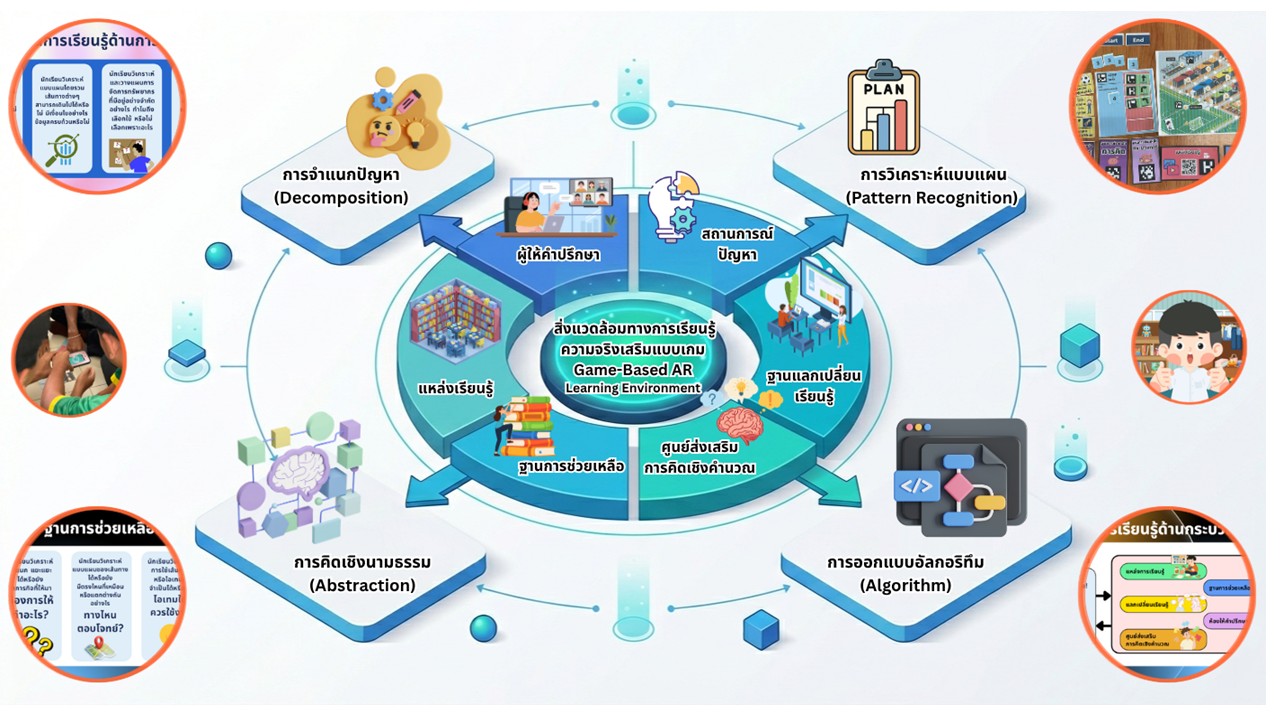
The objectives of this research were: (1) to develop the Game-Based Augmented Reality Learning Environment to Enhance Computational Thinking For 8th Grade Students. (2) to study the computational thinking of students learning through the Game-Based Augmented Reality Learning Environment; (3) to examine the learning achievement of students learning through the Game-Based Augmented Reality Learning Environment; and (4) to investigate students’ opinions toward the Game-Based Augmented Reality Learning Environment designed to enhance computational thinking. This developmental research followed the framework of Richey & Klein (2007) and was conducted in three phases: design and development, quality evaluation, and validation. The target group consisted of 20 Grade 8 students from Debsirin Khon Kaen School during the first semester of the 2025 academic year. The research instruments included the game-based augmented reality learning environment, a computational thinking assessment, a learning achievement test, and a student opinion questionnaire. The research findings revealed that: (1) the developed learning environment consisted of six components: problem situations, learning resources, learning exchange rooms, computational thinking promotion centers, scaffolding bases, and coaching sessions; (2) students demonstrated a high level of computational thinking; (3) students’ post-learning achievement scores were significantly higher than their pre-learning scores, with most students achieving scores at a good or higher level; and (4) students’ opinions toward the learning environment were at the highest level for content and media, and at a high level for design. The findings indicated that the developed game-based augmented reality learning environment was effective in enhancing students’ computational thinking and learning achievement.
Keywords: Learning environment, Game, Augmented Reality, Computational thinking
Article Details

This work is licensed under a Creative Commons Attribution-NonCommercial-NoDerivatives 4.0 International License.
References
กระทรวงศึกษาธิการ. (2560). ตัวชี้วัดและสาระการเรียนรู้แกนกลางกลุ่มสาระการเรียนรู้วิทยาศาสตร์และเทคโนโลยี (ฉบับปรับปรุง พ.ศ. 2560) ตามหลักสูตรแกนกลางการศึกษาขั้นพื้นฐาน พุทธศักราช 2551. กรุงเทพมหานคร: โรงพิมพ์ชุมนุมสหกรณ์การเกษตรแห่งประเทศไทย.
ชฎาพร ยางเงิน. (2562). การพัฒนากิจกรรมการเรียนรู้คำศัพท์ภาษาอังกฤษโดยใช้เกมสำหรับนักเรียนชั้นประถมศึกษาปีที่ 2. วารสารยอม, 30(1), 100-102.
พิเชฐ ศรีสังข์งาม และชัยยศ เดชสุระ. (2564). การพัฒนากิจกรรมการเรียนรู้ตามแนวทางสะเต็มศึกษาเพื่อส่งเสริมทักษะการคิดเชิงคำนวณของผู้เรียนระดับชั้นมัธยมศึกษาตอนต้น. วารสารวิจัยราชภัฏกรุงเก่า, 8(2), 65-80.
สุมาลี ชัยเจริญ. (2547). ทฤษฎีคอนสตรัคติวิสซึม. ขอนแก่น: ภาควิชาเทคโนโลยีการศึกษาและศึกษาศาสตร์ มหาวิทยาลัยขอนแก่น.
สุมาลี ชัยเจริญ. (2557). การออกแบบการสอน: หลักการทฤษฎีสู่การปฏิบัติ. ขอนแก่น: โรงพิมพ์แอนนาออฟเซต.
สุมาลี ชัยเจริญ. (2559). การออกแบบการสอน หลักการทฤษฎีสู่การปฏิบัติ. พิมพ์ครั้งที่ 2. ขอนแก่น: โรงพิมพ์เพ็ญพริ้นติ้ง.
อิศรา ก้านจักร. (2547). ผลการจัดสิ่งแวดล้อมทางการเรียนรู้บนเครือข่ายที่พัฒนาตามแนว onstructivism: Open learning environments (OLEs) สำหรับนักศึกษาระดับบัณฑิตศึกษา. วิทยานิพนธ์ปริญญาศึกษาศาสตรมหาบัณฑิต สาขาวิชาเทคโนโลยีการศึกษา บัณฑิตวิทยาลัย มหาวิทยาลัยขอนแก่น.
อิศรา ก้านจักร. (2559). พื้นฐานทางด้านเทคโนโลยีการศึกษา. ขอนแก่น: คลังนานาวิทยา.
Akcayir, M., & Akcayir, G. (2017). Advantages and challenges associated with augmented reality for education: A systematic review of the literature. Educational Research Review, 20, 1-11.
Anderson, J. R. (1983). The architecture of cognition. Harvard University.
Atkinson, R. C., & Shiffrin, R. M. (1968). Human memory: A proposed system and its control processes. In K. W. Spence & J. T. Spence (Eds.), The psychology oflearning and motivation: Advances in research and theory (Vol. 2, pp. 89-195). Academic Press.
Baddeley, A. D., & Hitch, G. J. (1974). Working memory. In G. A. Bower (Ed.), Recent advances in learning and motivation (Vol. 8, pp. 47-89). Academic Press.
Brackmann, C., Román-González, M., Robles, G., Moreno-León, J., Casali, A., & Barone, D. (2017). Development of computational thinking skills through unplugged activities in primary school. Informatics in Education, 16(2), 235-250.
Ferlazzo, L. (2019). Research in action: Ramping up support for long-term ELLs. Educational Leadership, 77(4), 16-23.
Flavell, J. H. (1979). Metacognition and cognitive monitoring: A new area of cognitive–developmental inquiry. American Psychologist, 34(10), 906-911.
Fosnot, C. T., & Perry, R. S. (1996). Constructivism: A psychological theory of learning. In C. T. Fosnot (Ed.), Constructivism: Theory, perspectives, and practice (pp. 8-33). Teachers College Press.
Gagne, R. M., Briggs, L. J., & Wager, W. W. (1992). Principles of instructional design (4th ed.). Harcourt Brace Jovanovich.
Garon, R., Murray, M., & Breault, R. (2016). ABC3D: Using an augmented reality mobile game to enhance literacy in early childhood. International Journal of Early Childhood Special Education, 8(2), 56-71.
Kirschner, P. A., Sweller, J., & Clark, R. E. (2006). Why minimal guidance during instruction does not work: An analysis of the failure of constructivist, discovery, problem-based, experiential, and inquiry-based teaching. Educational Psychologist, 41(2), 75-86.
Newell, A., & Simon, H. A. (1972). Human problem solving. Prentice Hall.
Organisation for Economic Co-operation and Development. (2019). Education at a glance 2019: OECD indicators. OECD Publishing.
Plass, J. L., Homer, B. D., Mayer, R. E., & Kinzer, C. K. (2020). Theoretical foundations of game-based learning. In J. L. Plass, R. E. Mayer, & B. D. Homer (Eds.), Handbook of game-based learning (pp. 3-24). The MIT Press.
Pratama, H., & Subriadi, A. P. (2021). Game-based learning using augmented reality. International Journal of Emerging Technologies in Learning (iJET), 16(12), 4–20.
Richey, R. C., & Klein, J. D. (2005). Developmental research methods: Creating knowledge from instructional design and development practice. Journal of Computing in Higher Education, 16(2), 23-38. http://dx.doi.org/10.1007/BF02961473
Richey, R. C., & Klein, J. D. (2005). Developmental research methods: Creating knowledge from instructional design and development practice. Journal of Computing in Higher Education, 16(2), 23–38.
Rumelhart, D. E. (1980). Schemata: The building blocks of cognition. In R. Spiro, B. Bruce, & W. Brewer (Eds.), Theoretical issues in reading comprehension (pp. 33–58). Erlbaum Associates.
Schwab, K. (2016). The fourth industrial revolution. World Economic Forum.
Sweller, J. (1988). Cognitive load during problem solving: Effects on learning. Cognitive Science, 12(2), 257–285.
Wing, J. M. (2006). Computational thinking. Communications of the ACM, 49(3), 33–35.
Wing, J. M. (2017). Computational thinking’s influence on research and education for all. Italian Journal of Educational Technology, 25(2), 7–14.
World Economic Forum. (2020). The future of jobs report 2020. https://www.weforum.org/reports/the-future-of-jobs-report-2020
Wu, J. H., Lee, Y. C., Chang, Y. J., & Liang, P. C. (2020). The effects of augmented reality on students' learning. Computers & Education, 12(2), 265–279.
