
The Development of Online Learning Environment Based on Constructivism Integrated with Artificial Intelligence Powered Coaching to Enhance Digital Citizenship Skills for 9th Grade Students.
Article Sidebar
Main Article Content
Abstract
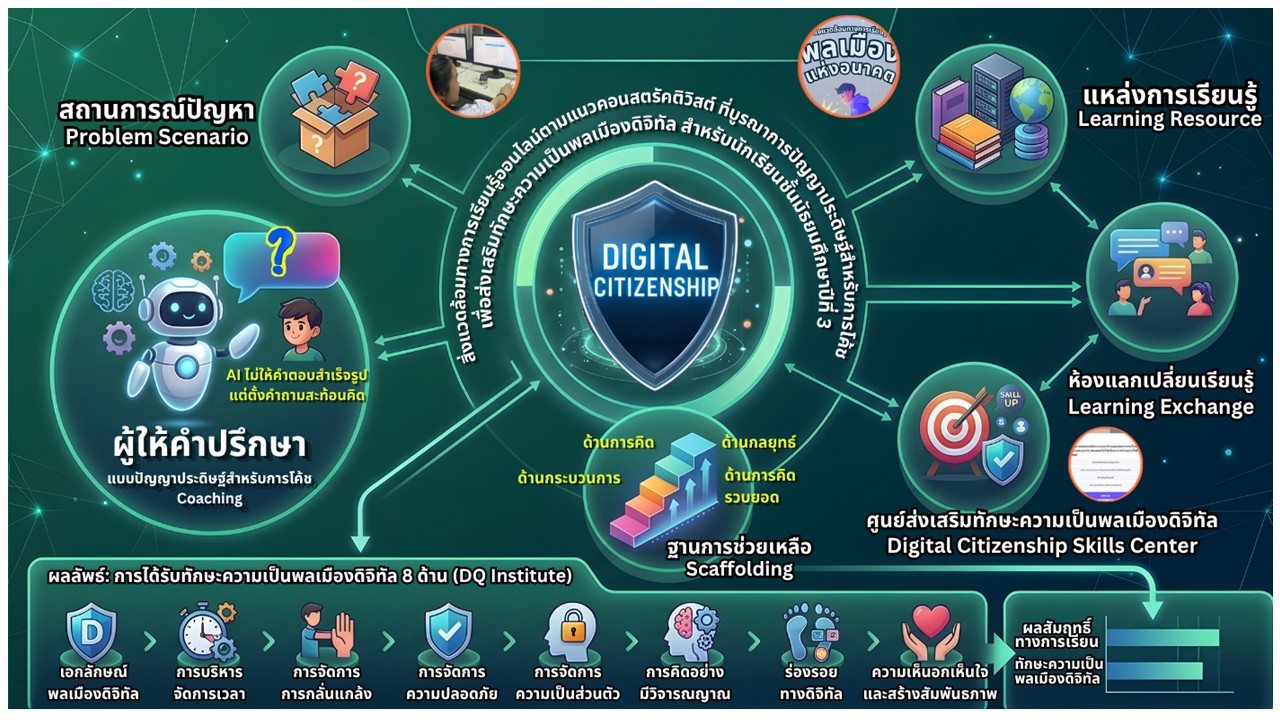
This research aimed to (1) develop an online learning environment based on constructivist principles that integrates artificial intelligence for coaching to promote digital citizenship skills; (2) study the digital citizenship skills of students learning with an online learning environment based on constructivist principles that integrates artificial intelligence for coaching compared to an online learning environment based on constructivist principles that does not integrate artificial intelligence; (3) compare the learning outcomes of students learning with an online learning environment based on constructivist principles that integrates artificial intelligence for coaching with those learning in an online learning environment based on constructivist principles that does not integrate artificial intelligence; (4) study students' opinions on the online learning environment based on constructivist principles that integrates artificial intelligence for coaching to promote digital citizenship skills. The research was conducted in a developmental framework according to Richey & Klein (2007), consisting of three phases: design and development, quality assessment, and validation. The target group consisted of 80 third-year high school students from Kalyanawat School in the first semester of the 2025 academic year, divided into a control group of 40 students and an experimental group of 40 students. The tools used included the online learning environment based on constructivist principles that integrates artificial intelligence for coaching to promote digital citizenship skills, a digital citizenship skills assessment, a learning achievement assessment, and a student opinion survey. The research findings indicated that: 1) The developed learning environment comprised six components: problem situations, learning resources, learning exchange rooms, a center for promoting digital citizenship skills, support bases, and coaching; 2) Students in the control group had very good overall digital citizenship skills, similar to those in the experimental group; 3) The learning achievements of the control group after learning were significantly higher than before, with the majority of students scoring above the passing threshold at a good level, which was also true for the experimental group, showing statistically significant learning outcomes after the course; 4) Students had a highly positive opinion of the learning environment regarding both content and media, while the design aspect was rated as high.
Keywords: Online Learning Environment, Constructivism, Artificial Intelligence, Digital Citizenship Skills
Article Details

This work is licensed under a Creative Commons Attribution-NonCommercial-NoDerivatives 4.0 International License.
References
ใจทิพย์ ณ สงขลา. (2553). การออกแบบการเรียนการสอนบนเว็บในระบบการเรียนอิเล็กทรอนิกส์ = Web-based instruction in e-learning system. กรุงเทพฯ: โรงพิมพ์แห่งจุฬาลงกรณ์มหาวิทยาลัย.
ใจทิพย์ ณ สงขลา. (2561). การออกแบบการเรียนแนวดิจิทัล: Digital learning design. กรุงเทพมหานคร: โรงพิมพ์แห่งจุฬาลงกรณ์มหาวิทยาลัย.
ชูชิต ชายทวีป. (2566). ทักษะความเป็นพลเมืองดิจิทัลของนักศึกษาในสถาบันอุดมศึกษาเอกชน. วารสารวิชาการมหาวิทยาลัยราชภัฏศรีสะเกษ, 17(1), 16-29.
ถนอมพร เลาหจรัสแสง. (2550, 18 มิถุนายน). ความหมายของ e-Learning. https://www.kroobanok.com/1586
ธัญธัช วิภัติภูมิประเทศ. (2557). ทักษะการเป็นพลเมืองดิจิทัลของนักศึกษาระดับปริญญาตรี. รายงานการวิจัย. กรุงเทพฯ: มหาวิทยาลัยศรีนครินทรวิโรฒ.
พิมลมาส อวิรุทธไพบูลย์. (2564). ผลของสิ่งแวดล้อมการเรียนรู้ตามแนวคอนสตรัคติวิสต์ที่ส่งเสริมทักษะสารสนเทศ. วิทยานิพนธ์ปริญญาศึกษาศาสตรมหาบัณฑิต สาขาวิชาเทคโนโลยีการศึกษา บัณฑิตวิทยาลัย มหาวิทยาลัยขอนแก่น.
วสันต์ ศรีหิรัญ, คณิต ไข่มุกด์, สรเดช ครุฑจ้อน, และปณิตา วรรณพิรุณ. (2562). การพัฒนารูปแบบสิ่งแวดล้อมทางการเรียนรู้ตามแนวทฤษฎีคอนสตรัคติวิสต์ สำหรับห้องเรียนแบบกลับด้านที่ส่งเสริมการเรียนรู้ในศตวรรษที่ 21 สําหรับนักศึกษาวิชาชีพครู. Veridian E-Journal, Silpakorn University ฉบับภาษาไทย สาขามนุษยศาสตร์ สังคมศาสตร์ และศิลปะ, 12(3), 674-696.
วิจารณ์ พานิช. (2555). วิถีสร้างการเรียนรู้เพื่อศิษย์ในศตวรรษที่ 21. กรุงเทพฯ: มูลนิธิสดศรี-สฤษดิ์วงศ์.
ปริวรรต องค์ศุลี. (2560). ปัญญาประดิษฐ์กับเนื้อหาวิชาในหลักสูตรวิทยาการคอมพิวเตอร์. วารสารวิชาการศรีปทุม ชลบุรี, 14(1), 160-169
สถาบันส่งเสริมการสอนวิทยาศาสตร์และเทคโนโลยี. (2560). ตัวชี้วัดและสาระการเรียนรู้แกนกลาง กลุ่มสาระการเรียนรู้วิทยาศาสตร์ (ฉบับปรับปรุง พ.ศ. 2560) ตามหลักสูตรแกนกลางการศึกษาขั้นพื้นฐาน พุทธศักราช 2551. กรุงเทพฯ: สถาบันส่งเสริมการสอนวิทยาศาสตร์และเทคโนโลยี.
สำนักงานสภาพัฒนาการเศรษฐกิจและสังคมแห่งชาติ. (2565). แผนพัฒนาเศรษฐกิจและสังคมแห่งชาติ ฉบับที่ 13 (พ.ศ. 2566-2570). กรุงเทพฯ: สำนักงานสภาพัฒนาการเศรษฐกิจและสังคมแห่งชาติ.
สุมาลี ชัยเจริญ. (2559). การออกแบบการสอน: หลักการ ทฤษฎี สู่การปฏิบัติ. พิมพ์ครั้งที่ 2. ขอนแก่น: คณะศึกษาศาสตร์ มหาวิทยาลัยขอนแก่น.
อนุชา โสมาบุตร. (2556, 25 กันยายน). ทฤษฎีคอนสตรัคติวิสต์ (Constructivist Theory). https://teacherweekly.wordpress.com/2013/09/25/constructivist-theory/
อิศรา ก้านจักร. (2559). พื้นฐานทางด้านเทคโนโลยีการศึกษา (ฉบับปรับปรุงครั้งที่ 2). ขอนแก่น: กลุ่มวิจัยนวัตกรรมและเทคโนโลยีทางปัญญา มหาวิทยาลัยขอนแก่น.
อิสมาแอล ปูยัง. (2566). การพัฒนาสิ่งแวดล้อมทางการเรียนรู้เสมือนจริงตามทฤษฎีคอนสตรัคติวิสต์เพื่อส่งเสริมความสามารถในการคิดเชิงคำนวณ รายวิชาวิทยาการคำนวณ 1 สำหรับนักเรียนชั้นมัธยมศึกษาปีที่ 4. Journal of Information and Learning, 34(2), 138–149.
DQ Institute. (2020). What is the DQ Framework? https://live.dqinstitute.org/global-standards/
International Society for Technology in Education. (2019). ISTE standards for students. https://www.iste.org/standards/for-students
Isaac, S., & Michael, W. B. (1995). Handbook in research and evaluation. 3rd ed. San Diego, CA: Educational and Industrial Testing Services.
UNESCO. (2019). Fostering digital citizenship education in Asia-Pacific. https://bangkok.unesco.org/content/fostering-digital-citizenship-education-asia-pacific
