
Embracing Cultural Diversity through Music: An Ethnomusicological Perspective on Learning in a Multicultural Classroom
Article Sidebar
Main Article Content
Abstract
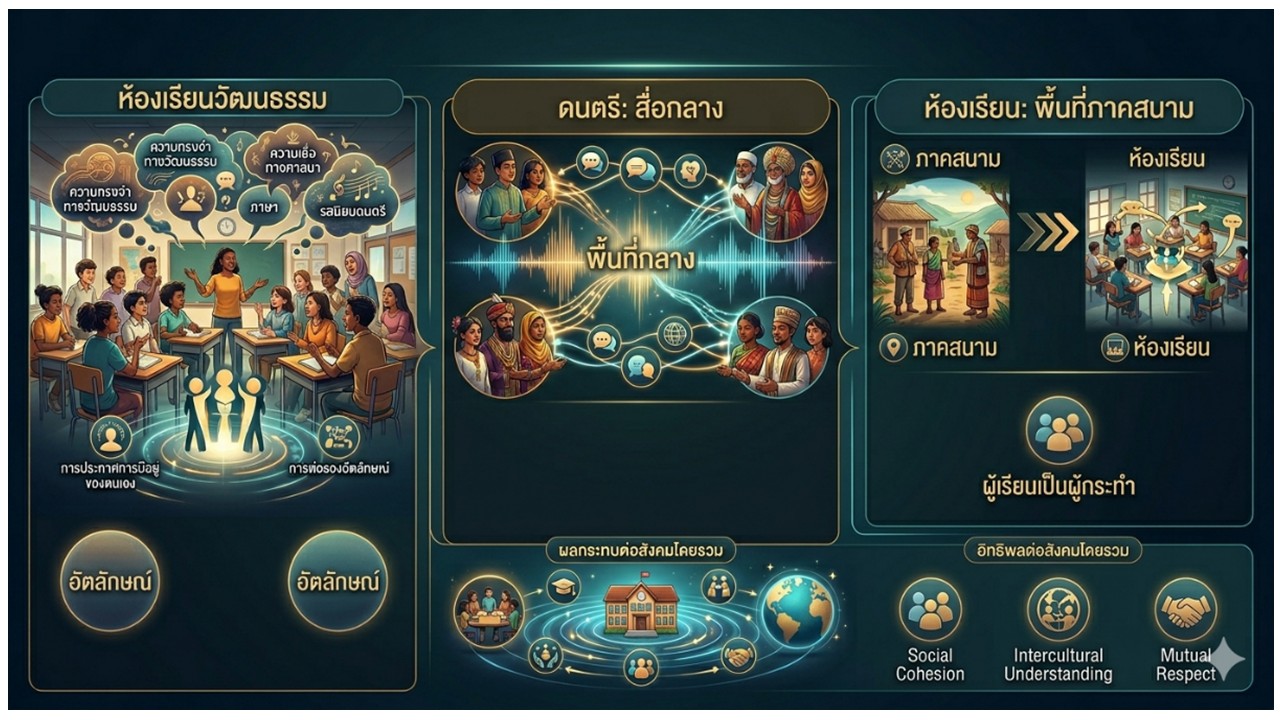
The multicultural music classroom is a space where students from various ethnic, linguistic, religious, and musical backgrounds engage and negotiate meanings via shared learning experiences. The purpose of this research is to investigate how classroom conversations and interactions serve as venues for self-expression, cultural identity negotiation, and co-construction of meaning in the context of music education in a multicultural society. Using a qualitative research approach based on ethnomusicological viewpoints, the study combines participatory learning theory, Edward Sapir's idea of language and meaning-making, and Jacques Lacan's theory of subject construction through symbolic systems. Data were gathered through participant observation, classroom discourse analysis, discussions, and student presentations in a graduate-level intercultural music course. The research discovered that the multicultural music classroom is more than just a location for learners to learn music; it is also a sociocultural milieu in which they may construct meanings, express themselves, and negotiate cultural positions via language and social interactions. Classroom discussions, responses to questions, and presentations enable students to justify and explain their worldviews and identities in light of their personal experiences, cultural memories, religious beliefs, and musical preferences. Music develops a common sense of meaning, encouraging international debate, critical thinking, and global civic awareness. According to the study, participatory learning in multicultural music education goes beyond instructional efficacy to help learners develop identities, negotiate cultural differences, and establish mutual understanding, all of which promote respectful coexistence in today's multicultural communities.
Keywords: Ethnomusicology, Multicultural Music Education, Identity Negotiation, Meaning-Making, Participatory Learning
Article Details

This work is licensed under a Creative Commons Attribution-NonCommercial-NoDerivatives 4.0 International License.
References
ต้องรัก จิตรบรรเทา (2560). บุคลิกภาพตามทฤษฎีจิตวิเคราะห์.วารสารสังคมศาสตร์วิชาการ, 10(2), 275-285. https://so04.tci-thaijo.org/index.php/social_crru/article/view/134234
ชิษณุพงค์ อินทร์แก้ว. (2022). ดนตรีกับการเมือง: คุณภาพชีวิตที่ดีส่งผลต่อการสร้างสรรค์ของศิลปิน. วารสารสหวิทยาการ, 19(1), 55–89. https://so06.tci-thaijo.org/index.php/citujournal/article/view/257587
นภาพร หงส์ทอง. (2547). อัตบุคคลในทัศนะของฌากส์ ลากอง. วิทยานิพนธ์ศิลปศาสตรมหาบัณฑิต, สาขาวิชาปรัชญา, คณะมนุษยศาสตร์, มหาวิทยาลัยเชียงใหม่.
Jones, E. (1910). Psycho-analysis and education. Journal of EducationalPsychology,1(9), 497–520. https://doi.org/10.1037/h0072604
MacGregor, EH. (2020). Participatory performance in the secondary music classroom and the paradox of belonging. Music Education Research, 22(2):229-241.
Meenakshi Singh, Sana Mukhtar Khan, & Mariya Waseem. (2025). Sigmund Freud's Psychoanalytical Theory of Personality: A Psychological and Educational Perspective. International. Journal of Contemporary Research In Multidisciplinary, 4(3), 57–62. https://doi.org/10.5281/zenodo.15412690
Sapir, E. (1921). Language: An introduction to the study of speech. Harcourt, Brace.
Shodiyeva, M. (2023). Sociolinguistics and Identification in the Classroom, Modern Science and Researcch. Modern Science and Research., 2(12), 494-498. https://doi.org/10.5281/zenodo.10361168
Silva, F. R. R. da, Filho, A. J. de A., Bezerra, M. de H. O., Vidal, A. A., Vasconcelos, F. J. M., Câmara, C. M. F., & Carneiro, S. N. V. (2023). A psicanálise nas práticas educacionais de ensino: pensamento de Freud. International Journal of Scientific Management and Tourism, 9(4), 2522–2539. https://doi.org/10.55905/ijsmtv9n4-027
Tangade, S. (2020). Use of Participatory Teaching Methods at University and College level is a Need of the Hour. International journal of innovative research in technology. 6(7):11-14.
