
A Study of Experiential Learning and Reflective Practice of Intern Students in Developing Professional Chinese Language Skills of Chinese for Service Industry Program
Article Sidebar
Main Article Content
Abstract
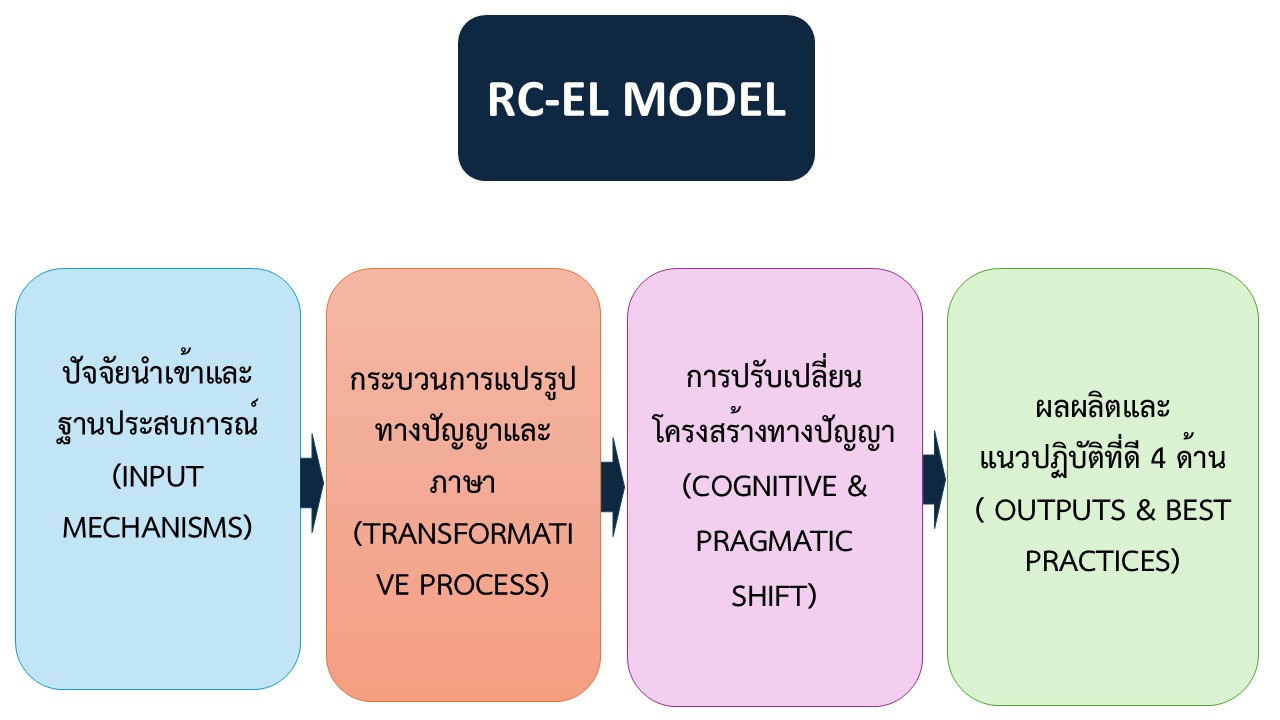
This study used a mixed-methods explanatory sequential design integrated with action research. The objectives were to: 1) examine the experiential learning processes and reflection patterns of student interns using professional Chinese in the hotel industry; 2) explore the learning styles and cognitive systems of interns through the implementation of reflective coaching to develop Chinese language skills for the hospitality industry; and 3) evaluate the achievement of interns' professional Chinese language competence before and after the reflective process. The target group consisted of 11 third-year undergraduate students majoring in Chinese for the Hospitality Industry, who completed a 16-week internship in hotels across Bangkok and its vicinity. Research instruments included a rubric-based professional Chinese competence assessment, a Critical Incident Record (CIR) based on Gibbs’ reflective cycle, and reflective coaching supervision guidelines. Quantitative data were analyzed using descriptive statistics, the Wilcoxon Signed-Ranks Test, and the Relative Gain Rate (RGR), while qualitative data were analyzed via content analysis. The findings revealed that: 1) the overall post-test mean score of the students' professional Chinese competence after receiving the reflective process was statistically significant higher than the pre-test score at the .01 level, with a high average relative gain rate of 64.73%, and the competency in crisis management and situational analysis demonstrated the highest increase; 2) content analysis of the CIR indicated that continuous reflection enabled students to overcome initial anxiety regarding Chinese tourists' expectations, transitioning toward deep reflection, recognizing appropriate linguistic functions in hotel operations, and developing concrete action plans to mitigate on-site errors; and 3) the hybrid reflective coaching model enhanced students' self-regulation and self-assessment capabilities, leading to the discovery of four best practices: shifting language functions from imperatives to polite options, utilizing a repertoire of polite phrases for immediate crisis resolution, integrating soft skills with verbal language, and implementing a micro-learning journal. These elements served as key mechanisms in elevating learners' competencies toward becoming efficient professionals in the global hospitality industry.
Keywords: Professional Chinese, Reflection, Coaching, Mixed-Methods Research, Hospitality Industry
Article Details

This work is licensed under a Creative Commons Attribution-NonCommercial-NoDerivatives 4.0 International License.
References
กิตติยา ฤทธิภักดี, อัศวยุช เทศอาเส็น, ปวรรณรัตน์ ประเทืองไทย, และ เบญจวรรณ แก้วสวัสดิ์. (2568). แนวทางการจัดการเรียนรู้แบบบูรณาการกับการทำงาน (WIL) สำหรับสาขาการท่องเที่ยวและการบริการ. วารสารสังคมพัฒนศาสตร์, 8(12), 213–226.
โชติกานต์ ใจบุญ, และ Ren, K. (2565). การวิเคราะห์ประเภทและฟังก์ชั่นของประโยคคำถามภาษาจีนที่พบในบทสนทนาระหว่างลูกค้าและพนักงานต้อนรับโรงแรมในประเทศจีน. วารสารศิลปศาสตร์ มหาวิทยาลัยสงขลานครินทร์, 14(1), 55–82.
นพดล วรรณสอน. (2563). การพัฒนาระบบบริหารจัดการการฝึกงานและปฏิบัติสหกิจศึกษา คณะบริหารธุรกิจและนิเทศศาสตร์ มหาวิทยาลัยพะเยา. วารสารวิชาการเพื่อการพัฒนานวัตกรรมเชิงพื้นที่, 6(3), 132–154.
ปิยะดา ศรีบุศย์ดี. (2564). การพัฒนากิจกรรมการเรียนการสอนภาษาจีนของนักศึกษาธุรกิจการโรงแรม ผ่านเกมในชั้นเรียนเพื่อเสริมสร้างทักษะภาษาจีน ทักษะทางอารมณ์และสังคม. วารสารเพื่อการพัฒนาการท่องเที่ยวสู่ความยั่งยืน, 3(2), 86–99.
ไพรทูล บุญศรี, ปรัชนันท์ เจริญอาภรณ์วัฒนา, และ สฎายุ ธีระวณิชตระกูล. (2568). การสร้างหลักสูตรฝึกอบรมในโรงแรม 4 ดาวเพื่อตอบสนองความต้องการของนักท่องเที่ยวจีนด้านการบริการที่เป็นเลิศในเขตกรุงเทพมหานคร. เศรษฐศาสตร์และบริหารธุรกิจปริทัศน์, 19(2), 196–217.
วันเฉลิม พ่วงธรรมรงค์. (2561). ความต้องการใช้ภาษาจีนเพื่อการสื่อสารกับนักท่องเที่ยวของพนักงานแผนกบริการส่วนหน้าของโรงแรมในเขตอำเภอเมือง จังหวัดกาญจนบุรี. วารสารนวัตกรรมการบริหารและการจัดการ, 6(2), 74–79.
สุธาสินี แม้นญาติ. (2564). การพัฒนารูปแบบโค้ชสะท้อนคิดเพื่อพัฒนาทักษะการจัดการเรียนรู้ในศตวรรษที่ 21 ของครูในโรงเรียนในสังกัดเทศบาลนครขอนแก่น. วารสารชุมชนแห่งการเรียนรู้วิชาชีพครู, 1(2), 194–211.
Boud, D., Keogh, R., & Walker, D. (1985). Reflection: Turning experience into learning. Kogan Page.
Brookfield, S. D. (1995). Becoming a critically reflective teacher. Jossey-Bass.
Creswell, J. W., & Plano Clark, V. L. (2018). Designing and conducting mixed methods research (3rd ed.). Sage.
Gibbs, G. (1988). Learning by doing: A guide to teaching and learning methods. Oxford Polytechnic.
Hatton, N., & Smith, D. (1995). Reflection in teacher education: Towards definition and implementation. Teaching and Teacher Education, 11(1), 33–49.
Jackson, D. (2015). Employability skill development in work-integrated learning: Barriers and best practice. Studies in Higher Education, 40(2), 350–372.
Kemmis, S., & McTaggart, R. (1988). The action research planner (3rd ed.). Deakin University Press.
Kolb, D. A. (1984). Experiential learning: Experience as the source of learning and development. Prentice Hall.
Moon, J. A. (2004). A handbook of reflective and experiential learning: Theory and practice. RoutledgeFalmer.
Patrick, C. J., Peach, D., Pocknee, C., Webb, F., Fletcher, M., & Pretto, G. (2008). The WIL (Work Integrated Learning) report: A national scoping study. Queensland University of Technology.
Schön, D. A. (1983). The reflective practitioner: How professionals think in action. Basic Books.
