
A Western Musical Instrument Practice Model Using a Metronome to Enhance Rhythmic Potential for Secondary School Students in Songkhla Province
Article Sidebar
Main Article Content
Abstract
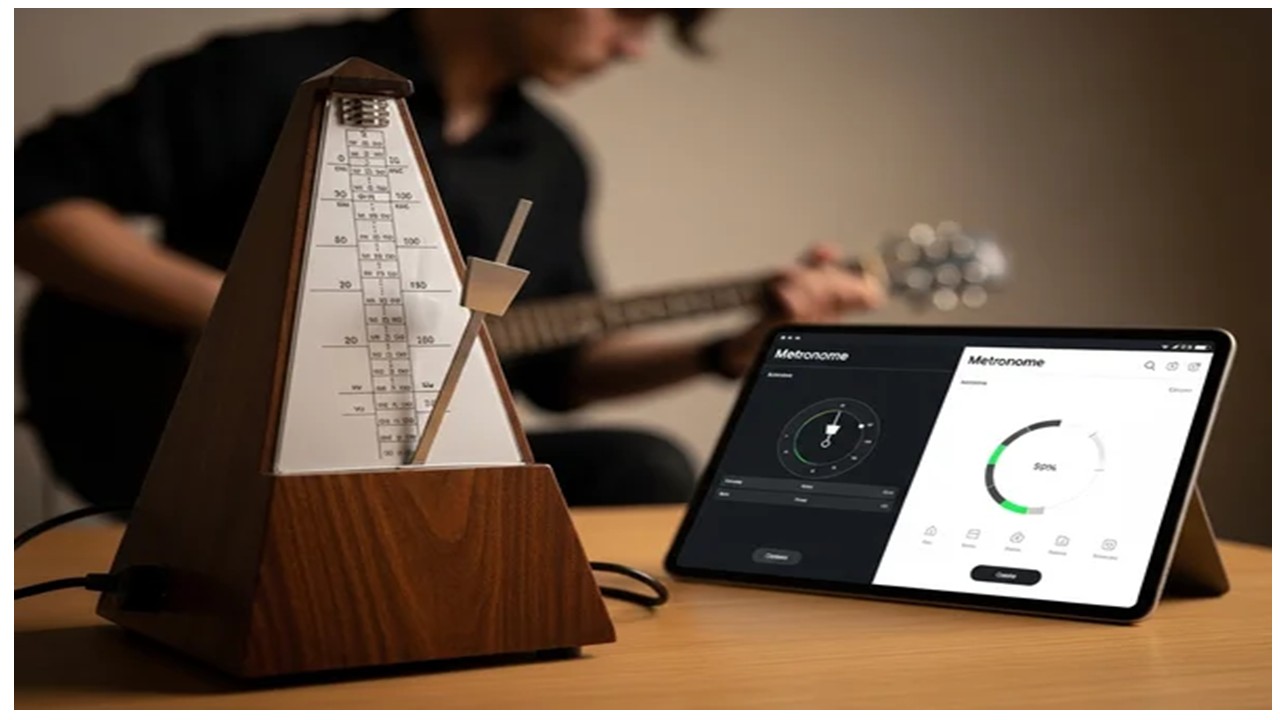
This study aimed to investigate methods, techniques, and applications of metronome-based practice for developing rhythmic skills among secondary school students in Songkhla Province, Thailand. Data were collected through semi-structured interviews with 25 international music teachers and analyzed descriptively. The findings revealed that the metronome plays a role beyond simply indicating tempo. It supports students’ beat awareness, tempo stability, rhythmic subdivision, and performance control. Teachers commonly introduced practice at a slow tempo, combined with counting, singing, clapping, and tapping before progressing to actual musical performance. Various metronome settings, mobile devices, headphones, and backing tracks were also employed to facilitate individual and contextualized practice. The synthesis of findings generated a pedagogical framework in which metronome practice progresses from external rhythm to internal pulse through the sequence: 1. Metronome, 2. Beat Awareness, 3. Rhythmic Control, 4. Internal Pulse, 5. Musical Expression, and 6. Ensemble Performance. This framework provides a practical foundation for developing systematic metronome-based instructional activities and promoting rhythmic competence, musical expression, and ensemble performance among secondary school students.
Keywords: Metronome, Rhythmic Skills, Instrumental Practice, Music Education, Secondary School Students
Article Details

This work is licensed under a Creative Commons Attribution-NonCommercial-NoDerivatives 4.0 International License.
References
Baugh, M. K. (2025). The slower the tempo, the harder the music: Strategies for teaching pulse and bow control in slow music. American String Teacher, 75(3), 15–20.
Boyle, J. D., & Radocy, R. E. (1987). Measurement and evaluation of musical experiences. Schirmer Books.
Brinkmann, S., & Kvale, S. (2015). InterViews: Learning the craft of qualitative research interviewing. Sage publications.
Brophy, T. S. (2000). Assessing the developing child musician: A guide for general music teachers. GIA Publications.
Carrer, L. R. J., Pompéia, S., & Miranda, M. C. (2023). Sensorimotor synchronization with music and metronome in school-aged children. Psychology of Music, 51(2). https://doi.org/10.1177/03057356221100286
Creswell, J. W., & Creswell, J. D. (2017). Research design: Qualitative, quantitative, and mixed methods approach. Sage publications.
Duke, R. A., Simmons, A. L., & Cash, C. D. (2009). It's not how much; it's how: Characteristics of practice behavior and retention of performance skills. Journal of Research in Music Education, 56(4), 310-321.
Ericsson, K. A., Krampe, R. T., & Tesch-Römer, C. (1993). The role of deliberate practice in the acquisition of expert performance. Psychological Review, 100(3), 363-406.
Fitts, P. M., & Posner, M. I. (1967). Human performance. Brooks/Cole.
Keele, S. W., Pokorny, R. A., Corcos, D. M., & Ivry, R. (1989). Do perception and motor production share common timing mechanisms: A correlational analysis. Acta Psychologica, 70(3), 263-280.
Klickstein, G. (2009). The musician's way: A guide to practice, performance, and wellness. Oxford University Press.
McPherson, G. E., & Renwick, J. M. (2001). A longitudinal study of self-regulation in children's musical practice. Music Education Research, 3(2), 169-186.
McPherson, G. E., & Zimmerman, B. J. (2011). Self-regulation of musical learning: A social cognitive perspective. In Self-regulated learning and academic achievement (pp. 327-347). Routledge.
Miller, B. A. (2012). Rhythmic instruction from square one: A constructivist teacher and her metronome. General Music Today, 26(1), 19–26. https://doi.org/10.1177/1048371312438134
Utermohl de Queiroz, D., Foletto, C., & López-Íñiguez, G. (2025). Pedagogical approaches to promote self-regulation in musical instrument learning: A PRISMA scoping review. Psychology of Music.
Wesolowski, B. C. (2012). Understanding and developing rubrics for music performance assessment. Music Educators Journal, 98(3), 36-42.
Zhou, Y., et al. (2022). Current state and future directions of technologies for music instrument pedagogy. Frontiers in Psychology.
