
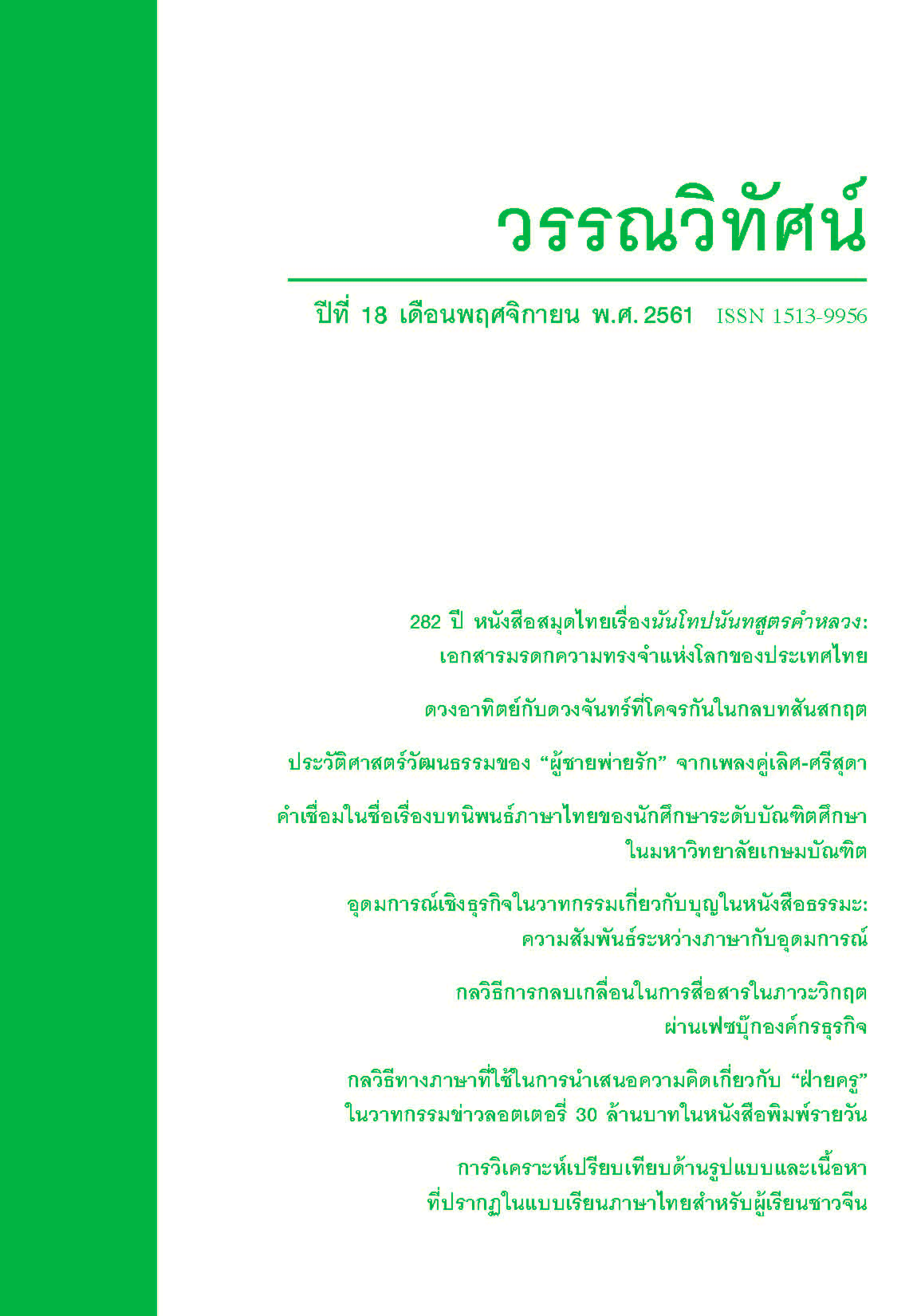
Hedging Strategies in Crisis Communication through Business Organization’s Facebook Page
Article Sidebar
Main Article Content
Abstract
This article aims to analyze the use of hedging strategies in communication during crisis through a business organization’s Facebook page. The data were collected from 14 official crisis-situation statements communicated via 7 business-organization’s Facebook pages. The findings revealed that there were 4 hedging strategies used by organizations: (1) Using non-specific utterances, (2) Softening drastic meaning of utterances, (3) Minimizing illocutionary act and (4) Maximizing illocutionary act. These hedging strategies reflect 3 functions of communication during crisis: (1) To avoid the commitment of utterances (2) To avoid creating a negative image and (3) To strengthen the degree of reliability of an utterance.
Article Details
References
จันทิมา อังคพณิชกิจ. (2561). การวิเคราะห์ข้อความ. (พิมพ์ครั้งที่ 2). กรุงเทพฯ: สํานักพิมพ์แห่งมหาวิทยาลัยธรรมศาสตร์.
บุษบา สุธีธร. (2555). เอกสารการสอนชุดวิชาการสร้างสรรค์และผลิตงานประชาสัมพันธ์ (หน่วยที่ 1–5). นนทบุรี: มหาวิทยาลัยสุโขทัยธรรมาธิราช.
พรนภัส ทองพูล. (2559). รูปเบี่ยงบังและหน้าที่ในแผ่นพับโฆษณาผลิตภัณฑ์เสริมอาหารลดนํ้าหนัก. (วิทยานิพนธ์ปริญญามหาบัณฑิต). มหาวิทยาลัยธรรมศาสตร์, กรุงเทพฯ.
รุ่งรัตน์ ชัยสําเร็จ. (2558). การสื่อสารองค์กร: แนวคิดการสร้างชื่อเสียงอย่างยั่งยืน. กรุงเทพฯ: สํานักพิมพ์แห่งจุฬาลงกรณ์มหาวิทยาลัย.
วรวรรณา เพ็ชรกิจ เพ็ญศิริ รัศมี Yuji Furuhashi และสุวคนธ์ พิญญาณ. (2559). รูปเบี่ยงบังระดับคําและหน้าที่ในบทความวิจัยภาษาไทยด้านวิทยาศาสตร์และมนุษยศาสตร์. วารสารศิลปศาสตร์, 16(2), 173–198.
ศิริพร ภักดีผาสุข. (2561). ความสัมพันธ์ระหว่างภาษากับอัตลักษณ์และแนวทางการนํามาศึกษาภาษาไทย. กรุงเทพฯ: สํานักพิมพ์แห่งจุฬาลงกรณ์มหาวิทยาลัย.
สุนันทา คงประโทน. (2544). กลวิธีการกลบเกลื่อนในการสนทนาเรื่องเพศของคนไทย. (วิทยานิพนธ์ปริญญามหาบัณฑิต). จุฬาลงกรณ์มหาวิทยาลัย, กรุงเทพฯ.
อมรา ประสิทธิ์รัฐสินธุ์. (2557). ลักษณะสองหน้าของภาษาวิชาการ: ความแจ่มชัดกับการเบี่ยงบังในการเขียนภาษาวิชาการไทย. ในภาษากับอํานาจ: บทความจากการประชุมวิชาการ (น. 105–107). กรุงเทพฯ: จุฬาลงกรณ์มหาวิทยาลัย.
Blum-Kulka, S., & Olshtain, E. (1984). Requests and apologies: A cross-cultural study of speech act realization patterns (CCSARP). Applied Linguistics, 5(3), 196–213.
Wilcox, D. L., & Reber, B. H. (2013). Public relations writing and media techniques.7th Edition. harlow, UK: Pearson.
Hubler, A. (1983). Understatements and Hedges in English. Amsterdam: John Benjamins Publishing Company.
Hyland, K. (1994). Hedging in academic writing and EAP textbooks. English for Specific Purposes, 13(4), 239–256.
Hyland, K. (1995). The author in the text: Hedging scientific writing. Hongkong Papers in Linguistics and Language Teaching, 18, 33–42.
Hyland, K. (1996). Writing without conviction? Hedging in scientific research articles. Applied Linguistics, 17, 433–454.
Hyland, K. (1998). Hedging in scientific research articles. Amsterdam: John Benjamins.
Lakoff, G. (1973). Hedges: A study in meaning criteria and the logic of fuzzy concepts. Journal of Philosophical Logic, 2, 458–508.
