
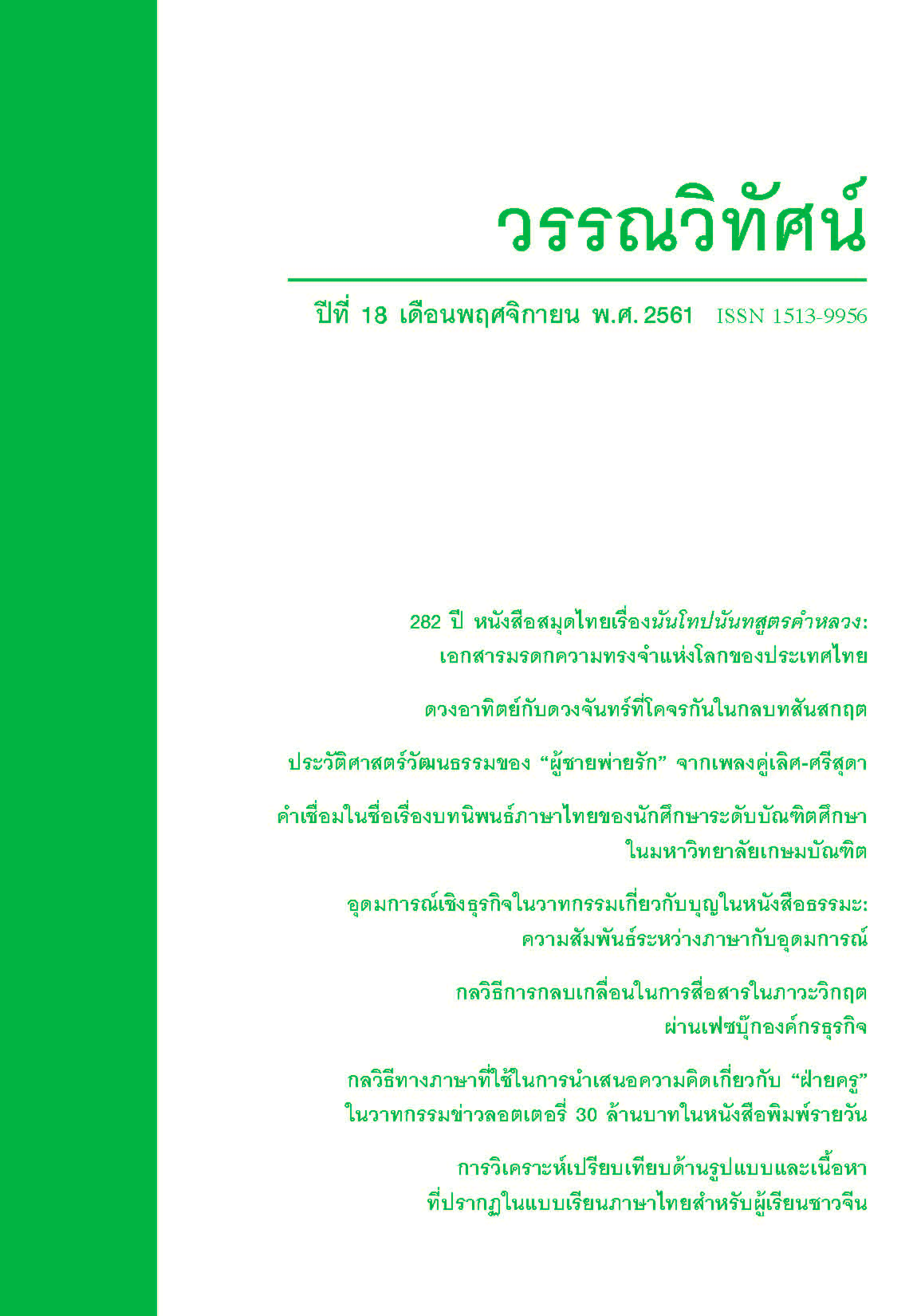
A Comparative Analysis of the Form and Content in Thai Textbooks for Chinese Learners
Article Sidebar
Main Article Content
Abstract
The purpose of this research is to analyze the form and content of fifteen Thai textbooks for Chinese learners, as well as to make some recommendations about writing textbooks for Chinese learners in terms of both form and content.
Findings show that all the selected textbooks were suitable for Chinese learners both in form and content.
The textbooks could be divided into two categories: 1) eight textbooks whose content could be divided into two parts, namely grammar and conversation/reading passages and 2) seven textbooks which mainly presented conversations/reading passages. Grammar points or language rules were explained further in other sections such as sentence structure, word/expressions usage, remarks from the texts, and content or text and grammatical points from the texts.
The grammatical content in the fifteen Thai textbooks consists of four topics: types of words based on their functions, phrases, types of sentences based on content and simple sentence based on communicative intent. The most commonly found topics in the conversations and reading texts mainly included food, recommending and ordering food, ingredients, and taste of food. The second type was greeting, introducing oneself and others, and getting to know each other. The third type was expressions in a daily routine, shopping or bargaining and places.
The most common types of exercises in the Thai textbooks are reading, reading and writing, and speaking respectively.
In addition, the researcher made some recommendations about how to create materials with forms and contents suitable for teaching Thai to Chinese learners.
Article Details
References
นวลทิพย์ เพิ่มเกษร. (2556). ทฤษฎีและวิธีสอนภาษาไทยสําหรับผู้เรียนชาวต่างประเทศ. กรุงเทพฯ: มหาวิทยาลัยธรรมศาสตร์.
พิชัย พินัยกุล. (2549). ตําราเรียนภาษาไทยสําหรับชาวจีน. กรุงเทพฯ: ไทยวรศิลป์การพิมพ์.
พิณทิพย์ ทวยเจริญ. (2533). สัทศาสตร์และสัทศาสตร์ปฏิบัติ. กรุงเทพฯ: มหาวิทยาลัยธรรมศาสตร์.
เหยาหลิง เหลียง. (2555). การสร้างหนังสือเรียนภาษาไทยธุรกิจสําหรับนักศึกษาจีนที่เรียนภาษาไทยในฐานะภาษาต่างประเทศ. (วิทยานิพนธ์ปริญญาศึกษาศาสตรมหาบัณฑิต). มหาวิทยาลัยเชียงใหม่, เชียงใหม่.
อุดม วโรตม์สิกขดิตถ์. (2552). ภาษาไทยเบื้องต้นสําหรับสําหรับผู้พูดภาษาจีน. กรุงเทพฯ:โอ.เอส. พริ้นติ้งเฮ้าส์.
Luo Yiyuan. (2547). เทคนิคในการสอนภาษาไทยขั้นพื้นฐานให้กับนักศึกษาจีน.วารสารมนุษยศาสตร์ปริทรรศน์, 26(1), 69–74.
Zhang Li. (2557). แบบเรียนภาษาไทยเพื่อการท่องเที่ยวสําหรับนักศึกษาชาวจีนวิชาเอกภาษาไทยมหาวิทยาลัยยูนนานนอร์มอลของสาธารณรัฐประชาชนจีน. (สารนิพนธ์ปริญญาศิลปศาสตรมหาบัณฑิต). มหาวิทยาลัยศรีนครินทรวิโรฒ, กรุงเทพฯ.
潘德鼎, 编著. (2004). หนังสือเรียนภาษาไทย 1泰语教程.第一册. 北京: 北京大学出版社.
潘德鼎, 编著. (2005a). หนังสือเรียนภาษาไทย 2泰语教程.第二册. 北京: 北京大学出版社.
潘德鼎, 编著. (2005b). หนังสือเรียนภาษาไทย 3泰语教程.第三册. 北京: 北京大学出版社.
潘德鼎, 编著. (2005c). หนังสือเรียนภาษาไทย 4泰语教程.第四册. 北京: 北京大学出版社.
廖宇夫, 编著. (2008). ภาษาไทยพื้นฐาน 1 基础泰语(1). 广州: 广东世界图书出版公司.
罗奕原, 编著. (2008). ภาษาไทยพื้นฐาน 2 基础泰语(2). 广州: 广东世界图书出版公司.
黄进炎, 林秀梅, 编著. (2009). ภาษาไทยพื้นฐาน 3 基础泰语(3). 广州: 广东世界图书出版公司.
林秀梅, 黄进炎, 编著. (2009). ภาษาไทยพื้นฐาน 4 基础泰语(4). 广州: 广东世界图书出版公司.
黄进炎, 林秀梅, 编著. (2003). 实用 ภาษาไทย 泰语教程. 广州: 广东世界图书出版公司.
李炳度, 编著. 邓应烈, 翻译. (2013). 我是泰语学习书. 北京: 北京语言大学出版社.
卢居正, 邱苏伦, 编写. (2007). ภาษาไทย 1 基础泰语. 北京: 外语教学与研究出版社.
邱苏伦, 编写. (2002). สนทนาภาษาไทย 泰语会话. 北京: 外语教学与研究出版社.
张君松, 编著. (2012). 大家来学泰语. 曼谷: 统一出版社有限公司.
