
MECHANISM AND COMMUNITY-BASED MANAGEMENT FOR LOW-INCOME ELDERLY DAY SERVICE CENTERS: A CASE STUDY OF ROI ET AND LADSAWAI MUNICIPALITIES
Article Sidebar
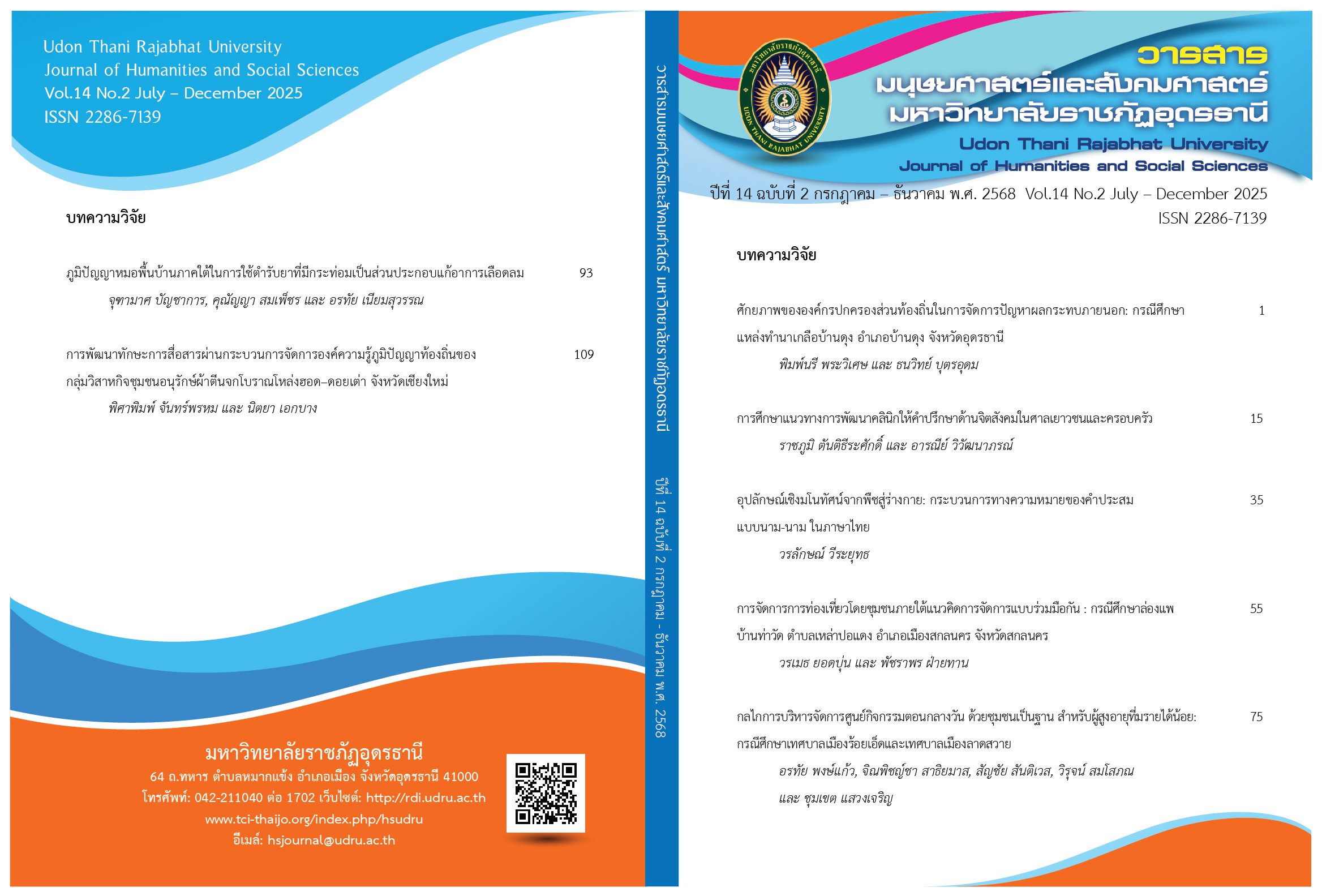
Main Article Content
Abstract
This research aimed to examine demands and to develop systems and management mechanisms for Day Service Centers appropriate for low-income communities, using Universal Design and community-based management as the core conceptual frameworks. An applied action research approach combined with mixed methods was employed. Data were collected from a total of 525 low-income elderly persons and persons with disabilities in two pilot areas: Roi Et Municipality, Roi Et Province, and Ladsawai Municipality, Pathum Thani Province. Research instruments consisted of a questionnaire and a set of assessment checklists (BPT-01 and BPT-02), developed under the support of the Program Management Unit on Area-Based Development (PMU, Thailand) and validated by experts. Quantitative data were analyzed using descriptive statistics, while qualitative data were analyzed through area-based analysis to reflect contextual differences between study sites. The findings revealed a high level of compounded vulnerability among the participants: 73% had chronic diseases, and 60.57% had experienced falls at home, which were associated with anthropometric mismatch and unsafe physical environments. The demand for Day Service activities emphasized an integrated approach encompassing health, economic empowerment, and socio-cultural dimensions. The key outcome of this research was the synthesis of a community-based management model for Day Service Centers, comprising (1) participatory mechanisms involving community members and local stakeholders, (2) the application of PMU-supported assessment tools as an evidence-based foundation for facility readiness assessment and center establishment decisions, (3) an integrated activity management system addressing health, economic, and socio-cultural dimensions, and (4) hybrid funding support from local administrative organizations. This model provides empirical evidence to support policy decision-making and contributes to the sustainable development of context-sensitive Day Service Centers in low-income communities.
Article Details
References
กฤตภัทร ถาปาลบุตร. (2564). การพัฒนาที่อยู่อาศัยสำหรับผู้มีรายได้น้อยในต่างประเทศและประเทศไทย. ขอนแก่น: โรงพิมพ์มหาวิทยาลัยขอนแก่น.
กรมกิจการผู้สูงอายุ. (2564). คู่มือการบริหารจัดการศูนย์พัฒนาคุณภาพชีวิตและส่งเสริมอาชีพผู้สูงอายุ. กรุงเทพฯ: กรมกิจการผู้สูงอายุ กระทรวงการพัฒนาสังคมและความมั่นคงของมนุษย์.
กรมกิจการผู้สูงอายุ. (2564). แนวทางการพัฒนาคุณภาพชีวิตผู้สูงอายุในประเทศไทย. กรุงเทพฯ: กรมกิจการผู้สูงอายุ กระทรวงการพัฒนาสังคมและความมั่นคงของมนุษย์.
จันทร์เพ็ญ แสนกล้า. (2562). การดูแลผู้สูงอายุในสังคมไทย: ความท้าทายและโอกาส. วารสารการพัฒนาชุมชนและสังคม, 45(3), 100–115.
ชุมเขต แสวงเจริญ, จิณพิชญ์ชา สาธิยมาส, สัญชัย สันติเวส, วิรุจน์ สมโสภณ, และ อรทัย พงษ์แก้ว. (2568). รายงานฉบับสมบูรณ์ สัญญาเลขที่ A13F670206: การพัฒนากลไกและระบบการจัดการที่อยู่อาศัยของผู้สูงอายุที่มีรายได้น้อยที่สอดคล้องกับบริบทของเมืองหรือชุมชนเพื่อทุกคน. ปทุมธานี: มหาวิทยาลัยธรรมศาสตร์.
ชุมเขต แสวงเจริญ, สุมาวลี จินดาพล, และ กตัญญู หอสูติสิมา. (2565). รายงานการวิจัยและนวัตกรรมฉบับสมบูรณ์ โครงการออกแบบปรับปรุงบ้านที่มีความเสื่อมโทรมมากสำหรับผู้สูงอายุที่มีรายได้น้อย. ปทุมธานี: มหาวิทยาลัยธรรมศาสตร์.
สถาบันวิจัยเพื่อการพัฒนาประเทศไทย. (2564). การพัฒนาคุณภาพชีวิตผู้สูงอายุในมิติที่ครอบคลุม. กรุงเทพฯ: สถาบันวิจัยเพื่อการพัฒนาประเทศไทย.
สำนักงานการพัฒนาการเศรษฐกิจและสังคมแห่งชาติ กองพัฒนาข้อมูลและตัวชี้วัดสังคม. (2564). รายงานวิเคราะห์สถานการณ์ความยากจนและความเหลื่อมล้ำของประเทศไทย ปี 2563. กรุงเทพฯ: สำนักงานสภาพัฒนาการเศรษฐกิจและสังคมแห่งชาติ.
World Health Organization. (2022). Housing and health guidelines: Age-friendly housing interventions. Geneva: World Health Organization.
Yamane, T. (1973). Statistics: An introductory analysis. 3rd ed. Harper and Row.
