
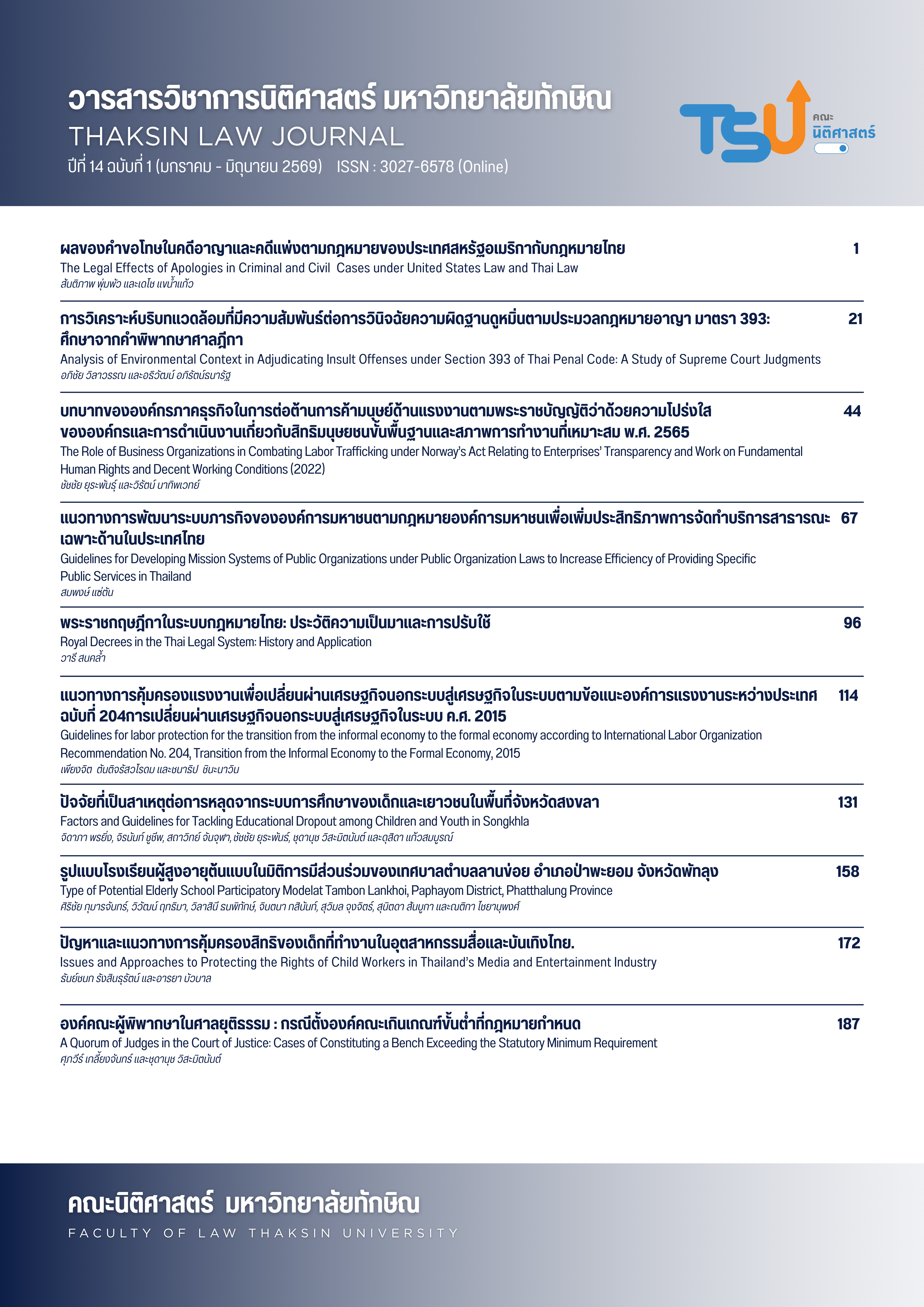
ผลของคำขอโทษในคดีอาญาและคดีแพ่งตามกฎหมาย ของประเทศสหรัฐอเมริกากับกฎหมายไทย
คำสำคัญ:
คำขอโทษ, ผลทางกฎหมาย, กฎหมายอาญา, กฎหมายแพ่งบทคัดย่อ
บทความนี้เพื่อวิเคราะห์ผลทางกฎหมายทั้งอาญาและแพ่งที่เกี่ยวข้องกับคำขอโทษ โดยจะเน้นถึงความสำคัญของคำขอโทษในกระบวนการยุติธรรม จากการศึกษาพบว่า กฎหมายต่างประเทศ โดยเฉพาะประเทศในระบบกฎหมายจารีตประเพณี (Common Law) เช่น สหรัฐอเมริกา คำขอโทษถูกมองว่าเป็น
กลไกสำคัญในการลดความขัดแย้งและส่งเสริมกระบวนการยุติธรรมเชิงสมานฉันท์ โดยหลายประเทศได้ออกกฎหมายเฉพาะ เช่น กฎหมายคำขอโทษ (Apology Laws) หรือกฎหมายการขอโทษ (Apology Act) เพื่อคุ้มครองคำขอโทษไม่ให้ถูกตีความเป็นการยอมรับความรับผิดทางแพ่งหรืออาญาโดยอัตโนมัติ ทำให้คู่กรณีกล้าแสดงความเสียใจและเข้าสู่กระบวนการไกล่เกยมากขึ้น ในบางกรณี ศาลสามารถนำคำขอโทษที่จริงใจ มาประกอบการพิจารณาลดโทษหรือกำหนดค่าเสียหายได้ แต่ต้องพิจารณาร่วมกับพยานหลักฐานและพฤติการณ์แห่งคดี เมื่อเปรียบเทียบกับกฎหมายไทยจะพบว่า ไทยไม่มีบทบัญญัติเฉพาะที่คุ้มครองคำขอโทษโดยตรง คำขอโทษจึงไม่ก่อให้เกิดผลทางกฎหมายโดยอัตโนมัติ อย่างไรก็ตาม ศาลไทยสามารถนำคำขอโทษมาพิจารณาเป็นพฤติการณ์ประกอบการใช้ดุลพินิจลดโทษตามประมวลกฎหมายอาญา มาตรา 78 หรือประกอบการกำหนดค่าสินไหมทดแทนในคดีแพ่งและคดีอาญาที่เรียกค่าเสียหายได้ ทั้งนี้ คำขอโทษในทั้งสองระบบกฎหมายมีบทบาทคล้ายกันในเชิงคุณค่า แต่แตกต่างกันในเชิงโครงสร้างทางกฎหมายและระดับของการคุ้มครองตามกฎหมาย
เอกสารอ้างอิง
Allan, A, & Carroll, R. (2016). Apologies in a Legal Setting: Insights from Research into Injured Parties’ Experiences of Apologies after an Adverse Event. Psychiatry, Psychology and Law, 24(1), 10–32. https://doi.org/10.1080/13218719.2016.1196511
Winship, V., & Robbennolt, J.K. (2018). Admissions of Guilt in Civil Enforcement. University of Minnesota Law School.
Tumelty, M. (2020). Medical Negligence Litigation and Apologies. European Journal of Health Law, 27(4), 386-403.
Jehle, A., & Miller, M.K. (2006). Apologies in the legal system: Helping offenders, victims, and the community. Restorative Directions Journal, 1-20. https://www.researchgate.net/ publication/262413909_Apologies_in_the_legal_system_Helping_offenders_victims_and_the_community.
Yamada, D.C. (2021). Therapeutic Jurisprudence: Foundations, Expansion, and Assessment. http://www.antoniocasella.eu/archipsy/Yamada_TJ_2021.pdf
Dijck, G.V. (2017). The Ordered Apology. Oxford Journal of Legal Studies, 37(3), 562-587.
Zhong, R., Baranoski, M., Feigenson, N., Davidson, L., Buchanan, A., & Zonana, H.V. (2014). So you're sorry? The role of remorse in criminal law. Journal of the American Academy of Psychiatry and the Law, 42(1), 39-48.
อโณทัย บำรุงพงษ์. (2537). อำนาจสั่งไม่ฟ้องคดีของพนักงานอัยการ โดยอาศัยเหตุผลทางรัฐประศาสโนบาย. รพีสาร 55, 56-58.
อุทัย อาทิเวช. (2563). การไกล่เกลี่ยข้อพิพาททางอาญา (พิมพ์ครั้งที่ 2). วี.เจ.พริ้นติ้ง.
ศาลฎีกา. (2546). คำพิพากษาศาลฎีกาที่ 6083/2546. ลงวันที่ 16 กันยายน 2546
จุฑารัตน์ เอื้ออำนวย. (2556). ระบบยุติธรรมและยุติธรรมทางเลือก : แนวการวิเคราะห์เชิง สังคมศาสตร์ (พิมพ์ครั้งที่ 1). สำนักพิมพ์จุฬาลงกรณ์มหาวิทยาลัย.
ศิริชัย วิชชุวัชรากร. (2561). มาตรการแทนการฟ้องคดีอาญา : บทวิเคราะห์ร่างพระราชบัญญัติ มาตรการแทนการฟ้องคดีอาญา พ.ศ. .... และกรณีศึกษาต่างประเทศ (พิมพ์ครั้งที่ 1). สถาบันพระปกเกล้า.
Beswick, S. (2024). Tort Law: Cases and Commentaries. Canadian Legal Information Institute.
Green, P., & Goldblatt, V., & Boulle, L. (2009). Mediation: Principles, Process, Practice. Sydney: LexisNexis.
Zhomartkyzy, M. (2023). The role of mediation in international conflict resolution. Law and Safety, 90(3), 169-178. https://doi.org/10.32631/pb.2023.3.14
Azlanudin, M.N.M. (2010). Role of Apology in Restorative Justice: Research Study. University Putra Malaysia.
Suzuki, M. (2022). Possibility of Sincere Apology in Restorative Justice: When and How?. International Journal of Offender Therapy and Comparative Criminology, 68(13-14), 1-21. https://doi.org/10.1177/0306624X221132238
Mayer, B. (1946). The dynamics of conflict resolution: a practitioner’s guide. United States of America.
Carroll, R.O. (2013). Apologies as a Legal Remedy. The Sydney law review, 35, 317-347.
Robbennolt, J.K. (2024). Apologies, Remorse, and Amends: Empirical Legal Studies Across Domains and Disciplines. European Journal of Empirical Legal Studies, 1(1), 3-18. https://doi.org/10.62355/ejels.19207
Bussani, M., Sebok, A., & Infantino, M. (2022). Common Law and Civil Law Perspectives on Tort Law. Oxford University Press. https://doi.org/10.1093/oso/9780195368383.001.0001
Petrucci, C.J. (2002). Apology in the criminal justice setting: evidence for including apology as an additional component in the legal system. Behavioral Sciences the Law, 20(4), 337-362. https://doi.org/10.1002/bsl.495
Hubbard, A.S.E., Hendrickson, B., Fehrenbach, K.S., & Sur, J. (2013). Effects of Timing and Sincerity of an Apology on Satisfaction and Changes in Negative Feelings During Conflicts. Western Journal of Communication, 77(3), 305-322. https://doi.org/10.1080/ 10570314.2013.770160
Slocum, D., Allan, A., & Allan, M.M. (2011). An emerging theory of apology. Australian Journal of Psycholog, 63(2), 83-92. https://doi.org/10.1111/j.1742-9536.2011.00013.x
Witvliet, C.V.O., Luna, L.R., Worthington, & Jr.E.L., Tsang, J. (2020). Apology and Restitution: The Psychophysiology of Forgiveness After Accountable Relational Repair Responses. Frontiers in Psychology, 11, https://doi.org/10.3389/fpsyg.2020.00284
Zehr, H. (2002). The Little Book of Restorative Justice. Good Books.
Braithwaite, J. (2002). Restorative Justice and Responsive Regulation. Oxford University Press.
ดาวน์โหลด
เผยแพร่แล้ว
ฉบับ
ประเภทบทความ
สัญญาอนุญาต
ลิขสิทธิ์ (c) 2026 วารสารวิชาการนิติศาสตร์ มหาวิทยาลัยทักษิณ

อนุญาตภายใต้เงื่อนไข Creative Commons Attribution-NonCommercial-NoDerivatives 4.0 International License.
บทความที่ได้รับการตีพิมพ์เป็นลิขสิทธิ์ของวารสารวิชาการนิติศาสตร์ มหาวิทยาลัยทักษิณ
ข้อความที่ปรากฏในบทความแต่ละเรื่องในวารสารวิชาการเล่มนี้เป็นความคิดเห็นส่วนตัวของผู้เขียนแต่ละท่านไม่เกี่ยวข้องกับคณะนิติศาสตร์ มหาวิทยาลัยทักษิณ และคณาจารย์ท่านอื่นๆในมหาวิทยาลัยฯ แต่อย่างใด ความรับผิดชอบองค์ประกอบทั้งหมดของบทความแต่ละเรื่องเป็นของผู้เขียนแต่ละท่าน หากมีความผิดพลาดใดๆ ผู้เขียนแต่ละท่านจะรับผิดชอบบทความของตนเองแต่ผู้เดียว

