
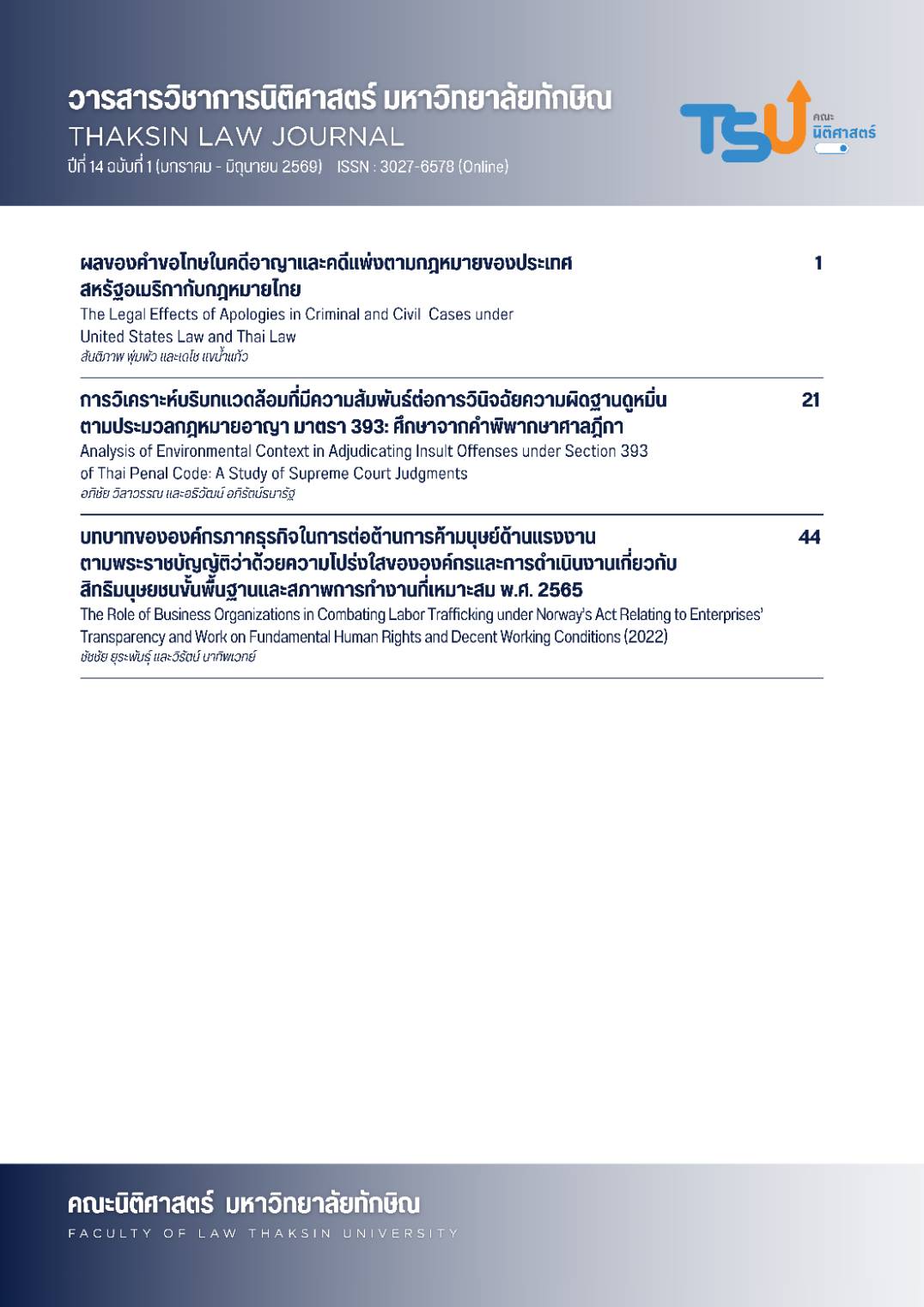
The Legal Effects of Apologies in Criminal and Civil Cases under United States Law and Thai Law
Keywords:
Apology, Legal Implications, Criminal Law, Civil LawAbstract
This article aims to analyze the legal effects of apologies in both criminal and civil law, with particular emphasis on the significance of apologies within the justice system. The study finds that in foreign legal systems especially those operating under the Common Law tradition, such as the United States apologies are regarded as an important mechanism for reducing conflict and promoting restorative justice. Many countries have enacted specific legislation, such as Apology Laws or Apology Acts, to protect apologies from being automatically interpreted as admissions of civil or criminal liability. Such legal protection encourages parties to express remorse openly and to engage more actively in mediation and alternative dispute resolution processes. In certain cases, courts may take sincere apologies into account when considering sentence mitigation or determining the amount of damages, provided that they are assessed together with other evidence and the overall circumstances of the case. By contrast, Thai law does not contain specific statutory provisions that directly protect apologies. As a result, an apology does not automatically produce legal effects. Nevertheless, Thai courts may consider an apology as a relevant circumstance when exercising judicial discretion to mitigate punishment under Section 78 of the Penal Code, or when determining compensation in civil cases and criminal cases involving claims for damages. Although apologies serve similar normative and moral functions in both legal systems, they differ significantly in terms of legal structure and the level of statutory protection afforded to them.
References
Allan, A, & Carroll, R. (2016). Apologies in a Legal Setting: Insights from Research into Injured Parties’ Experiences of Apologies after an Adverse Event. Psychiatry, Psychology and Law, 24(1), 10–32. https://doi.org/10.1080/13218719.2016.1196511
Winship, V., & Robbennolt, J.K. (2018). Admissions of Guilt in Civil Enforcement. University of Minnesota Law School.
Tumelty, M. (2020). Medical Negligence Litigation and Apologies. European Journal of Health Law, 27(4), 386-403.
Jehle, A., & Miller, M.K. (2006). Apologies in the legal system: Helping offenders, victims, and the community. Restorative Directions Journal, 1-20. https://www.researchgate.net/ publication/262413909_Apologies_in_the_legal_system_Helping_offenders_victims_and_the_community.
Yamada, D.C. (2021). Therapeutic Jurisprudence: Foundations, Expansion, and Assessment. http://www.antoniocasella.eu/archipsy/Yamada_TJ_2021.pdf
Dijck, G.V. (2017). The Ordered Apology. Oxford Journal of Legal Studies, 37(3), 562-587.
Zhong, R., Baranoski, M., Feigenson, N., Davidson, L., Buchanan, A., & Zonana, H.V. (2014). So you're sorry? The role of remorse in criminal law. Journal of the American Academy of Psychiatry and the Law, 42(1), 39-48.
อโณทัย บำรุงพงษ์. (2537). อำนาจสั่งไม่ฟ้องคดีของพนักงานอัยการ โดยอาศัยเหตุผลทางรัฐประศาสโนบาย. รพีสาร 55, 56-58.
อุทัย อาทิเวช. (2563). การไกล่เกลี่ยข้อพิพาททางอาญา (พิมพ์ครั้งที่ 2). วี.เจ.พริ้นติ้ง.
ศาลฎีกา. (2546). คำพิพากษาศาลฎีกาที่ 6083/2546. ลงวันที่ 16 กันยายน 2546
จุฑารัตน์ เอื้ออำนวย. (2556). ระบบยุติธรรมและยุติธรรมทางเลือก : แนวการวิเคราะห์เชิง สังคมศาสตร์ (พิมพ์ครั้งที่ 1). สำนักพิมพ์จุฬาลงกรณ์มหาวิทยาลัย.
ศิริชัย วิชชุวัชรากร. (2561). มาตรการแทนการฟ้องคดีอาญา : บทวิเคราะห์ร่างพระราชบัญญัติ มาตรการแทนการฟ้องคดีอาญา พ.ศ. .... และกรณีศึกษาต่างประเทศ (พิมพ์ครั้งที่ 1). สถาบันพระปกเกล้า.
Beswick, S. (2024). Tort Law: Cases and Commentaries. Canadian Legal Information Institute.
Green, P., & Goldblatt, V., & Boulle, L. (2009). Mediation: Principles, Process, Practice. Sydney: LexisNexis.
Zhomartkyzy, M. (2023). The role of mediation in international conflict resolution. Law and Safety, 90(3), 169-178. https://doi.org/10.32631/pb.2023.3.14
Azlanudin, M.N.M. (2010). Role of Apology in Restorative Justice: Research Study. University Putra Malaysia.
Suzuki, M. (2022). Possibility of Sincere Apology in Restorative Justice: When and How?. International Journal of Offender Therapy and Comparative Criminology, 68(13-14), 1-21. https://doi.org/10.1177/0306624X221132238
Mayer, B. (1946). The dynamics of conflict resolution: a practitioner’s guide. United States of America.
Carroll, R.O. (2013). Apologies as a Legal Remedy. The Sydney law review, 35, 317-347.
Robbennolt, J.K. (2024). Apologies, Remorse, and Amends: Empirical Legal Studies Across Domains and Disciplines. European Journal of Empirical Legal Studies, 1(1), 3-18. https://doi.org/10.62355/ejels.19207
Bussani, M., Sebok, A., & Infantino, M. (2022). Common Law and Civil Law Perspectives on Tort Law. Oxford University Press. https://doi.org/10.1093/oso/9780195368383.001.0001
Petrucci, C.J. (2002). Apology in the criminal justice setting: evidence for including apology as an additional component in the legal system. Behavioral Sciences the Law, 20(4), 337-362. https://doi.org/10.1002/bsl.495
Hubbard, A.S.E., Hendrickson, B., Fehrenbach, K.S., & Sur, J. (2013). Effects of Timing and Sincerity of an Apology on Satisfaction and Changes in Negative Feelings During Conflicts. Western Journal of Communication, 77(3), 305-322. https://doi.org/10.1080/ 10570314.2013.770160
Slocum, D., Allan, A., & Allan, M.M. (2011). An emerging theory of apology. Australian Journal of Psycholog, 63(2), 83-92. https://doi.org/10.1111/j.1742-9536.2011.00013.x
Witvliet, C.V.O., Luna, L.R., Worthington, & Jr.E.L., Tsang, J. (2020). Apology and Restitution: The Psychophysiology of Forgiveness After Accountable Relational Repair Responses. Frontiers in Psychology, 11, https://doi.org/10.3389/fpsyg.2020.00284
Zehr, H. (2002). The Little Book of Restorative Justice. Good Books.
Braithwaite, J. (2002). Restorative Justice and Responsive Regulation. Oxford University Press.
Downloads
Published
Issue
Section
License
Copyright (c) 2026 Thaksin Law Journal

This work is licensed under a Creative Commons Attribution-NonCommercial-NoDerivatives 4.0 International License.
บทความที่ได้รับการตีพิมพ์เป็นลิขสิทธิ์ของวารสารวิชาการนิติศาสตร์ มหาวิทยาลัยทักษิณ
ข้อความที่ปรากฏในบทความแต่ละเรื่องในวารสารวิชาการเล่มนี้เป็นความคิดเห็นส่วนตัวของผู้เขียนแต่ละท่านไม่เกี่ยวข้องกับคณะนิติศาสตร์ มหาวิทยาลัยทักษิณ และคณาจารย์ท่านอื่นๆในมหาวิทยาลัยฯ แต่อย่างใด ความรับผิดชอบองค์ประกอบทั้งหมดของบทความแต่ละเรื่องเป็นของผู้เขียนแต่ละท่าน หากมีความผิดพลาดใดๆ ผู้เขียนแต่ละท่านจะรับผิดชอบบทความของตนเองแต่ผู้เดียว

