
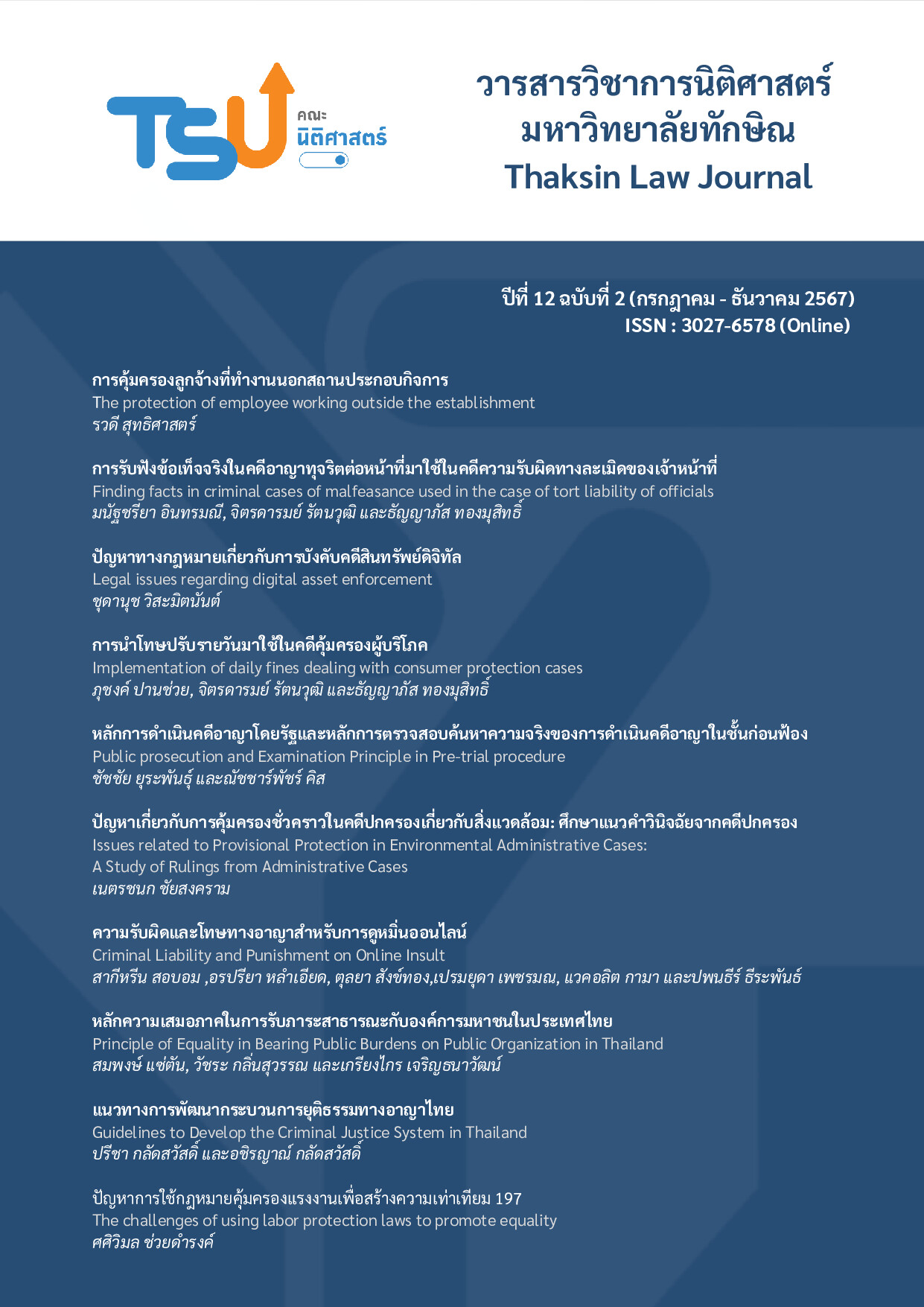
Implementation of daily fines dealing with consumer protection cases
Keywords:
Fixed rate fine, Daily fine, Consumer caseAbstract
The objectives of this research are to study the theoretical concepts related to punishment and fines of criminal cases, investigate the legal measures related to the enforcement of criminal fines in Thailand, analyze the rationale of legal measures for applying the daily systemic fines of consumer protection cases in Thailand and foreign countries and obtain guidelines for applying the principles of daily fine systems used for consumer protection cases in Thailand. In this regard, the study was conducted by a qualitative research system.
The study was found that fines were imposed on the offender's property instead of short-term imprisonment. It could be divided into 2 systems, namely the fixed rate adjustment and the inverse adjustment according to income (daily fines). The consumer protection case of the country at present, the law still uses a fixed rate adjustment system. but in other countries such as Sweden, Finland, Germany, France and the United States certify the inverse fine penalty system based on income (daily fines) applicable in a general manner. The reason that the penalty system of income-based inverse fine imposes a fine in which the amount of the fine is proportional to the degrees of the penalty or the severity of the offenses and varies according to the income or economic status of the offenders as well. Thus, creating equal legal effects between rich and poor offenders. This includes the case of entrepreneur or business operator offenders of consumer protection cases. Therefore, the principal recommendations, that is, Thailand should accept the introduction of the income-based inverse penalty system (daily fine) to apply for consumer protection cases with the section amendment of "Daily fine" in the Consumer Protection Act B.E. 2522.There are 3 factors to determine appropriate fines for offenders: 1) the severity of the act, 2) the consequences of the act, and 3) the offender's financial status.
References
วราภรณ์ ศิริสัจจวัฒน์. (2540). โทษปรับ : ศึกษากรณีระบบวันปรับ. วิทยานิพนธ์ปริญญามหาบัณฑิต, กรุงเทพฯ: จุฬาลงกรณ์มหาวิทยาลัย,.
ณัฐฐ์วัฒน์ สุทธิโยธิน. (2555). กฎหมายอาญาและอาชญาวิทยาชั้นสูง ทฤษฎีการลงโทษ หน่วยที่ 6 สาขาวิชานิติศาสตร์. กรุงเทพฯ: มหาวิทยาลัยสุโขทัยธรรมาธิราช.
พยนต์ สินธุนาวา. บทบาทและหน้าที่ของพนักงานคุมประพฤติด้านการสืบเสาะและพินิจ. เอกสารประกอบผลงานเรื่องที่ 1. กรมคุมประพฤติ กระทรวงยุติธรรม.
สหธน รัตนไพจิตร. (2527). ความประสงค์ของการ ลงโทษอาญา: ศึกษาเฉพาะประเทศไทยสมัยใช้กฎหมายลักษณะอาญาและประมวลกฎหมายอาญา. วิทยานิพนธ์นิติศาสตรมหาบัณฑิต, กรุงเทพฯ: สำนักพิมพ์มหาวิทยาลัยธรรมศาสตร์.
อิสร์กุล อุณหเกต. (2556). ระบบค่าปรับทางอาญา. กรุงเทพฯ: เปนไท.
Elena Kantorowicz- Reznichenko, Maximilian Kerk. (2020). Day Fines: Asymmetric Information and the Secondary Enforcement System. European Journal of Law and Economics.
คณะก้าวหน้า. (2565). Day-fine ไม่ใช่แค่เรื่องของค่าปรับ. สืบค้นวันที่ 17 กุมภาพันธ์ 2566, จาก https://progressivemovement.in.th.
M Riijihärvi. (1996). Corporate Criminal Liability – Finland in de Doelder and Tiedemann (eds), La Criminalisation du Comportement Collectif.
Hans-Jorg Albrecht, & Elmer H. Johnson. (1980). Fines and Justice Administration: The Experience of the Federal Republic of Germany. International Journal of Comparative and Applied Criminal Justice. 4 (1).
เพลินตา ต้นรังสรรค์. (2554). สัมมนาระดมความคิดเห็น เรื่อง แนวทางการจัดแบ่งกลุ่มความผิดและโทษในประมวลกฎหมายอาญาไทย. วารสารจุลนิติ, ก.ค. - ส.ค.
อุทัย อาทิเวช. (2554). รวมบทความกฎหมายวิธีพิจารณาความอาญาฝรั่งเศส. กรุงเทพฯ: ห้างหุ้นส่วนจำกัด วี.เจ.พริ้นติ้ง.
พิชยนต์ นิพาสพงษ์. (2542). โทษปรับโดยกำหนดตามวันและรายได้ (Day Fine). วิทยานิพนธ์ปริญญานิติศาสตรมหาบัณฑิต มหาวิทยาลัยธรรมศาสตร์.
Downloads
Published
Issue
Section
License
Copyright (c) 2024 Thaksin Law Journal

This work is licensed under a Creative Commons Attribution-NonCommercial-NoDerivatives 4.0 International License.
บทความที่ได้รับการตีพิมพ์เป็นลิขสิทธิ์ของวารสารวิชาการนิติศาสตร์ มหาวิทยาลัยทักษิณ
ข้อความที่ปรากฏในบทความแต่ละเรื่องในวารสารวิชาการเล่มนี้เป็นความคิดเห็นส่วนตัวของผู้เขียนแต่ละท่านไม่เกี่ยวข้องกับคณะนิติศาสตร์ มหาวิทยาลัยทักษิณ และคณาจารย์ท่านอื่นๆในมหาวิทยาลัยฯ แต่อย่างใด ความรับผิดชอบองค์ประกอบทั้งหมดของบทความแต่ละเรื่องเป็นของผู้เขียนแต่ละท่าน หากมีความผิดพลาดใดๆ ผู้เขียนแต่ละท่านจะรับผิดชอบบทความของตนเองแต่ผู้เดียว

