
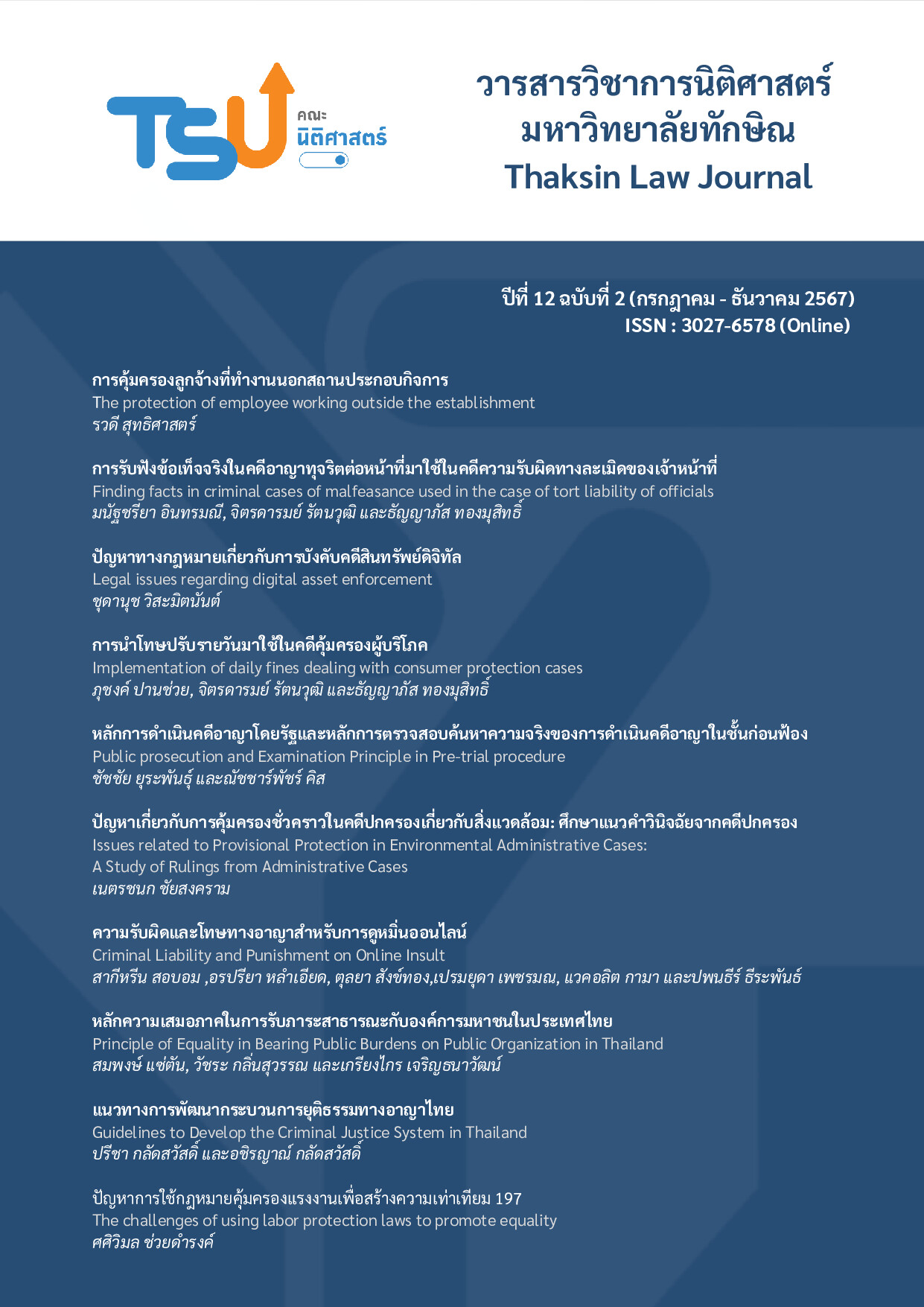
The protection of employee working outside the establishment
Keywords:
Working outside business establishments;, Request consent from employees;, Right to refuse engagement by employeesAbstract
The objective of this academic article is to present issues concerning employees working outside business establishments, examining Article 23/1 of the Labor Protection Act B.E. 2541 by examining Thai law in conjunction with the principles of the United Nations and the laws of the Philippines. The study proposes amendments to the Labor Protection Act, B.E. 2541, to enhance the protection of employees working outside business establishment. The study revealed that verbal agreements between employers and employees regarding work conducted outside of business establishment result in substantial legal complications. The manner of obtaining employee consent to work outside the business establishment: whether such consent should be sought once at the time of entering into the agreement or obtained from the employee on a case-by-case basis. Furthermore, essential welfare protections should be provided to employees working outside business establishments, and issues regarding the denial of rights upon the completion of the designated work hours, which could lead to insufficient protection for employees working outside business establishments. It is advisable to incorporate principles of international law and the laws of the Philippines, emphasizing valuable work practices and employee rights to rest. Moreover, when an employee declines to engage, the employer shall not penalize or evaluate the employee's performance based on that refusal. This practice should be clearer applied. Therefore, Thailand should amend the laws regarding agreements for employees to work outside the business establishment to include detailed specifications about the work. The manner of obtaining employee consent for working outside the business establishment must require consent on a case-by-case basis. Additionally, necessary welfare arrangements for employees working outside the business establishment must include access to clean drinking water and basic online first aid. Moreover, employees should have the right to refuse contact from the employer after work hours, including during breaks. These measures will lead to improved solutions for protecting employees who work outside the business establishment.
References
อฑตยา นิลทองคำ. (2564). แนวทางที่เหมาะสมในการกำหนดกฎเกณฑ์เกี่ยวกับการทำงานทางไกลผ่านมัลติมิเดีย (Telework) ในประเทศไทย (เอกัตศึกษาปริญญามหาบัณฑิต).กรุงเทพมหานคร. จุฬาลงกรณมหาวิทยาลัย. สืบค้นจาก https://digital.car.chula.ac.th/cgi/viewcontent.cgi?article=8779&context=chulaetd
ผู้จัดการออนไลน์. (2566). เชียงใหม่ออกประกาศขอทุกหน่วยงาน Work from Home หลังฝุ่นพิษรุนแรง-หวังลดผลกระทบสุขภาพประชาชน. สืบค้น 2 กุมภาพันธ์ 2567, จาก https://mgronline.com/local/ detail/9660000032365
สถาบันวิจัยเพื่อการพัฒนาประเทศไทย (ทีดีอาร์ไอ). (2563). ผลกระทบของการทำงานนอกสถานประกอบกิจการ (Work from home) ในช่วงโควิด-19: กรณีศึกษาของทีดีอาร์ไอ. สืบค้น 5 มกราคม 2567, จาก https://tdri.or.th/2020/05/impact-of-working-from-home-covid-19/
สำนักวิชาการ สำนักงานเลขาธิการสภาผู้แทนราษฎร. (2564). ร่างพระราชบัญญัติคุ้มครองแรงงาน (ฉบับที่..) พ.ศ. .... สืบค้น 5 กุมภาพันธ์ 2567, จาก https://dl.parliament.go.th/backoffice/ viewer2300/web/viewer.php
เกษมสันต์ วิลาวรรณ. (2566). คำอธิบายกฎหมายแรงงาน (พิมพ์ครั้งที่ 31). กรุงเทพมหานคร: โรงพิมพ์เดือนตุลา.
Apollo Technical. (2024). Surprising Working from Home Productivity Statistics. Retrieved 5 January 2024, from https://www.apollotechnical.com/working-from-home-productivity-statistics/ ?fbclid=IwAR0PhQzp8xqCvj2IM5fam_L_dkly7uRa5t62hbKwcsTONxSYIhyi3eyw_l8
นวีนา วรรธนผลากูร. (2563). รูปแบบการปฏิบัติงานจากจากที่พักอาศัย (work from home) ในสถานการณ์การแพร่ระบาดของโรคติดเชื้อไวรัสโคโรนา 2019: ศึกษากรณีสถาบันส่งเสริมการสอนวิทยาศาสตร์และเทคโนโลยี (สสวท.) (วิทยานิพนธ์ปริญญามหาบัณฑิต). กรุงเทพมหานคร. จุฬาลงกรณมหาวิทยาลัย. สืบค้นจาก https://digital.car.chula.ac.th/cgi/viewcontent.cgi?article=8538&context=chulaetd
อังคณา เตชะโกเมนท์. (ม.ป.ป.). งานที่มีคุณค่า (Decent Work). สืบค้น 5 มกราคม 2567, จาก http://ils.labour.go.th/attachments/091_Decentwork.pdf
สหธร เพชรวิโรจน์ชัย. (2564). Gig Economy คืออะไร กระทบกับบทบาทของ HR อย่างไร. สืบค้น
มกราคม 2567, จาก https://th.hrnote.asia/tips/210917-how-gig-economy-impact-hr/?fbclid=IwAR3J40X6N90NcPvaVUfaEyVbgCc-k9fPC5Vc9r_QQR4P9HL2rRhqCr4uUzk
สำนักงานสถิติแห่งชาติ. (2566). การสำรวจแรงงานนนอกระบบ พ.ศ.2565. สืบค้น 5 มกราคม 2567, จาก https://www.nso.go.th/sites/2014/DocLib13/ด้านสังคม/สาขาแรงงาน/Informal_work_force/2565/summary_65.pdf
คำพิพากษาฎีกาที่ 6067/2545
สำนักวิชาการ สำนักงานเลขาธิการสภาผู้แทนราษฎร. (2564). ร่างพระราชบัญญัติคุ้มครองแรงงาน (ฉบับที่..) พ.ศ. .... สืบค้น 5 มกราคม 2567, จาก https://dl.parliament.go.th/backoffice/viewer2300/web/viewer.php
กระทรวงแรงงาน. (2566). คำชี้แจงกระทรวงแรงงาน เรื่อง พระราชบัญญัติคุ้มครองแรงงาน (ฉบับที่ 8) พ.ศ.2566. สืบค้น 5 มกราคม 2567, จาก https://legal.labour.go.th/images/law/Protection2541/7/12042023.pdf
คณะกรรมการสิทธิมนุษยชนแห่งชาติ. (2564). ปฏิญญาสากลว่าด้วยสิทธิมนุษยชน. สืบค้นเมื่อวันที่ 20 ธันวาคม 2566, จาก http://library.nhrc.or.th/ulib/document/Fulltext/F12912.pdf
International Labour Organization (ILO). (2017). C177 - Home Work Convention,1996 (No. 177). Retrieved 5 February 2024, from
https://www.ilo.org/dyn/normlex/en/f?p=NORMLEXPUB:12100:0::NO::P12100_INSTRUMENT_ID:312322
International Labour Organization (ILO). (2017). R184 - Home Work Recommendation, 1996 (No. 184). Retrieved 5 February 2024, from https://www.ilo.org/dyn/normlex/en/f?p=1000:12100:::NO:12100:P12100_INSTRUMENT_ID:312522
กลุ่มงานมาตรฐานแรงงานระหว่างประเทศ กรมสวัสดิการและคุ้มครองแรงงาน. (2022).อนุสัญญาและข้อแนะอื่นๆ. สืบค้นเมื่อวันที่ 20 ธันวาคม 2566 จาก http://ils.labour.go.th/index.php?option=com_content&view=article&id=9&Itemid=10
Republic of the Philippines Department of Labor and Employment. (2022). Department Order No.237 Series of 2022. Retrieved 5 February 2024, from https://www.dole.gov.ph/php_assets/uploads/2022/09/DO-237-22-Revised-Implementing-Rules-and-Regulations-of-RA-No.-11165-Otherwise-Known-as-The- Telecommuting-Act.pdf
ปิยะขวัญ ชมชื่น. (2563). พระราชบัญญัติว่าด้วยการปฏิบัติงานจากที่บ้านของประเทศฟิลิปปินส์ (Telecommuting Act 2018). สืบค้น 5 มกราคม 2567, จาก https://lawforasean.krisdika.go.th/File/files/Final_Telecommuting Act 2018 PH(2).pdf
Senate of the Philippines. (2022). Senate S.No.2475. Retrieved 5 January 2024, from https://legacy.senate.gov.ph/lisdata/3691033287!.pdf
ตรีเนตร สาระพงษ์. (2566). การทำงานทางไกล และสิทธิที่จะตัดขาดการสื่อสารนอกเวลางาน. กรุงเทพมหานคร: โรงพิมพ์เดือนตุลา.
ตรีเนตร สาระพงษ์. (2564). กฎหมายคุ้มครองแรงงาน. (พิมพ์ครั้งที่ 6). กรุงเทพมหานคร: พิมพ์อักษร.
วิจิตรา (ฟุ้งลัดดา) วิเชียรชม. (2566). กฎหมายแรงงาน (พิมพ์ครั้งที่ 10). กรุงเทพมหานคร: โรงพิมพ์เดือนตุลา.
Cartoon Tanaporn. (2565). ‘สวัสดิการพนักงาน’ เบื้องหลังความสำเร็จของ Google บริษัทที่คนรุ่นใหม่อยากทำงานด้วยที่สุดในโลก. สืบค้น 5 กุมภาพันธ์ 2567, https://thegrowthmaster.com/company-culture/google?fbclid=IwAR3yHcH9q-ro-8T_PvjK9tn DueodzbKWbgwf9AMHo4Z7vQLfjswE-9P2_To#:~:text=มีอาหารให้ฟรี, กับเพื่อนร่วมงานได้
กระทรวงแรงงาน. (2566). คำชี้แจงกระทรวงแรงงาน เรื่อง พระราชบัญญัติคุ้มครองแรงงาน (ฉบับที่ 8) พ.ศ.2566. สืบค้น 5 มกราคม 2567, จาก https://legal.labour.go.th/images/law/Protection2541/7/12042023.pdf
กรมสวัสดิการและคุ้มครองแรงงาน. (2566). แนวปฏิบัติตามมาตรา 23/1 แห่งพระราชบัญญัติคุ้มครองแรงงาน พ.ศ. 2541 (สำหรับนายจ้าง-ลูกจ้าง). สืบค้น 5 กุมภาพันธ์ 2567, https://legal.labour.go.th/images/law/Protection2541/Guidelines_M23-1.pdf
พงษ์รัตน์ เครือกลิ่น. (2566). คำอธิบายกฎหมายแรงงานเพื่อการบริหารทรัพยากรมนุษย์ (พิมพ์ครั้งที่ 14). กรุงเทพมหานคร: สำนักพิมพ์ธรรมนิติ เพรส จำกัด.
Downloads
Published
Issue
Section
License
Copyright (c) 2024 Thaksin Law Journal

This work is licensed under a Creative Commons Attribution-NonCommercial-NoDerivatives 4.0 International License.
บทความที่ได้รับการตีพิมพ์เป็นลิขสิทธิ์ของวารสารวิชาการนิติศาสตร์ มหาวิทยาลัยทักษิณ
ข้อความที่ปรากฏในบทความแต่ละเรื่องในวารสารวิชาการเล่มนี้เป็นความคิดเห็นส่วนตัวของผู้เขียนแต่ละท่านไม่เกี่ยวข้องกับคณะนิติศาสตร์ มหาวิทยาลัยทักษิณ และคณาจารย์ท่านอื่นๆในมหาวิทยาลัยฯ แต่อย่างใด ความรับผิดชอบองค์ประกอบทั้งหมดของบทความแต่ละเรื่องเป็นของผู้เขียนแต่ละท่าน หากมีความผิดพลาดใดๆ ผู้เขียนแต่ละท่านจะรับผิดชอบบทความของตนเองแต่ผู้เดียว

