
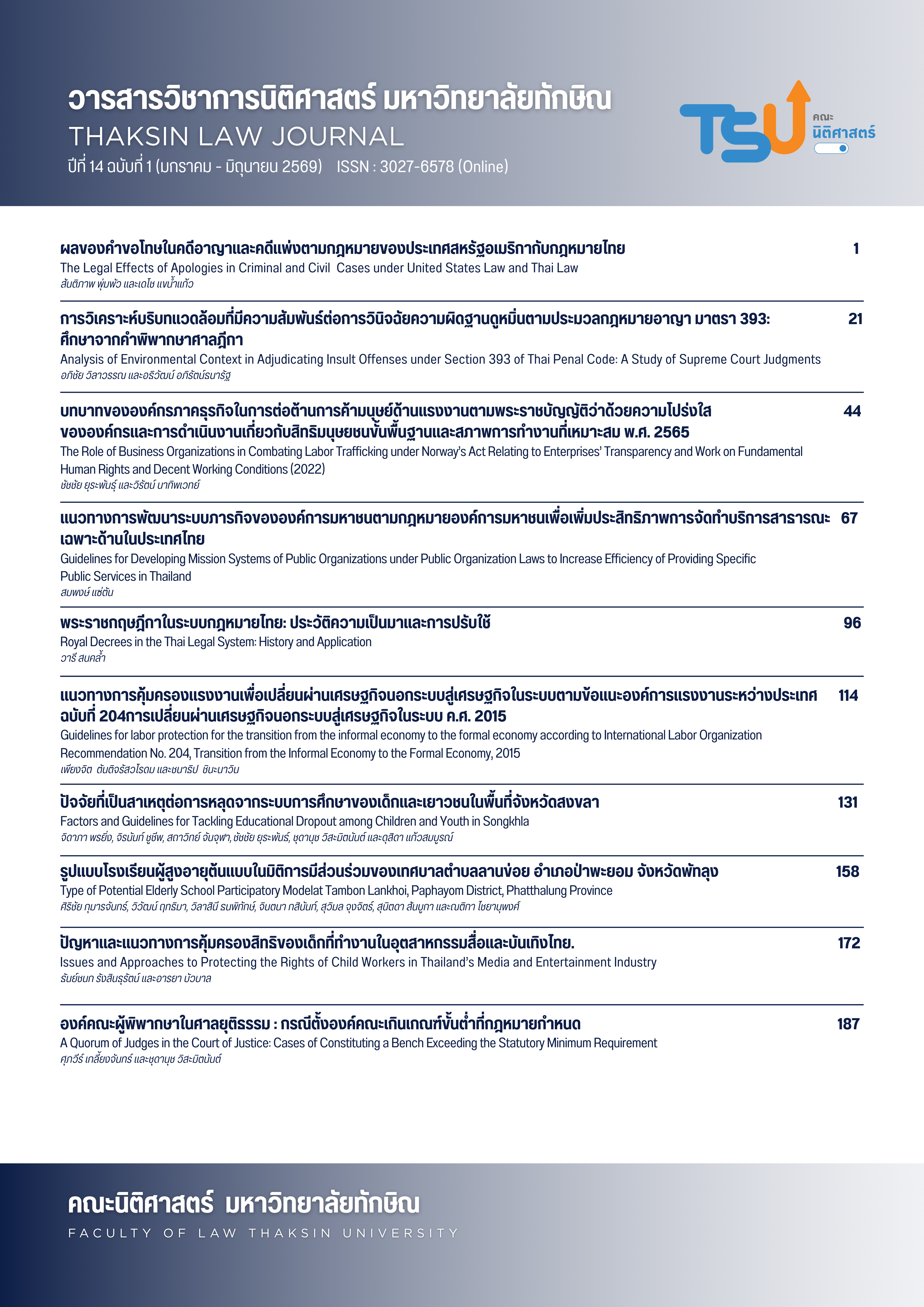
The Role of Business Organizations in Combating Labor Trafficking under Norway’s Act Relating to Enterprises’ Transparency and Work on Fundamental Human Rights and Decent Working Conditions (2022)
Keywords:
Labor Trafficking, Transparency Act Norway, Human Rights Due DiligenceAbstract
This article aims to examine the role of business organizations in Norway in combating labor trafficking under the Act Relating to Enterprises’ Transparency and Work on Fundamental Human Rights and Decent Working Conditions B.E. 2565 (2022), hereinafter referred to as the Transparency Act, and to analyze the feasibility of applying its principles within the Thai context. The study employs documentary research, focusing on the analysis of statutory provisions, corporate obligations, and enforcement mechanisms related to the prevention of labor trafficking within supply chains.
The findings reveal that the Transparency Act requires medium- and large-sized enterprises to conduct comprehensive Human Rights Due Diligence covering both their own operations and their supply chains. The Act further imposes obligations to disclose information to the public and to provide information upon request. These mechanisms constitute significant tools in reducing the risks of forced labor and labor trafficking within the business sector. Although Thailand does not currently have a specific law of a similar nature, certain principles of the Transparency Act may be adapted, beginning with the promotion of human rights risk reporting in the business sector, the development of effective regulatory oversight mechanisms, and the establishment of responsible supply chain standards.
References
International Labour Organization. (2022). Forced labour, modern slavery and trafficking persons: Data and research on forced labour. Retrieved March 4, 2025, from https://www.ilo.org/topics/forced-labour-modern-slavery-and-trafficking-persons/data-and-research-forced-labour
Nikkel, M., & Tennis, T. (2021, November 1). Facts & stats about human trafficking. Retrieved February 2, 2025, from https://theexodusroad.com/th/facts-stats-about-human-trafficking/
Council of Europe. (2022, June 8). Human trafficking in Norway: Progress on legislative reforms, but should avoid rapid deportations of foreigners without screening them. Retrieved February 13, 2025, from https://www.coe.int/en/web/portal/-/human-trafficking-in-norway-progress-on-legislative-reforms-but-should-avoid-rapid-deportations-of-foreigners-without-screening-them
U.S. Department of State. (2025). 2023 trafficking in persons report: Norway. Retrieved February 13, 2025, from https://www.state.gov/reports/2023-trafficking-in-persons-report/norway/
Forbrukertilsynet. (2021). Åpenhetsloven (Transparency Act). Retrieved February 13, 2025, from https://www.forbrukertilsynet.no/apenhetsloven
Thai Union. (2016). Statement on modern slavery. Retrieved February 20, 2025, from https://investor.thaiunion.com/newsroom/20160615-tu-modern-slavery-en.pdf
Global Labor Justice. (2022). Thailand: Labor justice and human rights violations in supply chains. Retrieved February 20, 2025, from https://globallaborjustice.org/portfolio-category/thailand/
Darity, W. A., Jr. (Ed.). (2008). Corporate social responsibility. In International encyclopedia of the social sciences (2nd ed., Vol. 2, pp. 136–138). Macmillan Reference USA.
Corporate social responsibility and organizational ethics. (2022). In Encyclopedia of business and finance (4th ed., Vol. 1, pp. 176–181). Macmillan Reference USA.
Stubholt, L. M., Moe, T. S., & Stærnes, N. (2024). The Norwegian legislation on social sustainability: An overview of the Transparency Act. Oslo Law Review, …(…), 1–15.
Corporate social responsibility and organizational ethics. (2022). In Encyclopedia of business and finance (4th ed., Vol. 1, pp. 176–181). Macmillan Reference USA.
Ferrara, M. H. (Ed.). (2013). Conducting business in developing countries. In Gale business insights handbook of global business law (pp. 141–151). Gale.
Beattie, A. (2025). The three pillars of corporate sustainability. Retrieved February 20, 2025,
from https://www.investopedia.com/articles/investing/100515/three-pillars-corporate-sustainability.asp
World Resources Institute & World Business Council for Sustainable Development. (2004). The greenhouse gas protocol: A corporate accounting and reporting standard (Revised ed.). Retrieved February 2, 2025, from https://ghgprotocol.org/sites/default/files/standards/ ghg-protocol-revised.pd
United Nations. (2011). Guiding principles on business and human rights. Retrieved February 8, 2025, from https://www.ohchr.org/documents/publications/guidingprinciples businesshr_en.pdf
United Nations. (2015). Transforming our world: The 2030 agenda for sustainable development. Retrieved January 26, 2025, from https://sdgs.un.org/2030agenda
สถาบันบัณฑิตพัฒนศาสตร์. (2565). Sustainable Development Goals: ความยั่งยืน และ ESG ความหมายและความสำคัญต่อธุรกิจและองค์กร. สืบค้นเมื่อ 13 กุมภาพันธ์ 2565, จาก https://nida.ac.th/what-is-sustainability/
OECD. (2018). OECD due diligence guidance for responsible business conduct. OECD Publishing.
พิภพ อุดร, สฤณี อาชวานันทกุล, และธิติมา อุรพีพัฒนพงศ์. (2561). การตรวจสอบสิทธิมนุษยชนอย่างรอบด้าน (Human Rights Due Diligence: HRDD). กรุงเทพฯ: สำนักงานคณะกรรมการสิทธิมนุษยชนแห่งชาติ.
สำนักงานคณะกรรมการกำกับหลักทรัพย์และตลาดหลักทรัพย์ และคณะนิติศาสตร์ จุฬาลงกรณ์มหาวิทยาลัย. (2565). แนวทางการตรวจสอบสถานะสิทธิมนุษยชนอย่างรอบด้าน (Human Rights Due Diligence) สำหรับบริษัทจดทะเบียน. กรุงเทพฯ: สำนักงานคณะกรรมการกำกับหลักทรัพย์และตลาดหลักทรัพย์.
วัชรชัย จิรจินดากุล. (2562). การตรวจสอบสิทธิมนุษยชนอย่างรอบด้านกับการควบคุมห่วงโซ่อุปทาน:กรณีศึกษาแรงงานเคลื่อนย้ายถิ่นฐานในอุตสาหกรรมก่อสร้างในจังหวัดสงขลา. วารสารนิติศาสตร์ มหาวิทยาลัยธรรมศาสตร์, 48(3), 554–572.
Ruggie, J. G. (2013). Just business: Multinational corporations and human rights. W. W. Norton & Company.
SDG Move. (ม.ป.ป.). ข้อมูลเบื้องต้นเกี่ยวกับ SDGs. ค้นเมื่อ 18 มกราคม 2568 จาก https://www.sdgmove.com/ intro-to-sdgs/
United Nations. (2015). Transforming our world: The 2030 agenda for sustainable development. Retrieved January 26, 2025, from https://sdgs.un.org/goals
Office of the National Economic and Social Development Council. (n.d.). About SDGs – Goal 8: Promote sustained, inclusive and sustainable economic growth, full and productive employment and decent work for all. SDGs Thailand. Retrieved February 28, 2026, from https://sdgs.nesdc.go.th/goal-8/
United Nations. (n.d.). Goal 12: Ensure sustainable consumption and production patterns. Global Goals. Retrieved February 28, 2026, from https://globalgoals.org/goals/12-responsible-consumption-and-production/
U.S. Department of State. (2025). 2023 trafficking in persons report: Norway. Retrieved February 8, 2025, from https://www.state.gov/reports/2023-trafficking-in-persons-report/norway/
BBC. (2025). Bangladesh factory collapse toll passes 1,000. Retrieved February 8, 2025, from https://www.bbc.com/news/world-asia-22476774
Ditlev-Simonsen, C. D. (2024). Acting on the Norwegian Transparency Act: Interpretation and implementation. In The fragility of responsibility: Norway’s transformative agenda for research, innovation and business.
Lae, R., & Smørdal, M. P. (2024, April 22). Norway’s new transparency act: An overview in light of international trends. Oslo Law Review, 10(2), 1–12.
Forbrukertilsynet. (2024). Forbrukertilsynets role in transparency law enforcement. Retrieved January 26, 2025, from https://www.forbrukertilsynet.no/vi-jobber-med/apenhetsloven/forbrukertilsynets-rolle
Norway. (2009). Act relating to the control of marketing and contract terms and conditions, etc. (Marketing Control Act). Retrieved January 26, 2025, from https://www.lovdata.no/ LOV-2009-01-09-2
Downloads
Published
Issue
Section
License
Copyright (c) 2026 Thaksin Law Journal

This work is licensed under a Creative Commons Attribution-NonCommercial-NoDerivatives 4.0 International License.
บทความที่ได้รับการตีพิมพ์เป็นลิขสิทธิ์ของวารสารวิชาการนิติศาสตร์ มหาวิทยาลัยทักษิณ
ข้อความที่ปรากฏในบทความแต่ละเรื่องในวารสารวิชาการเล่มนี้เป็นความคิดเห็นส่วนตัวของผู้เขียนแต่ละท่านไม่เกี่ยวข้องกับคณะนิติศาสตร์ มหาวิทยาลัยทักษิณ และคณาจารย์ท่านอื่นๆในมหาวิทยาลัยฯ แต่อย่างใด ความรับผิดชอบองค์ประกอบทั้งหมดของบทความแต่ละเรื่องเป็นของผู้เขียนแต่ละท่าน หากมีความผิดพลาดใดๆ ผู้เขียนแต่ละท่านจะรับผิดชอบบทความของตนเองแต่ผู้เดียว

