Developing a School Administration Model Based on Buddhist Principles for Buddhist Schools in Chiang Mai Province
Keywords:
Model development;, School administration; , Buddhist principles;, Buddhist schoolsAbstract
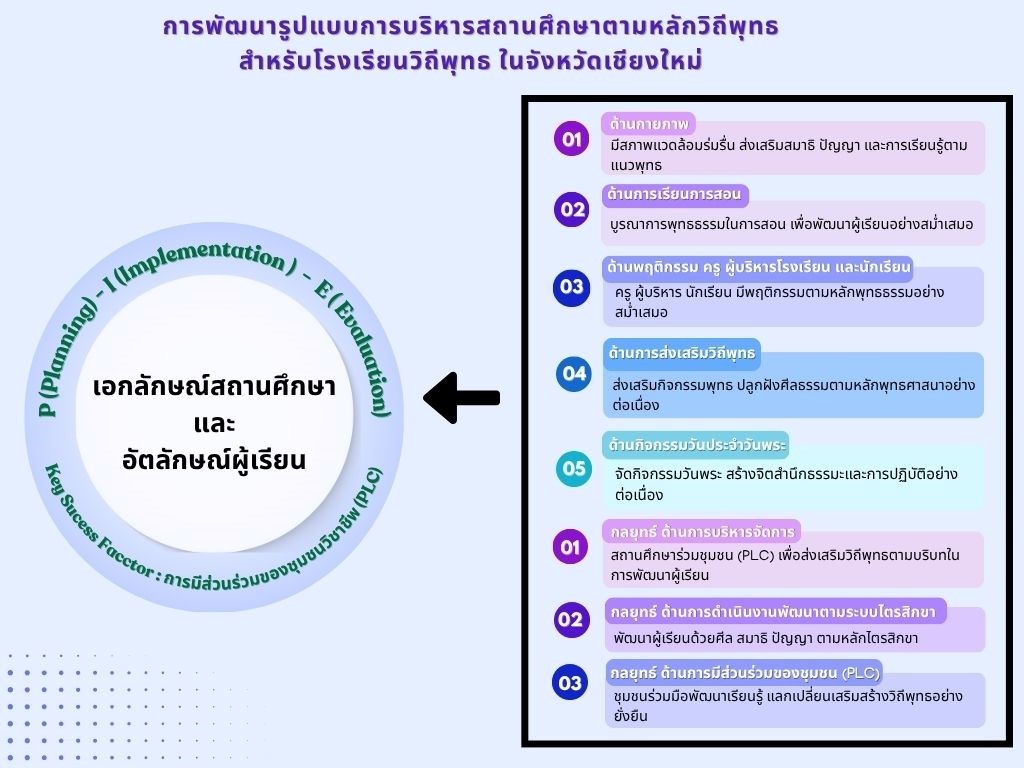
The objectives of this research were to: (1) examine the current and expected conditions of educational management based on Buddhist principles in Buddhist schools in Chiang Mai Province; (2) investigate the essential needs of Buddhist schools in Chiang Mai; (3) develop a school administration model based on Buddhist principles for Buddhist schools; and (4) evaluate the appropriateness and feasibility of the proposed model. A mixed-methods approach was employed, integrating both quantitative and qualitative data collection. The population consisted of 2,745 administrators, teachers, and related stakeholders, from which 1,160 participants were purposively selected as the sample. The research instruments included questionnaires, interviews, and assessment forms. Data were analyzed using basic statistics percentage, mean, standard deviation, the Priority Needs Index (PNI Modified), and content analysis.
The findings revealed that:
1. The overall current and expected conditions were at a high level ( = 4.34, S.D. = 0.82). The highest rating was found in Buddhist Holy Day activities (
= 4.54, S.D. = 0.47), while community participation received the lowest rating (
= 4.21, S.D. = 0.71).
2. The overall essential needs indicated a Priority Needs Index of 0.101, with the highest need in the physical aspect, whereas the behavioral aspect of administrators, teachers, and students showed the lowest need.
3. The developed school administration model based on Buddhist principles consisted of five components: physical aspect, instructional aspect, behavioral aspect of administrators and teachers, Buddhist Holy Day activities, and Buddhist-oriented promotion activities. The model was supported by three strategic elements: Buddhist-based administration, management aligned with the Threefold Training (Trisikkhā), and community participation.
4. The evaluation results showed that the overall appropriateness and feasibility of the model were at a high level, with the physical aspect and instructional aspect demonstrating the highest feasibility.
References
กรมวิชาการ. (2564). แผนพัฒนาเศรษฐกิจและสังคมแห่งชาติ ฉบับที่ 12 พ.ศ. 2560-2564. กรุงเทพฯ: สยามสปอร์ต.
กระทรวงศึกษาธิการ. (2546). แนวทางการดำเนินงานโรงเรียนวิถีพุทธ. กรุงเทพฯ: องค์การรับส่งสินค้าและพัสดุภัณฑ์ (ร.ส.พ.).
ยุกตนันท์ หวานฉ่ำ. (2555). การบริหารสถานศึกษากับประสิทธิผลของโรงเรียนในอำเภอคลองหลวง สังกัดสำนักงานเขตพื้นที่การศึกษาประถมศึกษาปทุมธานี เขต 1. (วิทยานิพนธ์ศึกษาศาสตรมหาบัณฑิต). ปทุมธานี: มหาวิทยาลัยเทคโนโลยีราชมงคลธัญบุรี).
รัตนชัย เอี่ยมพิทักษ์พร. (2565). รูปแบบการบริหารงานโรงเรียนประถมศึกษาตามแนวคิดโรงเรียนวิถีพุทธพระราชทาน. (ดุษฎีนิพนธ์ศึกษาศาสตรดุษฎีบัณฑิต). พระนครศรีอยุธยา: มหาวิทยาลัยมหาจุฬาลงกรณราชวิทยาลัย.
วัชรพล มะลิซ้อน. (2560). การปลูกฝังคุณธรรมในโรงเรียนวิถีพุทธโรงเรียนบ้านชุมแสง ตำบลชุมแสง อำเภอสตึก จังหวัดบุรีรัมย์. (วิทยานิพนธ์พุทธศาสตรมหาบัณฑิต). พระนครศรีอยุธยา: มหาวิทยาลัยมหาจุฬาลงกรณราชวิทยาลัย.
สำนักงานเขตพื้นที่การศึกษาประถมศึกษาเชียงใหม่ เขต 1. (2564). รายงานผลการดำเนินงานโรงเรียนวิถีพุทธ ประจำปี 2563. เชียงใหม่: สำนักงานศึกษาธิการจังหวัดเชียงใหม่.
สำนักงานเขตพื้นที่การศึกษาประถมศึกษาเชียงใหม่ เขต 2. (2564). รายงานผลการดำเนินงานโรงเรียนวิถีพุทธ ประจำปี 2563. เชียงใหม่: สำนักงานศึกษาธิการจังหวัดเชียงใหม่.
สำนักงานเขตพื้นที่การศึกษาประถมศึกษาเชียงใหม่ เขต 3. (2564). รายงานผลการดำเนินงานโรงเรียนวิถีพุทธ ประจำปี 2563. เชียงใหม่: สำนักงานศึกษาธิการจังหวัดเชียงใหม่.
สำนักงานเขตพื้นที่การศึกษาประถมศึกษาเชียงใหม่ เขต 4. (2564). รายงานผลการดำเนินงานโรงเรียนวิถีพุทธ ประจำปี 2563. เชียงใหม่: สำนักงานศึกษาธิการจังหวัดเชียงใหม่.
สำนักงานเขตพื้นที่การศึกษาประถมศึกษาเชียงใหม่ เขต 5. (2564). รายงานผลการดำเนินงานโรงเรียนวิถีพุทธ ประจำปี 2563. เชียงใหม่: สำนักงานศึกษาธิการจังหวัดเชียงใหม่.
สำนักงานเขตพื้นที่การศึกษาประถมศึกษาเชียงใหม่ เขต 6. (2564). รายงานผลการดำเนินงานโรงเรียนวิถีพุทธ ประจำปี 2563. เชียงใหม่: สำนักงานศึกษาธิการจังหวัดเชียงใหม่.
สำนักงานเขตพื้นที่การศึกษามัธยมศึกษาเชียงใหม่. (2565). รายงานผลการดำเนินงานโรงเรียนวิถีพุทธ ประจำปี 2563. สงขลา: สำนักงานศึกษาธิการจังหวัดสงขลา.
Creswell, J. W. (2013). Research design: Qualitative, quantitative, and mixed methods approaches. (4th ed.). Thousand Oaks, CA: SAGE Publications.