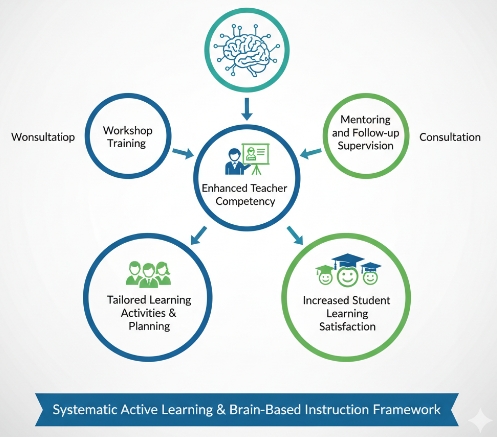
Development of Brain-Based Active Learning Management Competence of English Teachers in Thung Phra Subdistrict Schools Chaiyaphum Primary Educational Service Area Office 2
Keywords:
Active Learning;, Brain-Based Learning;, Action ResearchAbstract
This study aimed to 1) enhance English teachers’ knowledge and understanding of active learning through brain-based learning, 2) develop teachers’ competencies in active learning management, and 3) examine teachers’ satisfaction with the competency development process. The study employed an action research design conducted in two cycles based on Kemmis and McTaggart’s framework. The participants were eight English teachers. The research instruments included a knowledge test, lesson plan evaluation form, classroom instruction evaluation form, interview form, observation form, satisfaction questionnaire, and meeting records. Quantitative data were analyzed using mean, standard deviation, and percentage, while qualitative data were analyzed through content analysis.
The findings revealed that:
1. In the first cycle, self-directed learning, workshops, and follow-up supervision increased the teachers’ knowledge and understanding from 50.63% to 84.38%. The teachers were also able to develop high-quality lesson plans; however, they still lacked confidence in implementing the plans, particularly in the practice and knowledge-application stages.
2. In the second cycle, internal supervision and continuous coaching helped the teachers use a wider variety of learning activities, promote students’ learning through hands-on practice, and improve their instructional competencies.
3. The teachers’ overall satisfaction with the development process was at the highest level, particularly regarding the benefits for students. The two-cycle development process helped English teachers in schools within the Thung Phra Subdistrict cluster improve their knowledge, confidence, and ability to implement active learning through brain-based learning more effectively.
References
กิดานันท์ มลิทอง. (2543). เทคโนโลยีการศึกษาและนวัตกรรม. (พิมพ์ครั้งที่ 2). กรุงเทพฯ: จุฬาลงกรณ์มหาวิทยาลัย.
กุลิสรา จิตรชญาวณิช. (2566). วิธีการจัดการเรียนรู้ในศตวรรษที่ 21. (พิมพ์ครั้งที่ 4). กรุงเทพฯ: จุฬาลงกรณ์มหาวิทยาลัย.
ชนาธิป พรกุล. (2551). การออกแบบการสอน: การบูรณาการ การอ่าน การคิดวิเคราะห์ และการเขียน. กรุงเทพฯ: จุฬาลงกรณ์มหาวิทยาลัย.
รุ่ง แก้วแดง. (2544). การประกันคุณภาพการศึกษา. กรุงเทพฯ: ไทยวัฒนาพานิช.
วิโรจน์ สารรัตนะ. (2555). แนวคิด ทฤษฎี และประเด็นเพื่อการบริหารการศึกษา. (พิมพ์ครั้งที่ 8). กรุงเทพฯ: ทิพยวิสุทธิ์.
สำนักงานคณะกรรมการการศึกษาแห่งชาติ. (2546). พระราชบัญญัติการศึกษาแห่งชาติ พ.ศ. 2542 และที่แก้ไขเพิ่มเติม (ฉบับที่ 2) พ.ศ. 2545. กรุงเทพฯ: สำนักงานคณะกรรมการการศึกษาแห่งชาติ.
Bonwell, C. C., & Eison, J. A. (1991). Active learning: Creating excitement in the classroom. Washington, DC: School of Education and Human Development, George Washington University.
Bush, T. (2007). Educational leadership and management: Theory, policy and practice. South African Journal of Education, 27(3), 391-406.
Caine, R. N., & Caine, G. (1991). Making connections: Teaching and the human brain. Alexandria, VA: Association for Supervision and Curriculum Development.
Dick, W., Carey, L., & Carey, J. O. (2009). The systematic design of instruction (7th ed.). Upper Saddle River, NJ: Merrill/Pearson.