Information System Management for Academic Administration of Educational Institutions under Chiang Mai Primary Educational Service Area 4
Keywords:
Information System Management ; Academic Administration ; Chiang Mai Primary Educational Service Area Office 4Abstract
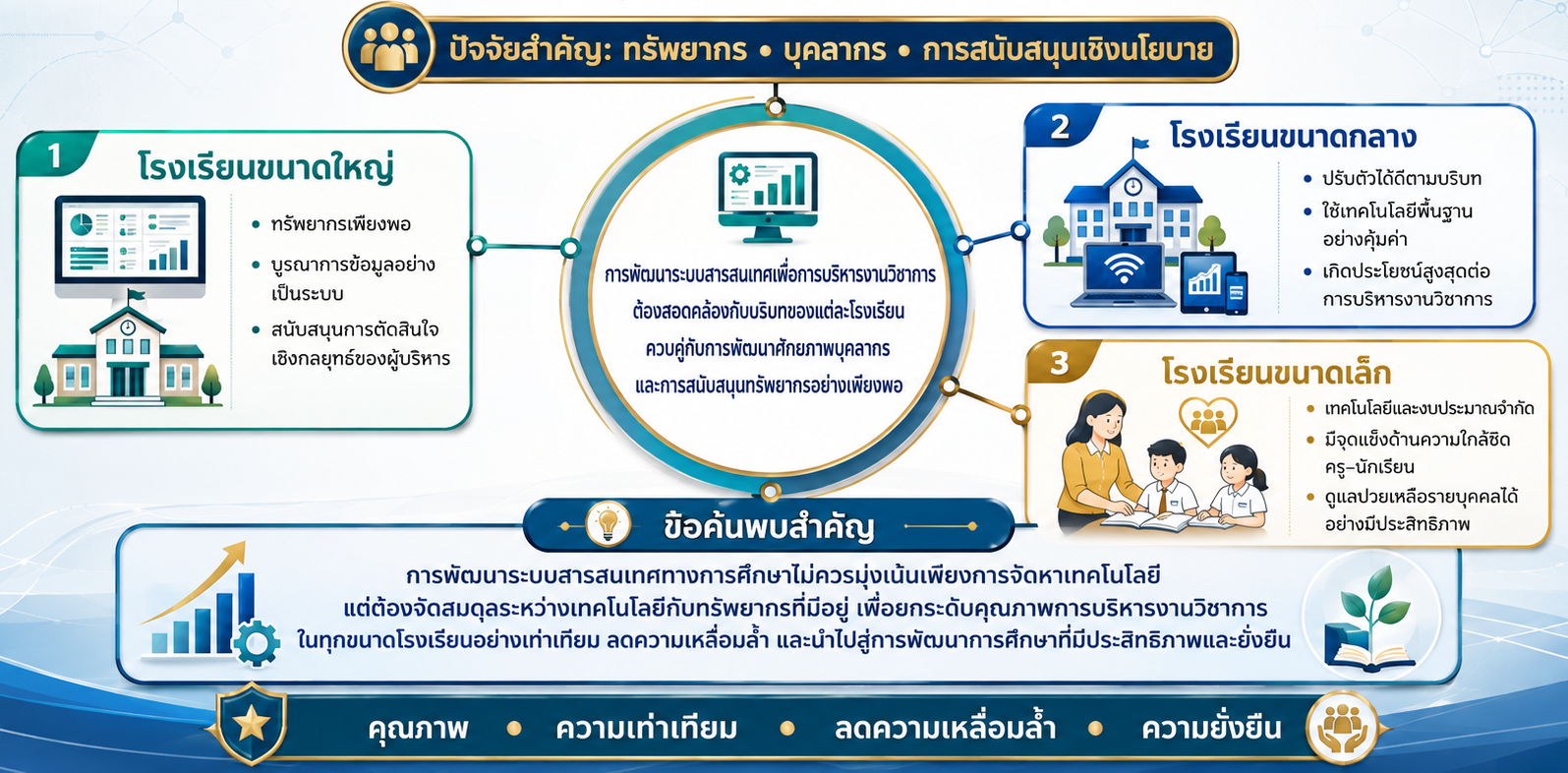
This research aimed to 1) study the current state and problems of information systems management for academic administration, and 2) compare the condition of said information systems management in schools under the Chiang Mai Primary Educational Service Area Office 4, classified by school size. The research hypothesized that large-sized schools would have higher efficiency in managing information systems than small and medium-sized schools. The sample group consisted of 285 teachers working under the Chiang Mai Primary Educational Service Area Office 4, obtained through proportional stratified random sampling based on school size (small, medium, large) using Krejcie and Morgan's table. The data collection instrument was a 5-level rating scale questionnaire. The statistics used for data analysis included frequency, percentage, mean, standard deviation, and One-Way ANOVA (F-test) to compare differences between groups.
The research findings revealed that the overall condition of information systems management for academic administration in schools was at a high level, with a total mean score of 3.87 When classified by aspect, the aspect with the highest level of practice was internal supervision followed by instructional media and innovation , and learning measurement and evaluation , respectively. The aspect with the lowest mean score was the learning process . Regarding the comparison by school size, the hypothesis testing revealed that school size affected the efficiency of information systems management differently across various aspects Curriculum Development: No statistically significant difference was found among schools of all sizes, indicating that all schools operate under the same central framework and standards. Instructional Media and Innovation and Student Support System: A significant difference was found, with large-sized schools performing at a distinctly higher level than small and medium-sized schools. This reflects their advantages in resources, budget, and technological infrastructure. Internal Supervision: Small-sized schools performed significantly lower than medium and large-sized schools, while no difference was found between medium and large schools. This suggests that larger schools have more formal and continuous supervision structures and systems. Learning Process and Measurement a nd Evaluation: Complex differences were observed. For the learning process, medium-sized schools differed from small and large-sized schools. For measurement and evaluation, a difference was found between small and medium-sized schools.In conclusion, the research hypothesis was partially supported. School size did not result in large schools having higher efficiency in all dimensions. Although large schools excelled in resource-intensive areas like media and innovation, no difference was found in curriculum development. This highlights the need for differentiated support policies tailored to the context of school size, particularly in strengthening the technological and resource capacities of small and medium-sized schools.