Development of Teachers’ Skills in Collaborative Learning Management Using STAD Techniques of Saharat Anukul School, Khon Kaen Primary Educational Service Area Office 3
Keywords:
Teacher Skill Development;, Cooperative Learning;, STAD Technique ;, Saharat Anukul School;, Khon Kaen Primary Educational Service Area Office 3Abstract
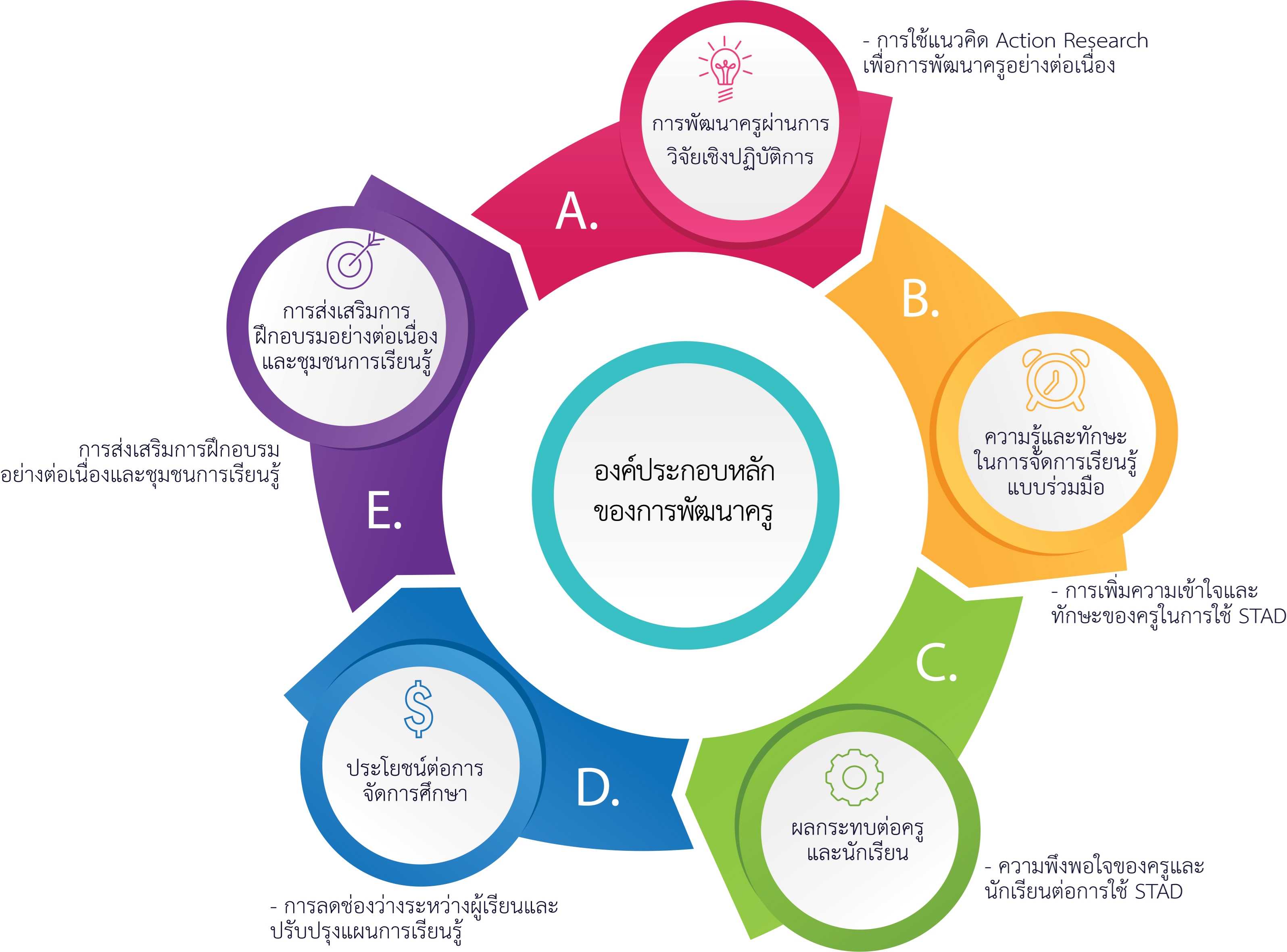
The purposes of this research were to: 1) develop teachers’ knowledge and understanding of cooperative learning through the STAD technique; 2) enhance teachers’ skills in implementing cooperative learning with the STAD technique; 3) examine teachers’ satisfaction with cooperative learning using the STAD technique; and 4) investigate students’ satisfaction with cooperative learning through the STAD technique. The research employed action research based on the model of Kemmis and McTaggart, conducted in two cycles, each consisting of planning, action, observation, and reflection. The participants were nine volunteer teachers from Saharat Anukul School under the Office of Khon Kaen Primary Educational Service Area 3. The instruments included a knowledge test, interviews, observation forms, meeting records, skill assessment forms, and questionnaires. Data were analyzed using descriptive statistics.
The findings revealed that:
1. Teachers’ knowledge and understanding of cooperative learning with the STAD technique significantly increased, with the post-workshop mean score being 3.89 points higher than the pre-workshop score.
2. Teachers’ cooperative learning skills were at a high level overall ( = 4.15), particularly in formative testing and progress evaluation (
= 4.22). Two teachers with moderate levels of performance were further supported through collaborative supervision in the second cycle, resulting in a substantial improvement to a high level (
= 4.44).
3. Teachers’ satisfaction with cooperative learning using the STAD technique was rated at a high level ( = 4.33).
4. Students also expressed high satisfaction with cooperative learning through the STAD technique ( = 4.45).
In conclusion, cooperative learning with the STAD technique effectively enhanced teachers’ knowledge, understanding, and instructional skills, while fostering satisfaction among both teachers and students. This indicates that the STAD technique contributes to effective instructional practices and achieves concrete development outcomes.
References
แคทรียา ใจมูล. (2550). ผลการจัดการเรียนรู้โดยใช้เทคนิค STAD ในกลุ่มสาระการเรียนรู้คณิตศาสตร์ เรื่อง อัตราส่วนและร้อยละ ชั้นมัธยมศึกษาปีที่ 2 โรงเรียนห้วยส้านยาววิทยา สำนักงานเขตพื้นที่การศึกษาเชียงราย เขต 2. (วิทยานิพนธ์ศึกษาศาสตรมหาบัณฑิต). เชียงราย: มหาวิทยาลัยราชภัฏเชียงราย.
ทิศนา แขมมณี. (2556). ศิลปะการสอน: ศาสตร์และศิลป์แห่งความเป็นครู. กรุงเทพฯ: จุฬาลงกรณ์มหาวิทยาลัย.
บุญชม ศรีสะอาด. (2560). การวิจัยเบื้องต้น. กรุงเทพฯ: สุวีริยาสาส์น.
พระราชบัญญัติการศึกษาแห่งชาติ พ.ศ. 2542 และที่แก้ไขเพิ่มเติม. (2542). ราชกิจจานุเบกษา, 116(74ก).
ยุรพงษ์ ฉัตรศุภสิริ. (2553). การเปรียบเทียบผลการจัดกิจกรรมการเรียนรู้กลุ่มสาระการเรียนรู้คณิตศาสตร์ เรื่อง ความน่าจะเป็น ชั้นมัธยมศึกษาปีที่ 5 ด้วยกลุ่มร่วมมือแบบ STAD กับการเรียนรู้แบบปกติ. (วิทยานิพนธ์การศึกษามหาบัณฑิต). มหาสารคาม: มหาวิทยาลัยมหาสารคาม.
ศิริวิมล หล้าหนูเหม่า. (2566). การพัฒนาชุดกิจกรรมการเรียนรู้คณิตศาสตร์ เรื่อง เศษส่วนด้วยการจัดการเรียนรู้แบบร่วมมือเทคนิค STAD ของนักเรียนระดับชั้นประถมศึกษาปีที่ 5. วารสารการบริหารนิติบุคคลและนวัตกรรมท้องถิ่น, 9(2), 155-167.
สำนักงานเลขาธิการสภาการศึกษา. (2563). รายงานการศึกษาไทยในศตวรรษที่ 21. กรุงเทพฯ: กระทรวงศึกษาธิการ.
สุธรรม ธรรมทัศนานนท์. (2554). หลักการ ทฤษฎี และนวัตกรรมการบริหารการศึกษา. (พิมพ์ครั้งที่ 2). มหาสารคาม: วิทยาลัยมหาสารคาม.
สุวิมล ว่องวานิช. (2553). การวิจัยปฏิบัติการในชั้นเรียน. กรุงเทพฯ: จุฬาลงกรณ์มหาวิทยาลัย.
อุษา มูลแก้ว. (2564). การจัดการเรียนรู้แบบร่วมมือ เทคนิค STAD ร่วมกับการใช้แผนผังความคิด (Mind Mapping) เพื่อพัฒนาความสามารถด้านการเขียนย่อความสำหรับนักเรียนชั้นมัธยมศึกษาปีที่ 1. (วิทยานิพนธ์การศึกษามหาบัณฑิต). พิษณุโลก: มหาวิทยาลัยนเรศวร.
Johnson, D. W., & Johnson, R. T. (2009). An educational psychology success story: Social interdependence theory and cooperative learning. Educational Researcher, 38(5), 365-379. https://doi.org/10.3102/0013189X09339057
Slavin, R. E. (1995). Cooperative learning: Theory, research, and practice (2nd ed.). Boston, MA: Allyn & Bacon.