The The Development of a Learning Management Model Based on Game-Based Learning Combined with Spelling Skill Exercises and the Class Point Program Affecting the Chinese Phonetic Spelling Reading Skills of Grade 8 Students Under the Khonkaen Secondary Educational Service Area Office
Keywords:
Game-Based Learning;, Class Point;, Skill Practice;, Chinese Phonetic Reading;, Learning ModelAbstract
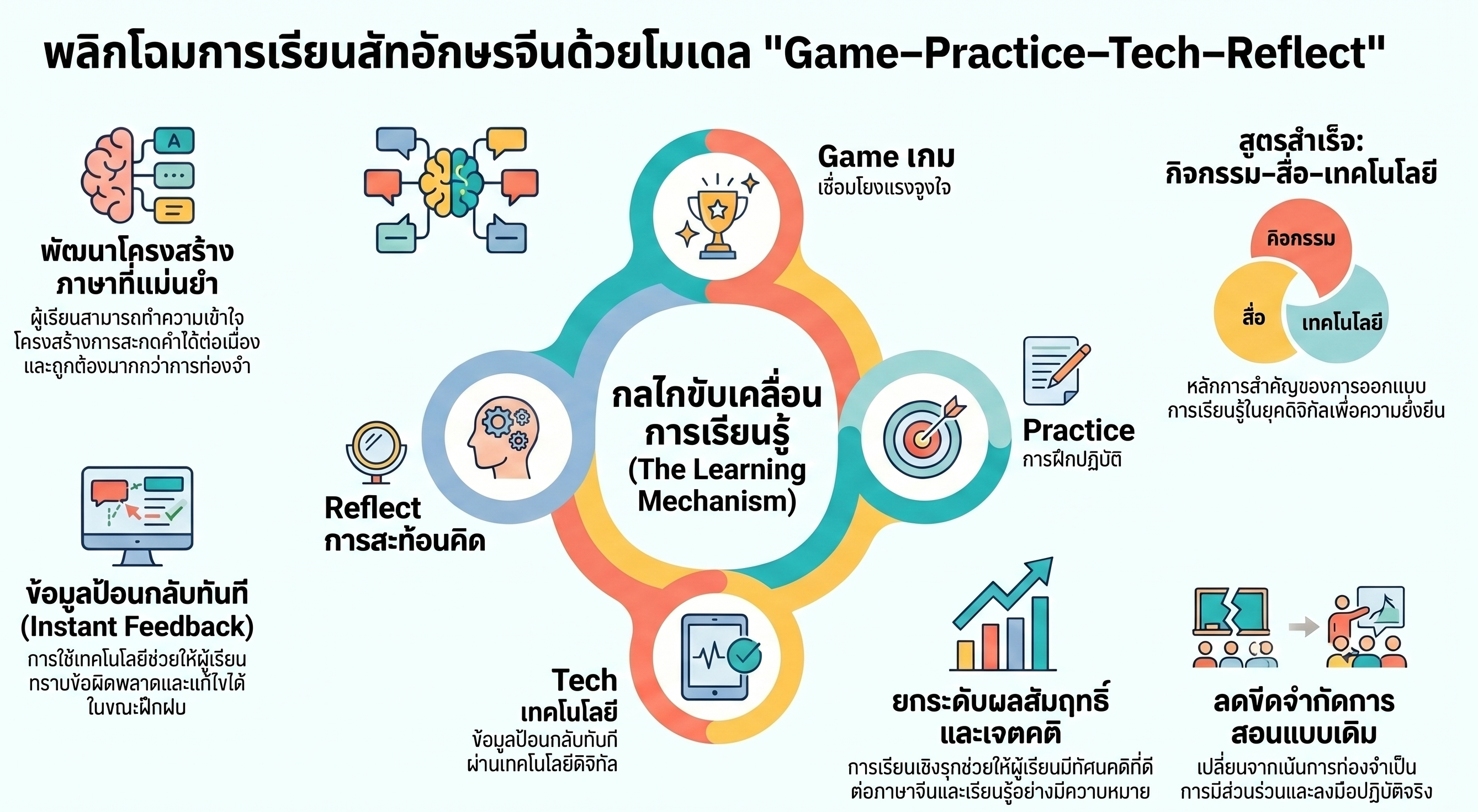
This research aimed to (1) investigate fundamental data and guidelines for developing a learning management model, (2) develop and validate the appropriateness of the model, (3) examine the effects of implementing the model, and (4) evaluate the feasibility and usefulness of a learning management model based on Game-Based Learning integrated with spelling skill exercises and the ClassPoint program on Chinese phonetic (Pinyin) spelling reading skills of Grade 8 students. This study employed a Research and Development (R&D) approach. The sample consisted of 40 Grade 8/8 students from Khonkaen Wittayayon School, selected through cluster random sampling. The research design followed a one-group pretest–posttest design. Research instruments included questionnaires, semi-structured interviews, lesson plans, a Chinese phonetic spelling test, and a student satisfaction questionnaire. Data were analyzed using mean, standard deviation, dependent t-test, and content analysis.
The findings revealed that:
1. The current state of learning management was at a moderate level ( = 3.15, S.D. = 0.82), whereas the desired state was at a high level (
= 4.48, S.D. = 0.57), leading to the development of a four-step learning model (Game-Practice-Tech-Reflect).
2. The developed model consisted of five components and was rated at the highest level of appropriateness ( = 4.51, S.D. = 0.35).
3. The implementation results showed that students’ post-test scores ( = 44.00) were significantly higher than their pre-test scores (
= 20.50) at the .01 level, and students’ satisfaction was at the highest level (
= 4.52, S.D. = 0.21).
4. Teachers evaluated the model as having the highest level of feasibility and usefulness ( = 4.56), indicating its potential for practical application and scalability in educational settings.
References
ถนอมพร เลาหจรัสแสง. (2556). การเรียนรู้ในยุคสมัยหน้า: รูปแบบและทฤษฎีการเรียนรู้อนาคต. กรุงเทพฯ: จุฬาลงกรณ์มหาวิทยาลัย.
ธีราภรณ์ ทรงประศาสน์. (2551). การใช้แบบฝึกเพื่อพัฒนาทักษะการแต่งประโยคสำหรับนักเรียนที่มีความบกพร่องทางการได้ยิน ชั้นประถมศึกษาปีที่ 6 โรงเรียนแพร่ปัญญานุกูล. (การค้นคว้าแบบอิสระศิลปศาสตรมหาบัณฑิต). เชียงใหม่:มหาวิทยาลัยเชียงใหม่.
นันทวัน สกุลไทย, และ สัจธรรม พรทวีกุล. (2567). การพัฒนาความสามารถการอ่านออกเสียงสัทอักษรจีนโดยการจัดการเรียนรู้แบบใช้เกมเป็นฐานสำหรับนักเรียนระดับชั้นประกาศนียบัตรวิชาชีพชั้นปีที่ 1. วารสารมจร อุบลปริทรรศน์, 9(3), 1589-1602.
นารา อ่ำศรี, ศรินย์พร ชัยวิศิษฏ์ และบุญรัตน์ แผลงศร. (2024). การพัฒนาสื่อการเรียนรู้โดยใช้แนวคิดเกมมิฟิเคชันเพื่อกระตุ้นการเรียนรู้ด้วย Class Point เรื่องการแสดงอัลกอริทึมในการแก้ปัญหาระดับชั้นประถมศึกษาปีที่ 3. วารสารเทคโนโลยีและสื่อสารการศึกษา คณะศึกษาศาสตร์ มหาวิทยาลัยมหาสารคาม, 7(22), 33-45.
เยาวลักษณ์ วิสุทธิ์สิริ, มนาภรณ์ บ้านเพิง และอัสมา ทรรศนะมีลาภ. (2564). การพัฒนาทักษะการพูดภาษาจีนโดยใช้กิจกรรมบทบาทสมมติกรณีศึกษาจากวิทยาลัยนานาชาติ วิทยาเขตสุราษฎร์ธานี มหาวิทยาลัยสงขลานครินทร์. วารสารครุศาสตร์อุตสาหกรรม, 20(3), 112-121. https://so06.tci-thaijo.org/index.php/umt-poly/article/view/256321
เสาวลักษณ์ โคตรสุวรรณ. (2567). การสอนโดยใช้เกมการเรียนรู้เพื่อพัฒนาทักษะการจดจำคำศัพท์ภาษาจีนนักเรียนชั้นประถมศึกษาปีที่ 2 ห้อง English Program โรงเรียนสาธิตมหาวิทยาลัยรามคำแหง วิทยาเขตบางนา. วารสารรามคำแหง ฉบับบัณฑิตวิทยาลัย, 7(3), 84-98.
Deng, H., Jermtaisong, R., & Suphakit, P. (2026). The effects of game-based learning combined with situational language teaching on Chinese character literacy of kindergarteners. Journal of Curriculum and Teaching, 15(1), 81-90.
Junco, R. (2012). The relationship between frequency of Facebook use, participation in Facebook activities, and student engagement. International Journal of Teaching and Learning in Higher Education, 24(2), 226-235.
Kirschner, P. A., & Karpinski, A. C. (2010). Facebook® and academic performance. Computers in Human Behavior, 26(6), 1237-1245.
Mayer, R. E. (2009). Multimedia learning. (2nd ed.). New York, NY: Cambridge University Press.
Organisation for Economic Co-operation and Development. (2015). Students, computers and learning: Making the connection. Paris: OECD Publishing.
Vate-U-Lan, P. (2015). Transforming classrooms through game-based learning: A feasibility study in a developing country. International Journal of Game-Based Learning (IJGBL), 5(1), 46-57.
Zhou, Y. (2003). The historical evolution of Chinese languages and scripts. Shanghai: Shanghai Education Press.