Développement of a school-based management model in the Most Challenging Highland schools in Remote Areas to develop the quality of educational institutions, Kaenoisuksa School, Under Chiang Mai Primary Education Service Area Office 3
Keywords:
Model Development; School-Based Management in the Most Challenging Highland schools in Remote Areas at Kaenoisuksa School.Abstract
The objectives of this Research and Development (R&D) were: 1) to study management guidelines for model development; 2) to construct and develop the model; 3) to implement the model; and 4) to evaluate the effectiveness of the School-Based Management (SBM) model for schools in the Most Challenging Highland schools in Remote Areas at Kaenoisuksa School, Chiang Mai Primary Educational Service Area Office 3. The target group consisted of 361 participants. The research instruments included document analysis forms, semi-structured interviews, focus group discussion records, model evaluation forms, and satisfaction questionnaires with a reliability coefficient of 0.80-1.00 Data were analyzed using content analysis, mean , and standard deviation (S.D.).
The research findings were as follows:
- Management Guidelines: The core principles of SBM for schools in the Most Challenging Highland schools in Remote Areas with maximum hardship comprise five dimensions: decentralization, participation, whole-system development, self-management, and supportive leadership. The guidelines suggest that schools should promote the use of digital technology in operations, encourage community engagement, develop quality according to institutional standards, and maintain continuous communication through both on-site and online meetings.
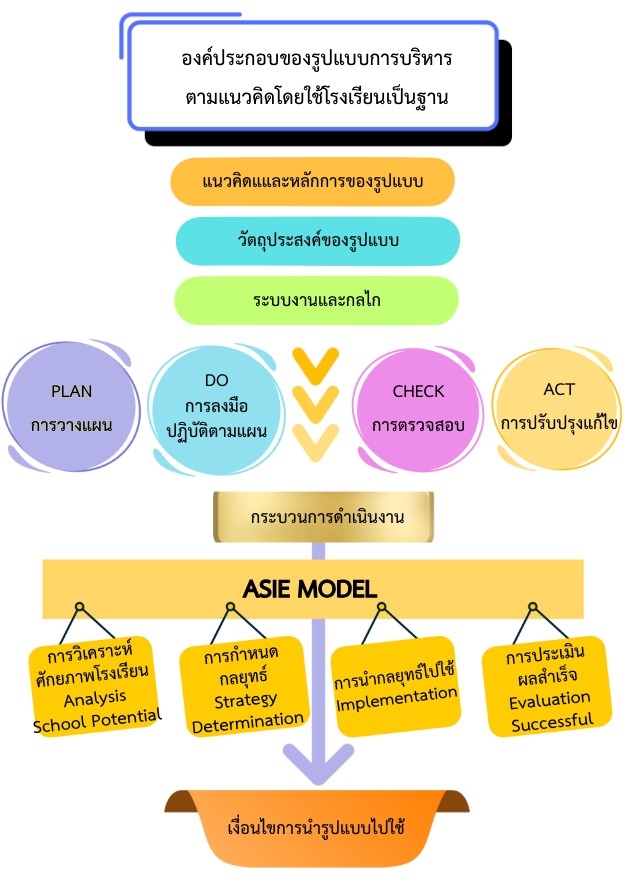
- Model Components: The developed SBM model consists of five components: concepts, principles, objectives, operational systems and mechanisms, and implementation procedures and conditions. The operational systems involve four areas: Planning, Organizing, Leading, and Controlling. The operational process, titled the ASIE Model, includes: 1) Analysis of School Potentials; 2) Strategy determination; 3) Implementation; and 4) Evaluation of Success. The evaluation of the model’s appropriateness and feasibility for practical use was at the highest level ( = 4.51, S.D. = 0.50).
- Implementation Results: The application of the model revealed that student quality, based on academic achievement across eight learning areas in the 2024 academic year (76.41%), was higher than in the 2023 academic year (69.22%), with an overall increase of 7.19%. Regarding teacher quality, teachers demonstrated high-level operational skills ($\bar{x}$ = 4.50, S.D. = 0.50). Furthermore, 100% of administrators, teachers, and educational personnel received professional recognition and awards from government agencies in the 2024 academic year. The quality of the administrative process was also at the highest level ( = 4.53, S.D. = 0.50).
- Model Evaluation: The evaluation of the SBM model in terms of utility, feasibility, propriety, and accuracy was at the highest level ( = 4.50, S.D. = 0.51). Overall satisfaction with the model implementation was also at the highest level ( = 4.53, S.D. = 0.50).