Development of Learning Achievement Using an Online Quiz Game Platform on Good Agricultural Practices (GAP) for Vegetable Production of Second-Year Vocational Certificate Students at Singburi College of Agriculture and Technology
Keywords:
Online Quiz Game Platform;, Learning Achievement;, Good Agricultural Practices (GAP);, Agricultural Vocational Education;, Active LearningAbstract
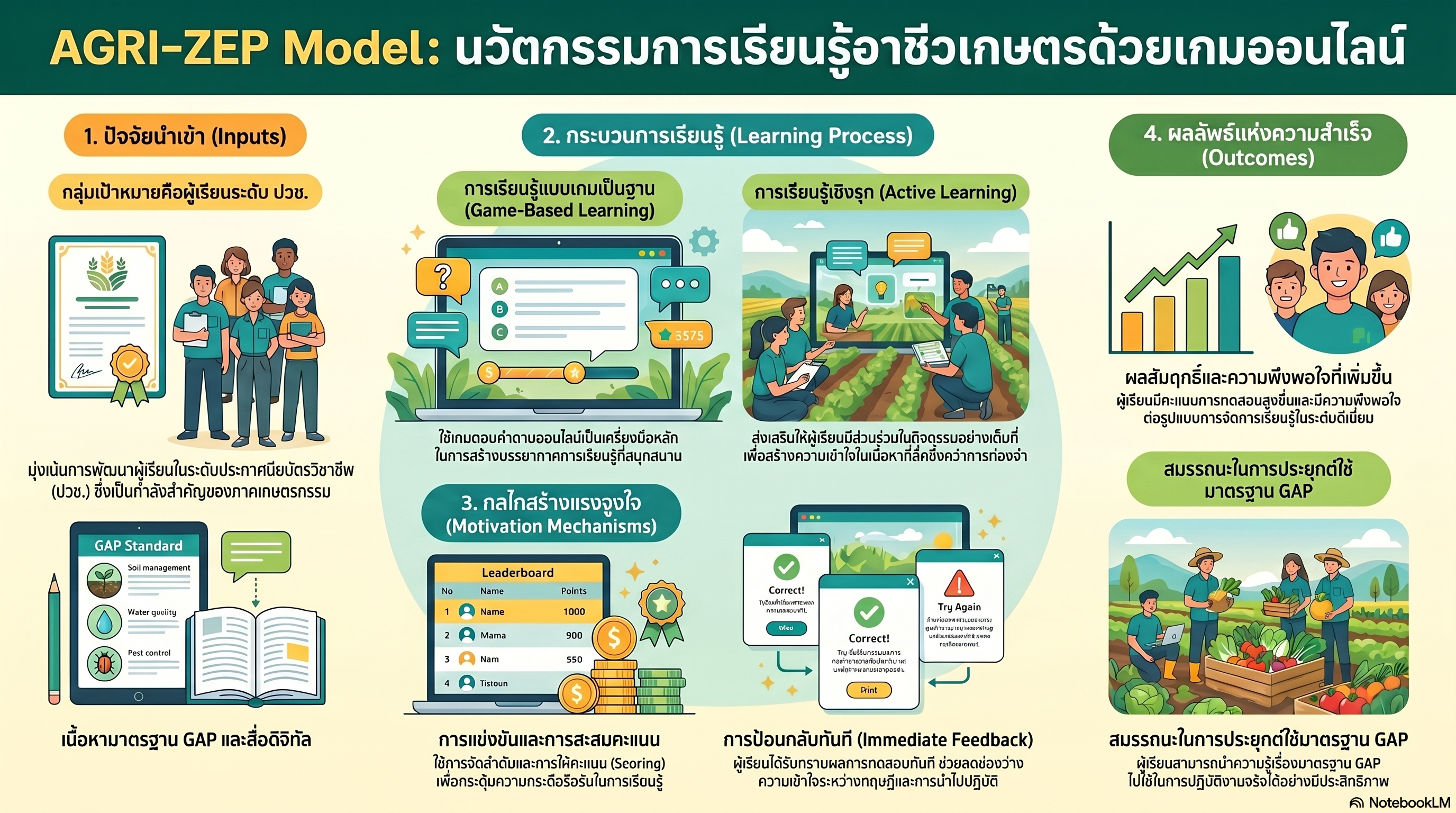
This research aimed to: 1) compare students’ learning achievement before and after learning through the Zep Quiz, and 2) examine the satisfaction of second-year Vocational Certificate students after learning through the Zep Quiz. This study is a quasi-experimental study. The sample consisted of 12 second-year Vocational Certificate students in the academic year 2025. The research instruments included a 20-item learning achievement test and a five-level satisfaction questionnaire. Data were analyzed using mean, standard deviation, and dependent samples t-test.
The findings revealed that:
1. A comparison of students’ learning achievement before and after learning using the online quiz-based game platform (Zep Quiz) showed that the post-test mean score ( = 15.66, S.D. = 1.61) was significantly higher than the pre-test mean score (
= 11.00, S.D. = 1.80) at the .01 level of statistical significance.
2. The satisfaction of second-year vocational certificate students after learning through the online quiz-based game platform (Zep Quiz) was found to be at a high level overall ( = 4.19, S.D. = 0.70). Students reported that the learning activities were enjoyable and challenging, and helped them understand the content more easily. In conclusion, the use of the online quiz-based game platform (Zep Quiz) can be considered a creative instructional medium that effectively promotes learner engagement and enhances learning achievement in the vegetable production course.
References
กรมวิชาการเกษตร. (2562). หลักเกณฑ์และวิธีการปฏิบัติทางการเกษตรที่ดีสำหรับพืชอาหาร (GAP). กระทรวงเกษตรและสหกรณ์. เข้าถึงได้จาก https://www.doa.go.th/oard5/wp-content/uploads/2024/02/04-gap.pdf
ทิลารัตน์ หนูปก. (2568). การพัฒนาผลสัมฤทธิ์ทางการเรียน เรื่องระบบประสาทและอวัยวะรับความรู้สึก วิชาชีววิทยา 4 ชั้นมัธยมศึกษาปีที่ 6 โดยการใช้เทคนิคการสอนแบบร่วมมือ Teams-Games-Tournament (TGT) ร่วมกับ ZEP Quiz. (รายงานการวิจัย). ตราด: โรงเรียนเขาสมิงวิทยาคม “จงจินต์รุจิรวงศ์อุปถัมภ์”.
ธัญวดี กำจัดภัย, จตุรพร กัณหา และประกายแก้ว เสียงหวาน. (2567). การพัฒนาผลสัมฤทธิ์ทางการเรียนด้วยเทคนิคการจัดการเรียนรู้โดยใช้เกมเป็นฐาน เรื่องโครงสร้างระบบเครือข่าย สำหรับมัธยมศึกษาปีที่ 6. วารสารวิจัยวิชาการ, 7(4), 309-324. https://so06.tci-thaijo.org/index.php/jra/article/view/263860
สำนักงานคณะกรรมการการอาชีวศึกษา. (2560). แนวทางการจัดการเรียนรู้ฐานสมรรถนะ. กรุงเทพฯ: สำนักงานคณะกรรมการการอาชีวศึกษา.
สำนักงานสภาพัฒนาการเศรษฐกิจและสังคมแห่งชาติ. (2565). แผนพัฒนาเศรษฐกิจและสังคมแห่งชาติ ฉบับที่ 13 (พ.ศ. 2566-2570). กรุงเทพฯ: สำนักงานสภาพัฒนาการเศรษฐกิจและสังคมแห่งชาติ.
อัญชิสา พันธ์ชัย. (2568). การพัฒนาทักษะการคิดเชิงคำนวณและความสามารถในการแก้ปัญหาแบบเรียลไทม์ โดยใช้นวัตกรรม ZEP Quiz Interactive Platform ของนักเรียนชั้นประถมศึกษาปีที่ 5 โรงเรียนเทศบาล 5 (บ้านศรีบุญเรือง) ตามแนวทางการจัดการเรียนรู้ฐานสมรรถนะในยุคดิจิทัล. ลำปาง: คลังนวัตกรรมทางการศึกษา จังหวัดลำปาง.
Bonwell, C. C., & Eison, J. A. (1991). Active learning: Creating excitement in the classroom (ASHE-ERIC Higher Education Report No. 1). Washington, DC: The George Washington University, School of Education and Human Development; ERIC Clearinghouse on Higher Education. Retrieved from https://eric.ed.gov/?id=ED336049
Dichev, C., & Dicheva, D. (2017). Gamifying education: What is known, what is believed, and what remains uncertain: A critical review. International Journal of Educational Technology in Higher Education, 14, Article 9. https://doi.org/10.1186/s41239-017-0042-5
Kolb, D. A. (1984). Experiential learning: Experience as the source of learning and development. Englewood Cliffs, NJ: Prentice-Hall.
Prensky, M. (2001). Digital game-based learning. New York, NY: McGraw-Hill.