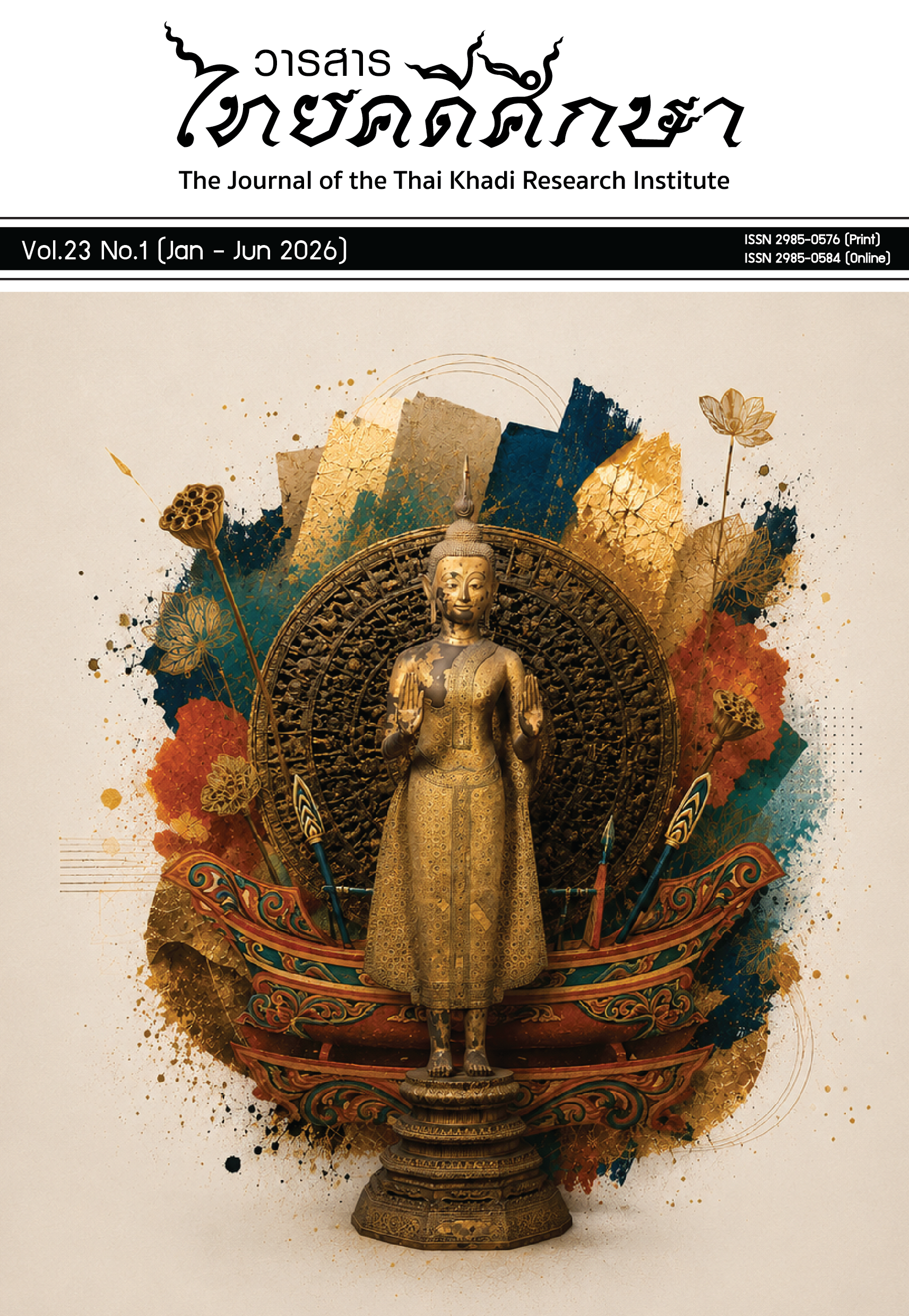
Floral - robed Ornamentation on Buddha Images in Rattanakosin Art
Article Sidebar
Main Article Content
Abstract
Floral - robed Buddha images cast from metal are widely distributed throughout Thailand. However, the form and method of making these Buddha images have not been thoroughly investigated. This article aims to employ art historical methodologies, historical documents, and interviews the artisans to analyse the evolution, the origins, and the factors contributing to the decline of the floral robe Buddha image, as well as to identify the reasons for variations in their forms across different periods.
Thefindings indicate that metal - cast Buddha images with floral robes from the late nineteenth and early twentieth centuries CEexhibit stylistic similarities to those produced in the eighteenth and nineteenth centuries CE. These images are likely the earliest group of floral robe Buddha images created through casting, resulting from the use of soapstone moulds since at least the reign of King Rama III. Most of the soapstone was likely sourced from Khao Cha - ngok, a site that continues to supply material today.
Floral robe Buddha images produced in the early to mid - twentieth century CE were influenced by the Phra Buddha Chinnarat group of Sukhothai style, in part due to the prominence of the royal court and nobility since the reign of King Rama IV. Additionally, these images were shaped by Lanna art Buddha images originating from Chiang Saen were regarded as ‘an authentic Siamese style’ and were believed to date back to the eleventh to twelfth centuries CE.
The general group of Sukhothai Buddha images also appeared in floral - robed Buddha images during the first half of the twentieth century CE. This trend is likely related to the use of Sukhothai art and culture to foster nationalist ideas since the reign of King Rama VI, as well as the publication of Sukhothai studies during that period. The decline of floral - robed Buddha images was likely due to the increasing popularity of Sukhothai Buddha images and the relatively high price of Buddha images with floral robes, which contrasted sharply with the serious economic decline in Siam at that time.
Downloads
Article Details

This work is licensed under a Creative Commons Attribution-NonCommercial-NoDerivatives 4.0 International License.
There is no charge for paper processing and publication. Once the paper is under peer-review process, however, if the paper is withdrawn for any reason the author will be responsible for the expense of 3,000 Baht occurred in the review process.
References
Akharanitipirakool, N. (2023). รูปแบบและที่มาของพระพุทธรูปยุคแรกเริ่มของบ้านช่างหล่อ [Patterns and Origins of Buddha Images in the Early Period of Ban Chang Lo, Bangkok]. Damrong Journal, 22(2), 97 - 120.
Apiwattano, C. (2001). คู่มือนำเที่ยววัดพระพุทธบาท [Wat Phra Phutthabat Guidebook]. Bangkok: Amarin Printing.
Banprasert, T & Chotiphanich, R. (2020). พระประวัติพระวรวงศ์เธอ พระองค์เจ้าประดิฐวรการ แม่กองสร้างวัดราชบพิธสถิตมหาสีมาราม พุทธศักราช 2412 - 2428 [Biography of Praditworakarn, the chief architect of Wat Ratchabophit Sathitmahasimaram, 1869 - 1885]. Bangkok: Wat Ratchabophit Sathitmahasimaram.
Cedes, J. (1928). โบราณวัตถุในพิพิธภัณฑสถาน สำหรับพระนคร [Antiquities in the Museum for Phra Nakhon]. Phra Nakhon: Sophonpipattanakorn Printing House.
Chanthanumat (Cherm), Pan. (1936). ประชุมพงศาวดาร ภาคที่ 64 พงศาวดารกรุงศรีอยุธยาฉบับพันจันทนุมาศ (เจิม) [Collection of Chronicles, Part 64, The Chronicles of Ayutthaya, Pan Chanthanumat (Cherm) Edition]. Phra Nakhon: Sophonpipattanakorn Printing House.
Chitchayano, S. (ed.). (2018). สมโภชพระอาราม 230 ปี วัดพระเชตุพนวิมลมังคลาราม [230th Anniversary Celebration of Wat Phra Chetuphon Vimol mangkalaram]. Bangkok: Wat Phra Chetuphon Vimolmangkalaram.
Chulalongkorn, His Majesty King. (1928). พระราชปรารภเรื่องพระพุทธชินราช [King Chulalongkorn, Royal Preamble on Phra Buddha Chinnarat]. Bangkok: Phanitchasap Udom Printing House.
Chulalongkorn, His Majesty King. (1965). พระราชหัตถเลขาคราวเสด็จมณฑลฝ่ายเหนือ ในรัชกาลที่ 5 (พิมพ์ครั้งที่ 3) [Royal Letter of His Majesty's visit to the northern provinces in the reign of King Rama V] (3rd ed). Phra Nakhon: Fine Arts Department.
Doojitakram, N. (2020, June 25). วัดดวงแข [Wat Duangkhe]. Retrieved February 5, 2022, from https://thaimna.wordpress.com/2020/06/25/ชม-4-วัดราษฎร์-เขตปทุมวัน-3/.
Jutavipat, W. (2001). หัตถกรรมไทย: ความเป็นมาและการผลิตในปัจจุบัน ศึกษากรณีการปั้นหล่อพระ การทำบาตรพระ การทำขลุ่ยและการทำของเล่นไม้ระกำ [Thai handicrafts: history and current production Study the case of making Buddha images, making alms to monks, making flutes, and making wooden toys]. Bangkok: Chulalongkorn University Press.
Ketwat, S. (2021, March 30). A soapstone carver at Khao Cha Ngok, Nakhon Nayok Province.
Literature and History Division. (1999a). ประชุมพงศาวดารฉบับกาญจนาภิเษก เล่ม 1 [Collected Chronicles of Golden Jubilee Edition, Volume 1]. Bangkok: Literature and History Division, Fine Arts Department.
Literature and History Division. (1999b). ประชุมพงศาวดารฉบับกาญจนาภิเษก เล่ม 5 [Collected Chronicles of Golden Jubilee Edition, Volume 5]. Bangkok: Literature and History Division, Fine Arts Department.
Mongkut, His Majesty King & Wichitwathakarn (Wijit), Maj. Gen. Luang. (1958). ตำนานพระแก้วมรกต ตำนานพระพุทธชินราช พระพุทธชินศรี และพระศรีศาสดา ตำนานพระพุทธสิหิงค์ [Legend of the Emerald Buddha Legend of Buddha Chinnarat Phra Buddha Chinsri and Phra Sri Satsada Legend of Phra Buddha Sihing]. Bangkok: Aksorn Service Printing Press.
Nanti, A. (2019). รูปแบบและกรรมวิธีการสร้างพระพุทธรูปครองจีวรลายดอกสมัยรัตนโกสินทร์ [Styles and methods for creating floral robes Buddha images in the Rattanakosin period]. (Master’s thesis, Art History Department, Silpakorn University).
National Archives. (n.d.). ใบบอกเมืองนครนายก ร.5 ม.2.12 ก [Nakhon Nayok city report R.5 M.2.12 K]. (n.p.).
National Archives. (n.d.). สำหรับตัวเรื่องทูตญี่ปุ่นที่เข้ามารับพระสรีระธาตุ และขอต้นโพธิ์ [For the story of the Japanese ambassador who came to receive the Buddha's relics and asked for a Bodhi tree]. Documents of King Rama V, Ministry of Education, ร.5 ศ.11 - 13. (n.p.).
Phikun Silpakarn Library. (2022, January 9). พระพุทธรูปทรงเครื่องวัดระฆังโฆสิตาราม คุณจ่ายวด คุณหญิงแย้มสร้างเมื่อ พ.ศ. 2399 [Bejeweled Buddha image of Wat Rakhang Khositaram. Khun Jayuad, Khun Ying Yam cast in 1856]. Retrieved February 5, 2022, from https://www.facebook.com/PikulKnowledgeCenter/.
Rajanubhab, D, H.R.H. Prince. (1958). นิทานโบราณคดี (พิมพ์ครั้งที่ 9) [Archaeological tales] (9th ed.). Bangkok: Klangwittaya.
Rajanubhab, D, H.R.H. Prince. (1975). ตำนานพระพุทธเจดีย์ [Legend of the Buddha Chedi]. Bangkok: Khlang Witthaya.
Ratchatawan, P. (2006). ร่องรอยจากชื่อชุมชนที่เหลืออยู่ : ภาพสะท้อนการเปลี่ยนแปลงและปรับตัว กรณีศึกษา ชุมชนบ้านช่างหล่อ บางกอกน้อย กรุงเทพฯ [Remaining traces of community names: reflections on change and adaptation, case study of Ban Chang Lo community, Bangkok Noi, Bangkok]. (Bachelor’s thesis, Anthropology Department, Faculty of Archeology, Silpakorn University).
Royal Gazette, Vol. 1. (1885). (n.p.).
Saising, S. (2013). พระพุทธรูปในประเทศไทย : รูปแบบ พัฒนาการและความเชื่อของคนไทย [Buddha statues in Thailand: styles, development, and beliefs of Thai people]. Bangkok: Department of Art History, Faculty of Archeology, Silpakorn University).
Tangkhawanit, W. (2014). ประวัติศาสตร์ “สุโขทัย” ที่เพิ่งสร้าง [The Newly Created History of Sukhothai]. Bangkok: Matichon.
Thamrungruang, R. (2018). เหตุต้น - ผลตาม เมื่อพระพุทธรูปสุโขทัยเป็นตัวแทนศิลปะยุคทองของไทย [Cause - Effect: When the Sukhothai Buddha is a representative of Thai Golden Age art]. In Tosomboon, S & Kamson, O. (ed.), อดีต ตัวตน กับความจริงแท้ของชาติพันธุ์ ศิลปะ และโบราณคดี [Past Self and the Real Truth of Ethnicity, Art, and Archeology] (85 - 122). Bangkok: Sirindhorn Anthropology Center.
Thianthaworn, W. (2018, September 9). สภาวการณ์ทางเศรษฐกิจยุคแบบตะวันตกในรัชกาลที่ 5 - 7 [Western economic circumstances during the reigns of King Rama 5 - 7]. Retrieved February 5, 2022, from https://www.matichon.co.th/columnists/news_1121421.
Uiyanon, P. (2022, February 22). อุปสรรคที่ทำให้ “คณะราษฎร” แก้ปัญหาเศรษฐกิจตกต่ำในทศวรรษ 2470 ได้อย่างจำกัด [Obstacles that limited the “People's Party” in solving the economic downturn in the 1920s]. Retrieved May 21, 2024, from https//www.silpa-mag.com/history/article_69941.
Wongthet, S. (ed.). (2021). พระแก้วมรกต [The Emerald Buddha]. Bangkok: Matichon.
Yuman, K. (2020, October 9). A casting artist in Baan Chang Lor, Bangkok.
สารบาญชี ส่วนที่ 1 คือตำแหน่งราชการสำหรับเจ้าพนักงานกรมไปรษณีย์กรุงเทพมหานคร เล่มที่ 1 [Conscription part 1, the official positions for Bangkok Post officials, Volume 1]. (1998). Bangkok: Tonchabub Publishing House.
สารบาญชี ส่วนที่ 2 คือราษฎรในจังหวัด ถนน แล ตรอก สำหรับเจ้าพนักงานกรมไปรษณีย์กรุงเทพมหานคร เล่มที่ 2 [Conscription part 2, people in the province, roads, and alleys for the officers of the Bangkok Postal Department, Volume 2]. (1998). Bangkok: Tonchabub Publishing House.
สารบาญชี ส่วนที่ 3 คือราษฎรในจังหวัดบ้าน หมู่ และลำน้ำสำหรับเจ้าพนักงานกรมไปรษณีย์กรุงเทพมหานคร เล่มที่ 3 [Conscription part 3, people in the province, villages and rivers for the Bangkok Post Office officers, Volume 3]. (1883). Bangkok: Ban Prat Le.
สารบาญชี ส่วนที่ 4 คือราษฎรในจังหวัดคูแลคลองลำปะโคลง สำหรับเจ้าพนักงานกรมไปรษณีย์กรุงเทพมหานคร เล่มที่ 4 [Conscription part 4, people in the province, canals, ditches for the Bangkok Postal Department officials, Volume 4]. (1883). Bangkok: Ban Prat Le.
Interviewee
Atichatanan, S. (2020, December 7). An owner of Patthanachang Foundry, Ban Chang Lor, Bangkok.
