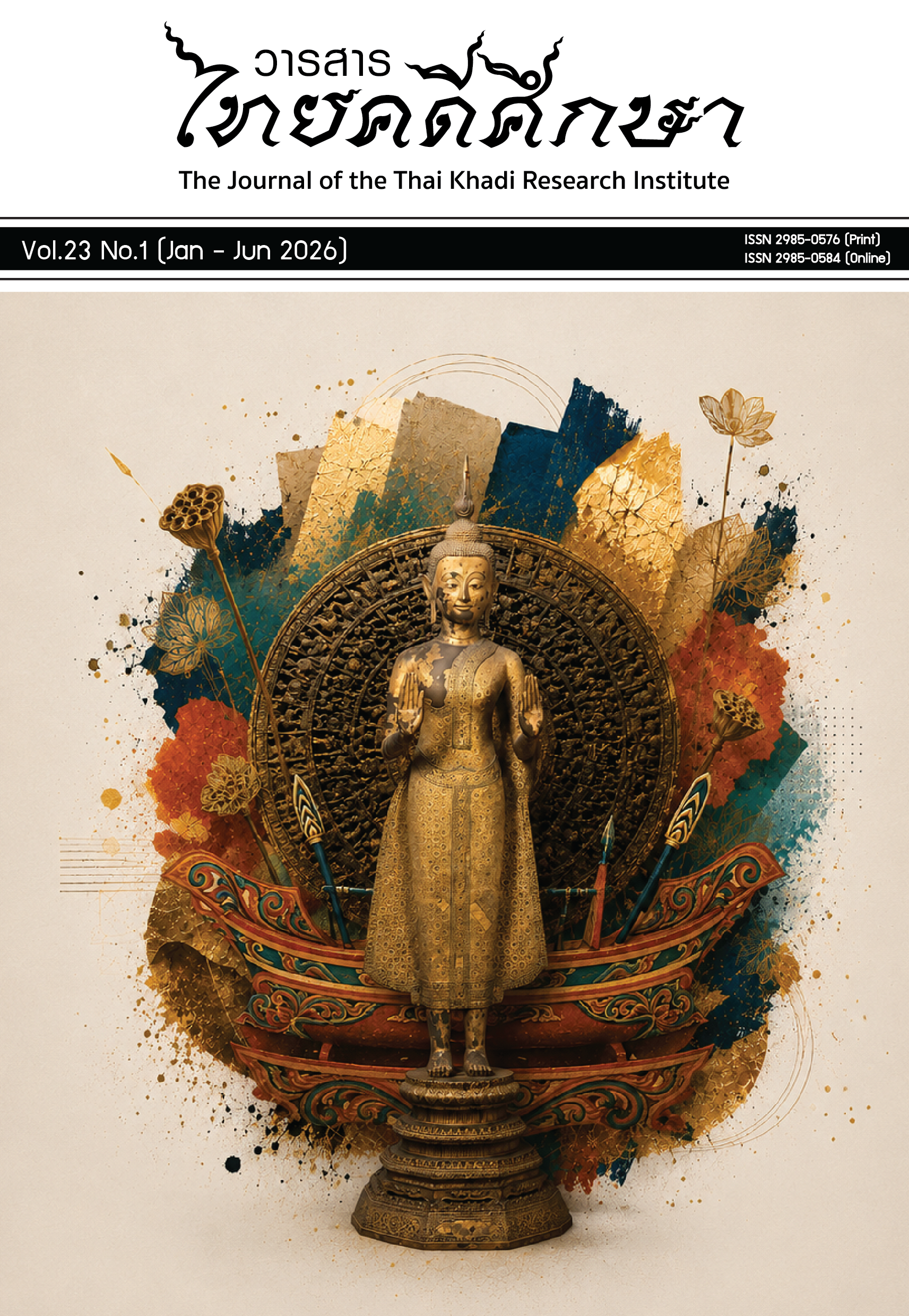
January - June 2026
Vol. 23 No. 1 (2026)
Among the varieties of research topics in Thai studies, the Journal of Thai Khadi Research Institute's current issue, Volume 23, Number 1, is the most diverse. This issue's content included art history, historiography, cultural studies, folk wisdom, tourist studies, and a book review.
The Round-shaped 108 Auspicious Buddha's Footprint in Sukhothai and Ayutthaya Arts: A Study of Its Original and Developmental Styles, written by Sirot Pinanratchathon, is the opening in the issue. His article aims to amplify the meaning of the signs that artisans in the past engraved on the 108 auspicious marks of the Buddha's footprint. He assumes that the theory of the great kingship is used, and that highlighting the wheel of Dhamma at the centre enhances the sacredness of the footprint. This development is not only based on political and social entanglement, but also on the religious principle in Sukhothai kingdom. Almost a century later, the Ayutthaya court's artisans are influenced by this developmental style. In his article, Sirot presents a comparative methodology for the various artefacts created from the late twentieth to the late twenty-first century. The study shows that the continuation of the artisans' practice illustrates the reinterpretation of the religious canon, called Lokasart, or the mythology of the earth's existence, which was the most important at the time.
As well as the art historical studies written by Naran Akharanitipirakool. Her study changes the perception that the Flora-roped Ornamentation on Buddha Images in the Rattanakosin Art, which can be seen in the work of a group of the court's artisans from the early eighteenth to the nineteenth century, or in the work of King Rama III, was characteristic of Siamese Buddhism before the Dhammayut reformation. According to this study, the ornamental floral-robes on Buddha images are dated much further back to the Sukhothai period or the thirteenth to fifteenth centuries. The ornamental floral-robed Buddha images are clearly influenced by the Sokhothai and Lanna Art. This style is recreated in Rattanakosin art at the metalsmith’s district, called Ban Chang Lor, in Bangkok, where soapstone moulds are still found today.
The Style of Trit Headdresses on Human-shaped Sculptures from the Noen Thang Phra Archaeological Site in Sam Chuk District, Suphan Buri Province, written by U-bonwan Sokrai. This article leads the readers to analyze the form of headdresses, called Trit in Thai, which date back to Indian Art and Angkor Art. This article leads the readers to analyzes the form of headdresses, called Trit in Thai, which date back to Indian Art and Angkor Art from the original places, but not influenced by archaeological sites inside Thailand.
Tattanit Tongdaeng wrote an article titled Recognition of Chinese Cultural Values or the Endorsement of Fashion Consumption. Her cultural studies of Chinese classical opera in Thailand trace the history of Thai people’s patronage of these shows since the Ayutthaya period. Chinese classical operas were popular among the Thai people, serving as an indicator of a highly hierarchical society. Popularity among Thai and Chinese people in Ayutthaya differed. The study finds that appreciation of the opera was shaped by education in philosophy, virtue, morals, and Chinese culture among Cantonese society in Ayutthaya. For Thai people, this is an exotic play from foreigners’ country. The writer of this article has made a keen point with the comparative study between Chinese and Thai classic opera, called Khon. The latter is regarded either as sacred or as a ritual behind the Thai kingship. Consequently, Thai elites support Khon rather than Chinese opera because of their political awareness.
The ‘royalist history’ may appear in the mode of writing narratives of the upper states of Siam. Chaipong Samnieng’ article, titled The Historiography of the Upper Siam States in the Lower Northern Region, criticizes the government-centered historical writings of the upper Siam states. The conventional writings are always entangled with the glory of Sukhothai, Ayutthaya, and Rattanakosin, or the capital cities of each past time. This study finds that during the 1970s, there were attempts to write their own stories, which enriched Northern people and social conditions, but these efforts never gained prominence in Thai history. The nationalistic historiography has already overshadowed the local ones and placed the labels as an authorizing historical writing over the local stories.
The local wisdom and tourist studies are in the article titled Knowledge Management Ecosystem to Convey and Preserve Arts and Crafts, Kolae Boat Model, in the Royal Craft Community, Khok Khian, Muang Narathiwat Province, by Abdullah Chelong and Mareekee Madeng. How cultural assets development, such as making the Kolae boat model, is described by quantitative methodology. Their article aims to propose a comprehensive and everlasting protection of the local community’s wisdom. The last article is A Study of Tourist Behavior Regarding Beliefs about Merit and Sin Influences Buddhist Tourism in Nakhon Ratchasima Province, written by Kittisak Klinmuenwai. This study is an example of tourist’s behavior within “religious tourism,” which is gaining popularity in Thai society.
This Journal’s issue concludes with a book review written by Pannatat Jittakul on Contesting the Mekong Frontier: A History of Disputed Territory by Tanapong Luekajornchai. His perspective on the introduction and analysis is interestingly useful. His review also continues the Journal of Thai Khadi Research Institute’s democratic space for the academic community, including Thai Studies scholars and for the public readership.
In consequence, on behalf of the editorial team, the Journal of Thai Khadi Research Institute hopes at its best that wider academic perspectives are open to everyone. And encouraging all readership to pursue a new academic frontier in ‘Thai Studies.’ And we certainly hope that the articles published in our Journal are persuasive. The editorial team thank you for the support and is open to suggestions for future improvements.
Chief Editor
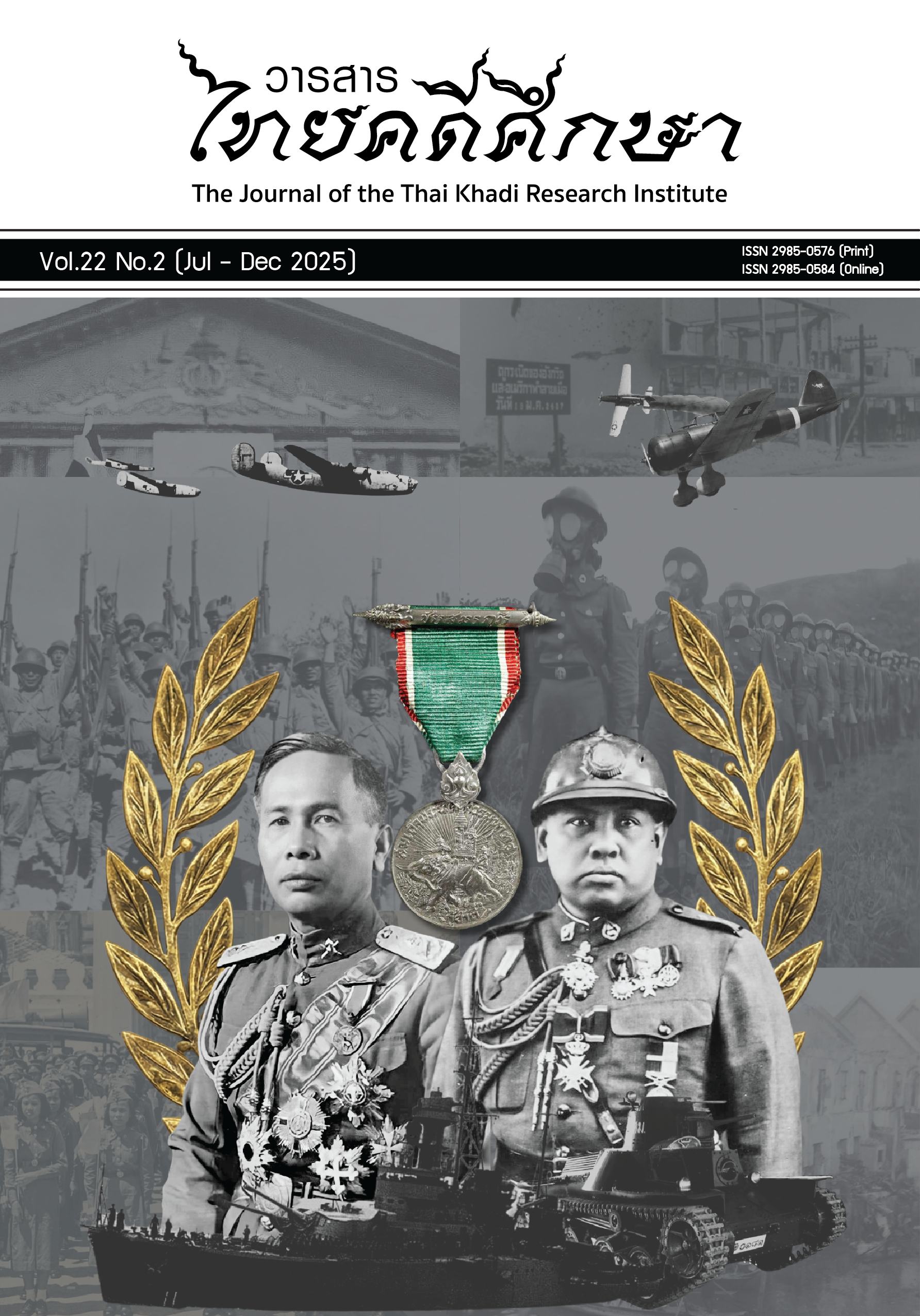
July - December 2025
Vol. 22 No. 2 (2025)
On October 24, 2025, the people of Thailand mourn the passing of Her Majesty Queen Sirikit, the Queen Mother of His Majesty the King Vajiralongkorn. From 1946 to 2016, the Queen Mother fulfilled royal duties side by side with the late His Majesty King Bhumibol. Her Royal Highness has contributed to shaping the image of ‘a perfect family’ and has served as ‘a centre of gratefulness.’ Her Royal Highness has also significantly supported the establishment of ‘the royal hegemony'. Since the day came, there has been speculation that it signifies the true decline of a remarkable era under the reign of the late His Majesty King Bhumibol, Rama IX. On behalf of the Thai Khadi Research Institute and the editorial board, I, the chief editor of this issue, extend my condolences to the Royal Family for their significant loss. As citizens of Thailand, we sincerely appreciate Her Royal Graces.
The current issue of the Journal of the Thai Khadi Research Institute represents the diversity of scholarly research, including history, regional folklore, culture, art history, and tourism. Today marks the 80th anniversary of the end of World War II. Boonpisit Srihong wrote an article titled Thailand and the Second World War Involving Process: A Revisionist History. Boonpisit invites the reader to explore the issue of Thailand's entry process into the War through newly discovered reliable sources. These sources indicate that, since the late 1920s, the Thai government and Thai citizens were highly cautious about the surrounding circumstances that could lead to a hint of war eruption. Boonpisit's finding is that the Thai government and its citizens had prepared for the disturbances before the Japanese imperial army invaded Thailand. Moreover, the preps were set up outside the pan-nationalist political condition. However, this article argues against the mainstreaming of the authoritarianism dispute in the early 1930s.
In addition, one of the well-known historical resources can provide us with a new aspect of the social history of Thai traditional music. Songpon Loedkobkune wrote an article titled Thai Music in the Ayutthaya Period: A Social History Based on the Statement of Khun Luang Wat Pradu Song Tham Evidence from the Royal Library. His reexamination of the famous primary sources draws a sketch of a vibrant society in the late Ayutthaya, where Thai traditional music was an integral part of daily life. Furthermore, the illustrative examples include various types of musical instruments readily available in the community marketplace. This picture reflects the diversity of a popular music culture, and the popularity of the specific market during this period sketches ‘bourgeois culture,’ which its shadows might have appeared at least in the late Ayutthaya period.
This issue includes folktale and folklore investigation. An article titled The Myths of King Taksin the Great and His Social and Cultural Relations with Nakhon Si Thammarat, written by Channarong Kongchim and his associates. The residence of King Taksin the Great after exile to the far Southern province was reinvestigated through hearsay and rumors. The southerners believed that since King Taksin the Great escaped the death penalty and spent his final phase of life in Nakhon Si Thammarat. Their finding suggests a geographic entanglement with oral history, which contradicts to popular historical narratives. Their dispute was built upon folktales, lullabies, and collective memories of the commoner. The Southerners also modified their endemic oral history into both tangible and intangible cultural assets. Finally, these local traditions remain valuable.
Another reason that makes Southerners wealthy in cultural assets is that their cuisine is reported as a transcultural by-product, as Bandit Grivijitr and his associates wrote an article titled The Diversity of Southern Food Cultures: Cross / Intercultural Food. The research project was funded by the Department of Cultural Promotion, Ministry of Culture. The project colleagues peer at local cuisine and serve it as a civil way of life. Southern cuisine exemplifies a transcultural marriage that creates dynamic and energetic substances, such as a specific menu served during the Islamic pilgrimage to Mecca, known as Hajj, which signifies the historical transmission of Arabic food culture in the past. In any case, the primary consideration is the selection and recalibration of suitable ingredients and condiments that meet the local dwellers’ preferences. As we can see, some of the Malay-Muslim cuisines reflect the Chinese selective and recalibrated preferences for local savory. As a result, the diversity of Southern food cultures illustrates the deep-seated geopolitics and globalization of this particular region. Colleagues of this researcher suggest that Southern cuisines hold greater significance than local eating traditions; moreover, they emphasise the globally transmitted companionship diet.
The amalgamation, selection, and recalibration can also be seen in art historical studies. An article titled Balustrade with Naga and Makara in Lanna art 21st - 22nd Buddhist Century, written by Nuttawan Numbut. He observes that prior to the twenty-first century, there was no integration of Naga concepts in the construction of a balustrade within the Lanna art tradition. The balustrade adorned with Naga and Makara motifs originates from the reign of King Tilokaraj and the reign of Kaeow Phutadhipatirat, nephew of King Tilokaraj, of the Mangrai dynasty, Kingdom of Lanna. Nuttawan proposes that technicians from Ayutthaya may have exerted influence on this particular decoration, considering the close involvement of the two kingdoms in warfare. Subsequently, Lanna technicians embraced these concepts and recreated them. Furthermore, Nuttawan also speculates on the correlation between the art styles that share similar ideals, such as depicting the image of the Buddha during the reign of King Tilokaraj. Notably, the Lawa Pura cast-metal Buddha features a bold, sharp shinbone. Nevertheless, this particular cast-metal Buddha style was influenced by the southern states, notably Ayutthaya.
Patronages always determine the characteristics of art objects as they are admired. Chankhanit Arvorn wrote The Study of Proportions of the Large Vihara in Kruba Srivichai Process: the Technical Relationship, Art Patterns and the Patronage Network. In this article, Chankhanit examines “Mok,” the proportions of the renovated Vihara under the patronage of Kruba Srivichai’s network. In his terms, Kruba Srivichai’s process refers to the renovation procedure of the local monastery throughout the northern provinces of Thailand. During the late 1910s and 1920s, the highest reverend reassembled the competent public figures, such as technicians, noblemen, entrepreneurs, and esteemed monks, and played a pivotal role as a leader of religious activities. These public figures and technicians leave their ‘signatures’ on the renovation procedures, as evident among the monasteries under the network’s patronage. Consequently, they became contemporary artistic works. Moreover, they provide a strong network under the patronage of the highest reverend Kruba Srivichai, which is reflected in their faithfulness, decisive leadership, and durable structure. Their potential energy demonstrates the achievement of Kruba Srivichai’s process in contemporary Lanna history.
The reconstruction of local heritage is also illustrated in creative tourism. An article titled Creative Tourism Identity and Image of Nonthaburi, Pathum Thani, and Ayutthaya, which is linked to the Bangkok Area, written by Puriwaj Dachum and his associate. The identities of local tourists’ destinations were found. Thanks to the search for charming visiting spots among the three riverbank provinces, Nonthaburi, Pathum Thani, and Ayutthaya. These three provinces are linked to Bangkok, Thailand’s capital and tourist attractions. The searching process includes cognitive behaviors of creative tourism identities over three provinces. They found that the riverside dwellings and multiculturalism are attracting tourism. These creative tourism identities showcase Thailand’s historic roots and attract both domestic and international sightseers. However, the cognitive behaviors of creative tourism, both among Thais and foreigners, are often portrayed more positively by the media than they actually are, particularly in the three areas. This pain point is considered a problem that needs to be addressed for a more accurate representation of tourism in the near future.
This current issue of the Journal of Thai Khadi Research Institute includes a recommendation of the latest book, New Directions in Thai Studies (2025), edited by Preedee Hongsaton and Ying-Kit Chan, suggested by Wirawan Naruepiti. This piece reviews the dominance of overseas-educated scholarships in Thai studies, specifically those from the United States of America and its companion academy from the West during the Cold War. This book collects the work of young scholars in early careers, whose suggestions are carefully designed within established frameworks. They introduce three components of the proposal: New History, New Discipline, and New Comparison. Furthermore, they aim to initiate critical conversations and propose new facets for challenging the dominant academic concepts. Moreover, Kavintorn Satien reviews a book of Grain Revolution: The History of Plant Recognition in Thai Society 1782 - 1992 (2023), written by Tiwaporn Jaikon. He compiles the essential aspects of the book, which leads to an understanding of the origin and transition of Thai plant taxonomy. This knowledge relates to the political, economic, and cultural conditions. Emphasised the Rattanakosin period. Nevertheless, the reviewer of this publication also proposes a credible solution to the identified gap.
Finally, on behalf of the editorial board, I express our sincere aspiration that the Journal of the Thai Khadi Research Institute will serve as a distinguished forum and platform for scholarly publications and academic exchanges within the field of ‘Thai Studies’. Moreover, we aim for it to make meaningful contributions to Thai society. We earnestly hope that our journal will continue to garner support and readership in the future.
Chief Editor

January - June 2025
Vol. 22 No. 1 (2025)
The Thai Khadi Research Institute Journal, in its current issue (Volume 22, No. 1) continues to serve as an academic platform reflecting multifaceted arts and culture in Thailand. Its dimensions comprise history, art, literature, and contemporary cultural expression, including local lore and community-based economics. These new articles offer diverse insights into scolarly dynamics in the Thai studies field.
Colonization of the Times: A Periodization Problem in Lanna History by Parit Chiwarak
A critical analysis of periodization in Lan Na history highlights how the concept of a modern era, emergent in the early twentieth century, was shaped by Western frameworks under the influence of Thai / Siamese historiography. Scholarly research on Lan Na history from a localist perspective was likewise influenced by Thai nationalist discourse and anti - Burmese bias, reflecting the ideological dominance of the Thai state during the First and Second World Wars and the Cold War. This article questions the neutrality of historical periodization in Lan Na historiography, illustrating how power ideology is inherited and embedded in historical knowledge. A new critical perspective for reading and understanding Lan Na history illuminates dynamic sources of historical knowledge in political, discursive, and ideological contexts.
Objects, Humans, and Spirits Coexist Through People's Sensory Experiences Along the Mekong River by Chanang Umparak
This article proposes a critical reassessment of contemporary conceptual frameworks for ecological studies by examining Arturo Escobar’s concept of the pluriverse and Timothy Ingold’s approach to an ecology of materiality. These perspectives are applied to a case study of riverbank communities along the Mekong River in Ubon Ratchathani Province, Thailand. Decentering the human perspective, Ingold's non - anthropocentric approach to environmental studies is used to analyze material culture and ecological anthropology. An experiential view of material objects as animate and agentive in the ecosystem transcends traditional material culture studies and ecological anthropology frameworks. Preliminary fieldwork reveals that local communities engage with the world intricately and multifariously. Comprehension is intertwined with the physical environment as well as belief, cultural practice, and interpersonal rapport with cohabitants. Innovatively querying conventional methodology diversifies world viewpoints and interpretations.
Thung Kula Rong Hai History from 1957 to 2017 by Thanakit Puchanha, Narawit Daoruaeng, and Thaveesilp Subwattana
An evaluation of the historiographical development of the Thung Kula Ronghai region over six decades focuses on the evolving concepts, methodologies, and sociopolitical contexts that shaped its histories chronologically. Impactful social currents, as well as locally and nationally, significant events, include state development projects, the rise of social history after the 1973 Thai popular uprising, the 1980s surge in community cultural awareness, and the emergence of localism after the 1997 Asian financial crisis. These factors diversely shape historical interpretative frameworks. A fresh outlook emerges on Thung Kula Ronghai geographically and as a dynamic space for temporal negotiation, memory, and evolving social meaning.
The Potential Influence of Thai Art on Myanmar Buddha Images Associated with Navagraha Days by Sura Piriyasanguanpong
Post-independence Buddha images in Burmese art represented new formal image installations linked to Navagraha deities and weekdays. Specific mudras (ritual poses) were chosen for each image to show links to a particular deity, unlike earlier Burmese art. The possible influence of the Early Rattanakosin period on Thai art is seen in Buddha images created by Burmese artisans in Myanmar and Thailand. Creative debate on international artistic exchanges ensues, blending data with interpretation.
Illustrated Books and Comics Lauding His Majesty King Bhumibol Adulyadej the Great: Dynamics of Regal Representation in Contemporary Panegyric Literature by Kanita Homsab and Thanya Sangkhaphanthanon
Dynamics of contemporary panegyric literature are explored through monarchic representations in illustrated books and comic strips published between 1999 and 2021 to commemorate His Majesty King Bhumibol Adulyadej the Great. Royal representation in laudatory literature is used as an analytical framework to compares portrayals with earlier ones. A newly humanistic regal portraiture highlights brilliance, selflessness, perseverance, and humor. These qualities are synthesized in the contemporary image of a virtuous ruler connected to his subjects. Broadening the analytical scope of royal celebratory literature unlocks potential for understanding dynamics of modern cultural memory construction.
Creative Product Procedures: Wat Phrarub Community Salted Eggs Developed by Applying Local Lore and Temple Museum Knowledge by Tiamjit Puangsomjit
A case study on community product development of Mae Fuen’s Salted Eggs in the Wat Phrarub community integrates local lore with creative economy principles and contemporary design. A four-step process includes knowledge retrieval, product design, cultural value enhancement, and collaboration with the local community, temple, and scholars. Community participation and collaborative networks are key to drive sustainable growth of local products. Cultural capital may be creatively leveraged in a tangible model that is adaptable and applicable in other contexts.
How to Live with Microbes in the Specialty Coffee World: A Case Study of Small-Scale Coffee Farmers and Processors in Chumphon Province by Nutsuda Punsab
The production process of Robusta coffee beans in Chumphon Province is analyzed by multispecies ethnography through intertwined human-microbe interactions. Fermentation, drying, and storage are studied in the growing specialty coffee market. Small-scale farmers and processors are increasingly prioritizing flavor quality and safety amidst uncertainties of the southern climate. By rethinking coffee production as a collaborative process between humans and other living organisms, a new perspectives explores the complexity of sensory perception, the localized control of fermentation processes, and contemporary ideas intertwining biology with cultural production practices.
(Before) Thai Football Goes to the World Cup Authors: Pinyapan Potjanalawan and Arjin Thong - yukong reviewed by Thanapiti Thipa
Football in Thailand has been transformed by power, shifting from centralized control to decentralized successful teams; space, in the stadium, the game, and off-field activities; and media, with production technology evolving to transmit sport to the public. The book historically and analytically explores the development of Thai football in diverse socioeconomic and sociopolitical contexts. Football is popular culture, a political instrument, a space for identity expression, and collective spirit builder. This multidimensional academic exploration of Thai football is informative and thought provoking.
The Thai Khadi Research Institute Journal editorial team strives to create a vibrant space for academic inspiration through diverse knowledge of people and approaches in highly relevant articles impactful for readers and society.
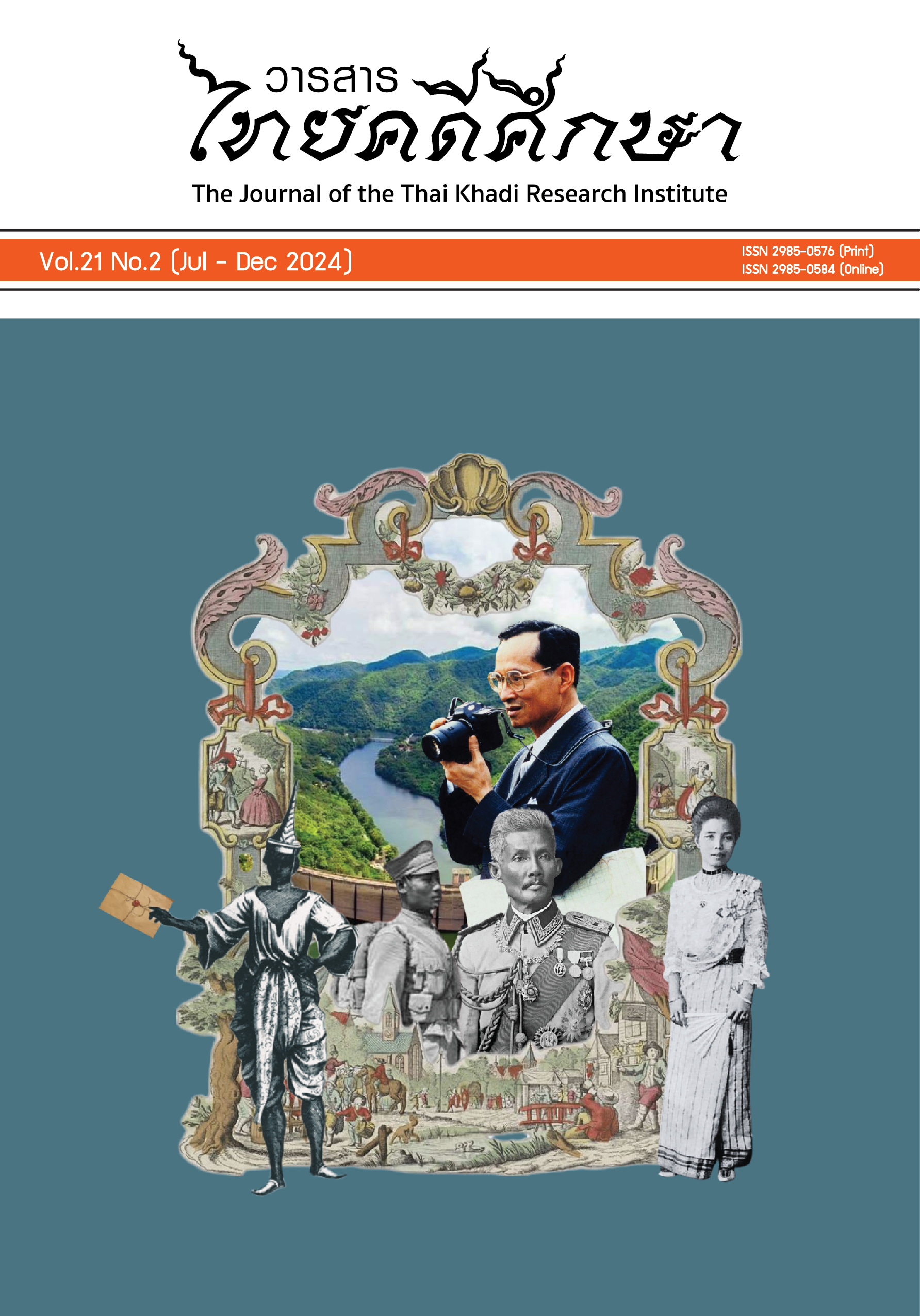
July - December 2024
Vol. 21 No. 2 (2024)
The Journal of the Thai Khadi Research Institute is a peer - reviewed journal that publishes research / academic articles in the areas of Thai studies. In this issue (Vol. 21 No. 2) eight articles published are in history, religion, literature, knowledge and truth reconstruction, and tourism.
Communication System between the Capital and Regional Cities from the Ayutthaya Period to the Reign of King Rama V by Wipat Lertrat tanarungsri and Julaporn Euarukskul
This article investigates the hypothesis that pre - modern communication between the provinces and the capital city was delayed due to travel impediments and remoteness. Findings show that in inter - urban communications near the capital commands and reports were exchanged minus intermediaries. In capital-provincial communications, however, commands and reports were transmitted through city halls. As relaying cities were allowed to make decision when to deliver, most commands and reports did not continuously travel from sender to receiver and sometimes sustained communication delays.
Formation and Growth of Knowledge about Isan from 1897 to 1917 by Cherdchai Buddee and Visarut Phungsoondara
This article studies the creation and expansion of knowledge about Isan during 1897 and 1917. Results were that Isan knowledge was originated from Siam political policies toward the region, including threatening French colonization and governing differences between the ruler from Bangkok and Isan residents. “Chronicle of the Isan Provinces” and “Geography of Siam” were key texts used by Siam to integrate Isan residents with Laotian identity to Thainess. Interestingly, knowledge about Isan was not solely created and expanded by Siam; Isan intellectuals participated in relevant processes by reproducing the knowledge and ideology in their writings.
Nirat (Loek) Phai and Nirat Pen Thahan: Didactic Literature under the Royal - Nationalisitc Ideology by Phannarai Chanhiran
This article explores two poems composed during the reign of King Rama VI as didactic literature to instruct Siamese citizens in royal nationalistic ideology. Results were that, composed after a royal edict closed all remaining gambling venues in 1917 and promulgation of the Military Service Act in 1916, both poems featured characteristics of didactic literature, focusing on the duties of citizenry towards the nation, religion and monarchy. In terms of teaching methods, both poems use literal words, figures of speech and fables. These findings may provide a new opportunity to review the history of specific literary genres during the reign of King Rama VI by relating them to socio - political contexts.
Royal Hegemony and Water Management during the Reign of King Bhumiphol Adulyadej by Asa Kumpha
This article explores water management in Thailand as led by the monarchy during the reign of King Rama IX. Results were that since the Siamese revolution in 1932, the rapport between the king and water management was reinvented, especially during the reign of King Rama IX, with the king no longer “an historical actor”. In this reign, water management occurred through the dimension of royal hegemony arising from a long accumulative process of working on Royal projects and charisma that increased as the reign extended. Royal hegemony, rather than sovereign state power, served as the basis of the king’s water management initiatives, which were widely adopted and practiced by diverse sections.
Wattangkuleeracha Jataka: Beliefs in the Creation of Buddha Statues in the Thai Buddhist Community by Saiyud Buathum
This article analyzes the lore of Jataka tales in presenting beliefs about the creation of Buddha statues in Thai society, using narrative theory and the structure of Jataka tales as study guidelines. Results were that Jataka tales present four beliefs concerning the creation of Buddha statues, including symbolizing the Buddha; representing endurance and longevity of Buddhism over five millennia; potential to be made from diverse materials; and generating happiness, success, power, and enlightenment. The lore of the Jataka tales is essential not only to the creation of Buddha statues but also the existence of Buddhism in Thai society.
The Maternal Construction of Women’s Mental Health: Language, Modern Psychiatric Practice, and Family Life in Developing Thailand from the 1950s to the 1970s by Boontariga Puangkham
This article examines the impact of modern psychiatric knowledge in inventing Thai women’s selfhood and family roles during the 1950s and the 1970s. Results were that modern psychiatry did not merely diagnose women as insane or abnormal. Instead, it positively defined a normal Thai woman based on modern psychiatric principles, recast female roles and responsibilities through individual relationships with family and society, and illuminated interactions between family members through specific knowledge - based roles. Women’s mental health has thus become a basis for the psychological well - being of the family, citizenry, and nation.
The Praxis of Thai Teacherness: De / Re - construction in Pre - service Teacher Education Curricula by Omsin Jatuporn
This article studies the praxis of Thai teacherness de / reconstruction in pre - service teacher education curricula by defining Thai teacherness as social construction that becomes hegemonic knowledge. The qualitative method was used with emphasis on self - reflection and dialectic technique. Results were that Thai teacherness existed as national - popular collective will; pedagogical approaches actively changed teachers and students’ entrenched ideas and thoughts; and the praxis of critical pedagogy through de / reconstruction of Thai teacherness demonstrated dual relationships of essential theoretical and praxis aspects needed for socio - cultural, economic, and political transformation.
Developing Slow Tourism Potential in Chai Nat Province by Puriwaj Dachum and Dolruthai Jiarakul
This article studies the tourism potential in Chai Nat province so as to develop a slow tourism model. Results were that among 38 tourism resources only six resources have high potential for slow tourism development. Four activity routes were designed to meet slow tourists’ interest, including local temples, food, nature and lifestyles. Five local products were identified, among which was the Khao Tankwa pomelo, the best known provincial identity. The slow tourism model developed comprised three strategies: destination image branding; local community product promotion; and strengthening construction by civil society.
Book review: Interregna in Comparison: Ineffective Adjustment to Changes in the 18th Century among Three Mainland Southeast Asian Kingdoms by Nidhi Eoseewong. Review by Varintorn Siripongnapat and Natkamol Kunthong.
This book gives insight into similarities and differences among three ancient kingdoms: Hanthawaddee - Ava, Ayutthaya, and Dai Viet, and the impact of foreign and domestic trade on population expansion. Since population characteristics tremendously affected administration, failure to adjust to changes in population led eventually to the collapse of the kingdoms. The book is recommended to both the general reader and scholars. It opens up an opportunity for many more comparative studies in Southeast Asia, brings a better understanding of the impacts of socio - economic and political changes on a nation, while encouraging a broader interpretation and understanding of phenomenon and history in Thai society and Southeast Asia contexts.
In summary, the articles published in the Journal of the Thai Khadi Research Institute Vol. 21 No. 2 deals with a variety of subjects as diverse as history, politics, religion and contemporary culture. They illustrate knowledge dynamics grounded on recognizing that knowledge is not fixed but undergoes constant evolution through its interactions with socio - cultural, economic and political elements. Moreover, they illuminate the power of knowledge, wisdom, criticism and a continued scholarly contribution towards sustainable development for the well - being and prosperity of Thai society.
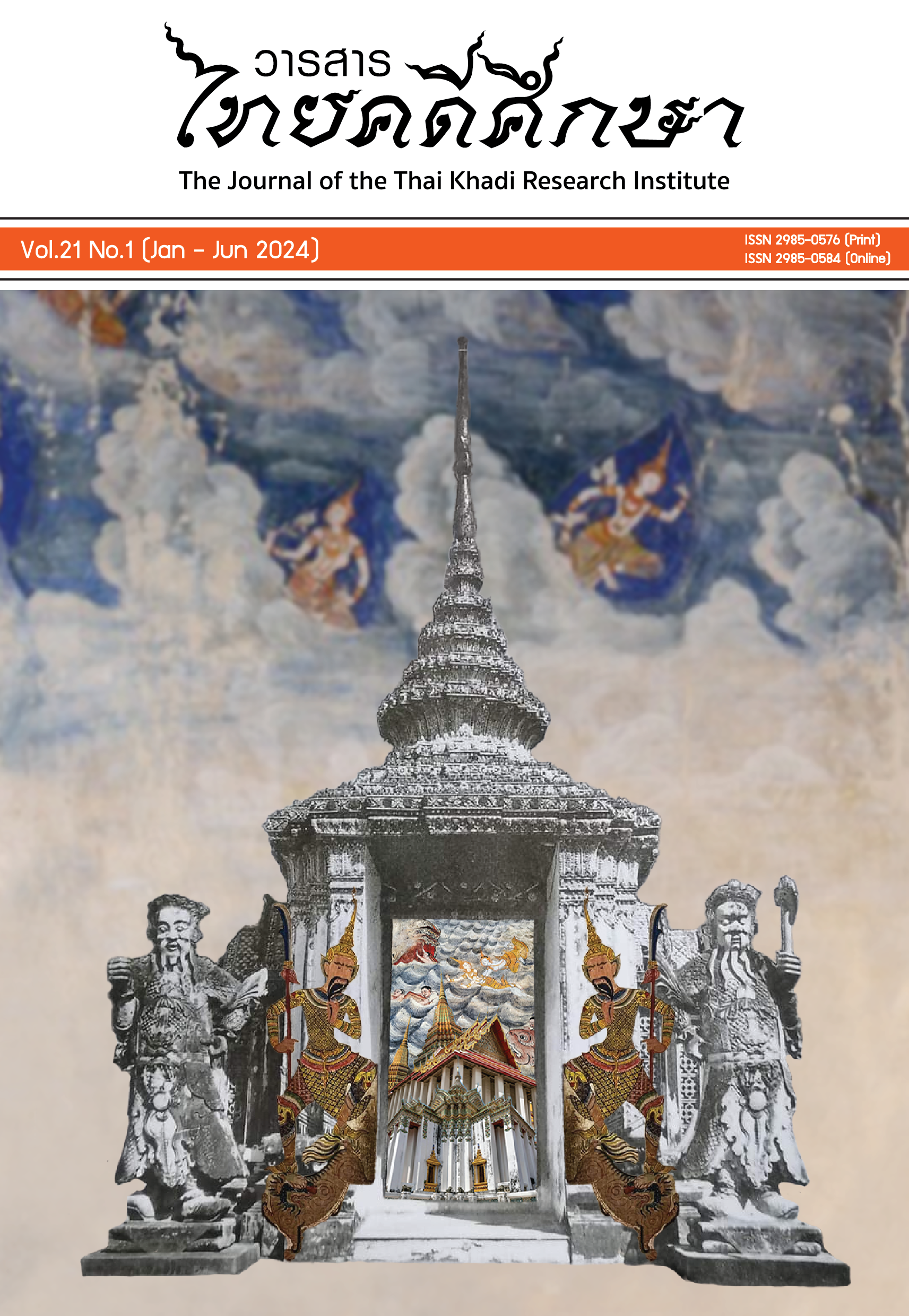
January - June 2024
Vol. 21 No. 1 (2024)
The Journal of the Thai Khadi Research Institute’s primary objective is to disseminate original research and academic articles in the field of Thai studies. In this issue, eight articles published deal with art, history and contemporary culture.
Artistic Prototypes from Wat Phra Chetuphon during the Reign of King Rama III by Sakchai Saisingha
This article analyzes Wat Phra Chetuphon’s artistic works initiated in the reign of King Rama III on the assumption that the architectural style of ordination hall amalgamates Thai traditional imagery and overseas influences. Results were that royal artisans notably transformed the architectural style and ideology, preserving Thai traditional and applying new imagery, in a trend that would influence later artisans.
Wat Muang, Bang Pahan District, Phra Nakhon Si Ayutthaya: Traditional Thai Paintings by Local Artisans outside the Capital Area during the Reign of King Rama V by Siraporn Kawinsuporn
This article explores stories and presentation styles as well as pictorial techniques and methods of mural paintings created in a temple outside the capital area during the reign of King Rama V, when mainstream paintings by royal artisans acquired Western-style realism. Results were that the Wat Muang mural paintings sustained characteristics associated with Thai traditional painting style, as influenced by artworks from the capital.
How the Words ‘Siam’, ‘Thai’, and ‘Lao’ were Understood before the Nineteenth Century by Tanapong Luekajornchai
This article studies two groups of documents: local evidence and Western travel records, to discern similarities and interrelationships of the words ‘Siam’, ‘Thai’, and ‘Lao’. It also studies the reason why Siam after the reforms of King Rama V tried to change ‘Laotians’ into ‘Thais’ not ‘Siamese’. Findings sheds light on the existence of decisively separate Thai and Lao nations which forms the basis of subsequent foundation of the Thai and Lao nations.
Historical Writings and the Making of the Siamese Army’s Honour from the Late 1900’s to the 1920’s by Pattarat Phanprasit
This article explores four historical works produced by the Siamese army from the 1910’s to the 1920’s to identify the meaning of being a soldier and Thai military ideology. Results were that the army historical writings were a viable instrument to promote soldier and military honor, create unity, and instill pride in serving the king and the country among soldiers.
Sports and Politics: The South East Asian Peninsular Games as an Instrument of Thailand’s Foreign Policy by Jintavat Sirirat
This article studies the roles of the South East Asian Peninsular (SEAP) Games in politics. Results were that the SEAP Games was a viable instrument for Thailand’s foreign policy in three ways: an anti-communist venture against mainland Southeast Asian communist movements; the first regional mechanism to improve relations between Thailand and its neighbors; and a platform for Thailand to demonstrate its status as an elder brother or regional hub. These underlined the importance of sports in Thai politics during the Cold War and the roles of sports as a complement to politics in Southeast Asia since old times.
Using Theatre Activities to Promote Knowledge Management: An Initiative by Mongkolchai Wiriyapinit
This article reports an exploratory research initiated the use of theatre activities to promote knowledge management (KM) in a context of teaching and learning. Qualitative research was done with data collected from students by open-ended questionnaire and a class diary. Results were that theatre activities may be applied to develop KM-promoting skills, such as teamwork, leadership, narration, and two-way communication. These skills are useful not only in academic contexts but also in different social contexts in real life.
Wanthong (2021): The Adaptation of Sepha Khun Chang Khun Phaen in Adaptation Industry by Praphakorn Klaisaman and Natthakarn Naknuan
This article examines the adaptation of Sepha Khun Chang Khun Phaen, a Thai folk epic, into Wanthong (2021) television series. The study shows that there are various aspects of adaptation, including reinterpretations and the adaptation of plot, characters, events and other components as well as the use of some social and cultural aspects in Thai contemporary society. Wanthong (2021) television series exemplify literary adaptation in the age of Thai digital television and adaptation industry.
Storytelling Creativity to Promote Food Tourism in Mon Community,Thong Pha Phoom by Ong Bunjoon
This article studies the creation of narratives through community engagement with food related to history and marginalized ethnic minorities to promote food tourism in the Thong Pha Phoom Mon community. Results were that Mon food culture remains deep-rooted. Through historical and food culture narratives Mon community preserves their culture, generates community income, innovates with tourist perceptions, and boosts acceptance from government organization by somewhat modifying its narratives to build identity from past history and culture to serve the present.
Book review: : New Era and Monarchy in the Royal Ceremonies of the Twelve Months. Authors: Thongchai Winitchakul, Pitchaya Soomjinda, Wipat Lertratanarangsri and Athit Srichan. Book reviewer: Nithi Nuangjamnong.
A book summary and an analysis of its contents, methodology, findings and conclusion. The reviewer points out that the book makes important contributions to Thai studies: it opens the boundaries of knowledge, generates a better and wider understanding of social history phenomenon and exemplifies the use of multidisciplinary approach to explore social phenomenon.
Finally, the editorial hopes that the Journal of the Thai Khadi Research Institute will continue serving as platform for publishing and sharing research outcomes, promoting the advancement and diversity in the field of arts and culture and different ways of living, and enabling readers and the society to access and build upon those discoveries.
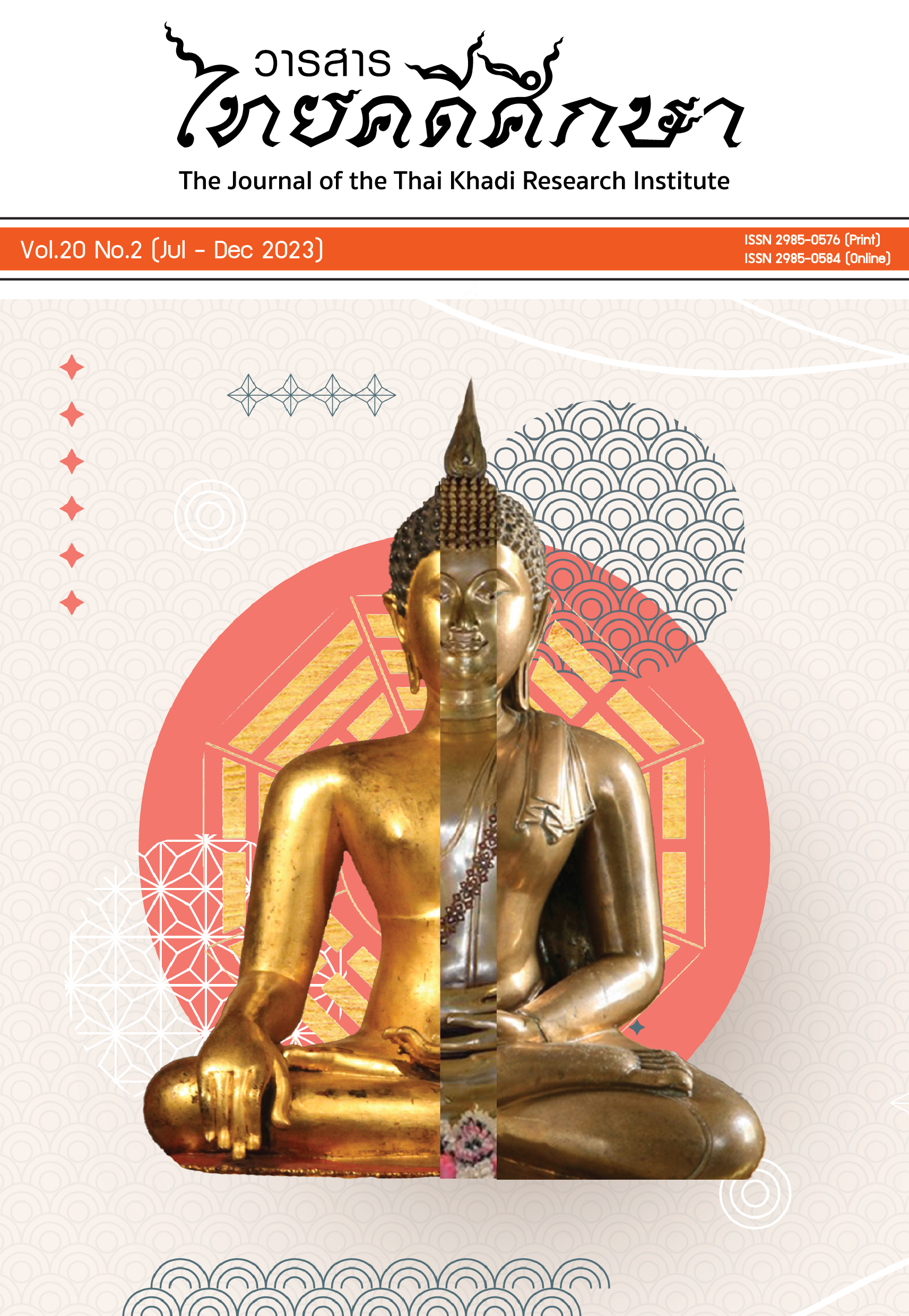
July - December 2023
Vol. 20 No. 2 (2023)
Art and culture are intrinsically linked; both are a product of human beings who create based on their belief and knowledge as well as truth of life. Art and cultural values can be expressed in different forms, ranging from religious, history, politics and administration to aesthetic beauty. Accordingly, the Journal of the Thai Khadi Research Institute vol. 20 no. 2 publishes eight research and academic articles reflecting the value of art and culture in different social phenomenon.
Phra Pairee Pinas: Adapting Javanese Buddhist Art to the King Rama IV Style by Dr.Sarun Makrudin. This article deals with Phra Pairee Pinas, a significant Buddha statue at Wat Bowonniwet Vihara, Bangkok. Received by His Majesty King Mongkut (Rama IV) when Rama IV was abbot of the temple, it resembles in style Dhyani Buddha statues at Candi Kalasan, Klaten, Java, Indonesia, of the late Central Java era (from the eighth to ninth century CE). The article goes deeply in details of the statue’s history, its Buddhist arts and the artistic design adapted to the style of the era of Rama IV.
Cultural Reproduction of Legendary Phra Buddha Sihing – Phra Singh Narratives in Contemporary Thai Society by Karakkada Bunwichai and Poramin Jaruworn. This article collects reproduced cultural information about legendary Phra Buddha Sihing- Phra Singh narratives in the context of contemporary Thai society and ideologically analyzes the reproduction. Documentary and fieldwork data were gathered from October 2019 to June 2021, along with supplementary analytical information online and from other related fieldwork. The principle of cultural reproduction was used as guidelines for data analysis. Results reveal stories behind the cultural reproduction of legendary Phra Buddha Sihing narratives; some stories are consistent, others are different.
The Influence of Ayutthaya Style on Burmese Buddha Statues of the Ava Kingdom by Sura Piriyasanguanpong. This article analyzes Burmese Buddha statues of the Ava Kingdom in style, origin and development. Analytical results indicated connections with artistic style of the Ayutthaya Kingdom in diverse seated and standing Buddha statues without royal attire. These findings suggest that the unique style of Burmese Buddha statues of the Ava Kingdom evolved from Bagan dynasty and possibly Ayutthaya influences, underlining the international impact of Thai art stylistics in neighboring countries.
From Devandha Jataka to Thewan Kham Kap: An Adaptation of the Pannasa Jataka Tale to Kap Folklore by Nattha Khamchoo. This article studies the history of two literatures: Devandha Jataka in Pannasa Jakata and Thewan Kham Kap poem, and the story behind the adaptation of Devandha Jataka into Thewan Kham Kap poem. Findings reveal that Thai elite poets skillful in literary adaptation have employed diverse techniques in creating a new version of literary work from old narrative or literature in accordance with social contexts at the time.
The Meanings and Lessons Learned from the Story of Being an Arahanta of Phra Ongkhulimal by Tiamjit Puangsomjit. This article studies meanings and lessons learned from Phra Ongkhulimal’s story of being an Arahanta based on search in the Tripitaka Canon and Atthakatha. Results were that the life story of Phra Ongkhulimal occurred due to Karma over several lives. An important lesson learned is that everyone should control their body, words, and mind in achieving a personal Kamma.
Western Influences on the Performance of Thai Dance: A Case Study of Striptease in Thailand from the Second World War to 2021 by Nareerat Phinitthanasarn. This article studies: 1) the history and context of Western influence on Thai dance performance through a case study of striptease from the Second World War to the present; and 2) artistic and overall ideal perspectives regarding striptease ensembles in Thai society. The results provide an insight into various aspects of the strip dance, especially its primary elements of performance: the purpose in creating the event; exhibition venue; and an audience seeking to recognize aesthetic origins of the work in addition to entertainment.
From University Back to the Kitchen: Representations of Women and Male Anxiety in Modern Dikir Music of the Southern Border Provinces of Thailand by Pichet Saengthong. This article studies the representation of women in modern dikir music performed by popular male singers in Southern border provinces of Thailand from 1987 to 1997. Results were that songs constructed views of women as opposites of men, through virtuous patterns based on patriarchal discourse defining values of good wives and mothers confined to the domestic sphere. Activities in public were taboo. Ideal femininity was related to traditional societal values more than modern society.
Knowledge, Power, and Feng Shui Expertise in Thai Society by Pinyapan Potjanalawan. This study contextualizes the current state of feng shui in physical space management as well as the cultural dynamics of feng shui practice in Thailand. In the late 1980s, feng shui began to impact private and public spaces, nationally dominating economic operations and political strategies. The author proposes that feng shui was akin to life coaches or space coaches who resolve personal problems by employing astrological instruments as well as space management.
Last but not least is Book Review of Suphasit Son Ying Phinit, an essay by Dr. Wanwiwat Rattanalam on an old Thai literature and a Thai national textbook Suphasit Son Ying, literally ‘Women Etiquette Book’. Presenting her article in English, Rujeeluck Seelakate, the reviewer, gives a summary of the book’s contents and background along with a critical assessment of its strengths and weaknesses. The book’s strengths are its well-organized contents, the analytical study of values and relevance of old etiquettes in the context of contemporary Thai society and culture, and a clear and thorough research methodology used by the author. Meanwhile, the weaknesses addressed by the reviewer are a lack of the biography of Suphasit Son Ying’s true author and a lack of comparative study between Suphasit Son Ying and other Thai women etiquette books.
Finally, we at the Thai Khadi Research Institute are grateful for all papers submitted for publication in the Journal. We wish to continue providing an academic forum for a variety of art, culture, people and disciplines in the hope that the production and dissemination of new research works on those subjects will benefit not only academic circles but also the public as well.
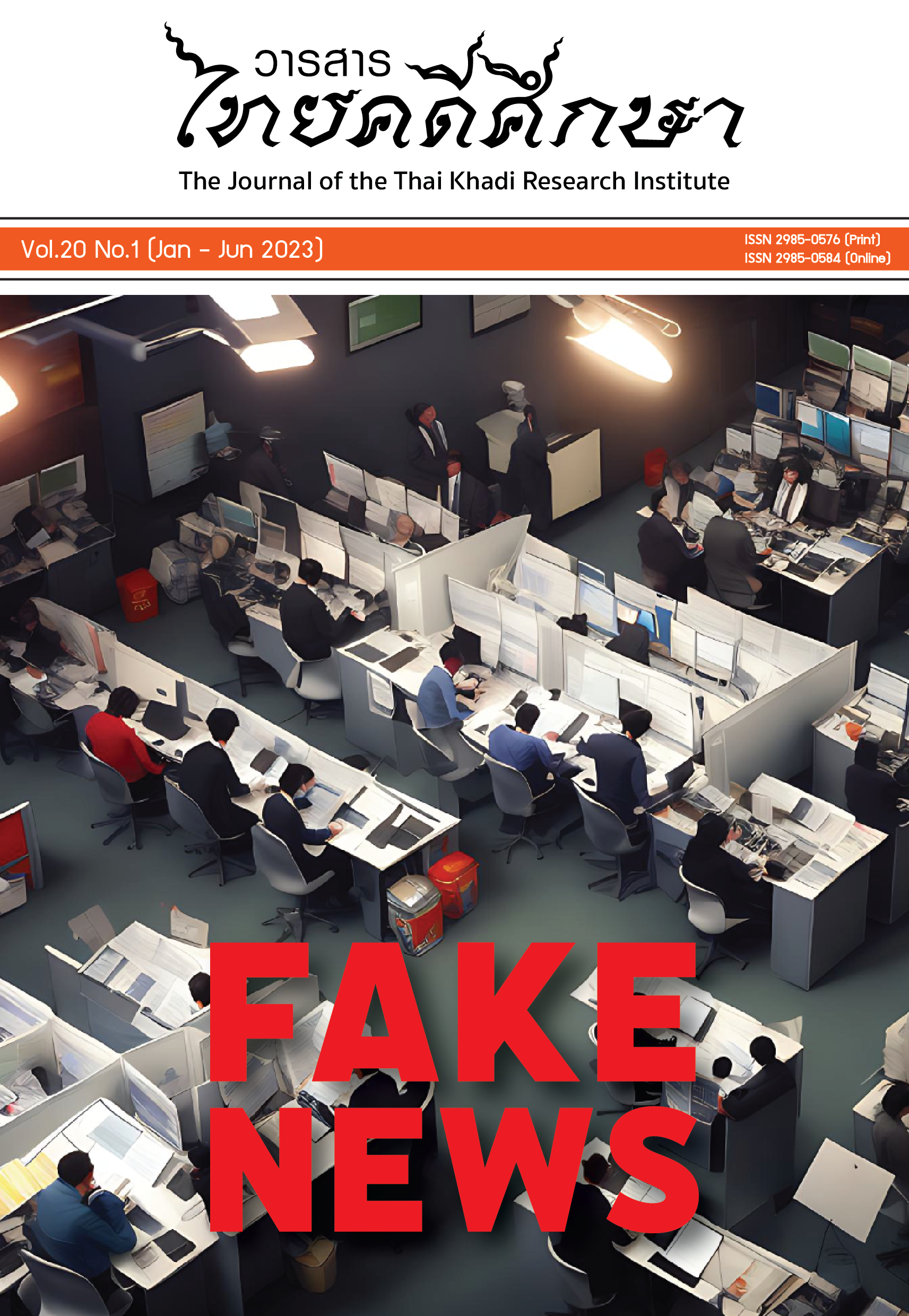
January - June 2023
Vol. 20 No. 1 (2023)
Culture is an empirical symbol of ‘prosperity’ acquired by a society through the process of learning and interaction among its members. It is in different aspects, concrete or abstract, and varies from society to society, depending on values given to culture by that society over time. The existence of culture is thus significant to the existence of a society’s prosperity.
Eight articles on different aspects of culture presented in the Journal of the Thai Khadi Research Institute Vol.20 No.1 are as follows:
Television Newsroom Culture in Thailand for Fact-Checking Disinformation by Wilaiwan Jongwilaikasaem. This article studies the working culture of Thai television newsrooms in checking for fake news. Results show that television newsrooms in Thailand still adhere to analog era editorial structure and production process. There is no fact checker to discern real news from disinformation. Fact-checking is primarily the duty of reporters and all editorial office staff. In addition, no television newsroom in Thailand has a defined policy to debunk disinformation
The Use of Shan Language to Represent Shan Identity in Products by Phannida Khanthaphad. This article studies the use of Shan language on the labels of products to signify Shan identity. Results were that Shan language on product labels mostly reflects Shan identity in historical and political aspects; traditions and culture; and nostalgic sentiments. Some other aspects such as love and happy family have been included on product labels recently.
The Concept and Understanding of Thaen in Isan Society: Past and Present by Wuttichai Sawangsang and Puttharak Prabnok. This article studies the concept and understanding of Thaen among Isan residents. Results were that Isan residents originally saw Thaen as a heavenly spirit ranked as the highest deity and creator of the world and mankind. Today, Thaen is still worshiped as an ancestral spirit, known as Phi Fha or Phi Thaen. However, Isan popular understanding of and attachment to Thaen today differs from the past. Six aspects of Thaen are attributable to contemporary Isan residents: belief, tradition, society, lifestyles, literature and poetry. These involve intellectual heritage and cultural capital more than spreading faith and religious teaching.
A Vessantara Jataka Painting Series Dated from 1907 to 1947 by Phetchaburi Craftspeople by Duangkamon Boonkaewsuk. This article presents the identities of a series of Vessanta Jataka paintings produced by Phetchaburi crafts workers in the early twentieth century. These include 13 painting cycle with contents associated with a religious literature, Mahajati Kum Luang, and a painting of the opening scene by Mr. Lert Phuangphradech. Results show that the paintings illustrated Thai traditional painting techniques matched Western styles in adding chiaroscuro and perspective. Adhering to Western styles was more visible in 1932 paintings by Mr. Lert Phuangphradech after his participation in drawing and painting the Emerald Buddha Temple gallery wall.
A Movable Throne Preaching Canopy from Wat Thasalaram in the Thammasat Museum of Anthropology: The Conservation Process and a Reflection on Phetchaburi Preaching Canopy Culture in the Early Twentieth Century by Chanan Mekmak and Mueanphim Suwankart. This article studies Phetchaburi preaching canopy culture in the early twentieth century, focusing on a case study of a movable throne preaching canopy relocated from Wat Thasalaram to the Thammasat Museum of Anthropology for conservation. Results were that the artifact was produced in the first phase of the early twentieth century (1877-1930), reflecting Phetchaburi’s preaching canopy culture among bourgeois religious patrons with its own distinctive artistry differed from the second (1935-1947) and third (1948-1966) phases.
Chaem Bunnag and the Creation of Ton Tamnan Uthai: New Historical Content, Origin of the Thais and Thai Migration from 1889 to 1890 by Nittayaporn Prompanya. This article explores the interplay between historical construction and international context in the late nineteenth century through the study of Ton Tamnan Uthai, compiled by Chaem Bunnag (1864-1907). Results were that the creation of the chronicle was influenced by the author’s work experience in the Anglo-Siamese territorial conflict starting in 1889. In it, he formulated new historical content focusing on the origin of the Tais and Tai migration from Central India and China.
Historical Dynamics of the Thonburi War by Samran Phondee. This article studies the cause, contexts and strategic analysis for tactical wars in Thailand from late Ayutthaya until the end of Thonburi (1703-1782). Results were that the last war between Ayutthaya and Burma leading to the fall of Ayutthaya in 1767 was primarily caused by imperial conceptualization and the problematic ethnic Mon. Throughout his reign, King Taksin waged numerous wars, using varied tactical strategies and a selection of young, knowledgeable, capable and loyal commanders. As a result, in most of the conflicts, his side was victorious.
Power Relations between the State and Islam in Modern Society: A Case Study of Chiang Mai Islamic Organization Administration by Sujinda Kamjorn. This article studies power relations between Thai state and Islam in modern society, focusing on a case study of Chiang Mai Provincial Islamic Council (CMPIC) administration. Findings reveal that the Chiang Mai Governor as representative of the state is legally authorized to accept the Islamic leader and preacher: Imam, Kateb and Bilan. Meanwhile, the CMPIC negotiated with the state to grant Chiang Mai Muslims more social space by electing their Islamic leader who possesses both legal and traditional authority.
Book Review: Anatta, the Soullessness of Nibbana, written by Watchara Ngamchitcharoen, reviewed by Tiamjit Puangsomjit. In this book, nibbana, the key concept in Buddhism, is described from new perspectives, using elaborate discussion and references in making a precise and all-round study of nibbana.
Brief reports on research, academic, art and culture conserving activities organized by the Thai Khadi Research Institute during January and June, 2023 are presented at the end of Journal.
It is hoped that the Journal of the Thai Khadi Research Institute continues to be a forum for disseminating and promoting the study of Thai society and culture among Thai and foreign scholars as well as a source of useful information for readers and the society as a whole.
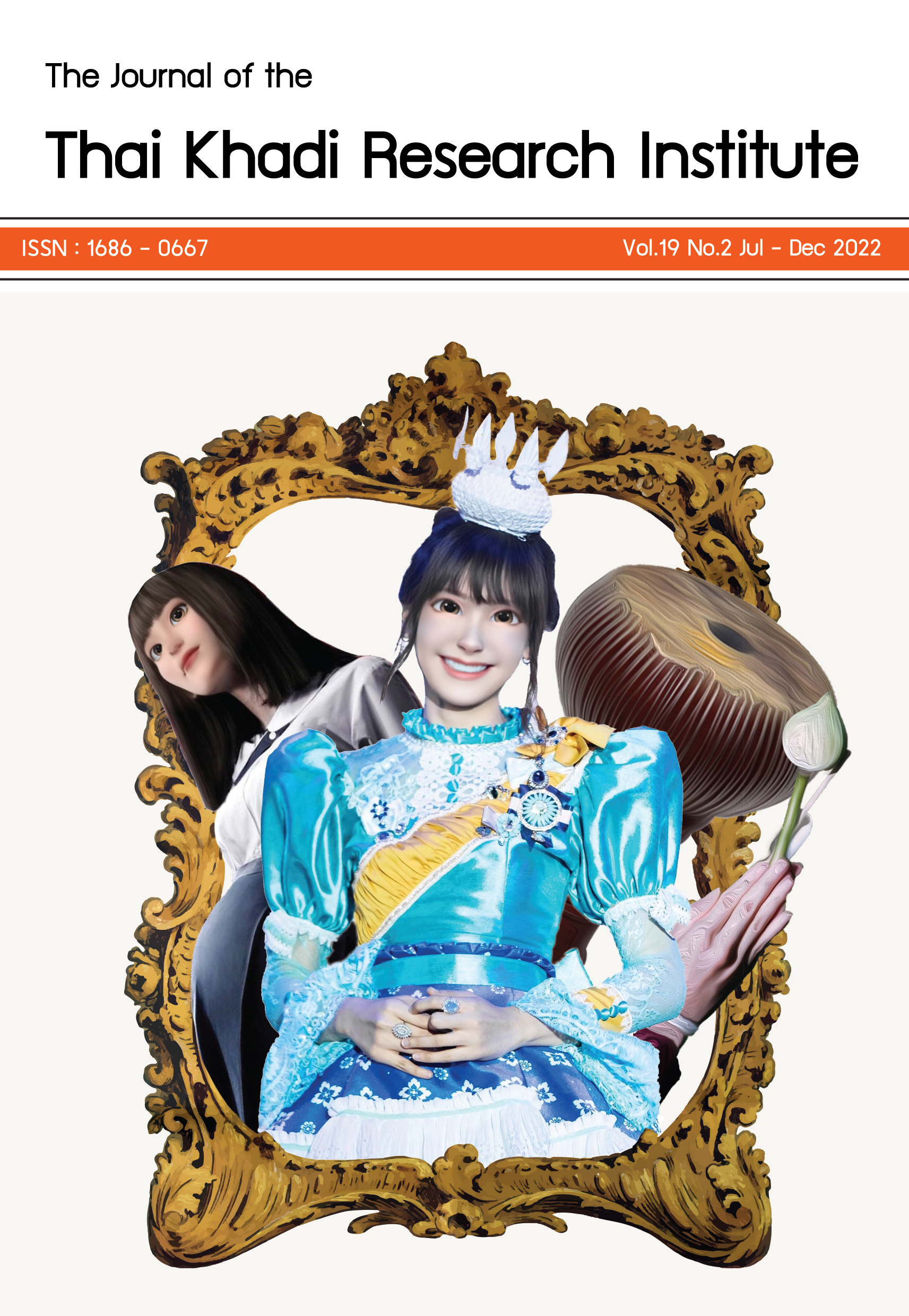
July - December 2022
Vol. 19 No. 2 (2022)
“Thainess” is a kind of discourse used to illustrate the cultural identity of Thai people as well as to create merchandise and service of economic values under the global culture dynamic and globalization. Case studies on Thainess presented in the Journal of the Thai Khadi Research Institute Vol.19 No.2 are as follows:
Thainess in “T - pop”: The Presentation of Thai Art and Culture in MVs by Thai Idol/Girl Groups during 2011 - 2021 by Thanapiti Thipa. This article studies Thainess in Thai idol/girl groups’ music videos over the past decade. Findings reveal that Thainess in Thai idol/girl group music videos is little, compared to other Thai popular music. Meanwhile, Thai popular music videos are more likely to accept the influence of Western, Japanese and Korean popular music in order to be modernized and popular among teen consumers.
Ram Thon Khok Sao Long: The Construction of Emergent Authenticity in Cultural Tourism Management of Khoksalung Community by Pornsawan Tripasai. The article deals with the cultural authenticity of Ram Thon Khok Sao Long, a local folk song performance constructed from the combination of the legend entitled “Khok Sao Long” and Ram Thon. Although the initial purpose is to create an authentic learning experience for tourists while increasing economic value to local performance, the staged authenticity has eventually become real and a pride for Khoksalung villagers.
How to Apply a Cultural Dimension for Supporting Community Tourism of Ban Huai Wai Phatthana, Buriram Province by Utis Tahom, Sujitra Yangnok, Khemeka Arrom, and Santipap Charam. This article focuses on a sustainable tourism development in a community in northeastern Thailand through the development of cultural resources, public relations, management, and community participation models. Positive impacts on local economy and other aspects are identified.
The Origin and Development of the Pattern of Acanthus Leaf in Thai Art by Supachai Sermsukcharoenchai. This article studies the pattern of Acanthus leaf in Thai artworks since the reign of King Narai the Great when Ayutthaya had close contacts with Western nations and Acanthus leaf was widely used to decorate the pediments of Western style buildings. In the reign of King Rama V, the pattern of Acanthus leaf was made by Western artists working for the Royal Court of Siam, and was authentic Western art. Thai master artisans in Ayutthaya and Rattanakosin periods adapted Acanthus leaf to Thai artistic style before combining it to traditional Thai patterns.
Shakh Muhummad Ali Sukari: Ritual and Belief of Thai Muslims in Phukhao Thong Community, Phranakhon Si Ayutthaya Province by Komluck Chaiya. This article studies the principle and practices of Thai Muslim Kodiriyahs living in Phukhao Thong community, Phranakhon Si Ayutthaya Province, which are characterized by high respect towards their spiritual leader, Shakh Muhummad Ali Sukari or To Kisaeh (1848 - 1932). Four rituals are held annually in his commemoration, distinguished by a procession carrying around his palanquin. At present, rituals and beliefs in To Kisaeh have been serving as a spiritual anchor to local population, help unite relatives and build networks among Kodiriyahs living in different parts of the country.
Technologies of Death, the Obliterated Torture and the Peace of Capital Punishment by Poowadon Chai-in. In this article, the author points out that throughout the Thai history of capital punishment there exist the collision of different political paradigms concerning the use of technology to punish and execute individuals sentenced to death. The invention of technology of death was supposed to be evolving under the concept of humanity and peace; in fact, it has been used by Thai state to govern and dominate people’s mind while obstructing the establishment of peace in society.
“Adolescent Mother” Discourse: A Case Study of the National Strategic Plan of the Prevention and Solution of Adolescent Pregnancy Problems B.E. 2560 - 2569 (2017 - 2026) by Patcha Jeungklinchan, Malee Jirawattananon and Narupon Duangwises. In this article, the authors analyzes adolescent mother discourse in the national strategic plan, using Foucault’s discourse analysis methodology. Findings show that the definition of adolescent mother is in line with universal standard and adolescent mother is considered a social problem. Sexuality and reproductive health knowledge put more pressures on women than men, resulting in continuing sexual bias. Thai state uses governmentality to control the reproduction of sexual responsibility and childhood discourses. Meanwhile, good mother discourse gives rise to social expectation that adolescent mothers raise their child; otherwise they are considered irresponsible mothers.
The Decade of Thai Khadi Research Institute: Academic Status of Knowledge by Ratchapon Yamkeep. This article explores the knowledge status of Thai Khadi research conducted during 2009 - 2018. The results show that, internally funded by Thammasat University and Thai Khadi Research Funds, most research is collaborative, with two or more Thai Khadi researchers working on the project. The researcher’s expertise is a starting point and a key tool for doing research in all disciplines.
Taste and Fan Clubs in ASEAN and China: Online Marketing and Politics of Emotion by Amphon Jirattikorn. A book review by Boonyanuch Nakha. One of the author’s main arguments is that the export of Thai TV series, a kind of soft power, has been obstructed so far by the stagnant TV production industry, the melodramatic characteristics of Thai soap operas and the lack of systematic support from the government. The reviewer suggests that in a rapidly changing society, details of situation, time, and social contexts should be taken into accounts in the analysis of fan clubs of different sub - cultures and tastes.
In addition to research articles and a book review, brief reports on academic, arts and cultural activities organized by the Thai Khadi Research Institute from July through December, 2022 are presented.
It is hoped that the Journal of the Thai Khadi Research Institute will be a forum and mediation for dissemination and exchange of knowledge on ‘Thai studies’ that benefit the academic community and the general public as well. Any contributions to the Journal, either article submission or readership, are highly appreciated.
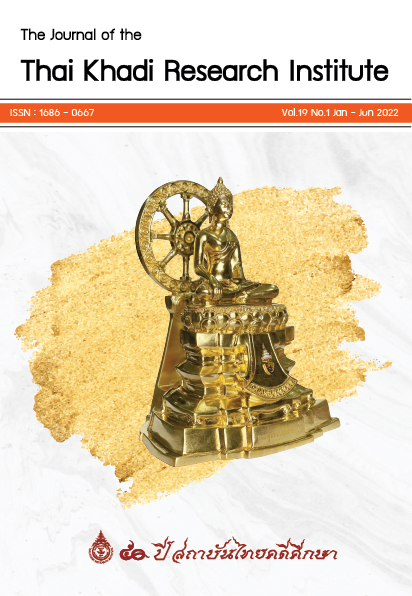
January - June 2022
Vol. 19 No. 1 (2022)
Stepping into year 51, the Thai Khadi Research Institute continues its mission to disseminate knowledge through the publication of a wide range of research/academic articles on “Thai Studies”. In the Journal of the Thai Khadi Research Institute Vol.19 No.1, eight articles on different fields of studies are presented as follows:
The Buddha Footprint at Adam’s Peak (Samantakuta) of Sri Lanka in Ayutthaya Art by Rungroj Tharungraeng. This article investigates Ayutthaya people’s perspectives on the Buddha Footprint at Adam’s Peak, believed to be imprinted by Lord Buddha on his visit to Sri Lanka. Several artifacts are examined, including stucco high - relief at Wat Pailom in Phetburi province, mural paintings at Wat Putthaisawan in Ayutthaya province and Triphum manuscripts. The position of the footprint in the center of Sri Lanka Island with or without other shrines on the side reflects their highest reverence for the footprint.
Painting of Dasa Jataka: Origin, Style of Arts and Presentation through Concepts of Local Artists in the Upper Isan along the Khong River by Phongsak Akaramatthanakul. This article studies the artistic style and presentation methods of mural paintings of Dasa Jataka in the northeastern region of Thailand. With the combination of local Isan style and traditional style of central Thailand, the painting was created for the first time at Wat Hua Wiang Rangsi, Amphur That Phanom, Nakhon Phanom Province by local artists of Luang Chan Akson group. Murals at Wat Hua Wiang Rangsi is a model for other temples in the area, such as Wat Phuttha Sima, Amphur That Phanom, Nakhon Phanom Province; Wat Latthikawan, Amphur Wan Yai, Mukdahan Province; and Wat Si Khun Muang, Ampur Chiang Khan, Loei Province.
History of Thai Education under the State’s Centralization (1947 - 2019) by Pinyapan Potjanalawan. This article studies the dynamics of Thai educational system under the centralization of coup d’etat governments since 1947. It was found that during the year 1957 - 1973 and 2014 - 2019, the government seized power from education and launched a mega project for the nation’s educational development without people consensus. The reformation of political institution under the 1997 Constitution led to an educational reform under consensus as well as queries about educational disparity and abuses of students’ right and liberty.
Value Added to Gastronomy Tourism via Teaching and Learning Thai Food by Supharom Prasatkaew. This article compares the recipes of Thai royal food with the recipes of Thai food in cooking classes for tourists. The results show that some recipes have different names but similar ingredients and cooking methods. Cooking classes for tourists always simplify cooking methods and ingredients. Some classes add values by telling myths and beliefs related to Thai food.
Lao Krung Food, the Cultural Identity of Ethnic Group: A Case Study of Lao Krung in Tambon Huai Duan, Amphoe Dontum, Nakhon Pathom Province by Pradtana Saeueng. This article examines the identity of Lao Krung food, including its authentic recipes and the use of natural ingredients found in the vicinity for cooking. Beyond nourishing the body, some food contains cultural aspects such as beliefs and wisdom of ancestors that inspire unity within the ethnic group. Crucial factors affecting Lao Krung food identity are social and economic changes as well as changes in consumption taste, village environment, agricultural technology, and local markets.
Aesthetics of Thai Scents: A Case Study of Traditional Thai Fragrances by Nalinnath Deesawadi and Watanapun Krutasaen. This article examines Thai scents aesthetics. It was found that many Thai scents are produced without original archetype. The prototypes of Thai scents are mostly from foreign countries or synthetic smell of local flowers. Without the understanding of the artistic value of scent creation and scent aesthetics related to cultural experiences, Thai scents are quite cliché.
Chan Chaokha: The Transition onto Post - Siam in Musical Plays Dimension by Chayuti Tassanawongwara and Tharanat Hinon. This article points out dynamics in Siamese art, in particular the transformation from traditional Thai music and performance to Lakorn Rong, a post - Siamese musical plays, under changing political, economic and socio - cultural conditions. The study of Chan Chaokha, a popular musical plays composed by Pranboon shows a compromise between tradition and modernity. While performance was obviously westernized, music reveals the confrontation between traditional Thai music and western music.
Home Sweet Home: The Ideas of Home and Family of Thai Middle Class in 1970s by Nattaphong Sakulleaw. This article investigates the ideas of home and family of Thai middle class as shown in ‘Home and Gardens’ magazines published in 1970s. Findings reveal that under the competitive and unpleasant circumstances of urban capitalized society, the middle class have developed their imagination of family as a private space of happiness as well as a space of feeling responsible for healing negative emotions. This results in a gradual decline of the traditional form of economic - based family.
What It Takes to Hold Hegemony: The Formation and Expansion of the King's Networks under the Interaction of Thai Elite from B.E. 2490s to 2530s (from mid - 1940s to mid - 1990s) A book review on a newly published book written by Asa Kampha, a researcher, professional level of the Thai Khadi Research Institute specialized in Thai political history, reviewed by Pichaya Koomquan. This book deals with the formation and retention of King Rama IX’s leading power in different dimensions and the establishment of “the King’s networks” in relevant to changes in the networks of Thai elites.
A short article on academic, art and cultural activities organized by the Thai Khadi Research Institute during January and June 2022 is presented at the end of Journal.
It is hoped that articles presented in the Journal of the Thai Khadi Research Institute Vol.19 No.1 respond to academic and public interest, widen knowledge and encourage more participation in Thai studies.

July - December 2021
Vol. 18 No. 2 (2021)
‘Religion’ is the state of knowledge and faith of mankind, reflecting the beginning, existence and end of ‘social phenomenon’ and ‘events’ in Thai and global societies. In particular, in the contexts of the COVID-19 pandemic, religion has become a mirror of samsara or the wheel of birth, old age, sickness and death while serving as a spiritual anchor to those who seek a way to get out of the crisis. In this situation, the Journal of the Thai Khadi Research Institute Vol.18 No.2 presents research articles derived from the interpretation and comparative study of different issues on dynamic impacts of social phenomenon and events.
The Connotations of Meritorious Action in Buddhism and Social Phenomenon by Tiamjit Puangsomjit. This article analyzes the meaning of punna or meritorious actions, a type of action in Buddhism classified as wholesome actions. Findings reveal that at the lexicon or worldly level, punna means happiness, the purification of innate characters, merit, and meritorious behaviors; at the connotation or dhamma level, it means renouncement, wisdom, supreme happiness, and nirvana. This implies that happiness is the sole meaning of punna at both Lokiya and Lokuthala levels and that the level of punna depends on the intention of the person who commits punna. At present, people make merits by giving with a desire for happiness, success and wealth rather than giving as an act of renouncement.
The Date of King Jayavarman VII’s Accession to the Throne: Its Relationship with the Interpretation of Bhutasamkhya, Veda Beliefs, and Political Contexts by Nipat Yaemdet, Chirapat Prapandvidya and Sombat Mangmeesukhsiri. The article discusses the date of King Jayavarman VII’s accession to the throne as recorded in Arogyasala and Pimeanakas inscriptions by four words: Veda-the sky-the number one-the moon. The date is still a subject for scholarly debate due to the interpretation of the word ‘Veda’. Considering the Bhutasamkhya system and beliefs of ancient India that the Brahmin see the four Vedas and thus have four eyes, the authors are of the opinion that the word ‘Veda’ denotes the number ‘4’, not the number ‘3’ (Veda=4, the sky=0, the number one=1, the moon=1); hence the date of King Jayavarman VII’s accession to the throne is the Saka era 1104 (A.D.1182, B.E. 1725).
Cultural Development of Ancient Communities in the Area between Loei and Nam Mong River Valleys before the 14th Century, Based on Archaeological Evidence by Kulavadi Samackthai, Dararat Mattariganond and Wiangkum Choun-u-dorn. This article presents a study on the cultural development of ancient communities in northeastern Thailand during prehistoric and historic periods. Findings reveal the establishment of the incipient community on the Mekong River at the north of Sakon Nakon basin, dating from 5,500 - 2,700 BE. Dating from the eight century AD, there existed ancient communities of Dvaravati culture. Theravada Buddhism was influential in this area during the early historic period, except for those communities where Mahayana Buddhism and Khmer art from Cambodia were combined.
From OTOP to OTOP Nawatwithi: A Community-Based Development Policy? by Kanjana Laochockchaikul. This article analyzes the implementation of OTOP Nawatwithi Tourism Community Policy, a national development policy organized by Community Development Department, Ministry of Interior, focusing on its community and local wisdom-based concepts. It was found that there are some changes in community-based concepts incorporated in OTOP and OTOP Nawatwithi policies. The concepts have never been realized, however due to the centralized and top-down characters of all development organizations involved.
Pat Salat: A Musical Onomatopoeia in Mon Palm Leaf Scripture by Jarun Kanchanapradit, Jatuporn Seemuang, Tharanat Hin-on, Vassakarok Kaewloy and Wanida Bhrammaputra. This article analyzes the musical onomatopoeia of Pat Salat, a major Mon musical instrument mentioned in a palm leaf scripture entitled Kayak Che Nu Fo (The Buddha Descending from Heaven) while illustrating the sound in the poet’s imagination that reflects the influence of music in Mon culture in the past as well as the relationship between music and Mon people’s faith in Buddhism.
A Comparative Study of Drug Remedies in the Pharmacopoeia of Wat Mai Phromphiram, Phitsanulok Province, and Those in the Official Traditional Thai Medicinal Scripture by Phakphon Sangngern. This article studies the remedies of five Thai herbal medicine recorded in 1867 in the pharmacopoeia of Wat Mai Phrompiram, Phitsanulok Province, in comparison with drug remedies of similar names and contents in the Official Traditional Thai Medicinal scripture, revised and compiled in 1870 under the order of King Chulalongkorn. It was found that the contents of one drug remedy, Tamrubya Brahma Bhaktra, in Wat Mai Phrompiram pharmacopoeia mostly resemble those in the official scripture, except for some minor differences in efficacy.
The Journal of the Thai Khadi Research Institute Vol.18 No.2 presents a book review of Buddha Images, Amulets, From the Crypt of Wat Ratchaburana’s Prang, Ayutthaya Province by Prof. Sakchai Saising, Ph.D., Department of Art History, Silpakorn University. Highlight include new findings and the division of arts in Khmer culture from those of central Thailand. Brief reports on academic, arts and cultural activities organized by the Thai Khadi Research Institute from July through December, 2021, are also included.
It is hoped that the Journal of the Thai Khadi Research Institute will be a forum and mediation for dissemination and exchange of knowledge on “Thai studies” that benefits the academic community and the general public as well. Any contributions to the Journal, either by article submission or readership are highly appreciated.
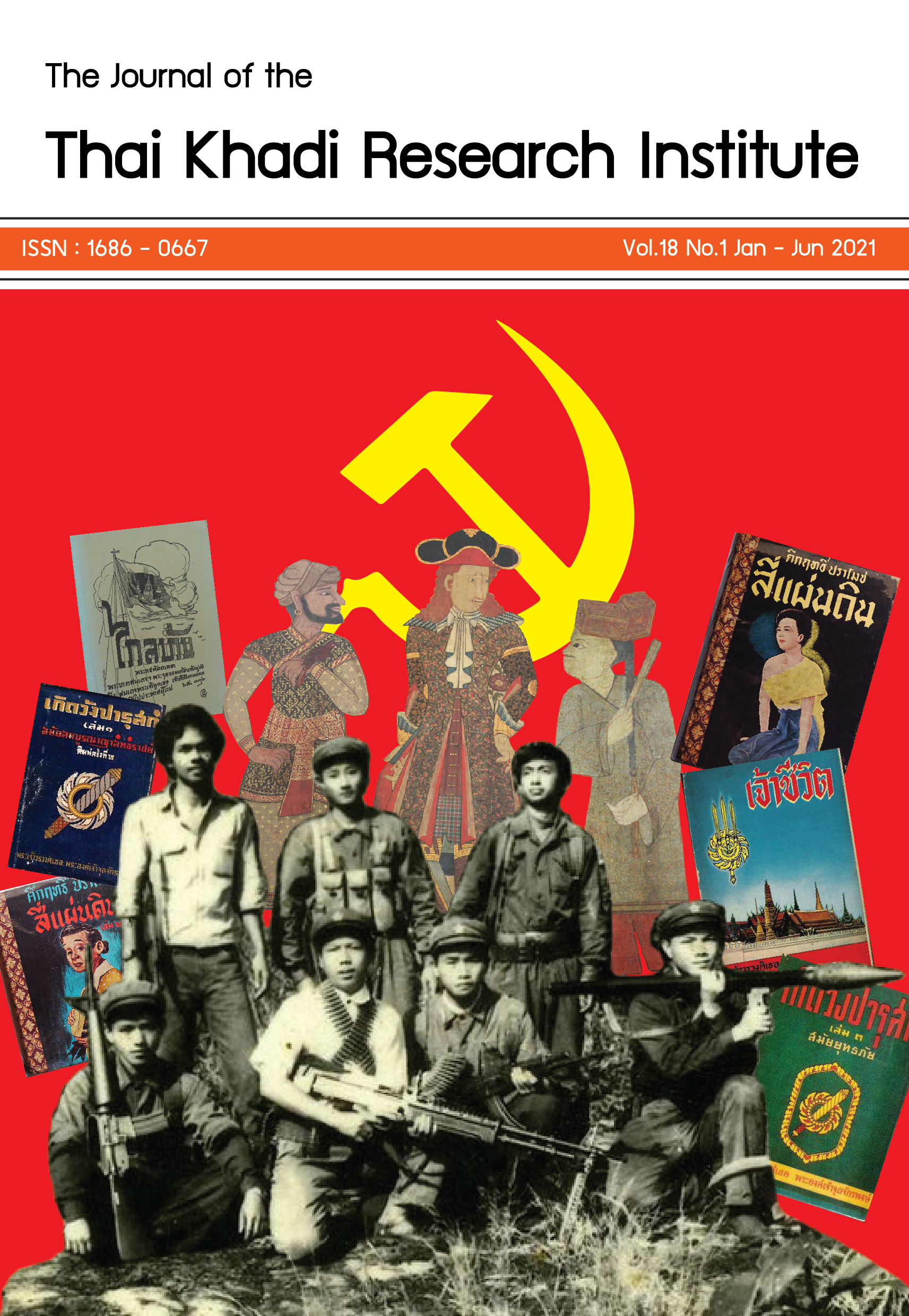
January - June 2021
Vol. 18 No. 1 (2021)
The Journal of the Thai Khadi Research Institute Vol.18 No.1 presents research articles on varied subjects and issues on “Thai studies”, among which are “former comrades” memories, intellectual historical studies on royal activities and book culture in the past, policy recommendations for the reformation of local administration, sociological studies on the world of stray-dog owners and Thai traditional medicine for cancer treatment.
A War of Memories and the Changing Notion of the Past of “Former Comrades” from 1977 to 2015 (B.E.2520s - 2550s) by Thikan Srinara A study and explanation of changes in thoughts of those who took arm and joined the Communist Party of Thailand (CPT) in their fight against Thai State through the analysis of their “memoirs” written during 1979 and 2015. Findings show changes in the narratives and memories in relevant to Thai politics and other circumstances. Starting from a romantic revolutionary life in memoirs written between 1976 and 1979, the comrades’ thoughts turn negative after the collapse of the CPT. Memoirs written after May 1992 through 1997 express changes from negative to positive thoughts, which eventually unfold into “valuable life experiences” in the latest memoirs. The flow of thoughts in memoirs not only represents the self-explanation of former comrades in different times but also give an explanation of the “Octobrists”, thus making contributions to “Octobrist studies”.
Definition of the Meaning of an “Old Thainess” in the Reign of King Rama III by Pavena Mu-ubon In attempt to re-interpret the reign of King Rama III within the intellectual historical study framework, the author points out that the political instability resulted from power competition among leading figures, associated with social changes, especially the mobilization of a large number of ethnic groups such as the Laos, Khmer and Mons to the Chaophraya River basin, makes it necessary for the King to establish his “hegemony”. By defining the meaning of “Thainess” in the “Old Siamese” concept, King Rama III was “Dhammikarajathiraj” who ruled over the ethnic groups, and, more importantly, exercised hegemony power over his relatives and the nobles. Nevertheless, the meaning of “Thainess” in King Rama III’s era is totally different from “Thainess” that the elite in absolute monarchy era tried to build.
Thai Book Culture during the Reign of King Rama IV to the Early of King Rama IX’s Reign: A Case Study of Semi-Academic Pocket Books by Wanaporn Pongpeng This article is another example of intellectual historical study exploring “Thai academic book culture”. Major findings reveal that all academic books are produced by cultural elites, writers of royal family members, and elite scholars during three consecutive periods of time: Siam encountered colonialism, Siam after the 1932 revolution and Siam after World War II. It was also found that political influences on social science and humanities books are obvious, resulting in a continued production and distribution of books in these disciplines in attempt of inherit the ideology of “Thainess” in support of state ideologies. This was not the case of books in science and technology. It can be said that as cultural and political elites are knowledge pioneers who conceptualize and write books in Thai society, according to the saying that “Knowledge is power”, to dominate through book culture is possible.
The Past, Present and Directions for the Future: The Relationship between Local Political Officials and Officials of Local Administrative Organizations in Thailand by Suthikirt Angaburana The article deals with the state of knowledge of local administration, giving an understanding of problems incurred from the relationship between local political officials and officials of local administrative organizations. These include a variety of problems, ranging from problems of power system in personnel administration and local administration to problems of merit system in personnel administration; from corruption to conflicts and violence among these two groups of local officials. To modify the relationship, the author proposes a model of “new balance” of local democracy, local autonomy, and merit system along with the development of measures and mechanisms by the government to ensure local autonomy, and the amendment of rules and regulations of local personnel administration in congruence with merit system.
The World of Stray-dog Owners: Life Experience, Points of View and Meaning by Nisa Sukprasert This article portrays stray-dog owners’ true colors, which differ from the old negative image of alienate, grimy, causing trouble and annoyance to the society. Actually, there is a process of being stray-dog owners, starting from the encounter of stray-dogs with some problems or in trouble and “deserve assistance”. After adopting the first dog and being experienced, it is possible that the next stray-dog (s) will follow. Stray-dog owners share some commonalities: they believe that keeping stray dogs at home is one way to help the society and other beings, thus making a merit. Usually, they are supported by families, and, more often than not, encounter a considerable amount of friction from neighbors. Stray-dog adoptions have brought many changes to the owners’ life, work schedule, leisure, and income allocation, in addition to providing space for their living. It’s the happiness that they choose because, for them, “stray dogs are more than just a pet”.
Factors Influencing Decision for Thai Traditional Medicine Treatment for Cancer, Treatment Results and Quality of Life of the Patient at the Jitmetta Mercy Foundation for Cancer Patients of Thailand (JFCT), Petchaburi Province by Thammarat Tuy-on, Ponlawat Maki and Arunporn Itharat The research results reveal that three major factors affecting cancer patients’ decision are information from former patients who completely recover, the patient’s opinion and family support, whereas two auxiliary factors are the patient’s knowledge and their experiences in Thai herbal medicine and Thai traditional medicine treatment. Most importantly, they are confident and have positive attitudes towards herbal medicine despite the fact that there’s still no scientific approval of their effectiveness. The factor that helps facilitate the treatment is the patient’s cooperation in taking a good care of themselves.
Book review in this issue deals with King Prasat Thong, Coup d’etat, Righteousness, Rituals and Arts written by Pitchaya Sumjinda. In his review, Kongsajja Suwanpetch presents the book’s critical issues and draws connections between the author’s ideas and other academic works. One example is the controversial issue of “Big Buddha Head”, whether or not it is the head of Phra Si Sanphetdayan, a gigantic image of Buddha which is the main object of veneration within the royal chapel of Ayutthaya.
Brief reports on academic, art and cultural activities organized by the Institute during January and June, 2021 and information about the oncoming national conference on the occasion of the 50th anniversary of the Thai Khadi Research Institute are available in the Journal.
It is hoped that the Journal of the Thai Khadi Research Institute will be a forum and mediation for dissemination and exchange of knowledge on “Thai studies” that benefit the academic community and the general public as well. Any contributions to the Journal, either article submission or readership, are highly appreciated.
Chief Editor
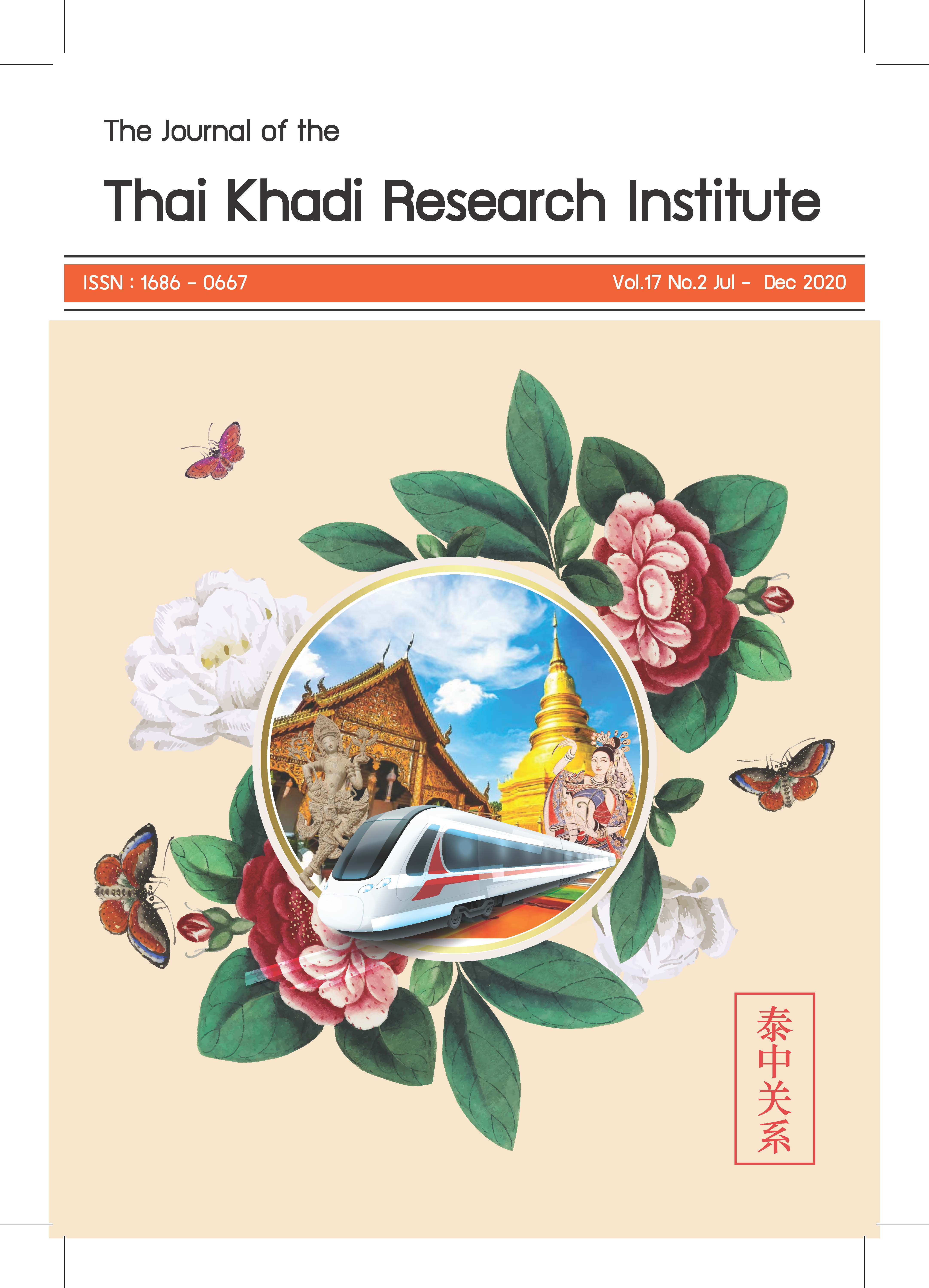
July - December 2020
Vol. 17 No. 2 (2020)
At present, the importance of ‘China’ or ‘the People’s Republic of China’ (PRC) to Thailand is undeniably increased, owing to Thailand’s internal order, should it be in its international policy or in its designation of China as ‘the most important major power’. Within a closer relationship context, the body of knowledge on ‘Chinese studies’ in Thailand and Sino -Thai relationships is in constant flux, subtle, thorough and diverse, as exemplified by three articles on different aspects of ‘China’ in the Journal of the Thai Khadi Research Institute Vol.17 No.2.
The Constuction of Knowledge on Sino - Thai Relations and the Application of Frontier Approach to the Studies of Sino - Thai Relations through the Exploration of Xie Yuanzhang’s (Cheah Yanchong) Life by Sitthithep Ekasitthipong. This article is intended to be an experimental case for the use of the ‘Frontier approach’ in Sino-Thai diplomatic relations study through the life and works of Cheah Yanchong (Yanyong Jiranakorn). In fact, since the late 1920s Chinese scholars have produced academic works opposing Thai History of Nan-chao version in an attempt to contend that Nan-chao is not the state of the Tai speaking ethic groups believed to be ancestor of the Thais. With his background as an overseas Chinese who returned from Thailand to motherland, Xie had proven to be a good asset to the Communist Party in the integration of the Tais as part of Chinese by convincing from his Tai studies perspectives that Tai society and culture had their origin in ancient Chinese civilization. It is noteworthy that the knowledge constructed by Xie is in response to both Thailand and China’s needs. For China, the emphasis of Chinese civilization influence over the Tais is in line with the idea that the Thais and Chinese have some connection, at least in cultural aspects. For Thailand, the adoption of Chinese civilization by the Tais enhances ‘the definition of the Thai nation’ under racial assimilation concept in which Chinese are included as part of ‘Thainess’, while the outdated academic perspective of proper Thai is denied.
Although the Sino - Thai diplomatic relations started officially in 1975, the importance of China to Thailand has significantly increased since the late 1990s and a closely relationship between the two countries has been established since 2014. Obviously, Thailand has been moving into Chinese geo - political influence area while stepping away from that of the United States under the ‘Turning Right to China’ policy articulated by Taksin Shinawatra government (2001 - 2006) and accelerated by the National Council for Peace and Order (NCPO) (2014 - 2019). Thailand - China High - speed Railway Project: Prospects for Northeastern Thailand Development by Hongpha Subboonrueng and Jintavat Sirirat is an evidence of Sino - Thai relations under the NCPO government. The study reveals that although the project with a railway line passing through Northeastern Thailand and linking Thai - Lao frontiers in Nong Khai province is not likely to be financially viable, the Thai authorities have indicated their willingness to proceed in order to continue friendly relations with China after Thai military coup in 2014 and the subsequent boycott of Western countries, and in accordance with the national strategies of regional development.
The Social Relations Change of the Hokchiu Chinese: A Case Study of the Hokchiu Chinese in Nabon District, Nakhon Si Thammarat Province (1925 - Present) by Sireethorn Thawornwongsa. A study on the transformation of the social relations and identity of ‘Hokchiu Chinese’ capitalists who have migrated from British Malaya to settle and pioneer rubber plantation in southern Thailand for over a century. The result shows that the Hokchiu’s social relations change is associated with the coming of commercial - based production and capitalism as well as the gradually strengthening relations with Thai authorities. This includes the classification of villagers into three groups: rich, mediocre and poor, with a clear - cut division of labor; the shift from ‘Tua Hia - Luok Nong’ to ‘employer–employee’ relations; the phase out of ‘Kongsi’ or Chinese partnership in production system; and the connection with Thai identities which lessens the intensity of traditional social grouping. Although the traditional social relations remain only in the form of social and cultural organizations, the Hokchiu Chinese make use of these organizations to open up trade and investment in rubber business with the PRC. Meanwhile, the PRC foresees opportunities to contact overseas Chinese capitalists in different regions through social and cultural organizations.
Besides those three articles on ‘China’, two more articles are published. The Recently Constructed Lanna: The Social History of the Upper Chao Phraya Basin (1932 - 2014 A.D.) by Pinyapan Pojanalawon. Inspecting northern Thailand history while reversing the acknowledgement of the region through ‘internal colony’ glasses, the author points out that changes in northern Thailand during the past 8 decades have been directed by the central government. This includes the rise of ‘the North’ after the fall of Monton Payap, the formation of the North after World War II, the North under ‘cold - war colonization’, the process of becoming ‘Lanna’ and centralized Chiang Mai; all of which feature Lanna history and identity as humble, rich in culture, non - resistance and reverie. Within the context of liberal democracy expansion, political conflicts among color shirts, regionalism, etc., however, Lanna has constructed a new form of political consciousness and consequently new identities which could be described as resistance and aggression.
Mani ‘Sakai’: Representations, Ethnicity and Marginality by Apichaya Kaewuthai. This article deals with the marginalization of the ‘Mani’ or ‘Sakai’ through daily newspaper and documentary discourse. Findings show that most representations of the Mani ‘Sakai’ in daily newspaper discourse are negative: they are a minority who leads an outdated ways of life, needs help and development. Meanwhile, the representations in documentary discourse show some positive aspects such as their deep connection to forests. The negative representations in both types of discourse clearly indicate that the Mani ‘Sakai’ are inferior to the majority of people in the country and are thus marginalized through deprivation, restriction and weakening.
Additionally, a book review on ‘Guidebook to Ancient Fine Arts in Lanna’ written by Professor Dr. Sakchai Saising and reviewed by Monwat Promrat, and reports on academic, art and culture activities organized by the Thai Khadi Research Institute from July to December 2020 are presented in the Journal of the Thai Khadi Research Institute Vol.17 No.2.
It is our hope that the Journal of the Thai Khadi Research Institute will be a forum and mediation for dissemination and exchange of knowledge on ‘Thai studies’ that benefits academic communities and the general public as well.

January - June 2020
Vol. 17 No. 1 (2020)
The Journal of the Thai Khadi Research Institute Vol.17 No.1 deals with research and academic articles in different areas of study, including the study of manuscript paintings that reflect locality and cultural changes in southern provinces in the mid-25th century Buddhist; the study of Maitreya statues produced in Rattanakosin period; a historiography analysis of an ‘unconventional chronicle’ written from a woman’s perspective; the analysis of Thai traditional music through the semiotic approach; and international dimension of inquiries into multiculturalism.
Paintings in Ancient Manuscripts ‘Sastra’: Formats, Folklores, Beliefs and Reflections of Culture in Southern Thailand during the 20th Century A.D. by Chutarat Chitsopa A study of paintings in ancient manuscripts known among people in the South as ‘Sastra’, meaning knowledge. Findings show that the manuscript paintings are the work of local artists who combined Western and traditional painting techniques, although those paintings are not as elaborate and realistic as the work of arts in the capital city. Common subjects for illustration are derived from literature, i.e. Ramayana, Sang Tong, Vessantara Jataka, etc. The composition of manuscript paintings bears some relationship to that of shadow puppets. Moreover, those paintings reflect cultural changes in southern provinces in the mid-25th century Buddhist under the centralization of the central government.
Image of Phra Sri Arn Holding a Talipot: Source and Form from the Evidence of Rattanakosin Sculptures by Chanisa Naknoy A study of Buddhist monk statues holding talipot fan in Rattanakosin period. Formerly the statues were identified either as Phra Malai or Maitreya (Phra Si-arn), with a tendency towards Phra Malai depending on Buddhist beliefs that Phra Si-arn is a deity in Dusita heaven, and thus should not be in monk robe. The study found that, according to Anakotwongse and Pathom Somphot Katha scriptures, Phra Si-arn was once in monkhood and the iconograhic feature of holding talipot fan can be related to his preaching miracle. In addition, the investigation of monk statues holding talipot fan in Central Thailand constructed in the reign of King Rama VI downwards shows that most of those statues are inscribed as Phra Si-arn. In the course of time the construction of Phra Siarn in the position of holding talipot fan has possibly become a tradition of Rattanakosin artists. Consequently, it could be implied that the image portraying a monk holding talipot fan produced in Rattanakosin period are more likely to be a representation of Phra Sri-arn.
Princess Narinthorn Thewi: The ‘Unconventional Chronicle’ from Women’s Perspective and the Changing of King Taksin’s Image in Thai History by Kampol Champapan A historiography analysis of Memoirs Archives of Princess Narinthorn Thewi, a historical writing of Thai history from Thonburi to early Rattanakosin period. Written from women’s perspective, the writing differs significantly from royal chronicles dominated by men, for example, the royal chronicles written and edited by Chao Phraya Tipakornwongse (Kham Bunnak) and Somdej Krom Phraya Damrong Rajanubhab. In this connection, Princess Narinthorn Thewi (Chao Krok Wat Po) should be recognized as the first female historian of Siam. As for the documentation of King Taksin, Princess Narinthorn Thewi viewed the transition from King Taksin to Chakri dynasty from a more humanistic perspective of women, thus returning, as could be read between the lines, righteousness and human dignity to the King.
Connecting to Thainess on the Bridge of Audiences’ Experiences in Western Music, A Case Study of Thai Contemporary Music by Sarupong Sudprasert Based on his research through the semiotic approach, the author points out that Thai contemporary music, developed during World War II by adapting Thai traditional music to Western harmony, vocal style and musical instruments, is actually a vehicle of Thainess, should it be musical signs and symbols declining from Thai traditional music, the art of literary composition, the melisma, the singing, and the instinctive feeling of relaxed and simple lifestyle of the ‘water’ people, all of which are ‘Thai characteristics’. Therefore, listening to Thai contemporary music reflects the audiences’ perception on the existence of Thainess as well as its alignment with globalization.
Multiculturalism during Critical Time by Bandit Grivijitr As the world is ‘turning right’ the multiculturalism and identity politics developed from post-marxism have been increasingly questioned. The reason behind this lies on the fact that the political philosophy of ‘multicultural society’ should definitely lie on the basis of ‘politics of recognition’. However, behind the elegant mask of ‘recognition’ and ‘understanding’ of the states that declare themselves as liberal and cultural diversity country, the society may not actually recognize multiculturalism. A variety of changes in the modern world, including the inflow of Muslim immigrants from the Middle East to Europe, will possibly bring about hostility, fear and violence among people in the society who neither recognize nor have sympathy towards the disadvantaged, the underdog, the border people. On the contrary, those people are labeled a social burden and criminal problems. It is undeniable, however, that multicultural problems are partly the result of the development of conceptual framework that overestimates the values of multiculturalism.
In addition, this issue contains a book review of ‘Prem Regime: the Hybrid System of Thai Politics ’ by Adinan Prompanjai, and a report of special lectures on ‘The Royal Barge Procession on the Royal Coronation 2019’, organized by the Thai Khadi Research Institute.
It is hoped that the Journal of the Thai Khadi Research Institute will be a forum and mediation for dissemination and exchange of knowledge on ‘Thai studies’ that benefit the academic community and the general public as well. Any contributions to the Journal, either article submission or readership, are highly appreciated.

July - December 2019
Vol. 16 No. 2 (2019)
This is Volume 2 of the Journal of the Thai Khadi Research Institute in its 16th year of publication. In this edition, readers will enjoy a variety of articles such as the study of the perception of Ayutthaya period history in the eyes of people in the early Rattanakosin era, the Historical Arts on how to determine ages of chedi or pagoda through the influence of architectural styles, the Anthropology study on identity changes for undertakers or “ Burner of Human Corps”, the study on the evaluation of cultural capital values on temples and ancient monuments through the concept of ICOMOS, as well as the study on the dimension of policy communication for tourism in Thailand. Readers will see that the essence appeared in this Journal of the Thai Khadi Research Institute have reflected the creation of contemporary academic field studies and other different methodologies that build up the knowledge on “Thai Study”.
The first article is on “Ayutthaya in Rattanakosin Era from the Reign of King Rama I
to King Rama V: A Documentary Research on Literature and Official Documents” by Nichapa Thichakornsakul. It is the study on worldview and perception of people during an early period of Rattanakosin period on Krung Sri Ayutthaya – the old capital city. The study was conducted through researching literatures, documents, and other evidences. It was found that people of the early Rattanakosin period saw Ayutthaya as the vanished -old capital city especially people’s view from the first three (3) reigns of Rattanakosin Era when the new capital city was established. The main focus points of early Kings were on building Bangkok – the new capital city – to be more beautiful and stable. However, the perception of Krung Sri Ayuttaya from the elite group showed different aspects which reflected politics in the royal courts, especially the conflicts between “The Front Palace” and “The Rear Palace” in the reign of King Rama 1. During the reign of King Rama 3, Sri Ayutthaya would mean Bangkok. This view reflected how people in that period saw the glory of Sri Ayutthaya even though it was destroyed. The newly built capital city had its grandeur and splendor just like the old Sri Ayutthaya. Then came the reign of King Rama 4 when people regarded Sri Ayutthaya as the old city which was the foundation of Siam. Therefore, the King placed importance in the restoration of the old city in order to show to the west during the invasion for colonies that Siam had long history and civilization. The King also wanted to show to the world how close the ties were between Ayutthaya Dynasty and the new Chakri Dynasty.
The next article is on “Chedi at Wat Hua Khuang in Prae Province: The Study of History and Architectural Style” by Nantaporn Poommanee. This is the study that gave insight into the concept that there were many major cities in the north of Thailand that built prominent monasteries with the name “ Wat Hua Khuang”. Most of such monasteries would be located on the northern side of the city’s courtyard or the city center. However, there were no clear nor fixed architectural styles of chedi in each compound of Wat Hua Khuang. People will see the diversity in architecture that resulted from local preferences and other influences at certain times. For example, the chedi of Wat Hua Kuang in Chiang Mai province was built in the bell shape on an octagonal base while chedi of Wat Hua Khuang in Lampang and Nan provinces were in the shape of castle roof top. Some of them were built with Burmese style architecture such as Wat Hua Khuang in Lamphun province. As for the chedi in Wat Hua Khuang in Prae province, it was found that the architectural style was in the shape of round bell on three- tiered base adorned with stucco of lotus blossoms in circular plan. It was developed from chedi at Wat Phra That Hariphunchai in Lamphun province during the period of 21st to 22nd century B.E. It was believed that the present style was from the major restoration during the reign of King Tilokaraj of the Mangrai dynasty around the end of the 20th century B.E. Such style influence also related to the Lanna history during the period of Chiang Mai – Lamphun (Mangrai dynasty) under King Tilokaraj who had expanded the influence to Prae province until Prae had became a part of Lanna. The Chedi at Wat Hua Khuang in Prae Province, therefore, signified the beginning of Lanna style bell-shape architecture that had influences on other chedis in Prae province.
The third article is on “The Changes of Identity of Undertakers in Urban Communities in Nakorn Si Thammarat Province” By Damrongphun Jaihowweerapong , Kettawa Boonprakarn, and Nattapong Jitniratana. The researchers studied the anthropology dimension on “Identity Politics” of small people who are less privileged under the power structure of Subaltern which, in this case, were the “corps burners” or “undertakers”. The study found that the identity of undertakers had changed because of the socio-economic context. For example, in the old times when cremations took place on funeral pyre in an open area using firewood to burn corps, undertakers’ identity were of low class people with intimidating looks who consumed food from Buddhist temples, who slept in funeral areas, who had bestiality with dogs, who used blankets from dead persons, who chanted an incantation of black magic rituals, and who believed in animism and supernatural, etc. However, the identity of undertakers had changed over times. They had fought and negotiated for the change of relations in power in the dimension of “Identity Politics”. At present, the identity of undertakers are shown as professional group of people with decent jobs, not the low class people. They emerge with new identity as the undertakers who put on suits to perform rites of cremation. They are highly skilled in the management of funerals. Every ritual step that they perform shows that they are the professional service providers for customers. Undertakers in the new era use Facebook and Line application to communicate and provide services to people. However, no matter how modernized they are, they still adhere to strict traditions, and rules. They still keep performing old rituals and ceremonies while preserving the key identity of “Undertakers”.
Then, there is an article on “Khongkharam Temple, Ratchaburi Province, Value of Tangible Cultural Capital and Direction for Promoting the Temple as a Learning Center of Mon Culture in Thailand” by Sirot Pinanratchathon. This is the study on Tangible culture which applied the concept of ICOMOS to evaluate the value of Tangible culture in four (4) categories. They are 1) Historic Value , 2) Aesthetic Value, 3) Scientific Value, and 4) Social Value. Results from the study show that Khongkharam Temple of Ratchaburi Province has been a center of a large Mon people community in Ratchaburi province since the early Rattanakosin era. The temple houses numerous arts that are related to Mon people’s culture. For example, there are pagodas in the style of Mon architecture, mural paintings in the main chapels (Ubosoth), murals in the sermon hall, as well as murals inside the Thai house of 9 rooms which are the monks’ chambers, and in Local museum of Mon people. All of these are cultural capital of Tangible culture. They have historic, aesthetic, scientific and social values. They provide the potential knowledge that can be used to promote the Khongkharam Temple as a learning center of arts and culture of Mon people in Thailand. The promotion of the learning center is with the concept of historical arts which will create knowledge and understanding based on scientific approach.
The last article is on “TAT Communication Policy and the Adaptation of Communities in Phang Nga and Trang Provinces to Discover Thainess Campaign” by Kawin Sing-in. The study explained the general picture of communication policy laid out by the Tourism Authority of Thailand (TAT) to promote the “Discover Thainess Campaign” as declared in the National Agenda since 2015. The objectives of the campaign were to accelerate quality tourism, and to showcase “Thainess” as the selling point to draw more revenue from tourism. Furthermore, the campaign aimed at strengthening local communities by distributing more income. The “Thainess” campaign is also under the concept of “Thailand 4.0” which aimed at creating the “Tourism 4.0”. The concept focused on driving grass root economy with tourism innovation. For selected communities in Phang-Nga and Trang Provinces, they showcased “Thainess” with emphases on “Old Towns” and “Fishing villages”. It was found that these communities adapted themselves to embrace tourism. For example, the revival of the distinctive Baba heritage, the revival of traditional dresses and authentic local food culture to glorify the feeling of “Nostalgia” for the past. As for the local fishing villages where Muslim people dwelled, it was found they open their houses for the Home Stay business to showcase their ways of life. They also presented Muslim culture as parts of tourism activities. However, when the Tourism Communication Policy is considered, it can be concluded that the “Discover Thainess” policy was very much a “Top- Down” policy. It did not focus on the participation of people in local communities as it should have been done.
This Journal of the Thai Khadi Research Institute also presents book reviews on “Memories du comte de Forbin, Chef D' Escarde, Chevalier de L'Ordre Melitaire de Sainte Louis by Chevalier de Forbin” ( Translated by M.C.Damras Damrong Devakula) as commented by Doungrak Chantang. There is reading recommendation for the book titled “Restoration and Preservation of Thai Mural Paintings in Myanmar at MahaThein Daw Gyi Temple and Kyauk Twa Gyi Phaya” by Sirot Pinanratchathon. Another reading recommendation is for the book “The Royal Barge Procession along the City’s River on the Occasion of the King’s Royal Coronation Ceremony 2019” by Asa Kumpha. These are the works carried out in the second half of the year 2019 by researchers and working team of the Thai Khadi Research Institute. In addition, there are news of academic and cultural activities that were organized by the Institute during the period of June – October 2019. Compilation and the summary of content derived from those activities are prepared for readers to enjoy.
Finally, our Editorial staff hopes that the Journal of the Thai Khadi Research Institute will be a platform and a meditator in dissemination and exchanges of knowledge on “Thai Study” where people can find academic answers and solutions which will be beneficial for society. We also wish that this academic Journal will receive continued support from interested public
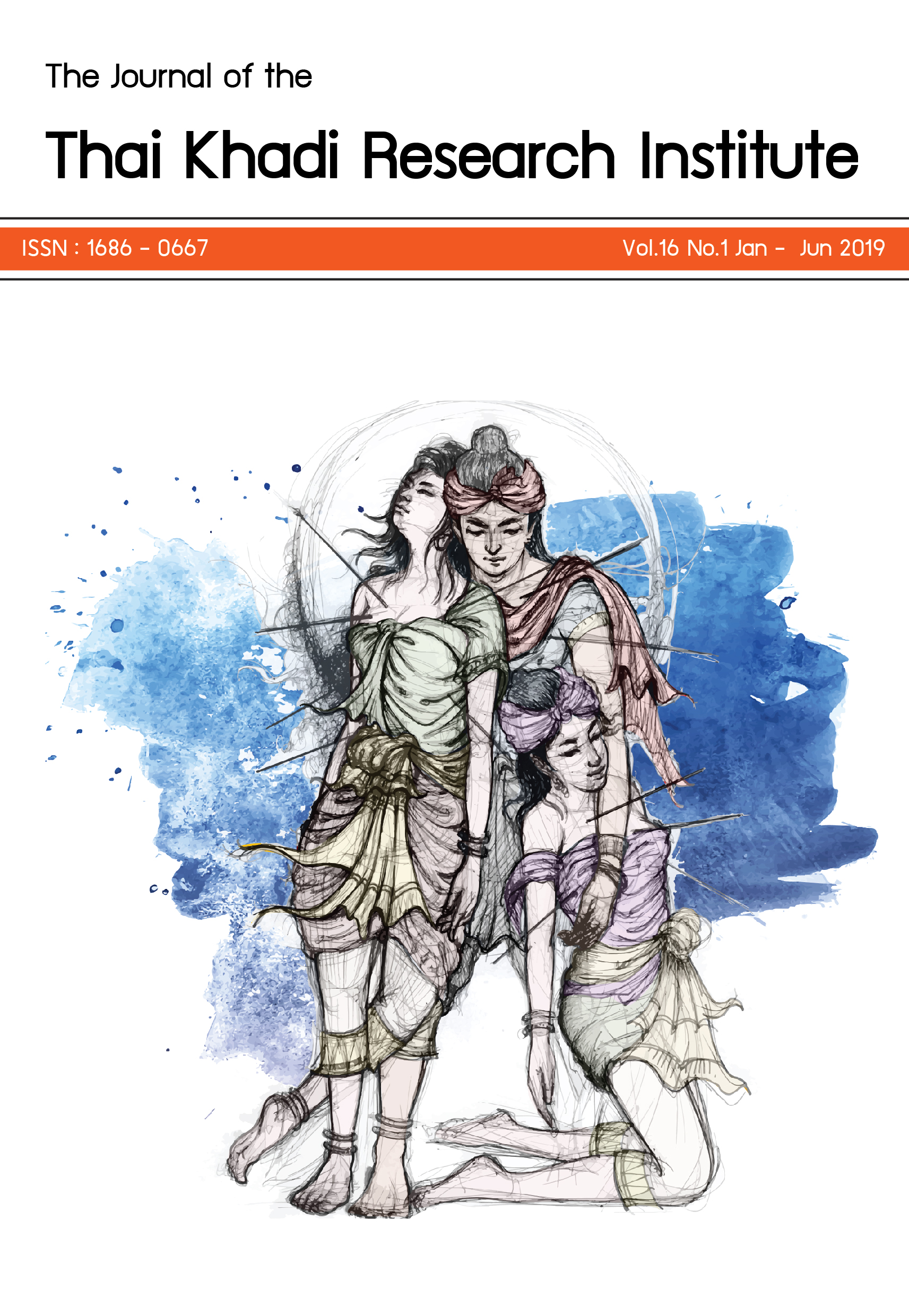
January - June 2019
Vol. 16 No. 1 (2019)
วารสารไทยคดีศึกษา ปีที่ 16 ฉบับที่ 1 เล่มนี้ประกอบด้วยบทความที่มีสารัตถะมุ่งเน้นไปทางด้านการเมืองในสังคมไทยผ่านแง่มุมต่าง ๆ หลากหลาย ได้แก่ วรรณกรรมลิลิตพระลอ นาฏกรรมฟ้อนม่านมุยเซียงตา ชุมชนอโศก การจัดการซากศพ และสินค้าสัตว์ป่า สารัตถะเหล่านี้ดูเผิน ๆ แล้วเหมือนว่าจะเป็นเรื่องในอดีตหรือเป็นเรื่องที่ไกลผู้คนในปัจจุบัน หากแต่เมื่อพิจารณาในความเป็นจริงแล้วสารัตถะเหล่านี้ยังคงสามารถนำมาใช้เตือนสติผู้คนในสังคมไทยปัจจุบันได้เป็นอย่างดี อีกทั้งสามารถนำความรู้เหล่านั้นไปสร้างสรรค์สังคม แก้ไขปัญหาสังคม และอธิบายปรากฏการณ์ในสังคมปัจจุบันได้
บทความแรกของวารสารฉบับนี้เรื่อง “บทเรียนทางการเมืองจากลิลิตพระลอ” ของ สมเกียรติ วันทะนะ ผู้เขียนได้ศึกษา “ลิลิตพระลอ” ซึ่งเป็นวรรณกรรมที่เชื่อกันว่าแต่งขึ้นในสมัยกรุงศรีอยุธยาตอนต้น (ราว พ.ศ. 1893 - 2112) ในฐานะเป็นตัวบทของความคิดทางการเมืองที่สอนในสิ่งที่กษัตริย์หรือผู้ปกครองแผ่นดินควรยับยั้งชั่งใจในเรื่องความรัก โดยที่กษัตริย์พึงหลีกเลี่ยงความรักที่มีลักษณะสุดขั้ว เพราะความรักเช่นนั้นอาจนำมาซึ่งความสูญเสียอย่างมหันต์ ทั้งในส่วนพระองค์และพระราชอาณาจักรของพระองค์ บทเรียนทางการเมืองจากลิลิตพระลอที่ผู้เขียนมุ่งนำเสนอคือ ความรักของพระลอที่ไม่ฟังคำทัดทานของพระราชมารดาจนนำไปสู่ความตาย และทำให้เมืองสรวงไร้กษัตริย์ปกครอง
บทความเรื่อง “ฟ้อนม่านมุยเซียงตา: อิทธิพลนาฏกรรมพม่าในสังคมไทย ศึกษาวิเคราะห์ความหมายของชื่อชุดการแสดง บทขับร้อง และโครงสร้างของทำนองเพลง” ของ สิทธิพร เนตรนิยม ผู้เขียนได้ศึกษาประวัติความเป็นมาของชื่อชุดการแสดง บทขับร้อง และทำนองเพลง ที่ปรากฏในการแสดงชุดฟ้อนม่านมุยเซียงตา ภายใต้กรอบการศึกษาและระเบียบวิธีวิจัยทางด้านประวัติศาสตร์ ภาษาศาสตร์ และการวิเคราะห์โครงสร้างทางดนตรี ผู้เขียนพบว่าฟ้อนม่านมุยเซียงตาเป็นการแสดงที่เกิดขึ้นจากการเลื่อนไหลทางวัฒนธรรมข้ามแดนระหว่างไทยกับพม่าที่มีมาอย่างต่อเนื่องและยาวนาน ชื่อของการแสดงชุดนี้มีที่มาจากชื่อเพลง “เวซะยันตา” ซึ่งเป็นเพลงพม่าสำเนียงอยุธยา ที่ไทยนำมาบรรเลงเป็นเพลงแรกของชุดการแสดง โดยใช้บทขับร้องที่มีสำเนียงและข้อความบางคำคล้ายคลึงกับภาษาพม่า ที่เมื่อนำมาวิเคราะห์พบว่ามีความหมายไปในเชิงรำพันถึงคนรักภายใต้สภาพแวดล้อมของป่าเขาอันทุรกันดาร ซึ่งแตกต่างไปจากบทขับร้องในเพลงเวซะยันตาของพม่าที่บรรยายถึงสภาพความงามของเมืองมัณฑเลย์ ส่วนทำนองเพลงฟ้อนม่านมุยเซียงตาโดยเฉพาะในเพลงแรกมีโครงสร้างของทำนองตรงกับเพลงเวซะยันตาของพม่ากว่าร้อยละ 75
ต่อมาเป็นบทความเรื่อง “หมู่บ้าน - พุทธสถาน - โรงเรียนสัมมาสิกขา: การประกอบสร้างชุมชนทางศีลธรรมของชาวอโศก” ของ บัณฑิต ศิริรักษ์โสภณ ผู้เขียนได้ศึกษา “อโศก” ว่าเป็นขบวนการพุทธศาสนาที่ก่อรูปขึ้นในสังคมไทยตั้งแต่ต้นทศวรรษ 2510 ขบวนการนี้ปรากฏตัวตนเป็นองค์กรเอกเทศชัดเจนในปี 2518 เมื่อท่านโพธิรักษ์ผู้นำทางจิตวิญญาณคนสำคัญประกาศแยกตัวออกจากการปกครองของมหาเถรสมาคม ทำให้อโศกทำงานเผยแพร่พุทธศาสนาตามแนวทางของตนเอง โดยอ้างอิงการปฏิบัติตามหลักพระธรรมวินัยด้วยการก่อตั้งชุมชนอโศกขึ้นหลายแห่งทั่วประเทศไทย พร้อมกับขยายเครือข่ายสมาชิกหรือ “ญาติธรรม” ออกไปอย่างกว้างขวาง ผู้เขียนได้มุ่งศึกษาชุมชนอโศกที่จังหวัดนครปฐม เพื่อทำความเข้าใจการประกอบสร้างขึ้นเป็นชุมชนทางศีลธรรม จากองค์ประกอบได้แก่ หมู่บ้าน พุทธสถาน และโรงเรียนสัมมาสิกขา ผู้เขียนได้พบว่าทั้งสามองค์ประกอบนี้เกื้อหนุนให้ชาวอโศกบรรลุถึงนิพพานหรือสิ้นทุกข์ได้ในลักษณะของกระบวนการลดละเลิกกิเลสอย่างสะสมค่อยเป็นค่อยไป ผ่านการปฏิบัติแบบรวมหมู่ นอกจากนั้นยังทำให้อโศกจัดวางสถานะที่แน่นอนของตนเองในสังคมไทยในฐานะ “ตัวแบบที่เข้มงวด” สำหรับการฝึกฝนปฏิบัติธรรมและการผลิตทางเศรษฐกิจทั้งพึ่งตนเองและช่วยเหลือผู้อื่นไปพร้อม ๆ กัน
บทความเรื่อง “การเมืองเรื่องซากศพ: การกำจัดความสยดสยอง และควบคุมซากศพโดย “กระบวนการทำให้ศิวิไลซ์” ในสยามช่วงทศวรรษ 2430” ของ ภัทรนิษฐ์ เกียรติธนวิชญ์ ผู้เขียนศึกษาการปลงซากศพที่ถือเป็นธรรมเนียมปฏิบัติที่อยู่คู่กับสังคมไทยมาช้านาน โดยแต่เดิมการปลงศพล้วนเต็มไปด้วยสิ่งที่มีลักษณะที่ก่อให้เกิดความรู้สึกสยดสยองแก่ผู้ที่พบเห็นซึ่งปรากฏเป็นปกติในสังคมราษฎร ผู้เขียนพบว่าในช่วงทศวรรษ 2430 ชนชั้นนำสยามได้ริเริ่มสิ่งที่อาจจะเรียกว่า “กระบวนการทำให้ศิวิไลซ์” ซึ่งทำให้ความสยดสยองที่มีมาแต่เดิมกลายเป็นสิ่งตรงข้ามกับ “ความอารยะ” และมีการจัดการกับความสยดสยองเหล่านี้ผ่านการแต่งตั้งสัปเหร่อพร้อมออกกฎเกณฑ์ต่าง ๆ เพื่อหวังให้สยามมีความเจริญและมีอารยะทัดเทียมกับตะวันตก ผลประการหนึ่งของการไล่ล่าตามความศิวิไลซ์แบบตะวันตกนี้คือรัฐสยามสามารถใช้อำนาจเด็ดขาดมากขึ้นในชีวิตประจำวันของราษฎร ผ่านการบงการร่างกายและซากศพ
บทความสุดท้ายเรื่อง “สินค้าสัตว์ป่า: ปฏิบัติการในชีวิตประจำวันของผู้ค้าลาวในตลาดชายแดนไทย – สปป. ลาว” ของ สุดารัตน์ ศรีอุบล และจักรพันธุ์ ขัดชุ่มแสง ผู้เขียนได้ศึกษาปฏิบัติการในชีวิตประจำวันของผู้ค้าลาวที่จุดผ่อนปรนบ้านหนองมน พบว่าผู้ค้าลาวได้ใช้กลวิธีต่าง ๆ ในการดำเนินกิจกรรมทางเศรษฐกิจข้ามพรมแดนที่เป็นการลักลอบขนส่งสินค้าผิดกฎหมาย ปฏิบัติการดังกล่าวถูกปรับให้สอดคล้องกับยุทธศาสตร์ของรัฐและกฎระเบียบต่าง ๆ ในการควบคุมการเดินทางข้ามพรมแดนของผู้คนและสินค้า โดยเฉพาะข้อห้ามเรื่องการซื้อขายสินค้าที่ระบุไว้ในอนุสัญญาว่าด้วยการค้าระหว่างประเทศซึ่งชนิดสัตว์ป่าและพืชป่าที่ใกล้สูญพันธุ์ อนุสัญญาดังกล่าวส่งผลให้ผู้ค้าลาวไม่สามารถขายสัตว์ป่าได้อย่างเปิดเผยและเป็นอิสระดังเช่นในอดีต ทำให้ผู้ค้าลาวต้องใช้ปฏิบัติการโดยอาศัยพื้นที่ เวลา และโอกาสในการต่อรองกับเจ้าหน้าที่เพื่อให้กิจกรรมการค้าสินค้าสัตว์ป่าสามารถดำเนินต่อไปได้
นอกจากนี้ ในวารสารฉบับนี้ยังมีส่วนอื่น ๆ ที่น่าสนใจคือ บทวิจารณ์หนังสือเรื่อง “Limology: ชายแดนศึกษากับเขต – ขันธ์วิทยาของพื้นที่ใน / ระหว่าง” โดย จักรกริช สังขมณี วิจารณ์โดย รัชพล แย้มกลีบ รวมถึงข่าวกิจกรรมวิชาการและศิลปวัฒนธรรมจำนวนหลายกิจกรรมที่สถาบันไทยคดีศึกษาจัดขึ้นในช่วงเดือนมกราคม - มิถุนายน 2562 โดยกองบรรณาธิการได้รวบรวมและสรุปสาระสำคัญของกิจกรรมเหล่านี้มาไว้ด้วย
สุดท้ายนี้ กองบรรณาธิการฯ หวังว่าวารสารไทยคดีศึกษาจะได้เป็นสื่อกลางในการเผยแพร่และแลกเปลี่ยนวิชาการด้านไทยศึกษา และเป็นวารสารทางวิชาการที่ผู้สนใจให้การสนับสนุนต่อไป
July - December 2018
Vol. 15 No. 2 (2018)
วารสารไทยคดีศึกษา ปีที่ 15 ฉบับที่ 2 ประกอบด้วยบทความที่มีสารัตถะหลาก หลายมิติ โดยเฉพาะทางด้านประวัติศาสตร์ศิลปะ ประวัติศาสตร์ การเมืองการปกครอง และพุทธศาสนา ซึ่งล้วนแล้วแต่มีประเด็นที่แตกต่างกันออกไป ในขณะเดียวกัน เป็นที่น่าสังเกตว่าบทความเหล่านี้ต่างก็มีมุมมองหรือกระบวนทัศน์ที่คล้ายคลึงกันอย่างน่าสนใจ นั่นคือเป็นการศึกษาในเชิง “บูรณาการ” ที่เกิดจากการเชื่อมโยงความรู้จากสาขาวิชา ต่าง ๆ จนทำให้เกิดเครือข่ายองค์ความรู้ใหม่ขนาดใหญ่ ที่มีความกว้างขวาง มีความถูกต้องและชัดเจนมากขึ้น และสามารถนำความรู้เหล่านั้นไปสร้างสรรค์สังคม แก้ไขปัญหาสังคม หรืออธิบายปรากฏการณ์ในสังคมได้อย่างเข้าใจ
เริ่มต้นวารสารด้วยบทความพิเศษเรื่อง “อยุธยามาจากไหน: มุมมองผ่านหลักฐานทางศิลปกรรม” โดย ศาสตราจารย์ ดร.ศักดิ์ชัย สายสิงห์ ภาควิชาประวัติศาสตร์ศิลปะ มหาวิทยาลัยศิลปากร ที่ให้มุมมองใหม่ต่อการศึกษาประวัติศาสตร์และผู้คนสมัยอยุธยาด้วยองค์ความรู้ทางด้านประวัติศาสตร์ศิลปะ เนื่องจากในสมัยอยุธยาเป็นราชธานีมีการรวบรวมผู้คนมาจากหลายพื้นที่ซึ่งมีวัฒนธรรมที่แตกต่างกันจึงเป็นช่วงเวลาที่มีความซับซ้อนทางด้านวัฒนธรรมเป็นอย่างมาก ทำให้การศึกษาประวัติศาสตร์สมัยอยุธยาจากหลักฐานเอกสารนั้นยังคงมีช่องว่างทางความรู้ที่ยังไม่ได้รับคำตอบอยู่อีกมาก อย่างไรก็ดี ในสมัยอยุธยาได้มีการสร้างงานศิลปกรรมขึ้นเป็นจำนวนมากและยังคงเหลือเป็นหลักฐานถึงปัจจุบัน โดยเฉพาะงานสถาปัตยกรรมประเภทเจดีย์และงานประติมากรรมประเภทพระพุทธรูป ซึ่งเมื่อศึกษาประวัติศาสตร์ศิลปะของหลักฐานเหล่านี้อย่างเป็นระบบ จะทำให้ทราบถึงรูปแบบศิลปะ ความหมายทางประติมานวิทยา อายุการสร้าง และสายวิวัฒนาการของหลักฐานเหล่านั้นที่เชื่อมโยงอยู่กับกลุ่มช่างหรือกลุ่มคน ผู้เป็นเจ้าของงานศิลปกรรมที่แท้จริง จึงทำให้ทราบถึงเอกลักษณ์เฉพาะของงานศิลปกรรมของกลุ่มคนต่าง ๆ ได้ หรืออาจกล่าวได้ว่าเอกลักษณ์รูปแบบศิลปะสามารถบ่งชี้ถึงกลุ่มคนได้ บทความนี้จึงเป็นการศึกษาเชิงบูรณาการที่เชื่อมโยงความรู้ทางด้านประวัติศาสตร์ศิลปะเข้ากับความรู้ทางด้านประวัติศาสตร์ ซึ่งนับเป็นการนำความรู้ใหม่ที่อยู่นอกเหนือหลักฐานเอกสารที่การศึกษาทางด้านประวัติศาสตร์ให้ความสำคัญ ทำให้เกิดเป็นความรู้ใหม่ที่มีความกว้างขวางมากขึ้น เป็นการเปิดประเด็นการศึกษาใหม่ทางด้านประวัติศาสตร์สมัยอยุธยา อาทิ ประเด็นเรื่องเจดีย์ทรงปรางค์สัญลักษณ์ของกลุ่มชนจากเมืองลพบุรี และข้อสันนิษฐานเรื่องพระเจ้าอู่ทองมาจากเมืองลพบุรี, เจดีย์ทรงระฆังที่มีชุดรองรับองค์ระฆังในผังแปดเหลี่ยมสัญลักษณ์ของกลุ่มคนจากเมืองสุพรรณบุรีและสรรคบุรี, เจดีย์ทรงระฆังแบบสุโขทัยและชาวสุโขทัยในอยุธยา, เจดีย์ทรงระฆังแบบล้านนา สัญลักษณ์ของชาวล้านนาในอยุธยา เป็นต้น อนึ่ง ในการนี้กองบรรณาธิการวารสารไทยคดีศึกษาขอขอบคุณศาสตราจารย์ ดร.ศักดิ์ชัย สายสิงห์ เป็นอย่างสูง ที่กรุณาเขียนบทความพิเศษนี้ให้กับวารสารไทยคดีศึกษา
บทความเรื่อง “พลวัตสถาบันพระมหากษัตริย์เชิงเครือข่าย: ข้อสังเกตว่าด้วยความเปลี่ยนแปลงของเครือข่ายชนชั้นนำไทย พ.ศ. 2495 – 2535” โดย อาสา คำภา บทความนี้มุ่งตั้งข้อสังเกตต่อสถาบันพระมหากษัตริย์ในเชิงเครือข่ายอย่างเฉพาะเจาะจงลงไปมากกว่าการศึกษาที่ผ่านมาในอดีต โดยการวิเคราะห์เพื่อสร้างคำอธิบายความสัมพันธ์ระหว่าง สถาบันพระมหากษัตริย์เชิงเครือข่ายกับเครือข่ายชนชั้นนำไทย ซึ่งเป็นการศึกษาในลักษณะเชื่อมโยงความรู้จากประเด็นต่าง ๆ ที่เคยกระจัดกระจายเป็นส่วน ๆ ทำให้เกิดเครือข่ายความองค์ความรู้ใหม่ขนาดใหญ่ที่สามารถนำไปอธิบายปรากฏการณ์ทางการเมืองการปกครองในสังคมในสมัยรัชกาลที่ 9 ให้เกิดความเข้าใจที่ชัดเจนมากขึ้นว่า สถาบันพระมหากษัตริย์เชิงเครือข่ายถือเป็นส่วนหนึ่งในโครงสร้างเครือข่ายชนชั้นนำไทย การก่อรูปและพลวัตของสถาบันพระมหากษัตริย์เชิงเครือข่ายเป็นสิ่งที่สัมพันธ์กับพระราชอำนาจนำในพระบาทสมเด็จพระเจ้าอยู่หัวภูมิพลอดุลยเดชในแต่ละช่วงเวลา ในขณะที่กลุ่มก้อนตัวแสดงในสถาบันพระมหากษัตริย์เชิงเครือข่ายล้วนเป็นสมาชิกของกลุ่มชนชั้นนำไทยที่มีความสัมพันธ์กันในแบบอิสระเชิงสัมพัทธ์ โดยในเครือข่ายชนชั้นนำไทยนี้จะมีฉันทามติชนชั้นนำไทยเป็นสิ่งสำคัญ ซึ่งมีผลต่อการกำหนดช่วงเวลาแห่งพระราชอำนาจนำด้วย บทความนี้จึงมีความโดดเด่นในฐานะเป็นองค์ความรู้ใหม่ที่ให้ภาพเครือข่ายสถาบันพระมหากษัตริย์ในสมัยรัชกาลที่ 9 ซึ่งเป็นสมัยที่ยาวนานที่สุดในประวัติศาสตร์ชาติไทยอย่างน่าสนใจ
บทความเรื่อง “จารึกปราสาทพิมานอากาศ ของพระนางศรีอินทรเทวี: สารัตถะและความสำคัญในการสดุดีพระเกียรติพระเจ้าชัยวรมันที่ 7” โดย นิพัทธ์ แย้มเดช และจิรพัฒน์ ประพันธ์วิทยา บทความนี้มุ่งศึกษาจารึกในประเด็นเรื่องสารัตถะและการสดุดีพระเกียรติพระเจ้าชัยวรมันที่ 7 โดยพบว่าประเด็นเรื่องสารัตถะ จารึกได้กล่าวถึงด้านประวัติศาสตร์ โดยเฉพาะพระราชประวัติของพระเจ้าชัยวรมันที่ 7 ไว้หลายเรื่อง รวมถึงวีรกรรมของพระองค์ในการทำสงครามกับกองทัพจามปา และข้อมูลพระประวัติของพระนางศรีชัยราชเทวีและพระนางศรีอินทรเทวี ในด้านศาสนาจารึกได้กล่าวถึงความผสมผสานระหว่างศาสนาพุทธกับศาสนาพราหมณ์ และมีการเชิดชูศาสนาพุทธอยู่เหนือศาสนาอื่น ๆ ในด้านสังคมและวัฒนธรรมจารึกได้กล่าวถึงวิถีปฏิบัติของสตรีในราชสำนักโดยเฉพาะการศึกษาวิชาพระพุทธศาสนา และสภาพปัญหาทางสังคมในช่วงเวลานั้น สำหรับประเด็นเรื่องการสดุดีพระเกียรติพระเจ้าชัยวรมันที่ 7 นั้นจารึกได้สร้างภาพลักษณ์ของพระองค์ให้เป็นกษัตริย์ในอุดมคติที่มีความยิ่งใหญ่ เป็นยอดนักรบ และมีความงดงามเป็นเลิศ พระองค์อยู่ในฐานะพุทธราชาที่มีความเลื่อมใสในพระพุทธศาสนา ในขณะเดียวกันพระองค์ก็อยู่ในฐานะเทวราชาที่มีคุณสมบัติเช่นเดียวกับพระอินทร์ บทความนี้จึงมีความโดดเด่นในด้านการตีความจารึกซึ่งถือเป็นหลักฐานสำคัญ โดยพยายามวิเคราะห์จารึกในเชิงบูรณาการ นอกเหนือไปจากการศึกษาจารึกโดยทั่วไป ที่มักเป็นการถอดความเท่านั้น จึงสามารถแสดงให้เห็นถึงองค์ความรู้ใหม่ทั้งในด้านสารัตถะและข้อสังเกตต่าง ๆ ต่อบริบทที่ซ่อนอยู่เบื้องหลังสารัตถะเหล่านั้น โดยอาศัยการศึกษาเชื่อมโยงกับจารึกหลักอื่น ๆ ที่มีความเกี่ยวข้อง ทำให้เกิดเครือข่ายองค์ความรู้ขนาดใหญ่ที่สามารถให้ภาพเรื่องราวของพระเจ้าชัยวรมันที่ 7 รวมถึงวัฒนธรรมและสังคมของเขมรในช่วงเวลานั้นได้อย่างกว้างขวางและลึกซึ้งขึ้น
บทความเรื่อง “ลวดบัวฐานในสถาปัตยกรรมทวารวดี: รูปแบบ ที่มา และความสัมพันธ์กับสถาปัตยกรรมอินเดีย” โดย พงษ์ศักดิ์ นิลวร บทความนี้ได้มุ่งศึกษาประวัติศาสตร์ศิลปะของสถาปัตยกรรมในสมัยทวารวดีในประเทศไทย เชื่อมโยงกับศาสนสถานในศิลปะอินเดีย ทั้งในกลุ่มอินเดียภาคเหนือและอินเดียภาคใต้ เพื่อค้นหาที่มาหรือแรงบันดาลใจในการทำฐานเจดีย์สมัยทวารวดี การศึกษาเชื่อมโยงระหว่างดินแดนที่ห่างไกลกันเช่นนี้ทำให้เกิดการขยายพรมแดนความรู้ให้มีความก้าวหน้ามากขึ้นอย่างรวดเร็ว บทความนี้จึงมีความน่าสนใจเนื่องจากทำให้ทราบถึงประเด็นใหม่ ๆ ทางวิชาการ ที่พบว่าสถาปัตยกรรมสมัยทวารวดีนอกจากกจะได้รับแรงบันดาลใจมาจากศิลปะอินเดียทั้งอินเดียภาคเหนือและอินเดียภาคใต้แล้ว ยังมีการสร้างสรรค์รูปแบบขึ้นใหม่ตามรสนิยมของตน และเป็นที่นิยมอย่างกว้างขวางจนกลายเป็นรูปแบบที่เป็นเอกลักษณ์ของตนเองอย่างชัดเจน
เช่นเดียวกับบทความเรื่อง “มหาโพธิวิหารจำลองในไทยสมัยพุทธศตวรรษที่ 26: การส่งผ่านรูปแบบทางศิลปกรรมจากอินเดีย และการเคลื่อนคลายของความหมายเชิงสัญลักษณ” โดย สุระ พิริยะสงวนพงศ์ ที่มุ่งใช้ระเบียบวิธีวิจัยทางด้านประวัติศาสตร์ศิลปะมาวิเคราะห์รูปแบบศิลปะ เหตุผลในการสร้าง และคติหรือความหมายเชิงสัญลักษณ์ ของมหาโพธิวิหารจำลองในไทยในสมัยพุทธศตวรรษที่ 26 โดยวิเคราะห์เปรียบเทียบกับมหาโพธิวิหารองค์ต้นแบบที่เมืองพุทธคยา ประเทศอินเดีย และมหาโพธิวิหารจำลองที่สร้างขึ้นในภูมิภาคเอเชียตะวันออกเฉียงใต้ในช่วงก่อนพุทธศตวรรษที่ 26 ได้แก่ ล้านนา พุกาม และหงสาวดี โดยพบว่ามหาโพธิวิหารที่จำลองในช่วง พุทธศตวรรษที่ 26 ไม่ได้ทำตามระบบแผนผังสัตตมหาสถานอย่างที่ต้นแบบหรือช่วงก่อนพุทธศตวรรษที่ 26 แล้ว และยังละเลยการปลูกต้นพระศรีมหาโพธิ์ที่เป็นสัญลักษณ์สำคัญอันเกี่ยวเนื่องกับนามมหาโพธิวิหารด้วย แต่กลับพบว่ามีหลายแห่งที่จำลองขึ้นโดยเชื่อมโยงปูชนียสถานในกลุ่มสังเวชนียสถานทั้ง 4 ซึ่งไม่เคยปรากฏในช่วงก่อนหน้า และนิยมสร้างขึ้นเพื่อใช้งานในหลายลักษณะ การจำลองมหาโพธิวิหารเหล่านี้สามารถอ้างอิงรูปแบบโดยตรงจากอินเดีย อันแสดงให้เห็นถึงการหวนสู่อินเดียในฐานะเป็นแหล่งอ้างอิงความศักดิ์สิทธิ์ในโลกพุทธศาสนา ซึ่งเปลี่ยนไปจากในอดีตที่เคยอ้างอิงลังกามาก่อน บทความนี้มีความน่าสนใจด้วยเป็นการศึกษาเชื่อมโยงหลักฐานที่อยู่ห่างไกลกัน แต่มีความสัมพันธ์ต่อกันในฐานะเป็นศาสนสถานเนื่องในพุทธศาสนาแหล่งสำคัญที่นิยมสร้างจำลองต่อเนื่องกันมาอย่างยาวนาน จึงเป็นการขยายพรมแดนความรู้ให้กว้างขวางขึ้น ทำให้เกิดองค์ความรู้ใหม่ที่เป็นคำอธิบายอย่างเป็นเหตุเป็นผลต่อปรากฏการณ์ความนิยมสร้างมหาโพธิวิหารในสังคมไทยปัจจุบัน
บทความเรื่อง “ความย้อนแย้งของการฆ่าตัวตายว่าด้วยทัศนะทางวิชาการเชิงพุทธกับความเชื่อของคนไทยและพุทธทัศนะ” โดย เทียมจิตร์ พ่วงสมจิตร์ บทความนี้เสนอประเด็นที่น่าสนใจเกี่ยวกับความย้อนแย้งของผลจากการฆ่าตัวตายในทัศนะต่าง ๆ ในสังคมไทยว่าเป็นบาปกรรมหรือไม่เป็นบาปกรรม โดยพบว่าในทัศนะทางวิชาการที่มุ่งพิจารณาความหมายของศีลและธรรมกล่าวว่าการฆ่าตัวตายนั้นไม่ผิดศีลข้อปาณาติบาตแต่ผิดธรรม ส่วนในทัศนะของความเชื่อชาวไทยกล่าวว่าการฆ่าตัวตายนั้นเป็นบาปกรรมหนักจะต้องตกนรกและต้องเวียนกลับมาเกิดเพื่อจะฆ่าตัวตายอีกนับร้อยชาติ อย่างไรก็ดี จากการค้นคว้าเพิ่มเติมของผู้เขียนบทความพบว่าในทัศนะของพระพุทธเจ้านั้นมุ่งให้ความสำคัญต่อจิตที่เป็นเหตุมากกว่าวิธีการและผลคือความตาย ซึ่งเป็นไปตามแนวทางของการพิจารณาแก้ไขเหตุให้ถูกต้องเพื่อผลที่ถูกต้อง โดยให้ความสำคัญต่อจิตที่สว่างมีความผ่องใสปราศจากมลทินของกิเลสและตัณหา จุดเด่นของบทความนี้อยู่ที่การวิเคราะห์ทัศนะที่แตกต่างกันในเชิงบูรณาการ โดยได้เชื่อมโยงสาระสำคัญของทัศนะที่แตกต่างกันดังกล่าวจึงกลับพบว่าพระพุทธศาสนามีทัศนะต่อเรื่องการฆ่าตัวตายอย่างสอดคล้องกันเป็นระบบโดยไม่มีการย้อนแย้งกัน
บทความเรื่อง “การจัดการความรู้ชุมชนผ่านศูนย์การเรียนรู้โหนดนาเล เพื่อสร้างความเข้มแข็งของชุมชนโดยใช้ภูมิปัญญาท้องถิ่นเป็นฐานในอำเภอสทิงพระ จังหวัดสงขลา” โดย เจตน์สฤษฎิ์ สังขพันธ์, ชิดชนก เชิงเชาว์ และเกษตรชัย และหีม บทความนี้มุ่งศึกษาการจัดการความรูชุมชนตำบลท่าหิน ผ่านศูนย์การเรียนรู้โหนดนาเล เพื่อสร้างความเข้มแข็งชุมชนโดยใช้ภูมิปัญญาท้องถิ่นเป็นฐาน โดยพบว่าชุมชนนี้ได้มีการแสวงหาความรู้ภายในจากบุคคลในชุมชนที่มีความเชี่ยวชาญด้านการทำนา การขึ้นต้นตาลโตนด และการทำประมง มีการแสวงหาความรู้ภายนอกจากการไปศึกษาดูงาน การอบรมและแลกเปลี่ยนความรู้ มีการใช้นวัตกรรมมาช่วยพัฒนาความรู้หรือภูมิปัญญาดั้งเดิมให้มีประสิทธิภาพมากขึ้น มีการจัดเก็บความรู้และการค้นคืนความรู้ และมีการถ่ายทอดความรู้ผ่านการจัดกิจกรรมให้เยาวชนภายในชุมชนและบุคคลภายนอกที่สนใจ ศูนย์การเรียนรู้นี้ได้สร้างความเข้มแข็งทางสังคมเนื่องจากช่วยให้ความสัมพันธ์ภายในครอบครัวมีความแน่นแฟ้นมากขึ้น ทำให้ชุมชนมีความสามัคคี ชุมชนมีการรื้อฟื้นประเพณีดั้งเดิมให้กลับคืนมา และชุมชนยังได้มีการพัฒนาภูมิปัญญาโดยใช้นวัตกรรมในวิถีการผลิตทำให้มีรายได้เพิ่มขึ้นแก่ครอบครัวและชุมชน
กล่าวได้ว่าบทความทั้งหมดในวารสารไทยคดีศึกษาฉบับนี้ต่างก็มีมุมมองในการศึกษาเชิงบูรณาการ ที่เป็นการเชื่อมโยงความรู้จากสาขาวิชาต่าง ๆ เข้าด้วยกัน อันทำให้เกิดความรู้ใหม่ที่มีความถูกต้องและชัดเจนมากขึ้น เป็นการขยายพรมแดนความรู้ให้กว้างขวางออกไปจนกลายเป็นเครือข่ายความรู้ขนาดใหญ่ที่เชื่อมโยงถึงกัน ในขณะเดียวกันผลของการศึกษาลักษณะนี้ก็ทำให้ความรู้ใหม่มีความลึกซึ้งแตกฉานมากขึ้นตามไปด้วย
นอกจากนี้ ในวารสารฉบับนี้ยังมีส่วนอื่น ๆ ที่น่าสนใจคือ บทวิจารณ์หนังสือเรื่อง “อดีตการเมืองไทย ทิศทางการเมืองไทยในอนาคต: มุมมองบนพื้นฐานปัจจัยการเปลี่ยนแปลงในวิถีชีวิตและกระบวนทัศน์ของคนไทย” โดย ธีรยุทธ บุญมี วิจารณ์โดย สุทธิเกียรติ อังกาบูรณะ รวมถึงข่าวกิจกรรมวิชาการและศิลปวัฒนธรรมจำนวนหลายกิจกรรมที่สถาบันไทยคดีศึกษาจัดขึ้นในช่วงเดือนกรกฎาคม - ธันวาคม 2561 โดยกองบรรณาธิการได้รวบรวมและสรุปสาระสำคัญของกิจกรรมเหล่านี้มาไว้ด้วย
สุดท้ายนี้ กองบรรณาธิการฯ หวังว่าวารสารไทยคดีศึกษาจะได้เป็นสื่อกลางในการเผยแพร่และแลกเปลี่ยนวิชาการด้านไทยศึกษา และเป็นวารสารทางวิชาการที่ผู้สนใจให้การสนับสนุนต่อไป
January - June 2018
Vol. 15 No. 1 (2018)
วารสารไทยคดีศึกษา ปีที่ 15 ฉบับที่ 1 ประกอบด้วยบทความหลากหลายมิติ ทั้งทางด้านประวัติศาสตร์ สังคมศาสตร์ สถาปัตยกรรมศาสตร์ และประวัติศาสตร์ศิลปะ แต่ประเด็นสำคัญประการหนึ่งที่ทุกบทความต่างมุ่งนำเสนอร่วมกันคือ การศึกษาถึงเหตุปัจจัยหลากหลายแง่มุมที่ทำให้เกิดปรากฏการณ์ต่าง ๆ ในสังคมไทย ซึ่งน่าสนใจที่จะศึกษาเพื่อให้เกิดความชัดเจนและเผยแพร่ในวงกว้าง
บทความเรื่อง “ประวัติความเป็นมาของการเรียกชื่อสีแบบไทยโบราณ: กรณีศึกษาหมู่สีเขียว” โดย เกรียงไกร ฮ่องเฮงเส็ง ศึกษาถึงการเรียกชื่อสีในแต่ละสังคมและวัฒนธรรมที่มีความแตกต่างกัน โดยศึกษาเฉพาะหมู่สีเขียวเพียงสีเดียว พบว่าปรากฏลักษณะการเรียกชื่อสีเขียวแตกต่างกันออกไปมากกว่า 30 ชื่อ ตัวอย่างเช่น เขียวขี้ม้า เขียวหัวเป็ด เขียวตั้งแช ฯลฯ ประการสำคัญได้พบว่าเหตุปัจจัยที่ทำให้เกิดชื่อสีเขียวต่าง ๆ นั้นมีความสัมพันธ์แนบแน่นกับภูมิปัญญา ความเชื่อ ประเพณี และวิถีการดำรงชีวิตของคนไทยในอดีต ทั้งนี้ยังขึ้นอยู่กับสิ่งแวดล้อมและบริบทที่เกี่ยวข้องด้วย เหตุปัจจัยจำนวนมากเหล่านี้ส่งผลให้เกิดการบัญญัติชื่อสีเขียวลักษณะต่าง ๆ ในสังคมไทย
บทความเรื่อง “จิตรกรรมภาพยันต์ตรีนิสิงเห เพดานหอพระไตรปิฎก วัดป่าไผ่” โดย สิโรตม์ ภินันท์รัชต์ธร ศึกษาถึงรูปแบบและความหมายของจิตรกรรมบนเพดานหอไตร วัดป่าไผ่ อำเภอโพธาราม จังหวัดราชบุรี พบว่าภาพเขียนยันต์ตรีนิสิงเหแห่งนี้มีลักษณะเป็นงานช่างพื้นบ้าน สันนิษฐานว่าเขียนขึ้นในสมัยรัชกาลที่ 5 ลงมา โดยกลุ่มช่างพื้นบ้านที่มีความเชี่ยวชาญงานจิตรกรรมไทย เหตุปัจจัยประการสำคัญที่ทำให้เกิดการสร้างสรรค์จิตรกรรมที่มีลักษณะเฉพาะแห่งนี้ คงน่าจะได้รับแรงบันดาลใจและการออกแบบจากพระมหาเป้อ พระสงฆ์ชาวมอญอดีตเจ้าอาวาสของวัดแห่งนี้ ผู้ซึ่งมีชื่อเสียงด้านการลงยันต์ตรีนิสิงเหอยู่ในพื้นที่นี้ในช่วงเวลาดังกล่าว อันเป็นการผสมผสานตามแบบงานช่างพื้นบ้าน ระหว่างการใช้จิตรกรรมตกแต่งอาคารเนื่องในพุทธศาสนาตามจารีตประเพณี กับการใช้จิตรกรรมในความหมายทางด้านคติความเชื่อเฉพาะบุคคล
บทความเรื่อง “พระอุโบสถและพระวิหารสมัยอยุธยาตอนปลาย - รัตนโกสินทร์ตอนต้นในพื้นที่คลองอ้อมนนท์ จังหวัดนนทบุรี” โดย ปัทมา เจริญกรกิจ และ สมคิด จิระทัศนกุล ศึกษาถึงรูปแบบ วิธีการสร้างสรรค์ หน้าที่การใช้งาน และกำหนดอายุการสร้างโดยสังเขป ของพระอุโบสถและพระวิหารสมัยอยุธยาตอนปลายถึงรัตนโกสินทร์ตอนต้นในพื้นที่คลองอ้อมนนท์ จังหวัดนนทบุรี พบว่าจากตัวอย่างพระอุโบสถและพระวิหารกรณีศึกษามีจำนวนทั้งหมด 23 วัด 24 อาคาร สามารถแบ่งออกได้ 4 กลุ่ม โดยรูปแบบอาคารที่พบมากที่สุดคืออาคารที่มีการทำพะไลด้านหน้า - หลัง หรือที่เรียกว่าเพิงหน้า ประการสำคัญพบว่าเหตุปัจจัยที่กำหนดให้รูปแบบอาคารมีรายละเอียดการสร้างสรรค์ที่แตกต่างกันนั้น เนื่องมาจากความต้องการในการใช้งานอาคารของคนแต่ละพื้นที่ซึ่งมีความแตกต่างกันไป
บทความเรื่อง “ชีวิตป่า: การเผชิญกับภาพแทนของกะเหรี่ยงโผล่วในเขตรักษาพันธุ์สัตว์ป่า ทุ่งใหญ่นเรศวร” โดย บัณฑิต ไกรวิจิตร ศึกษาภาพแทนกลุ่มชาติพันธุ์กะเหรี่ยง - โผล่ว ในป่าทุ่งใหญ่นเรศวร จังหวัดกาญจนบุรี ภาพแทนดังกล่าวได้แก่ ปรัมปรา นิทาน เรื่องเล่า การนับถือผีและธรรมชาติ คือกระบวนการสร้างความเป็นสังคมชาวกระเหรี่ยง - โผล่วที่ซึ่งสังคมถูกสร้างขึ้นจากความสัมพันธ์ที่มีต่อธรรมชาติ ปัจจัยสำคัญที่ทำให้เกิดปรากฏการณ์ภาพแทนของชาวกระเหรี่ยง - โผล่วคือ ชาวกระเหรี่ยง - โผล่วได้ย้ายมุมมองข้ามไปคิดจากจุดยืนของชีวิตหลากหลายสายพันธุ์ในป่า แล้วย้อนกลับมานิยามความเป็นมนุษย์ ดังนั้นวัฒนธรรมหรือภาพแทนของชาวกระเหรี่ยง - โผล่วจึงถูกผสมจากภาพแทนและมุมมองที่สัมพันธ์กับความหลากหลายข้ามสายพันธุ์
บทความเรื่อง “พัฒนาการของกลุ่มทุนและเครือข่ายธุรกิจในภาคเหนือของประเทศไทย พ.ศ. 2446 – ปัจจุบัน” โดย ชัยพงษ์ สำเนียง ที่ได้ศึกษาความเปลี่ยนแปลงทางเศรษฐกิจในภาพกว้าง เพื่อสะท้อนให้เห็นถึงการพัฒนาที่ส่งผลต่อการขยายตัวทางเศรษฐกิจและการสะสมทุนของกลุ่มทุน ซึ่งทำให้เห็นถึงสัมพันธภาพขององค์ประกอบต่าง ๆ ที่เปลี่ยนไป และทำให้เห็นภาพของการพัฒนาในหลากหลายรูปแบบ โดยเสนอว่าภายใต้ความเปลี่ยนแปลงของเศรษฐกิจ ทุน กลุ่มทุน และนโยบายของรัฐ มีวัฒนธรรมเฉพาะกำกับอยู่ภายใต้การร่วมมือและโอบอุ้มของรัฐและกลุ่มทุน เพราะกลุ่มทุนมีความสำคัญในการกำหนดทิศทางของเศรษฐกิจ ความเปลี่ยนแปลงนี้ไม่เพียงสะท้อนให้เห็นความสัมพันธ์เชิงอำนาจระหว่างองค์ประกอบต่าง ๆ ที่เปลี่ยนแปลงไป แต่ยังสะท้อนให้เห็นพลวัตของทุนที่ปรับเปลี่ยนไปตามบริบทและเงื่อนไขทางประวัติศาสตร์ด้วย
นอกจากนั้น ยังมีส่วนอื่น ๆ ที่น่าสนใจคือ บทวิจารณ์หนังสือ เรื่อง “พุทธจักรวาลวิทยา” ของ พระมหาหรรษา ธมฺมหาโส (นิธิบุณยากร) โดย เทียมจิตร์ พ่วงสมจิตร์ รวมถึงข่าวกิจกรรมวิชาการและศิลปวัฒนธรรมจำนวนหลายกิจกรรมที่สถาบันไทยคดีศึกษาจัดขึ้นในช่วงเดือนมกราคม - มิถุนายน พ.ศ. 2561 โดยกองบรรณาธิการได้รวบรวมและสรุปสาระสำคัญของกิจกรรมเหล่านี้มาไว้ด้วย
สุดท้ายนี้ กองบรรณาธิการฯ หวังว่าวารสารไทยคดีศึกษาจะได้เป็นสื่อกลางในการเผยแพร่และแลกเปลี่ยนวิชาการด้านไทยศึกษา และเป็นวารสารทางวิชาการที่ผู้สนใจให้การสนับสนุนต่อไป