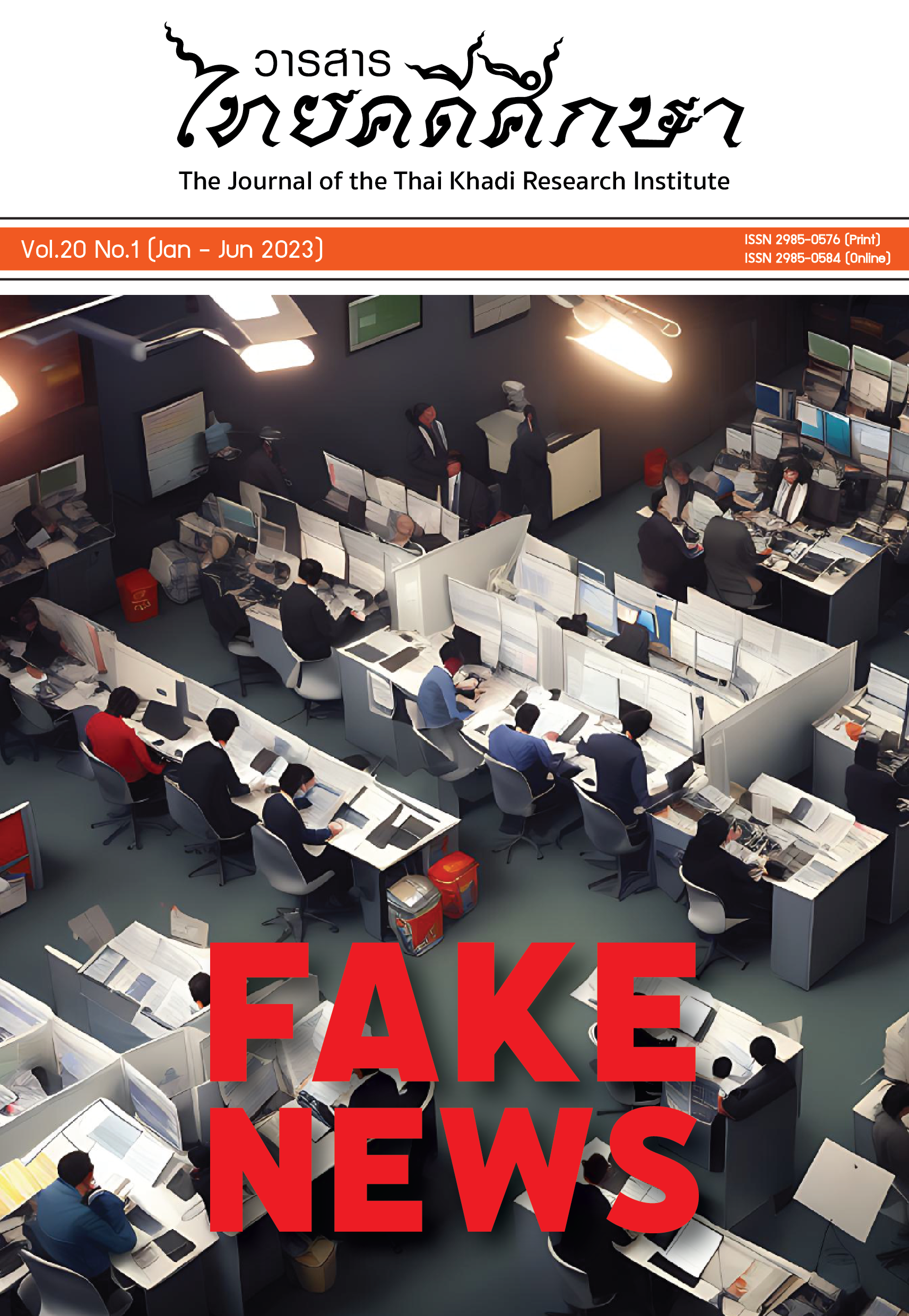
วัฒนธรรมห้องข่าวโทรทัศน์ไทย กับการตรวจสอบข่าวปลอม
Article Sidebar
Main Article Content
บทคัดย่อ
ในยุคดิจิทัล การบิดเบือนข้อมูล ข่าวลวงและข่าวปลอมกลายเป็นเรื่องปกติในสื่อดิจิทัล ทำให้การโต้ตอบกลับด้วยการเผยแพร่ข้อมูลที่ถูกต้องแก่สังคมในอัตราที่ใกล้เคียงกันเป็นสิ่งที่ยากมาก ขณะเดียวกันการผลักภาระให้กับผู้รับสารที่ต้องรู้เท่าทันการบิดเบือนข้อมูล ข่าวลวงและข่าวปลอมเป็นสิ่งที่ไม่ถูกต้องเช่นเดียวกัน ในสภาวะที่ผู้รับสารในสังคมไทยยังมีความรู้ไม่เท่ากัน การตรวจสอบข้อเท็จจริงจึงเป็นรากฐานที่สำคัญสำหรับบทบาทหน้าที่และความรับผิดชอบต่อสังคมของคนข่าว บทความนี้จึงมุ่งศึกษาถึงวัฒนธรรมการทำงานของห้องข่าวโทรทัศน์ไทยว่ามีการทำข่าวและมีกลไกการตรวจสอบข่าวปลอมอย่างไร ในสภาวะการแพร่ระบาดของข่าวปลอมหรือข้อมูลเท็จที่มาพร้อมกับเทคโนโลยีสมัยใหม่ในนามดิจิทัล ภายใต้วัตถุประสงค์ 1) เพื่อสำรวจการทำงานของกองบรรณาธิการข่าวไทยถึงกลไกการตรวจสอบข่าวปลอม 2) เพื่อสร้างกลไกการป้องกันข่าวปลอมในระบบนิเวศสื่อ
ผลการศึกษาพบว่า ห้องข่าวโทรทัศน์ไทยยังมีวัฒนธรรมการทำข่าวที่ยังยึดติดกับโครงสร้างการทำงานและกระบวนการผลิตข่าวของกองบรรณาธิการที่มีตั้งแต่ยุคแอนะล็อก โดยมีตำแหน่ง ผู้อำนวยการฝ่ายข่าว รองผู้อำนวยการฝ่ายข่าว บรรณาธิการบริหาร ผู้ช่วยบรรณาธิการ โปรดิวเซอร์ ผู้เรียบเรียงข่าว ผู้สื่อข่าว ที่มีการทำงานเป็นลำดับชั้น แต่ไม่มีตำแหน่ง Fact Checker สำหรับตรวจสอบข้อเท็จจริงว่าเป็นข่าวจริงหรือข่าวปลอมเป็นการเฉพาะ โดยบรรณาธิการข่าวชี้ว่าการตรวจสอบข้อเท็จจริงเป็นหน้าที่ของผู้สื่อข่าวโดยเบื้องต้น และเป็นหน้าที่ของทุกคนในกองบรรณาธิการที่ต้องตรวจสอบข้อเท็จจริงก่อนข่าวถูกนำเสนอทุกครั้ง ตั้งแต่บรรณาธิการ ผู้ช่วยบรรณาธิการ และผู้เรียบเรียงข่าว นอกจากนี้พบว่าทุกห้องข่าวโทรทัศน์ไทยไม่มีนโยบายตอบโต้ข่าวปลอม แต่ถ้ามีข่าวปลอมที่เป็นเรื่องใหญ่และส่งผลกระทบคนส่วนใหญ่ จะมีการนำเสนอเพื่อให้ประชาชนรับทราบว่าคือข่าวปลอม
Downloads
Article Details

อนุญาตภายใต้เงื่อนไข Creative Commons Attribution-NonCommercial-NoDerivatives 4.0 International License.
ผู้เขียนจะต้องลงนามในแบบฟอร์มรับรองบทความ เพื่อให้คำยืนยันความรับผิดชอบว่า บทความของผู้เขียนนั้นไม่เคยตีพิมพ์ที่ใดมาก่อน พร้อมรับทราบว่า กระบวนการส่งบทความเข้าพิจารณาและตีพิมพ์ในวารสารไทยคดีศึกษานั้น จะไม่มีการเรียกเก็บค่าใช้จ่ายในการดำเนินการ ยกเว้น ในกรณีที่ผู้เขียนขอยกเลิกการตีพิมพ์บทความในวารสารไทยคดีศึกษาไม่ว่าด้วยสาเหตุใด และหลังจากบทความนั้นเข้าสู่กระบวนการพิจารณาของผู้ทรงคุณวุฒิไปแล้ว ผู้เขียนจะต้องรับผิดชอบต่อค่าใช้จ่ายที่เกิดขึ้นในกระบวนการประเมินเป็นจำนวนเงิน 3,000 บาท (สามพันบาทถ้วน)
เอกสารอ้างอิง
Allan, L., Alan, M. & Orna, Y. (2018). What is fact-checking and why is it important?. Retrieved August 6, 2021, from https://coinform.eu/what-is-fact-checking-and-why-is-it-important/.
American Press Institute. (2021). Journalism as a discipline of verification. Retrieved August 12, 2021, from https://www.americanpress institute.org/journalism-essentials/verification-accuracy/journalism-discipline-verification/.
Andrea Renda. (2018). The legal framework to address “fake news”: possible policy actions at the EU level. Retrieved August 6, 2021, from https://www.europarl.europa.eu/RegData/etudes/IDAN/201 8/619013/IPOL_IDA(2018)619013_EN.pdf.
Ballotpedia. (2018). What is fact-checking?. Retrieved September 8, 2021, from https://ballotpedia.org/What_is_fact-Checking.
Beckett, C. (2017). Fake news: the best thing that’s happened to journalism. Retrieved August 6, 2021, from https://blogs.lse.ac.uk/polis/2017/03/11/fake-news-the-best-thing-thats-happened-to-journalism/.
Edson, C., Tandoc, Jr., Zheng, W. & Richard, L. (2017). Defining “Fake News”, Digital Journalism, 6(2), 137 - 153.
European Commission. (2017). Next steps against fake news: Commis sion sets up High-Level Expert Group and launches public consultation. [online] Retrieved August 6, 2021, from http://europa.eu/rapid/press-release_IP-17-4481_en.htm [accessed 03/ 04/2018].
European Commission. (2018). Final report of the High - Level Expert Group on Fake News and Online Disinformation. Retrieved August 9, 2021, from http://ec.europa.eu/newsroom/dae/docu ment.cfm?doc_id=50271 [accessed03/04/2018].
Graves, L. & Amazeen, M. (2019). Fact - Checking as Idea and Practice in Journalism. Retrieved August 24, 2021, from https://oxfordre.com/communication/view/10.1093/acrefore/97801902 28613.001.0001/acrefore-9780190228613-e-808.
Graves, L. (2016). Deciding What’s True: The Rise of Political Fact - Checking in American Journalism. New York: Columbia University Press.
Graves, L. (2018). Boundaries not drawn: Mapping the institutional roots of the global fact - checking movement. Journalism Studies, 19(5), 613 - 631.
Graves, L. & Anderson, C. (2020). Discipline and promote: Building infrastructure and managing algorithms in a “structured journalism” project by professional fact-checking groups. New Media & Society, 22(2), 342 - 360.
Ireton, C. & Posetti, J. (2018). Journalism, fake news & disinformation: handbook for journalism education and training. Retrieved August 6, 2021, from https://digitallibrary.un.org/record/1641987# record-files-collapse-header.
Lewandowsky et al. (2020). The Debunking Handbook 2020. Retrieved August 6, 2021, from https://www.climatechangecommunication. org/wp-content/uploads/2020/10/DebunkingHandbook2020.pdf.
Lowrey, W. (2017). The Emergence and Development of News Fact - checking Sites. Journalism Studies, 18(3), 376 - 394.
McQuail, D. (2005). McQuail’s Mass Communication Theory (5th ed). Oxford London: SAGE Publications.
Posetti, J. & Matthews, A. (2018). A short guide to the history of ‘fake news’: A learning module for journalists and journalism educators. Retrieved August 22, 2021, from https://www.icfj.org/news/short-guide-history-fake-news-and-disinformation-new-icfj-learning-module [accessed 23 / 07 / 2018].
Tambini, D. (2017). Fake News: Public Policy Responses. Media Policy Brief 20. London: Media Policy Project, London School of Economics and Political Science. Retrieved September 6, 2021, from https://core.ac.uk/download/pdf/80787497.pdf?fbclid=IwAR2plmI 40dVo wxO.
Waisbord, S. (2018) Truth is What Happens to News. Journalism Studies, 19(13), 1866 - 1878.
Waisbord, S. (2018). Truth is What Happens to News: On journalism, fake news, and post - truth. Journalism Studies 19(53), 1 - 13.
Interviewees
Bunyapanich, K. (2020, January 12). Editor of investigative news group, Thai PBS Television Station.
Cha-em, S. (2020, January 18). Deputy Director of News, Amarin Television Station.
Khaengkhan, B. (2020, January 17). Editor - in - Chief, Channel One 31 News Television Station.
Khunthong, W. (2020, January 13). News Editor, Thairath TV Television Station.
Pri - Ngam, C. (2020, January 9). News Editor, Channel 3 Television Station.
Thongnak, J. (2020, January 10). Deputy Manager of News Department 2, Channel 7 Television Station.
Wiriyaphanpongsa, S. (2020, January 7). Executive Editor, PPTV Television Station.
