
Value Relevance of Fair Value Hierarchy Information and the Impact of Corporate Governance Scores on Stock Price
Article Sidebar
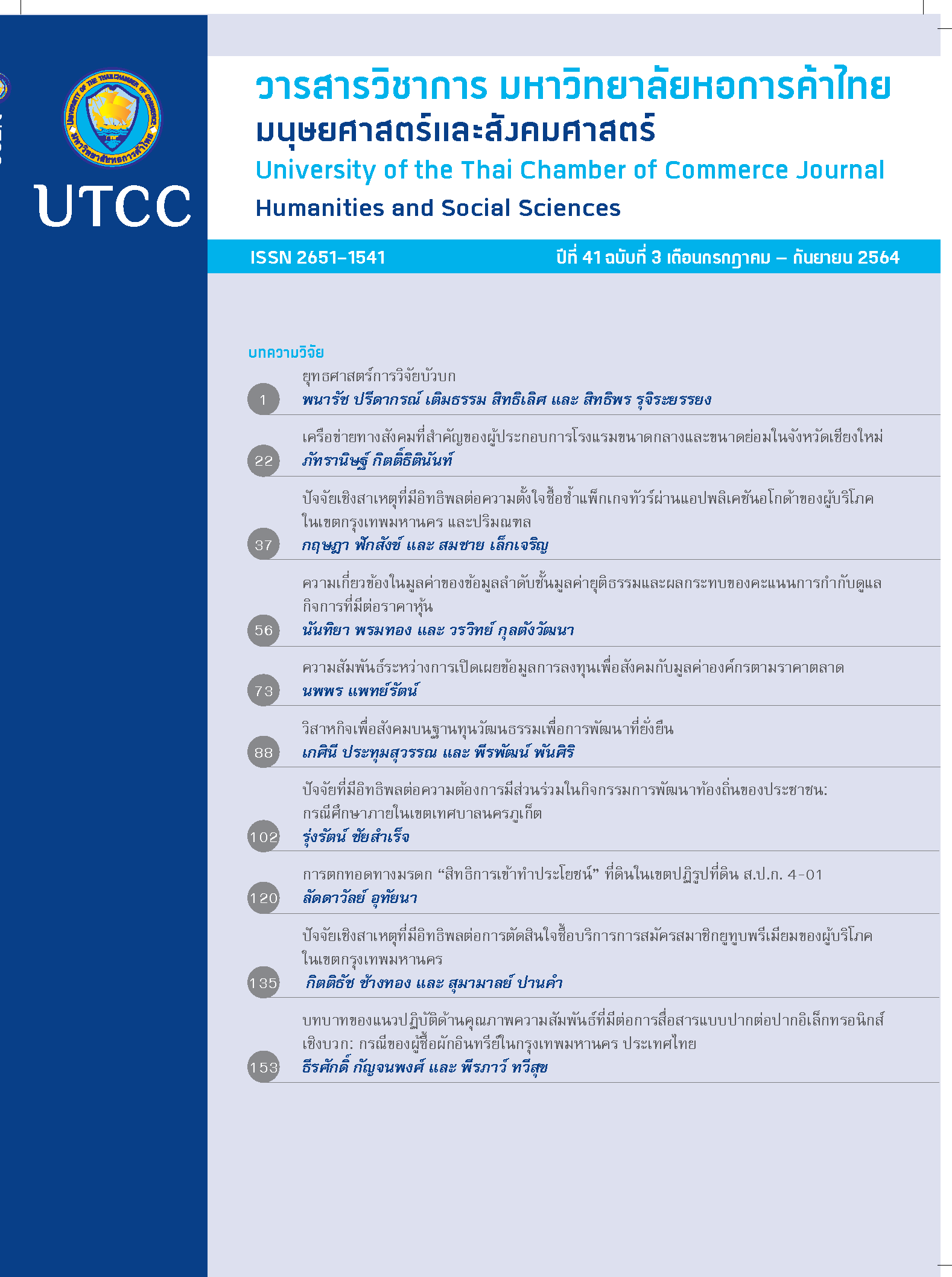
Main Article Content
Abstract
This research aims to examine the value relevance of fair value hierarchy of investment in marketable securities and the impact of corporate governance scores on stock price of listed firms in the Stock Exchange of Thailand. The sample includes 175 firms in financial sector during 2015 - 2019, and then analyzed using descriptive statistics and multiple regression analysis. Research results are as follows: (1) Levels 1 fair value has significantly and positively influenced stock price, Levels 2 fair value has significantly and negatively influenced stock price, and Levels-3 fair value was not found. As a result, Levels 1 and 2 fair value are more value relevant than Level 3. (2) Corporate governance scores have no influence on value relevance of fair value hierarchy and stock price.
Article Details

This work is licensed under a Creative Commons Attribution-NonCommercial-NoDerivatives 4.0 International License.
ลิขสิทธิ์ของบทความ
ผลงานที่ได้รับการตีพิมพ์ถือเป็นลิขสิทธิ์ของมหาวิทยาลัยหอการค้าไทย ห้ามมิให้นำเนื้อหา ทัศนะ หรือข้อคิดเห็นใด ๆ ของผลงานไปทำซ้ำ ดัดแปลง หรือเผยแพร่ ไม่ว่าทั้งหมดหรือบางส่วนโดยไม่ได้รับอนุญาตเป็นลายลักษณ์อักษรจากมหาวิทยาลัยหอการค้าไทยก่อน
References
กังสดาล แก้วหานาม, ศิริลักษณ์ ศุทธชัย, และนภาพร ลิขิตวงศ์ขจร. (2560). ความสัมพันธ์ระหว่างระดับคะแนนการกำกับดูแลกิจการที่ประเมินโดยสมาคมส่งเสริมกรรมการบริษัทไทยกับผลการดำเนินงานของบริษัทจดทะเบียนในตลาดหลักทรัพย์แห่งประเทศไทย. วารสารการจัดการมหาวิทยาลัยวลัยลักษณ์, 6(1), 44-53.
ธีนทัต โกศัลวิตร, และเคียงขวัญ อักษรวงศ์. (2562). การศึกษาความสัมพันธ์ระหว่างการกำกับดูแลกิจการและมูลค่าตลาดของกิจการ: กรณีศึกษาของบริษัทจดทะเบียนในตลาดหลักทรัพย์แห่งประเทศไทยและตลาดหลักทรัพย์ เอ็ม เอ ไอ. วารสารบริหารศาสตร์ มหาวิทยาลัยอุบลราชธานี, 8(15), 82-99.
ภัทรพงศ์ เจริญกิจจารุกร. (2560). คะแนนการกำกับดูแลกิจการและปัจจัยที่มีบทบาทต่อมูลค่าธุรกิจบริษัทจดทะเบียนในประเทศไทย. วารสารบริหารธรุกิจเทคโนโลยีมหานคร, 14(1), 1-24.
แววดาว พรมเสน. (2563). ความสัมพันธ์ระหว่างความเสี่ยงกับตัวชี้วัดผลการดำเนินงานของบริษัทจดทะเบียนในตลาดหลักทรัพย์แห่งประเทศไทย. วารสารวิชาการ มหาวิทยาลัยหอการค้าไทย มนุษยศาสตร์และสังคมศาสตร์, 40(2), 83-102.
ศิลปพร ศรีจั่นเพชร. (2559). ผู้สอบบัญชีกับการตรวจสอบมูลค่ายุติธรรม. วารสารวิชาการบริหารธุรกิจ สมาคมสถาบันอุดมศึกษาเอกชนแห่งประเทศไทยในพระราชูปถัมภ์ สมเด็จพระเทพรัตนราชสุดาฯ สยามบรมราชกุมารี, 5(2), 9-15.
สภาวิชาชีพบัญชี. (2561). มาตรฐานการรายงานทางการเงิน ฉบับที่ 13 เรื่อง การวัดมูลค่ายุติธรรม. สืบค้นเมื่อ 30 กรกฎาคม 2563, จาก http://www.tfac.or.th/Article/Detail/66976.
สมาคมส่งเสริมสถาบันกรรมการบริษัทไทย. (2558). CGR 2015 report. สืบค้นจาก http://www.thai-iod.com/imgUpload/CGR2015%20Report(1).pdf
สมาคมส่งเสริมสถาบันกรรมการบริษัทไทย. (2559). CGR 2016 report. สืบค้นจาก http://www.thai-iod.com/imgUpload/ CGR%202016 %20Report(1).pdf
สมาคมส่งเสริมสถาบันกรรมการบริษัทไทย. (2560). CGR 2017 report. สืบค้นจาก http://www.thai-iod.com/imgUpload/CGR%20Report% 202017(1).pdf
สมาคมส่งเสริมสถาบันกรรมการบริษัทไทย. (2561). CGR 2018 report. สืบค้นจาก http://www.thai-iod.com/imgUpload/CGR%20Report% 202018.pdf
สมาคมส่งเสริมสถาบันกรรมการบริษัทไทย. (2562). CGR 2019 report. สืบค้นจาก http://www.thai-iod.com/imgUpload/CGR2019%20Report(1).pdf
สำนักงานคณะกรรมการกำกับหลักทรัพย์และตลาดหลักทรัพย์. (2560). การกำกับดูแลกิจการที่ดี. สืบค้นเมื่อ 22 มิถุนายน 2563, จาก http://www.cgthailand.org/TH/principles/CG/Pages/cg-concept.aspx#cg
Barth, M. E., & Landsman, W. R. (2010). How did financial reporting contribute to the financial crisis?. European Accounting Review, 19(3), 399–423.
Bosch, P. (2012). Value relevance of the fair value hierarchy of IFRS 7 in Europe - How reliable are mark-to-model fair values?. FSES Working Papers 439. Faculty of Economics and Social Sciences, University of Freiburg/Fribourg Switzerland.
Enrico, L., Sabrina, P., Marco, T., & Marcantonio, D. M. (2012). Fair value hierarchy in financial instruments disclosure - Is there transparency for investors? Evidence from the banking industry. Journal of Governance and Regulation, 1(4), 23-38.
Fama, E. (1970). Efficient capital markets: A review of theory and empirical work. Journal of Finance, 25(2), 383-417.
Goh, B. W., Li, D., Ng, J., & Yong, O. K. K. (2015). Market pricing of banks’ fair value assets reported under SFAS 157 since the 2008 financial crisis. Journal of Accounting and Public Policy, 34(2), 129-145.
Hair, J. F., Black, W.C., Babin, B. J., & Anderson, R. E. (2010). Multivariate data analysis (7th ed.). Upper Saddle River, NJ: Prentice Hall.
Siekkinen, J. (2017). Board characteristics and the value relevance of fair values. Journal of Management and Governance, 21(2), 435–471.
Šodan, S. (2015). The impact of fair value accounting on earnings quality in eastern European countries. Procedia Economics and Finance, 32, 1769 – 1786.
Song, C.J., Tomas, W.B., & Yi, H. (2010). Value relevance of FAS 157 fair value hierarchy information and the impact of corporate governance mechanisms. The Accounting Review, 85, 1375-1410.
Swatdikun, T., & Ungphakorn, T. (2018). Fair value accounting of investment securities and earnings management: Empirical evidence from Thai listed companies. Kasetsart Applied Business Journal, 12(16), 1-13.
Taplin, R., Yuan, W., & Brown, A. (2014). The use of fair value and historical cost accounting for investment properties in China. Australasian Accounting, Business and Finance Journal, 8(1), 101-113.
Verriest, A., Gaeremynck, A., & Thornton, B. D. (2013). The impact of corporate governance on IFRS adoption choices. European Accounting Review, 22(1), 39-77.
Watcharasindhu, S., & Panmanee, P. (2017). Accounting information about fair value in Thai property funds. International Journal of Applied Computer Technology and Information Systems, 6(2), 40-46.
Yao, T. D., Percy, M., Stewart, J., & Hu, F. (2017). Fair value accounting and earnings persistence: Evidence from international banks. Journal of International Accounting Research, 17(1), 47-68.
