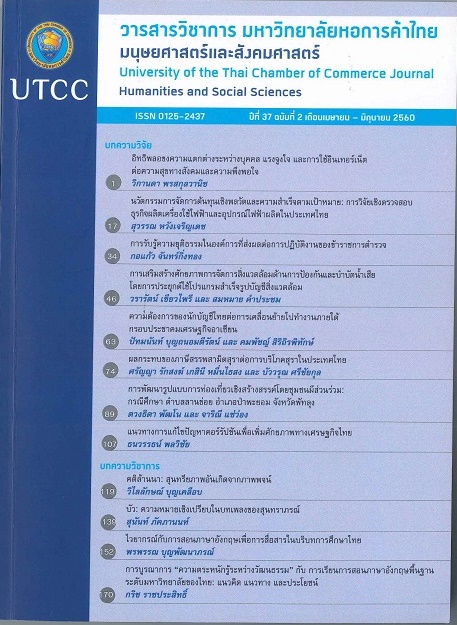
นวัตกรรมการจัดการต้นทุนเชิงพลวัตและความสำเร็จตามเป้าหมาย: การวิจัยเชิงตรวจสอบธุรกิจผลิตเครื่องใช้ไฟฟ้าและอุปกรณ์ไฟฟ้าผลิตในประเทศไทย
Article Sidebar
Main Article Content
บทคัดย่อ
งานวิจัยนี้มีวัตถุประสงค์เพื่อตรวจสอบเชิงประจักษ์ถึงผลกระทบของนวัตกรรมการจัดการต้นทุนเชิงพลวัตและความสำเร็จตามเป้าหมาย โดยผ่านตัวแปรคั่นกลางได้แก่ การใช้ประโยชน์ของต้นทุนอย่างคุ้มค่า ความสามารถในการผลิตอย่างมีประสิทธิภาพและการเพิ่มขึ้นของมูลค่า นอกจากนั้นความสามารถในการเรียนรู้ขององค์กรเป็นตัวแปรแทรก โดยใช้แบบสอบถามในการเก็บข้อมูลจากธุรกิจผลิตเครื่องใช้ไฟฟ้าและอุปกรณ์ไฟฟ้าในประเทศไทยจำนวน 303 ราย และใช้สถิติการวิเคราะห์การถดถอยแบบกำลังสองน้อยที่สุดทั่วไป (OLS) ผลการศึกษาพบว่า นวัตกรรมการจัดการต้นทุนเชิงพลวัตมีผลกระทบเชิงบวกต่อความสำเร็จตามเป้าหมายโดยผ่านการจัดการต้นทุนเชิงพลวัตกับตัวแปรคั่นกลาง นอกจากนั้น ความสามารถในการเรียนรู้ขององคืกรมีความสัมพันธ์เชิงบวกระหว่างนวัตกรรมการจัดการต้นทุนให้เกิดประโยชน์ต่อการดำเนินงาน ก่อให้เกิดความสำเร็จมากขึ้นโดยใช้การได้เปรียบในการแข่งขันเชิงพลวัตและความอยู่รอดขององค์กรอย่างต่อเนื่อง
Article Details
ลิขสิทธิ์ของบทความ
ผลงานที่ได้รับการตีพิมพ์ถือเป็นลิขสิทธิ์ของมหาวิทยาลัยหอการค้าไทย ห้ามมิให้นำเนื้อหา ทัศนะ หรือข้อคิดเห็นใด ๆ ของผลงานไปทำซ้ำ ดัดแปลง หรือเผยแพร่ ไม่ว่าทั้งหมดหรือบางส่วนโดยไม่ได้รับอนุญาตเป็นลายลักษณ์อักษรจากมหาวิทยาลัยหอการค้าไทยก่อน
เอกสารอ้างอิง
Anderson, M., Asdemir, Q., & Tripathy, A. (2013).Use of precedent and antecedent information in strategic cost management.Journal of Business Research, 66(5), 643- 650.
Archie L. (2003). A constraint-based framework for strategic cost management. Industrial Management & Data Systems, 103, 591-599.
Baden-Fuller, C., & Volberda, H. (1997).Strategic renewal: How large complex organizations prepare for the future.International Studies in Management and Organization, 27(2), 95-120.
Bandura, A. (1999). A social cognitive theory of personality. In L.A. Pervin & O.P. John (Eds.), Handbook of personality: Theory and research (pp. 154-196) (2nd ed.).
New York: The Guilford Press.Biddle, G., & Hilary, G. (2006). Accounting quality and firm-level capital investment.
The Accounting Review, 81, 963-982.
Buciuniene, I., & Kazlaurskaite, R. (2012). The linkage between HRM, CSR and performance outcomes. Baltic Journal of Management, 7(1), 5-24.
Chenhall, R. H. (2003). Management control systems design within its organizational context finding form contingency-based research and direction for the future. Accounting Organizational and Society, 28(2-3), 127-168.
Cinquini, L., & Tenucci, A. (2010). Strategic management accounting and business strategy: A loose coupling. Journal of Accounting Organizational Change, 6(2), 228-259.
Cronbach, L. J. (1951). Coefficient alpha and internal structure of tests. Psychometrical,16(3), 297-334.
Dekker, H., & Smidt, P. (2003). A survey of the adoption and use of target costing in
Dutch Firms. International Journal Production Economics, 84(3), 293-305.
Grant, R. M. (1996). Toward a Knowledge- Based Theory of the Firm. Strategic Management Journal, 17, 109-122.
Hair, J. F., Black, W. C., Babin, B. J., & Anderson, R. E. (2006). Multivariate data analysis (7th ed.). Upper Saddle River, NJ: Prentice Hall.
Hewett, K., Roth, M S., & Roth, K. (2003). Conditions influencing headquarters and foreign subsidiary roles in marketing activities and their effects on performance. Journal of International Business Studies, 34, 567-585.
Krejcie, R.V., & Morgan, D. W. (1970). Determining sample size for research activities.Psychological Measurement, 30, 607-610.
Martinette, L. (2014). Relationship between learning orientation and business performance and the moderating effect of competitive advantage: An accounting service firm’s perspective. International Business & Economics Research Journal,13, 779-792.
Picur, D. R. (2007). The effects of accounting knowledge on the omission of value added information in wealth measurement and distribution decisions. Review of Accounting and Finance, 6(1), 15-23.
Santa, R., Ferrer, M., Bretherton, P., & Hyland,P. (2009). The necessary alignment between technology innovation
effectiveness and operational effectiveness. Journal of Management and Organization,15(2), 155-169.
Valanciene L., & Gimzauskiene, E. (2007). Does implementation of modern management accounting conceptions ensure corporate value creation?.Economics and Management, 12 (5),154-164.
Wang, H.W., & Wu, M.C. (2012). Business type industry value chain and R&D performance: Evidence from High-Tech Firms in an Emerging Market. Technological Forecasting & Social Change, 79(2), 326-340.
Wangcharoendate, S. (2015). Internal auditoutsourcing and sustainable audit success: An empirical investigation of listed companies in the Stock Exchange of Thailand. University of the Thai Chamber of Commerce Journal, 35(1), 1-21.
