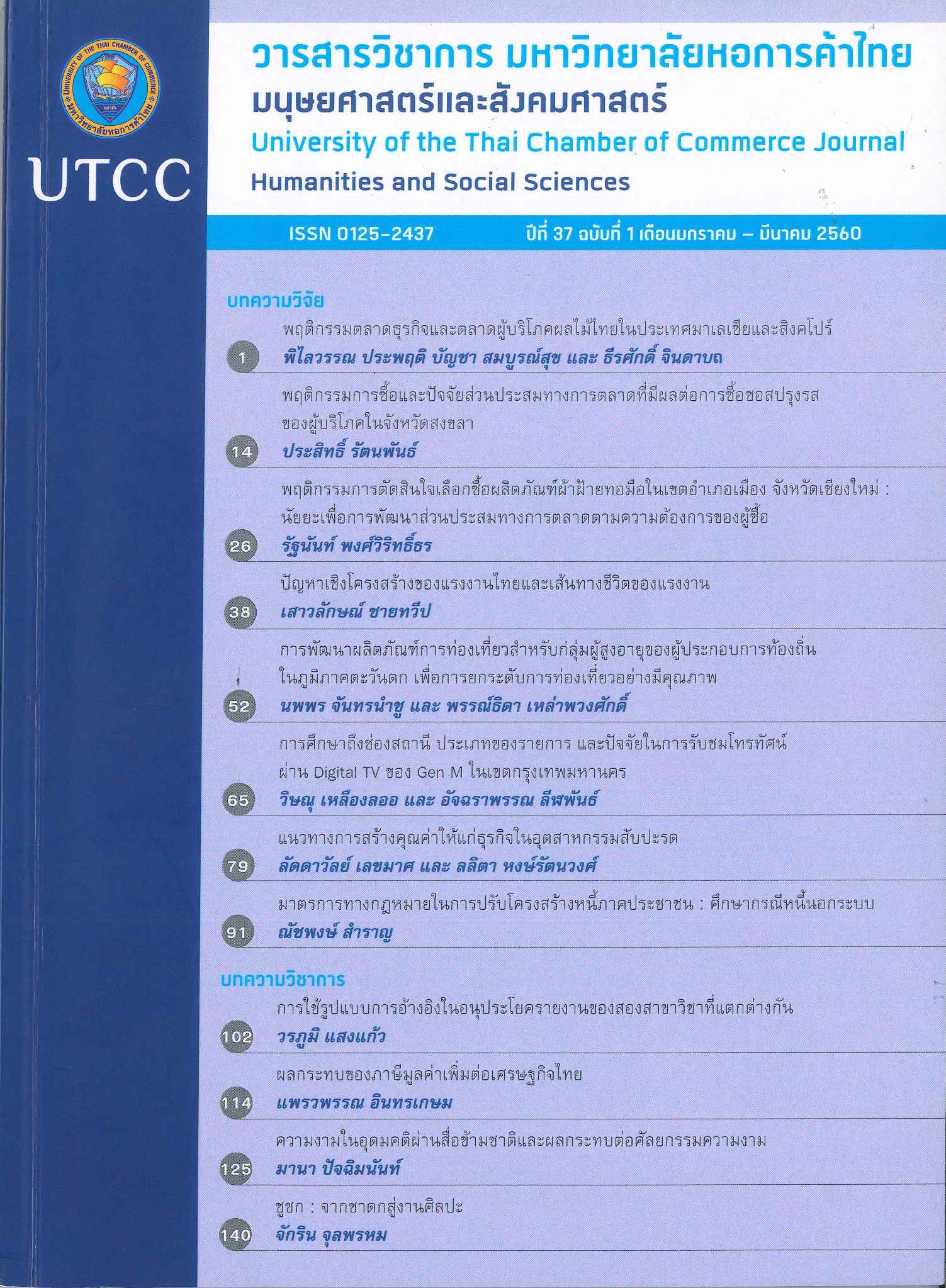
แนวทางการสร้างคุณค่าให้แก่ธุรกิจในอุตสาหกรรมสับปะรด
Article Sidebar
Main Article Content
บทคัดย่อ
การศึกษานี้มีวัตถุประสงค์เพื่อค้นหาปัจจัยที่สนับสนุนให้เกิดการสร้างคุณค่าของอุตสาหกรรมสับปะรดในประเทศไทย เพื่อใช้เป็นเครื่องมือประเมินความสมารถในการแข่งขันในระดับธุรกิจในด้านการสร้างคุณค่าที่จะส่งผลต่อการสร้างความสามารถในการแข่งขันให้แก่องค์การได้อย่่างยั่งยืน ผลการศึกาษา พบว่า มีปัจจัยสำคัญ 8 ประการที่ก่อให้เกิดผลสำเร็จในการสร้างคุณค่าให้แก่บริษัทผู้ผลิตสับปะรดของประเทศไทย ซึ่งมีความสอดคล้องกับงานวิจัยที่ผ่านมา แต่มีข้อค้นพบเพิ่มเติมจากงานวิจัยที่ผ่านมา พบว่า ควรเพิ่มอีก 2 ปัจจัย คือ " การสร้างวัฒนธรรมองค์การ" และ "การคำนึงถึงผู้มีส่วนได้ส่วนเสีย" เพราะจะทำให้เกิดการสร้างมูลค่าและการพัฒนาอุตสาหกรรมสับปะรดของประเทศไทยได้ครบทั้งระบบ การศึกษาครั้งนี้นำไปสู่การพัฒนาทฤษฎีในบริบทของประเทศไทยและเป็นประโยชน์ในเชิงปฏิบัติให้แก่ธุรกิจทั้งในอุตสาหกรรมสับปะรด และอุตสาหกรรมอื่น ๆ ในประเทศไทย ยังสามารถใช้เป็นแนวทางให้แก่หน่วยงานภาครัฐสามารถนำข้อมูลไปกำหนดนโยบายเพื่อการยกระดับอุตสาหกรรมให้ขีดความสมารถสูงขึ้น
Article Details
ลิขสิทธิ์ของบทความ
ผลงานที่ได้รับการตีพิมพ์ถือเป็นลิขสิทธิ์ของมหาวิทยาลัยหอการค้าไทย ห้ามมิให้นำเนื้อหา ทัศนะ หรือข้อคิดเห็นใด ๆ ของผลงานไปทำซ้ำ ดัดแปลง หรือเผยแพร่ ไม่ว่าทั้งหมดหรือบางส่วนโดยไม่ได้รับอนุญาตเป็นลายลักษณ์อักษรจากมหาวิทยาลัยหอการค้าไทยก่อน
เอกสารอ้างอิง
Cap Gemini Ernst and Yong Center for Business Innovation. (2000). Measuring the future: the value creation index. Retrieved June 18,2016, from https://www.managementplace.com/fr/gem/future.pdf.
Chatain, O.(2010). Value creation.competition, and performance in buyer-supplier relationships. Strategic Management Journal, 32(1), 76-102.
Chiranuragsi, W., & Pathumnakul, J.(2010). Value creation strategy development in plastic industry. Retrieved August 10,2016, from https://www.fibo.kmutt.ac.th/ (in Thai).
Dietl, H., Royer, S.,& Uwe, S.(2009). Value creation architectures and competitive advantage: lessons from the European automobile industry. California Management Review, 51 (53), 24-48.
Electrical and Electronics Institute.(2008). Feasibility study of value creation to electronics industry by creating linkages with other industries. Retrieved May 30, 2016, from https://www.oie.go.th/โครงการศึกษาความเป็นไปได้ในการสร้าง-value-creation-ให้กับอุตสาหกรรมอิเล็กทรอนิกส์ (in Thai).
Handorf, W.C. (2007). A index of risk management and value creation. Bank Accounting and Finance, 20(4), 4-22.
Lekmat,L.(2013). A framework for entrepreneurial intensity: Sustainable advantages for organizations. University of the Thai Chamber of Commerce Journal, 33 (Special isse). 464-475.
Lekmat,L., & Chelliah, J. (2014). What are the antecedents to creating sustainable corporate entrepreneurship in Thailand?.Contemporary Management Research,10(3): 181-202.
Madmia,B.(2013). How vaiue chain management improves quality control. Retrieved July12,2016, from https://www.tpa.or.th/publicsher/pdfFileDownloadS/FQ%20139%20p35-39.pdf (in Thai).
Office of Agricultural Economics. (2014).Pineapple strategy year 2015-2026. Retrieved August 25,2016, from https://www.doa.go.th/hort/images/stories/academy/pine-statusfruit.pdf (in Thai).
Porter, M.E.(1985). Competitive advantage and sustaining superior performance. New York, NY:Free Press.
Winyarat, P.(2005). Value creation: critical factors for good and service developments. Retrieved June 27, 2016, from https://webhost.cpd.go.th/ewt/spscpd/download/value.doc (in Thai).
