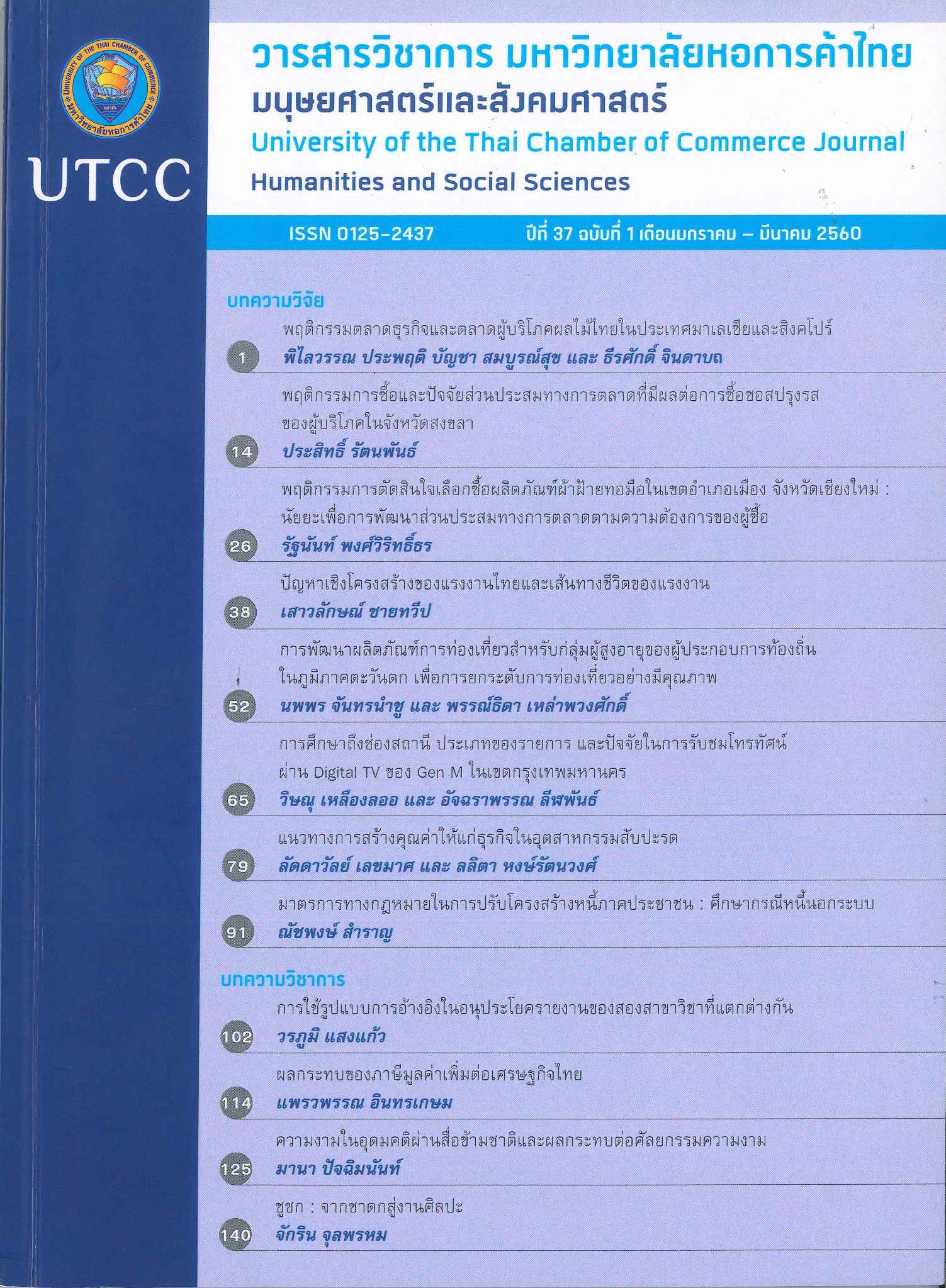
ความงามในอุดมคติผ่านสื่อข้ามชาติและผลกระทบต่อศัลยกรรมความงาม
Article Sidebar
Main Article Content
บทคัดย่อ
บทความนี้มีวัตถุประสงค์เพื่อนำทฤษฎีจักรวรรดินิยมทางวัฒนธรรม (Cultural Imperialism) และแนวคิดอื่น ๆ ที่เกี่ยวข้องมาวิเคราะห์ปรากฎการณ์การเกิดความงามในอุดมคติผ่านสื่อข้ามชาติและผลกระทบต่อการศัลยกรรมความงามในประเทศไทย และอธิบายเชื่อมโยงไปถึงจักรวรรดินิยมเชิงโครงสร้างที่ส่งอิทธิพลของสื่อข้ามชาติจากประเทศไทยไปสู่ประเทศกัมพูชาในมิติของความงามในอุดมคติและการทำศัลยกรรม ผู้เขียน พบว่า ประเทศโลกที่หนึ่งมีนโยบายที่ชัดเจนในการเผยแพร่วัฒนธรรมต่าง ๆ ผ่านสื่อข้ามชาติและธุรกิจข้ามชาติเพื่อให้เกิดการยอมรับในวัฒนธรรมของประเทศโลกที่หนึ่ง โดยมีเป้าหมายสุดท้าย คือ การเจริญเติบโตทางเศรษฐกิจในระดับโลก ส่นหนึ่งของวัฒนธรรมที่ถูกยอมรับ คือ ความงามในอุดมคติจากประเทศโลกที่หนึ่งซึ่งแตกต่างจากความงามตามมีบรรทัดฐานเดิมของสังคม ทำให้เกิดความไม่พึงพอใจในรูปร่างหน้าตาของตนเองเมื่อเกิดการเปรียบเทียบตนเองกับภาพความงามจากสื่อ หรือความต้องการได้สิทธิพิเศษจากความงามการเลื่อนชนชั้นทางสังคม และการซื้อทุนทางเชื้อชาติ ส่งผลให้เกิดความต้องการในการทำศัลยกรรมในที่สุด
Article Details
ลิขสิทธิ์ของบทความ
ผลงานที่ได้รับการตีพิมพ์ถือเป็นลิขสิทธิ์ของมหาวิทยาลัยหอการค้าไทย ห้ามมิให้นำเนื้อหา ทัศนะ หรือข้อคิดเห็นใด ๆ ของผลงานไปทำซ้ำ ดัดแปลง หรือเผยแพร่ ไม่ว่าทั้งหมดหรือบางส่วนโดยไม่ได้รับอนุญาตเป็นลายลักษณ์อักษรจากมหาวิทยาลัยหอการค้าไทยก่อน
เอกสารอ้างอิง
Banner, L.W. (1983). American beauty. Chicago,IL: University of Chicago Press.
Blair, L, & Shalmon, M. (2005). Cosmetic surgery and the cultural construction of beauty. Art Education, 53(3), 14 -18 .
Bourdieu, P.(1986). The forms of capital. In John G.R. (Ed.). Handbook of theory and research for the sociology of education (pp.241-258). New York, NY: Greenwood Press.
Bryant, S.L. (2013). The beauty ideal: The effects of European standard of beauty of black women. Columbia Social Work Review, 4, 80-91.
Darling-Wolf, F.(2004). Sites of attractiveness: Japanese women and westernized representations of feminine beauty. Critical Studies in Media Communication,21 (4), 325-345.
Davies, G., & Han, G. (2011). Korean design. Media International Australia,141, 146-156.
Dittmar, H., Haliwell, E., & lev, S. (2006). Does Barbie make girls want to be thin? The effect of experimental exposure to images of dolls on the body image of 5-to 8-year-old girls. Developmental Psychology, 42 (2),283 -292.
Edmonds, A (2007). The poor have the right to be beautiful: Cosmetic surgery in neoliberal Brazil. Journal of the Royal Anthropological Institute (N.S.), 13 (2), 363-381.
Farshidfar, Z., Dastjerdi, R., & Shahabizadeh, F. (2013). Acceptance of cosmetic surgery: Body image, self esteem and conformity Procedia-Social and Behavioral Sciences, 84 (9), 238-242.
Gimlin, D. (2000). Cosmetic surgery: beauty as commodity. Qualitative Sociology, 23 (1), 77-98.
Hailken, E.(1997). Venus envy: A history of cosmetic surgery. Baltimore, MD: Johns Hopkins University Press.
Hall, S. (1997). Representation: Cultural representations and signifying practices. London: Sage.
Holiday, R., Bell, D., Cheung, O., & Probyn, (2015).Brief encounters: Assembling cosmetic surgery tourism. Social Science and Medicine, 124, 298-304.
Hunter, M.L. (2011). Buying racial capital: Skin-bleaching and cosmetic surgery in a globalized World The Journal of Pan African Studies, 4(4), 142-164.
Johansson, P. (1998). Chinese women and consumer culture: Discourse on beauty and identity in advertising and women’s magazine, 1985-1995. Stockholm: Stockholms Universitet.
Jones, G. (2011). Globalization and beauty: Historical and firm perspective. EurAmerica, 41 (4), 885-916.
Kaewtape,K., & Hinwiman, S.(2008). A stream of thought political communication study. ฺBangkok: Pappim. (in Thai).
Lee, S. (2014). The effects of cosmetic surgery realty shows on women’s beliefs of beauty privileges, perceptions of cosmetic surgery, and desires for cosmetic enhancements. American Communication Journal, 16, 1-8.
Li, E.P.H. Min, H.J., Belk, R.W. & Kimura, S (2008). Skin lightening and beauty in four Asian cultures. Advances in Consumer Research, 35, 444-119.
Luo, W.(2012). Selling cosmetic surgery and beauty ideals: The female body in the web sites of Chinese hospitals. Women’s Studies in Communication, 35, 68-95.
Moran, C., & Lee, C. (2013). Selling genital cosmetic surgery to healthy Women: A multimodal discourse analysis of Australian surgical websites. Critical Discourse Studies, 10 (4), 373-391.
Patchimnan, M. (2013). Thailand's brand image in the view of foreign investors. University of the Thai Chamber of Commerce Journal, 33 (Special issue), 198-211. (in Thai).
Renzetti, C.M., Curran, D.J., & Maier, S.L.(2012). Women, men, and society. (6th ed.). Upper Saddle River, NJ: Pearson.
Schuller, K. (2009). Facial uplift: Plastic surgery, cosmetics and the retailing of whiteness in the work of María Cristina Mena. Journal of Modern Literature, 32 (4), 82-104.
Sott. L.M. (2005). Fresh lipstick: Redressing fashion and feminism. New York, NY: Palgrave Macmillan.
Serdar,K.L. (2005). Female Body image and the mass media: Perspectives on how women internalize the ideal beauty standard. Retrieved June 18,2016, from http://www.westminstercollege.edu/myriad/index.cfm?parent=2514&detail=4475&content=4795
Sharp, G., Tiggemann, M., &mattiske, J. (2014). The role of media and peer influences in Australian women’s attitudes towards cosmetic surgery. Body Image, 11 (4).482-487.
Sonsawangpol, T.(2011).Beauty consumption culture of Thai women in the Korean popular culture. (Unpublished master's thesis). Chulalongkorn University,Bangkok.(in Thai).
Stefanile, C., Nerini, A., & Matera, C. (2014). The factor structure and psychometric properties of the Italian version of the acceptance of cosmetic surgery scale. Body Image, 11
Tiantian, Z.(2014). Buying beauty: Cosmetic surgery in China. The Journal of Asian Studies, 73(3), 789-790.
Tisopa, J.(2013). Beauty by surgery: Women, beauty and cosmetic surgery in Thai society. (Unpublished master's thesis). Thammasat University, Bangkok. (in Thai).
Utamachan, W. (2003). The world of broadcasting, from the beginning to the era of globalization. Bangkok: Pappim.(in Thai).
Utroskre, D. (2015). Millenial buying power is set to transform the beauty business.Retrieved May 25,2016, from http://www.cosmeticsdesign.com/Market-Trends/ Millennial-buying-power-is-set-to-transform-the-beauty-business
Wiroonrath, S., Lertputtarak, S., Kristhanin, D., & Wongtana-anek, T. (2013). The influence of Thai television media on Lao people’s consumption of Thai products: A Case study in Vientiane Burapha University’s Journal, 8 (1), 42-55. (in Thai).
Xie, Q., & Zhang, M.(2013). White or tan? A cross-cultural analysis of skin beauty advertisements between China and the United States. Asian Journal of Communication, 23 (5), 538-554.
Zhang, M. (2012). A Chinese beauty, body image, and mass media. Chinese Journal of Communication, 5 (4). 437-454.
