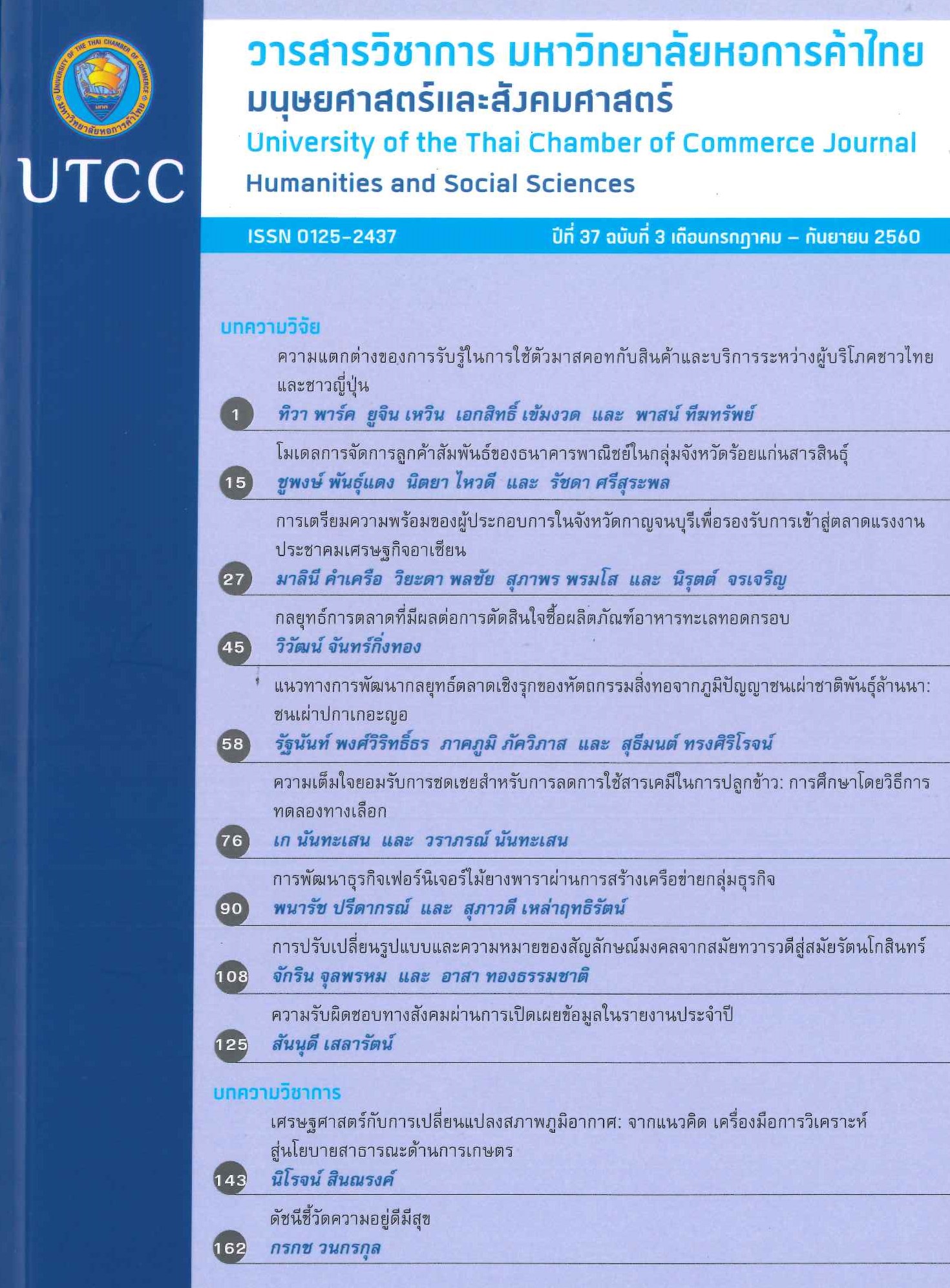
ความแตกต่างของการรับรู้ในการใช้ตัวมาสคอทกับสินค้าและบริการระหว่างผู้บริโภคชาวไทยและชาวญี่ปุ่น
Article Sidebar
Main Article Content
บทคัดย่อ
บริษัทต่างประเทศทั่วโลกใช้สัญลักษณ์มาสคอทเป็นตราสินค้าเพื่อเป็นส่วนหนึ่งของกลยุทธ์การตลาดของพวกเขาที่จะดึงดูดลูกค้า่และสร้างความภักดีต่อแบรนด์ ดังนั้น การทำความเข้าใจประสิทธิภาพของการตลาดสัญลักษณ์เหล่านี้ เช่นเดียวกับผลกระทบต่อผู้บริโภคขึ้นอยู่กับความแตกต่างของแต่ละบุคคลจะมีความรู้ที่สำคัญสำหรับบริษัทเหล่านี้ การวิจัยครั้งนี้มีวัตถุประสงค์เพื่อวัดความแตกต่างส่วนบุคคลของชาวไทยและชาวญีปุ่นในด้านการรับรู้ โดยเฉพาะเพศ อายุ สัญชาติ และปัจจัยอื่น ๆ ที่เกี่ยวข้อง นักวิจัยตั้งสมมติฐานว่าเพศหญิงมีแนวโน้มที่จะจำสัญลักษณ์มาสคอทกับสินค้าและบริการได้ดีกว่าเพศชาย ผู้กรอกแบบสอบถามที่อายุต่ำกว่า 18 ปีมีแนวโน้มที่จะจำสัญลักษณ์ได้ดีกว่าผู้กรอกแบบสอบถามที่มีอายุมากกว่า และผู้กรอกแบบสอบถามชาวญี่ปุ่นมีแนวโน้มที่จะจำสินค้าและบริการมากกว่าผู้กรอกแบบสอบถามชาวไทย ผู้กรอกแบบสอบถามชาวไทยจะมีแนวโน้มที่จะซื้อสินค้าและบริการหลังจากที่รับรู้สัญลักษณ์เมื่อเทียบกับชาวญีุปุ่น ผลที่ได้แสดงถึงความไม่แตกต่างของอายุ เพศ อย่างไรก็ตาม ระหว่างคนไทยและญี่ปุ่นจะมีการจดจำตัวมาสคอทในลักษณะที่แตกต่างกันด้านปัจจัยที่จดจำสินค้า นอกจากนี้ ปัจจัยที่ทำให้ทั้งผู้กรอกแบบสอบถามชาวไทยและชาวญุี่ปุ่นจำสัญลักษณ์ของแบรนด์สำหรับการซื้อสินค้ามีดังนี้ ความน่ารักของตัวละครที่เห็นโฆษณาต่าง ๆ ที่ผ่านสื่อ ความมีสีสันของตัวมาสคอทกว่าแบรนด์มาสคอทตัวอื่น ๆ ซึ่งผลยังระบุมีความสำคัญที่เกี่ยวข้องกับผลกระทบของการใช้สื่อโฆษณาในการรับรู้ของผู้บริโภค
Article Details
ลิขสิทธิ์ของบทความ
ผลงานที่ได้รับการตีพิมพ์ถือเป็นลิขสิทธิ์ของมหาวิทยาลัยหอการค้าไทย ห้ามมิให้นำเนื้อหา ทัศนะ หรือข้อคิดเห็นใด ๆ ของผลงานไปทำซ้ำ ดัดแปลง หรือเผยแพร่ ไม่ว่าทั้งหมดหรือบางส่วนโดยไม่ได้รับอนุญาตเป็นลายลักษณ์อักษรจากมหาวิทยาลัยหอการค้าไทยก่อน
เอกสารอ้างอิง
Abernety, A.M., & Frank, G.R. (1996). The information content of advertising a meta-analysis. Journal of Advertising Research, 2, 1-17.
Aiemraaorpakdee, P. (2009). Role of brand identity in determining the popularity of brand reputation. University of the Thai Chamber of Commerce Journal, 29(3),183-192. (in Thai).
Aiemraaorpakdee, P. (2010). Personal branding in business. University of the Thai Chamber of Commerce Journal, 30(2), 116-123. (in Thai).
Atkin, C., & Miller, M. (1975). The effects of television advertising on children: Experimental evidence. Washington, DC: Office of Child Development
Bhattacharya, C.B., & Sen, S. (2003). Consumer- company identification: A framework for understanding consumers’ relationships with companies. Journal of Marketing, 67,76-89
Blair, T.C., & Chiou, S.C. (2014). The impact of brand knowledge on consumers of different genders and from different cultures. Asia Pacific Management Review, 19(1), 47-59.
Brown, S. (2010). Where the wild brands are: Some thoughts on anthropomorphic marketing. The Marketing Review, 10(3), 209-224.
Chang, E.C. (2014). Influences of the spokes- character on brand equity antecedents. Asia Pacific Journal Market Logistics, 26, 494-515.
Connell, P.M., Brucks, M., & Nielsen, J.H. (2014). How childhood advertising exposure can create biased product evaluation that persist into adulthood. Journal Consumer Research, 41, 119-134.
Cooper-Chen, A. (1999). An animated imbalance. Gazette, 61(3-4), 293-310.
Costa, M. (2010, March 25). Brand characters: Pulling customers’ heart strings. Marketing Week, p. 16
Delbaere, M., McQuarrie, E.F., & Phillips, B.J. (2011). Personification in advertising. Journal of Advertising, 40(1), 121-130
Dotz, W., Morton, J., & Lund, J.W. (1996). What a character?: Twentieth-century American advertising icons. San Francisco, CA:Chronicle Books.
Fletcher, M. (2001). A taste of real life. Marketing Event, 35(2), 2
Fournier, S. (1998). Consumers and their brands: Developing relationship theory in consumer research. Journal of Consumer Research, 24(4), 343-373.
Freling, T.H., Crosno, J.L., & Henard, D.H. (2010). Brand personality appeal: conceptualization and empirical validation. Journal of the Academy of Marketing Science, 39(3), 392-406
Hemar-Nicolas, V., & Gollety, M. (2012). Using brand character when targeting children: What for? an exploration of managers’
and children’s viewpoints. Young Consumers: Insight and Ideas for Responsible Marketers, 13: 20-29.
Hofstede, G. (1984). Culture’s consequences: International differences in work-related values. Beverly Hills, CA: Sage.
Jacobson, L. (2008). Advertising, mass merchandising, and the creation of children’s consumer culture. In L. Jacobson (Ed.), Children and consumer culture in American society: A historical handbook and guide (pp. 3-25). Westport, CT: Greenwood.
Kraak, V.I., & Story, M. (2015, February). Influence of food companies’ brand mascots and entertainment companies’ cartoon media characters on children’s diet and health: A systematic review and research needs. Obesity Reviews, pp. 107-126
Mascots: Building place in consumers’ heart. (2013). Retrieved August 25, 2016, from https://www.campaignlive.co.uk
Neeley, S., & Schumann, D. (2004). Using animated spokes-character in advertising to young children: Does increasing attention to advertising necessarily lead to product preferences. Journal of Advertising, 33(3), 7-23.
Patterson, A., Khogeer, Y., & Hodgson, J. (2013). How to create an influential anthropomorphic mascot: Literary musings on marketing, make-believe, and meerkats. Journal of Marketing Management, 29(1-2), 69-85
Richert, R.A., Robb, M.B., & Smith, E.I. (2011). Media as social partners: The social nature of young children’s learning from screen media. Child Development, 82, 82-95
Schultz, E.J. (2012). Mascots are brand’s best social-media accessories. Advertising Age,83(13), 2-25.
Thompson, T., & Zerbinose, E. (1997). Television cartoons: Do children notice it’s a boy’s world?. Sex Roles, 37(5-6), 415-432.
Warapitayut, K. (2014). A preliminary study of the possibility of branding communication through print media and special events for generation –Y. University of the Thai Chamber of
Commerce Journal, 34(1), 164-176. (in Thai).
Woodside, A.G. (2008). Using the forced metaphor-elicitation technique (FMET) to meet animal companions within self. Journal of business Research, 61(5), 480-487.
Yukantawanithchai, T. (2010). IMC (Integrated Marketing Communication). University of the Thai Chamber of Commerce Journal, 30(2), 99-115. (in Thai).
