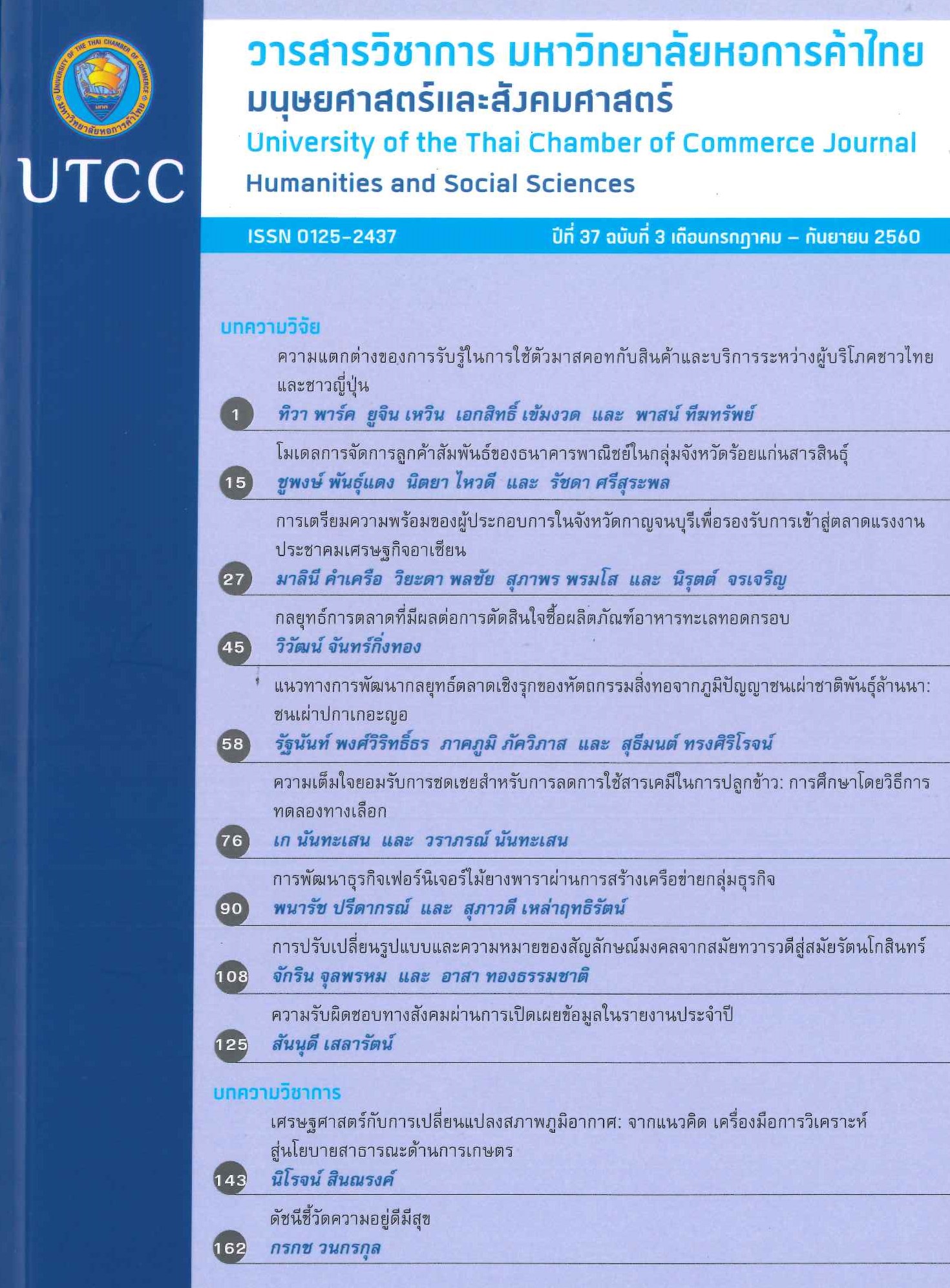
ความรับผิดชอบทางสังคมผ่านการเปิดเผยข้อมูลในรายงานประจำปี
Article Sidebar
Main Article Content
บทคัดย่อ
งานวิจัยครั้งนี้ศึกษาการเปิดเผยข้อมูลสังคมและสิ่งแวดล้อมในรายงานประจำปีของบริษัทในกลุ่มอุตสาหกรรมทรัพยากรที่จดทะเบียนในตลาดหลักทรัพย์ เพื่อศึกษาว่ามีข้อมูลทางสังคมและสิ่งแวดล้อมประเภทใดบ้างที่ถูกเปิดเผยและศึกษาว่าบริษัทใช้รายงานประจำปีในการแสดงความรับผิดชอบต่อสังคมหรือไม่ การวิเคราะห์เนื้อหาได้ถูกนำมาใช้ในการวิเคราะห์ข้อมูล หัวข้อที่ศึกษาประกอบด้วย สิ่งแวดล้อม ทรัพยากรมนุษย์ การมีส่วนร่วมในชุมชน สินค้า บริการและลูกค้า ประเด็นทางด้านจริยธรรม และข้อมูลทางบัญชี ผลการวิจัย พบว่าข้อมูลที่ถูกเปิดเผยส่วนใหญ่เกี่ยวข้องกับความรับผิดชอบและพันธสัญญาต่อผู้มีส่วนได้เสีย นอกจากนี้ บริษัทให้ข้อมูลเกี่ยวกับกิจกรรมที่วางแผยว่าจะกระทำต่อสังคมและสิ่งแวดล้อม แต่ไม่ได้ให้ข้อมูลเกี่ยวกับสิ่งที่ได้ทำไปแล้วมากนัก ในปัจจุบันรายงานประจำปีไม่ใช่เครื่องมือสื่อสารที่เหมาะสมสำหรับแสดงความรับผิดชอบทางสังคม ข้อมูลที่เปิดเผยไม่เพียงพอต่อกลไกของความรับผิดชอบทางสังคม แหล่งข้อมูลอื่น เช่น รายงานการพัฒนาที่ยั่งยืน ให้ข้อมูลที่จำเป็นมากกว่า
Article Details
ลิขสิทธิ์ของบทความ
ผลงานที่ได้รับการตีพิมพ์ถือเป็นลิขสิทธิ์ของมหาวิทยาลัยหอการค้าไทย ห้ามมิให้นำเนื้อหา ทัศนะ หรือข้อคิดเห็นใด ๆ ของผลงานไปทำซ้ำ ดัดแปลง หรือเผยแพร่ ไม่ว่าทั้งหมดหรือบางส่วนโดยไม่ได้รับอนุญาตเป็นลายลักษณ์อักษรจากมหาวิทยาลัยหอการค้าไทยก่อน
เอกสารอ้างอิง
Ahmed, K., & Courtis, J.K. (1999). Associations between corporate characteristics and disclosure levels in annual reports: a meta-analysis. British Accounting Review, 31(1), 35-61.
Behn, R. (2001). Rethinking democratic accountability. Washington, DC: Brookings Institution Press.
Bhattacharyya, A. (2008). Adherence to the Global Reporting Initiative’s (GRI) social and environmental disclosure requirements by Indian organizations. Journal of the Asia Pacific Centre for Environmental Accountability, 30(4), 12-26.
Bovens, M. (2005). Public Accountability. In E.Ferlie, L. Lynn, & C. Pollitt (Eds.), The Oxford handbook of public management (pp. 182-208). Oxford, England: Oxford University Press.
Branco, M.C., & Rodrigues, L.L. (2008). Factors influencing social responsibility disclosure by Portuguese companies. Journal of Business Ethics, 83(4), 658-701.
Chau, G.K., & Gray, S.J. (2002). Ownership structure and corporate voluntary disclosure in Hong Kong and Singapore. The International Journal of Accounting, 37(2), 247-265.
Deegan, C., Rankin, M., & Tobin, J. (2002). An examination of the corporate social and environmental disclosures of BHP from 1983-1997: A test of legitimacy theory. Accounting, Auditing and Accountability Journal, 15(3), 312-343.
Ebimobowei, A. (2011). A study of social accounting disclosures in the annual reports of Nigerian companies. Asian Journal of Business Management, 3(3),145-151.
Ghazali, N. (2007). Ownership structure and corporate social responsibility disclosure: Some Malaysian evidence. Corporate Governance, 7(3), 251-266.
Global Reporting Initiative. (2011). Sustainability reporting guidelines. Retrieved August 20, 2016, from https://www.globalreporting.org
Gray, R., Kouhy, R., & Lavers, S. (1995). Corporate social and environmental reporting: A review of the literature and longitudinal study of UK disclosure. Accounting, Auditing and Accountability Journal, 8(2), 47-77.
Hackston, D., & Milne, M.J. (1996). Some determinants of social and environmental disclosures in New Zealand companies. Accounting, Auditing and Accountability Journal, 9(1), 77-108.
Hossain, M., & Hammami, H. (2009). Voluntary disclosure in the annual reports of an emerging country: The case of Qatar. Advances in Accounting, 25(2), 255-265.
Ijiri, Y. (1983). On the accountability-based conceptual framework of accounting.Journal of Accounting and Public Policy, 2(2), 75-81.
Islam, M., & Deegan, C. (2010). Media pressures and corporate disclosure of social responsibility performance information: A study of two global clothing and sports retail companies. Accounting and Business Research, 40(2), 131-148.
Jensen, M., & Meckling, W. (1976). Theory of the firm: Managerial behavior, agency costs and ownership structure. Journal of Financial Economics, 3(4), 305-360.
Kondo, S. (2002). Fostering dialogue to strengthen good governance. in J. Bertók (Ed.), Public sector transparency and accountability: Making it happen (pp.7-11). Paris, France: OECD.
Kuasirikun, N., & Sherer, M. (2004). Corporate social accounting disclosure in Thailand. Accounting, Auditing and Accountability Journal, 17(4), 629-660.
Malena, C., Forster, R., & Singh, J. (2004). Social Accountability: An Introduction to the concept and emerging practice. Retrieved August 7, 2016, from https://siteresources.
worldbank.org
Mia, P., & Al-Mamun, A. (2011). Corporate social disclosure during the global financial crisis. International Journal of Economics and Finance, 3(6), 174-187
Mulgan, R. (2002). Accountability issues in the new model of governance. Retrieved September 2, 2016, from https://dspac.anu.edu.au/bitstream/1885/41731/3/mulgan.pdf
Newson, M., & Deegan, C. (2002). Global expectations and their association with corporate social disclosure practices in Australia, Singapore and South Korea.The International Journal of Accounting, 37(2), 183-213.
Noknoi, C. (2015). Corporate social responsibility: Concept and experiences. University of the Thai Chamber of Commerce Journal, 35(3), 154-163. (in Thai).
Power, M. (1991). Auditing and environmental expertise: Between protest and professionalization. Accounting Auditing & Accountability Journal, 4(3), 30-42.
Ratanajongkol, S., Davey, H., & Low, M. (2006). Corporate social reporting in Thailand: The news is all good and increasing.Qualitative Research in Accounting and Management, 3(1), 67-83.
Ringov, D., & Zollo, M. (2007). The impact of national culture on corporate social performance. Corporate Governance, 7(4),476-485.
Selaratana, S. (2015). Accountability through information disclosure on websites: A case study of the Thai Ministry of Finance. University of the Thai Chamber of Commerce Journal, 35(2), 145-160.
Smith, M., Yhaya, K., & Amiruddin, A. (2007). Environmental disclosure and performance reporting in Malaysia. Asian Review of Accounting, 15(2), 185-199.
Suttipun, M., & Stanton, P. (2012). Determinants of environmental disclosure in Thai corporate annual reports. International Journal of Accounting and Financial Reporting, 2(1), 99-115.
Tilt, C. (1994). The influence of external pressure groups on corporate social disclosure: Some empirical evidence. Accounting, Auditing and Accountability Journal, 7(4), 47-72.
Williams, S. (1999). Voluntary environmental and social accounting disclosure practices in Asia-Pacific Region: An international empirical test of political economy theory.
The International Journal of Accounting, 34(2), 209-238
Williams, S., & Ho, C. (1999). Corporate social disclosures by listed companies on Thai websites: An international comparison. The International Journal of Accounting,34(3), 389-419.
