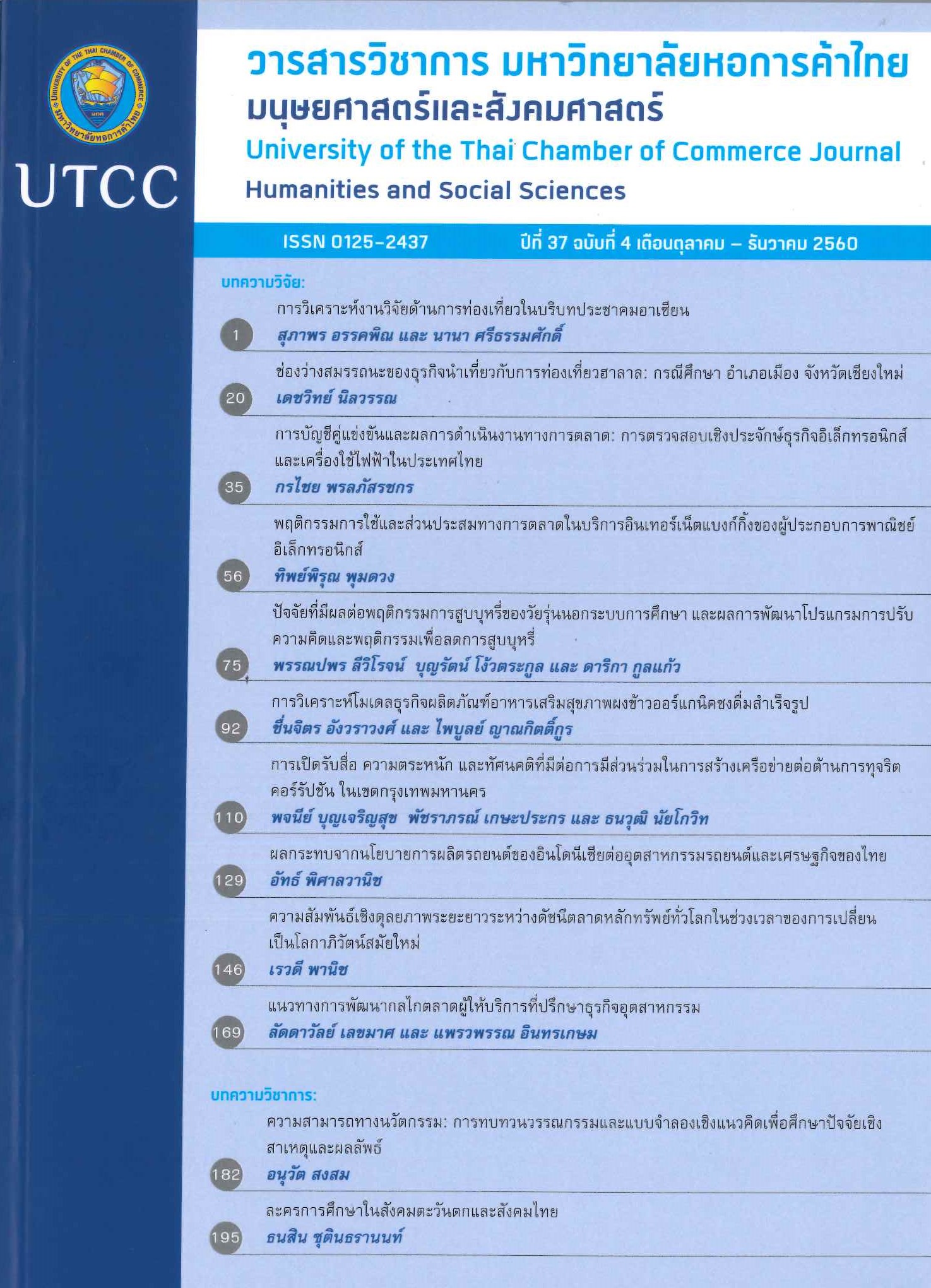
การบัญชีคู่แข่งขันและผลการดำเนินงานทางการตลาด: การตรวจสอบเชิงประจักษ์ธุรกิจอิเล็กทรอนิกส์และเครื่องใช้ไฟฟ้าในประเทศไทย
Article Sidebar
Main Article Content
บทคัดย่อ
การวิจัยนี้มีวัตถุประสงค์เพื่อทดสอบผลกระทบของการบัญชีคู่แข่งขันที่มีต่อผลการดำเนินงานทางการตลาดของธุรกิจอิเล็กทรอนิกส์และเครื่องใช้ไฟฟ้าในประเทศไทยซึ่งมีศักยภาพทางการตลาด ประสิทธิผลทางการตลาด และความได้เปรียบทางการแข่งขันเป็นตัวแปรกลาง การบัญชีคู่แข่งขัน โดยศึกษาจากธุรกิจอิเล็กทรอนิกส์และเครื่องใช้ไฟฟ้าในประเทศไทยจำนวน 175 บริษัทเป็นกลุ่มตัวอย่าง และใช้แบบสอบถามเป็นเครื่องมือ ตรวจสอบเครื่องมือวิจัยโดยใช้สถิติการวิเคราะห์ปัจจัย การหาค่าอำนาจจำแนก แลฃะการหาค่าความเชื่อมั่น พบว่า มีคุณภาพอยู่ในเกณฑ์ที่ยอมรับได้ ผลการทดสอบสมมุติฐานการวิจัยด้วยสถิติการวิเคราะห์สหสัมพันธ์และการวิเคราะห์ความถดถอยแบบพหุคูณ พบว่า การประเมินต้นทุนคู่แข่งขันและการประเมินผลการดำเนินงานคู่แข่งขัน มีผลกระทบสำคัญต่อศักยภาพทางการตลาดและความได้เปรียบทางการแข่งขันในขณะที่การติดตามทางการแข่งขันมีอิทธิพลสำคัญต่อศักยภาพทางการตลาด ประสิทธิผลทางการตลาด และผลการดำเนินงานทางการตลาด นอกจากนี้ ศักยภาพทางการตลาด ประสิทธิผลทางการตลาดความได้เปรียบทางการแข่งขัน และผลการดำเนินงานทางการตลาดมีความสัมพันธ์กัน การวิจัยนี้พยายามบูรณาการการประเมินต้นทุนคู่แข่งขัน การติดตามตำแหน่งทางการแข่งขัน และการประเมินผลการดำเนินงานคู่แข่งขันของการบัญชีคู่แข่งขันในกรอบแนวคิดเดียวกัน และก่อให้เกิดประโยชน์โดยสามารถขับเคลื่อนศักยภาพทางการตลาดและประสิทธิผลทางการตลาด และอธิบายผลลัพธ์ของความได้เปรียบทางการแข่งขันและผลการดำเนินงานทางการตลาดได้เป็นอย่างดี ซึ่งผู้บริหารสามารถประยุกต์ใช้ประโยชน์ของข้อดีและข้อได้เปรียบจากการเริ่มต้นนำระบบการบัญชีคู่แข่งขันมาใช้ในองค์กรอย่างมีประสิทธิผล โดยจัดสรรทรัพยากรเพื่อให้เกิดการจัดเตรียมกิจกรรมและกลยุทธ์การดำเนินงานเกี่ยวกับคู่แข่งขันได้ดี ส่งผลให้มีความได้เปรียบทางการแข่งขันอย่างยั่งยืน และบรรลุผลการดำเนินงานที่เหนือกว่าทั้งด้านการเงินและไม่ใช่การเงิน
Article Details
ลิขสิทธิ์ของบทความ
ผลงานที่ได้รับการตีพิมพ์ถือเป็นลิขสิทธิ์ของมหาวิทยาลัยหอการค้าไทย ห้ามมิให้นำเนื้อหา ทัศนะ หรือข้อคิดเห็นใด ๆ ของผลงานไปทำซ้ำ ดัดแปลง หรือเผยแพร่ ไม่ว่าทั้งหมดหรือบางส่วนโดยไม่ได้รับอนุญาตเป็นลายลักษณ์อักษรจากมหาวิทยาลัยหอการค้าไทยก่อน
เอกสารอ้างอิง
Anderson, S., & Guilding, C. (2006). Competitorfocused accounting applied to a hotel context. International Journal of Contemporary Hospitality Management, 18(3), 206-218.
Appiah-Adu, K. (1999). Marketing effectiveness and customer retention in the service sector. The Service Industries Journal, 19(3), 26-41
Armstrong, J. S., & Overton, T. S. (1977). Estimating non-response bias in mail surveys. Journal of Marketing Research, 14(3), 396-402.
Cadez, S., & Guilding, C. (2007). Benchmarking the incidence of strategic management accounting in Slovenia. Journal of Accounting and Organizational Change, 3(2), 126-146.
Cadez, S., & Guilding, C. (2008). An exploratory investigation of an integrated contingency model of strategic management accounting. Accounting, Organizations and Society, 33, 836-863.
Chan, S. C. H., & Mak, W. (2012). Benevolent leadership and follower performance: The mediating role of leader-member exchange (LMX). Asia-Pacific Journal of Management,
29, 285-301.
Chen, K. (2014). Improving importanceperformance analysis: the role of the zone of tolerance and competitor performance: The case of Taiwan’s hot spring hotels.Tourism Management, 40, 260-272.
Churchill, G. A., Jr. (1979). A paradigm for developing better measures of marketing Constructs. Journal of Marketing Research, 16, 64-73.
Cooper, R., & Slagmulder, R. (1998). Strategic cost management. Management Accounting, 80(1), 14-15.
Fong, C. C. F., & Wong, J. (2012). Competitor analysis and accounting of social networking site service companies in China. Journal of Technology Management in China, 7(3), 243-254.
Griffith, D. A., Yalcinkaya, G., & Calantone, R. J. (2010). Do marketing capabilities consistently media effects of firm intangible capital on performance across institutional environments? Journal of World Business, 45, 217-227.
Guilding, C. (1999). Competitor-focused accounting: an exploratory note. Accounting, Organizations and Society, 24, 583-595.
Lamberti, L., & Noci, G. (2010). Marketing strategy and marketing performance measurement system: Exploring the relationship. European Management Journal, 28, 139-152.
Li, J. J., Zhou, K. Z., & Shao, A. T. (2009). Competitive position, managerial ties and profitability of foreign firms in China:An interactive perspective. Journal of International Business Studies, 40, 339- 352.
Milichovsky, F., & Simberova, I. (2015). Marketing effectiveness: Metrics for effective strategic marketing. Engineering Economics, 26(2), 211-219.
Nath, P., Nachiappan, S., & Ramanathan, R. (2010). The impact of marketingcapability, operations capability and diversification strategy on performance: A resourcebased view. Industrial Marketing Management, 39, 317-329.
Neter, J., Wasserman, W., & Kutner, M. H. (1985). Applied linear statistical models: Regression, analysis of variance, and experimental designs. (2nd ed.).Homewood, IL: Irwin.
Nunnally, J. C., & Bernstein, I. H. (1994). Psychometric theory. New York, NY: McGraw-Hill
Nwokah, N. G., & Ahiauzu, A. I. (2008). Managerial competencies and marketing effectiveness in corporate organizations in Nigeria. Journal of Management Development, 27(8), 858-878.
Pino, C., Felzensztein, C., Zwerg-Villegas, A. M., & Arias-Bolzmann, L. (2016). Nontechnical innovations: Market performance of exporting firms in South Africa. Journal of Business Research, 69, 4385-4393.
Radas, S., & Matovac, V. A. (2006). Competitive position and its relationship to Innovation. In L. Galetic (Ed.), Proceedings of the 3rd international conference on an enterprise
odyssey: Integration and distintegration (pp. 378-1391). Zagreb, Croatia: n.p.
Ripolles, M., & Blesa, A. (2012). International new ventures as “small multinationals”: The importance of marketing capabilities. Journal of World Business, 47, 277-287.
Saeidi, S. P., Sofian, S., Saeidi, P., Saeidi, S. P., & Saaeidi, S. A. (2015). How does corporate social responsibility contribute to firm financial performance?: The mediating role of competitive advantage, reputation and customer satisfaction. Journal of Business Research, 68, 341- 350.
Tsao, W. (2014). Enhancing competitive advantages: the contribution of mediator and moderator on stickiness in the LINE. Journal of Retailing and Consumer Services, 21, 933-941.
Wang, C. (2014). How relational capital mediates the effect of corporate reputation on competitive advantage: Evidence from Taiwan high-tech industry. Technological Forecasting and Social Change, 82, 167- 176.
