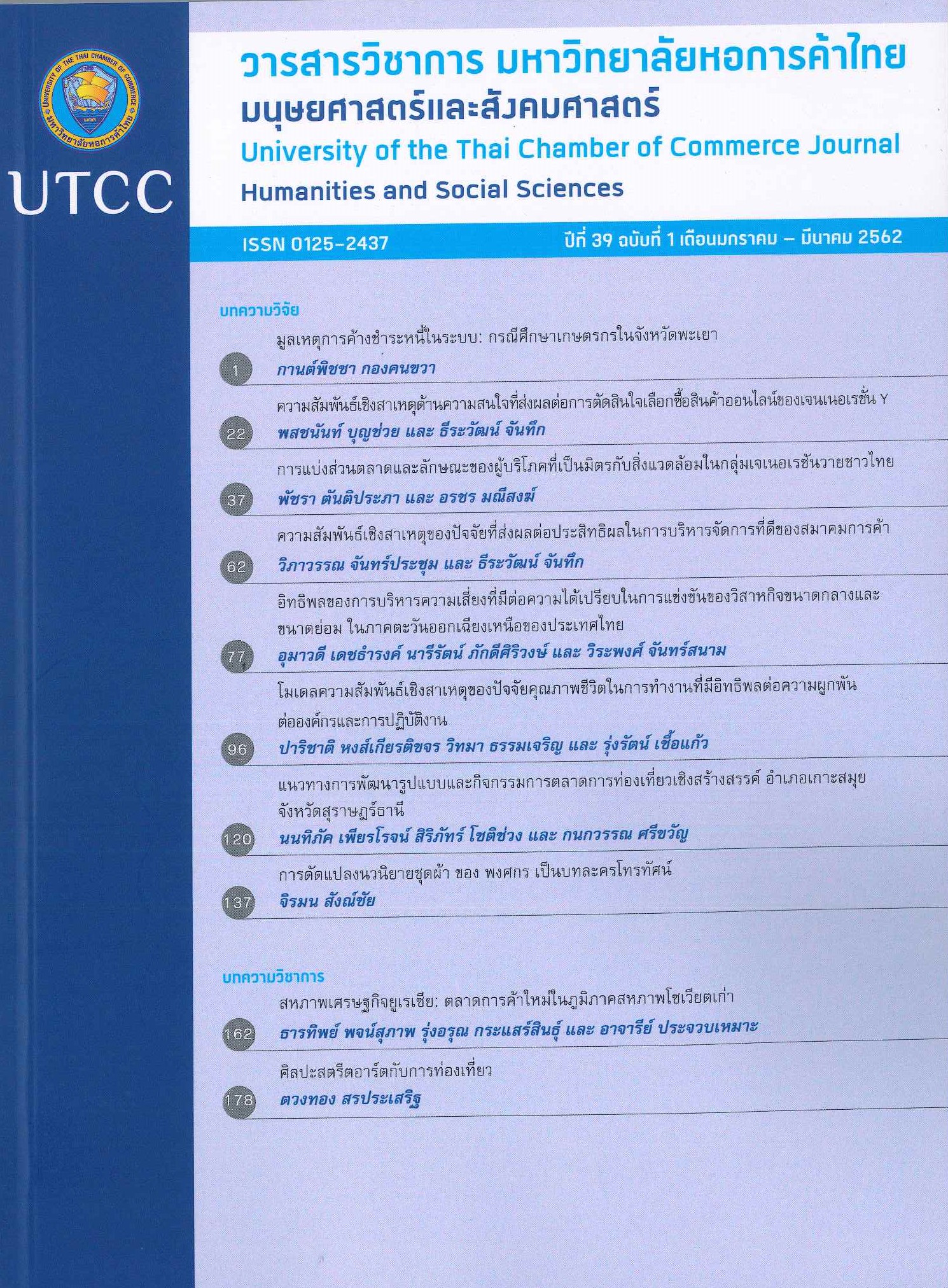
สหภาพเศรษฐกิจยูเรเซีย: ตลาดการค้าใหม่ในภูมิภาค สหภาพโซเวียตเก่า
Article Sidebar
Main Article Content
บทคัดย่อ
การรวมกลุ่มในระดับภูมิภาคได้รับความนิยมในช่วงหลังสิ้นสุดสงครามโลกครั้งที่ 2 การรวมกลุ่มทางเศรษฐกิจมิใช่เป็นเพียงความร่วมมืออย่างใกล้ชิดทางการเมืองเท่านั้น แต่ยังช่วยสร้างโอกาสการค้าและการลงทุนระหว่างประเทศ ด้วยการขจัดอุปสรรคทางการค้าและการสร้างอำนาจการต่อรองสหภาพเศรษฐกิจยูเรเซียเป็นความพยายามในการสร้างเขตการค้าเสรีของกลุ่มสหภาพโซเวียตเก่า มุ่งสร้างระบบจัดเก็บภาษีประเทศนอกกลุ่มและอุปสรรคทางการค้าอื่น ๆ เพื่อลดการนำเข้าจากต่างประเทศและเพื่อปกป้องผู้ผลิตภายในประเทศตนเองกลุ่มประเทศยูเรเซียเป็นตลาดใหม่ที่มีศักยภาพ อีกทั้งยังเป็นประตูเชื่อมความร่วมมือทางการค้าระหว่างยุโรปตะวันตกและฝั่งเอเชียตะวันออกเฉียงใต้
Article Details
ลิขสิทธิ์ของบทความ
ผลงานที่ได้รับการตีพิมพ์ถือเป็นลิขสิทธิ์ของมหาวิทยาลัยหอการค้าไทย ห้ามมิให้นำเนื้อหา ทัศนะ หรือข้อคิดเห็นใด ๆ ของผลงานไปทำซ้ำ ดัดแปลง หรือเผยแพร่ ไม่ว่าทั้งหมดหรือบางส่วนโดยไม่ได้รับอนุญาตเป็นลายลักษณ์อักษรจากมหาวิทยาลัยหอการค้าไทยก่อน
เอกสารอ้างอิง
Amiti, S. (2016). India’s proposed trade pact with Russia-led EAEU bloc on fast track. RetrievedJanuary 26, 2017, from http://www.thehindubusinessline.com/economy/indias-proposed-
trade-pact-with-russialed-eaeu-bloc-on-fasttrack/article8206297.ece
Aslund, A. (2013). Push for customs union turns friends to foes. Retrieved December 4, 2017,from http://www.themoscowtimes.com/opinion/article/push-for-customs-union-turns-friends- to-foes/485789.html
Deceuninck, F. (2016). The European Union & the Eurasian Economic Union: Competingregionalisms towards the neighbourhood? Ukraine being sandwiched between two blocs
(Unpublished master’s thesis). Université Catholique de Louvain, France.
Dragneva, R., & Wolczuk, K. (2015). Ukraine between the EU and Russia: The integration challenge.London, England: Palgrave Macmillan.
Eurasian Development Bank. (2017). Bank profile. Retrieved July 26, 2017, from https://eabr.org/ en/about/
EurasianEconomic Commission. (2016).Eurasianeconomic integration:Facts andfigures. Retrieved December 4, 2017, from http://www.eurasiancommission.org/en/Documents/БрошюраЦифры и факты итог англ.pdf
Eurasian Fund for Stabilization and Development. (2017). About EFSD. Retrieved December 4, 2017, from https://efsd.eabr.org/en/about/
Fabbrini, S. (2009). European regionalism in comparative perspective: Features and limits of the new medievalis approach to world order. Coral Gables, FL: University of Miami.
Hancock, K. L., & Libman, A. (2014). The forgotten region: Russia and Eurasia. Retrieved December 4, 2017, from http://web.isanet.org/Web/Conferences/FLACSO-ISA%20BuenosAires%202014/Archive/61fcee73-a1f4-4aab-ae78-96164936ee08.pdf
Kazanstsev, A. (2008). Russian policy in Central Asia and the Caspian Sea Region. Europe-Asia Studies, 60(6), 1073-1088.
Metcalf, L. K. (1998). The council of mutual economic assistance: The failure of reform. New York: Columbia University Press
Miller, T., & Kim, A. B. (2017). Index of economic freedom 2017. Retrieved January 16, 2018, from http://www.heritage.org/index/download
Mostafa, G. (2016). Economic integration in Eurasia: Challenges and opportunities. World Review of Business Research, 6(2), 46-57.
Obydenkova, A. (2011). Comparative regionalism: Eurasian cooperation and European integration:The case for neofunctionalism?. Journal of Eurasian Studies, 2(2), 87-102.
Qoraboyev, I. (2010). From Central Asian regional integration to Eurasian integration space? The changing dynamics of Post-Soviet regionalism. Retrieved June 24, 2018, from https://
papers.ssrn.com/sol3/papers.cfm?abstract_id=1633563
Schenkkan, N. (2015). Impact of the economic crisis in Russia on Central Asia. Russian Analytical Digest, 165(17), 3-6.
Tarr, D. G. (2016). The Eurasian Economic Union among Russia, Belarus, Kazakhstan, Armenia and the Kyrgyz Republic: Can it succeed where its predecessor failed?. Eastern European Economics, 54(1), 1-22.
Transparency International. (2017). Corruption perceptions index 2017. Retrieved June 24, 2018, from https://www.transparency.org/news/feature/corruption_ perceptions_index_2017
United Nations Conference on Trade and Development. (2018). World investment report: Investment and new industrial policies. Retrieved September 4, 2018, from http://unctad.
org/en/PublicationsLibrary/wir2018_en.pdf
Vinokurov, E. (2017). Eurasian Economic Union: Current state and preliminary results. Russian Journal of Economics, 3(1), 54-70.
V. (2015). Estimating the economic effects of reducing non-tariff barriers in the EEU. (Report 29). St. Petersburg, Russia: Centre for Integration Studies ofEurasian Development Bank
World Bank. (2017). Doing business 2017: Opportunity for all. Washington, DC: Author
Yuan, J. D. (2010). China’s role in establishing and building the Shanghai Cooperation Organization (SCO). Journal of Contemporary China, 19(67), 855-859.
