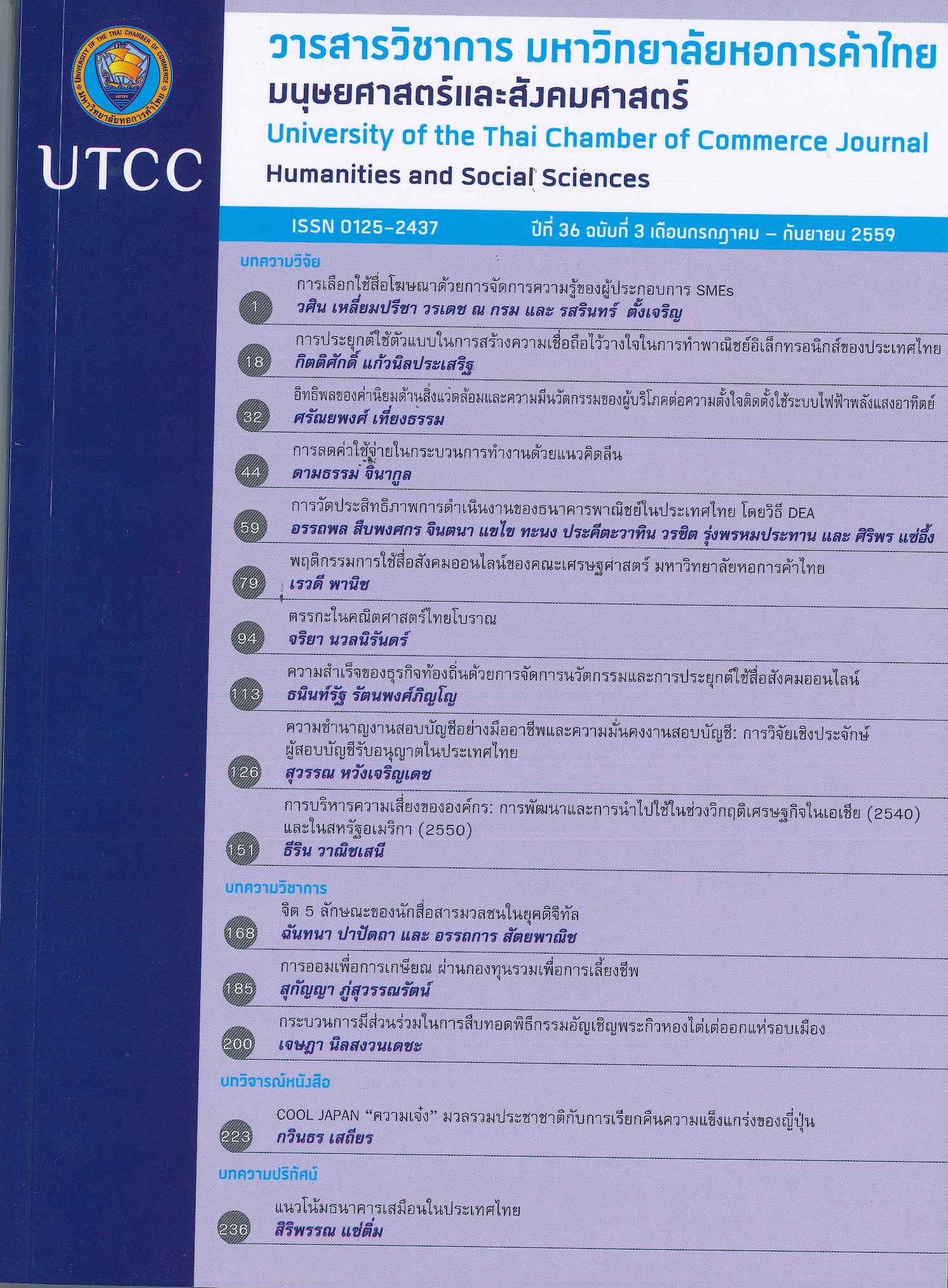
ความชำนาญงานสอบบัญชีอย่างมืออาชีพและความมั่นคงงานสอบบัญชี: การวิจัยเชิงประจักษ์ผู้สอบบัญชีรับอนุญาตในประเทศไทย
Article Sidebar
Main Article Content
บทคัดย่อ
งานวิจัยนี้มีวัตถุประสงค์เพื่อตรวจสอบเชิงประจักษ์ถึงผลกระทบของความชำนาญงานสอบบัญชีอย่างมืออาชีพต่อความมั่นคงงานสอบบัญชี โดยใช้แบบสอบถามในการเก็บข้อมูลจากผู้สอบบัญชีรับอนุญาตในประเทศไทยจำนวน 355 ราย และใช้สถิติการวิเคราะห์การถดถอยแบบกำลังสองน้อยที่สุดทั่วไป (OLS) ผลการศึกษาพบว่า ความชำนาญตรวจสอบบัญชีอย่างมืออาชีพมีผลกระทบเชิงบวกต่อความมั่นคงงานสอบบัญชีโดยผ่านตัวแปรคั่นกลางที่เป็นผลลัพธ์จากงานสอบบัญชี ส่วนตัวแปรที่เกิดขึ้นก่อนหน้านั้นได้แก่ การฝึกอบรมอย่างต่อเนื่อง ความสนใจเทคโนโลยีการตรวจสอบ การปรับปรุงกระบวนการตรวจสอบ มีความสัมพันธ์เชิงบวกกับความชำนาญงานสอบบัญชีอย่างมืออาชีพ แต่ตัวแปรแทรกประกอบด้วยกฎระเบียบทางวิชาชีพที่เข้มงวดมีความสัมพันธ์เชิงบวกระหว่างความชำนาญงานสอบบัญชีอย่างมืออาชีพกับตัวแปรคั่นกลางเป็นส่วนใหญ่ ในขณะที่การแข่งขันในตลาดงานสอบบัญชีมีความสัมพันธ์เชิงบวกระหว่างตัวแปรก่อนหน้านั้นกับความชำนาญงานสอบบัญชีอย่างมืออาชีพเพียงบางส่วนเท่านั้น
Article Details
ลิขสิทธิ์ของบทความ
ผลงานที่ได้รับการตีพิมพ์ถือเป็นลิขสิทธิ์ของมหาวิทยาลัยหอการค้าไทย ห้ามมิให้นำเนื้อหา ทัศนะ หรือข้อคิดเห็นใด ๆ ของผลงานไปทำซ้ำ ดัดแปลง หรือเผยแพร่ ไม่ว่าทั้งหมดหรือบางส่วนโดยไม่ได้รับอนุญาตเป็นลายลักษณ์อักษรจากมหาวิทยาลัยหอการค้าไทยก่อน
เอกสารอ้างอิง
American Institute of Certified Public Accountants. 2001. “The Effect of Information Technology on the Auditors’ Consideration of Internal Control in a Financial Statements Audit.” In Statement of Auditing Standards No. 94. New York: AICPA.
Asare, S., and Wright, M. 2004. “The Effectiveness of Alternative Risks Assessment and Program Planning Tools in a Fraud Setting.” Contemporary Accounting Research 21, 1:325-352.
Bandura, A. 1999. “A Social Cognitive Theory of Personality.” In L.A. Pervin and O.P. John (Eds.), Handbook of Personality: Theory and Research, pp. 154-196. 2nd ed. New York: The Guilford Press.
Barrett, Michael, Cooper, David J., and Jamal, Karim. 2005. “Globalization and the Coordinating of Work in Multinational Audits.” Accounting, Organizations and Society 30, 1: 1-24.
Cronbach, Lee J. 1951. “Coefficient Alpha and Internal Structure of Tests.” Psychometrical 16, 3: 297-334.
Dorotta, Ihab, et al. 2006. “Teaching and Evaluating Professionalism for Anesthesiology Residents.” Journal of Clinical Anesthesia 18, 2: 148-160.
Dull, Richard B., Graham, Allan W., and Baldwin, Amelia A. 2003. “Web-Based Financial Statements: Hypertext Links to Footnotes and Their Effect on Decisions.” International Journal Accounting Information Systems 4, 3: 185-203.
Feng, Mei, Li, Chan, and McVay, Sarah. 2009. “Internal Control and Management Guidance.” Journal of Accounting and Economics 48, 2-3: 190-209.
Fenwick, T. 2003. “Innovation: Examining Workplace Learning in New Enterprises.” Journal of Workplace Learning 15, 3: 123-132.
Goh, S., and Richards, G. 1997. “Benchmarking the Learning Capacity of Organizations.” Journal of European Management 15, 5: 575-583.
Grant, R. M. 1996. “Toward a Knowledge-Based Theory of the Firm.” Strategic Management Journal 17: 109-122.
Hair, Joseph F., et al. 2006. Multivariate Data Analysis 7th ed. Upper Saddle River, NJ: Prentice Hall.
Hewett, K., Roth, M S., and Roth, K. 2003. “Conditions Influencing Headquarters and Foreign Subsidiary Roles in Marketing Activities and Their Effects on Performance.” Journal of International Business Studies 34, 567-585.
Hilton, Sean, and Southgate, Lesley. 2007. “Professionalism in Medical Education.” Teaching and Teacher Education 23, 3: 265-279.
Howieson, Bryan. 2009. “Accounting Practice in the New Millennium: is Accounting Education Ready to Meet the Challenge?.” The British Accounting Review 35, 2: 69-103.
Institute of Internal Auditors. 2009. IIA Position Paper: The Role of Internal Auditing in Enterprise-Wide Risk Management. Altamonte Springs, FL: IIA.
International Accounting Standard Board. 2001. International Accounting Standards Board: IAS Around the World, How IAS are Being Used [Online]. Available: https://www.iasb.org.uk
Krejcie, R.V., and Morgan, D. W. 1970. “Determining Sample Size for Research Activities.” Education and Psychological Measurement 30, 3: 607-610.
Malter, Alan J., and Dickson, Peter R. 2001. “The Effect of Individual Learning on Competitive Decision-making and Firm Performance.” Journal of Research in Marketing 18, 1-2:
99-117.
Mansi, Sattar A., Maxwell, William F., and Miller, Darius P. 2004. “Does Auditor Quality and Tenure Matter to Investors?: Evidence from the Bond Market.” Journal of Accounting Research 42, 4: 755–793.
Martinov-Bennie, Nonna, and Pflugrath, Gary. 2009. “The Strength of an Accounting Firm’s Ethical Environment and the Quality of Auditors’ Judgments.” Journal of Business Ethics 87, 2: 237-253.
McMillan, Keith P. 2004. “Trust and the Virtues: A Solution to the Accounting Scandals?.” Critical Perspectives on Accounting 15, 6-7: 943-953.
Miller, J. R., Reed, S.A., and Strawser, R.H. 1993. “Bank Loan Officers’ Perceptions of the New Audit Report.” Accounting Horizons 7: 39-52.
Nelson, Mark W. 2009. “A Model and Literature Review of Professional Skepticism in Auditing.” Journal of Practice and Theory 28, 2: 1-34.
Nicolaou, Andreas I. 2000. “A Contingency Model of Perceived Effectiveness in Accounting Information Systems: Organizational Coordination and Control Effects.” International Journal of Accounting Information Systems 1, 2: 91-105.
Obaidat, Ahmad N. 2007. “Accounting Information Qualitative Characteristics Gap: Evidence from Jordan.” International Management Review 3, 2: 26-32.
O’Leary, Daniel E. 2002. “Knowledge Management across the Enterprise Resource Planning Systems Life Cycle.” International Journal of Accounting Information Systems 3, 2:
99-110
Peecher, Mark E., Schwartz, Rachel, and Solomon, Ira. 2007. “It is All about Quality: Perspectives on Strategic-Systems Auditing.” Accounting Organization and Society 32, 4-5: 463-486.
Real, Juan C., Leal, Antonio, and Roldán, José L. 2006. “Information Technology as a Determinant of Organizational Learning and Technological Distinctive Competencies.” Industrial Marketing Management 35, 4: 505-521.
Wangcharoendate, Suwan. 2015. “Internal Audit Outsourcing and Sustainable Audit Success: An Empirical Investigation of Listed Companies in The Stock Exchange of Thailand.” University of the Thai Chamber of Commerce Journal 35, 1: 1-21.
Watkins, Ann L., Hillison, William, and Morecroft, Susan E. 2004. “Audit Quality: A Synthesis of Theory and Empirical Evidence.” Journal of Accounting Literature 23, 153–193.
Wilks, T., and Zimbelman, M. 2004. “Decomposition of Fraud Risk Detection Assessments and Auditors’ Sensitivity to Fraud Cues.” Contemporary Accounting Research 21, 3: 719-746.
Wong, Peter S.P., and Cheung, Sai On. 2008. “An Analysis of Relationship between Learning Behavior and Performance Improvement of Contracting Organizations.” International Journal of Project Management 26, 2: 112-123.
