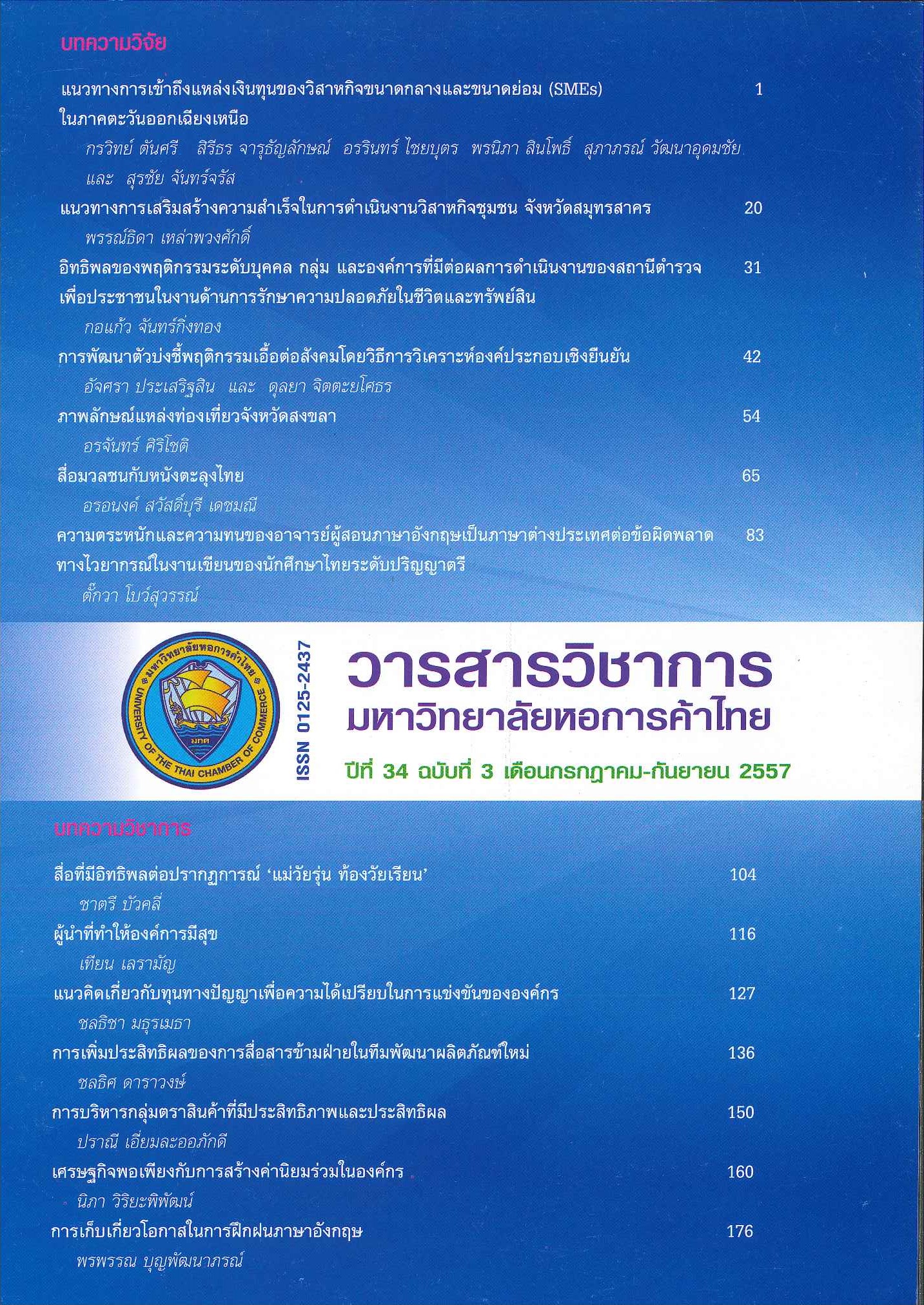
การพัฒนาตัวบ่งชี้พฤติกรรมเอื้อต่อสังคมโดยวิธีการวิเคราะห์องค์ประกอบเชิงยืนยัน
Article Sidebar
Main Article Content
บทคัดย่อ
การวิจัยนี้ มีวัตถุประสงค์เพื่อพัฒนาตัวบ่งชี้พฤติกรรมเอื้อต่อสังคมโดยวิธีการวิเคราะห์องค์ประกอบเชิงยืนยัน กลุ่มตัวอย่างคือ นิสิต/ นักศึกษา มหาวิทยาลัยของรัฐและเอกชน ในกรุงเทพมหานครและปริมณฑล จำนวน 500 คน ได้มาด้วยวิธีการเลือกกลุ่มตัวอย่างแบบ 2 ขั้นตอน (two-stage sampling) เก็บรวบรวมข้อมูลจากแบบวัดพฤติกรรมเอื้อต่อสังคม แบบ 5 ระดับ ประกอบด้วย 5 ตัวบ่งชี้ย่อย ตัวบ่งชี้ละ 5 ข้อคำถาม รวม 25 ข้อ ผลการวิเคราะห์ความสัมพันธ์ระหว่างตัวแปรขององค์ประกอบพฤติกรรมเอื้อสังคม ได้แก่ 1) ด้านการให้ 2) ด้านการแบ่งปัน 3) ด้านการช่วยเหลือผู้อื่น 4) ด้านการปลอบโยน และ 5) ด้านการร่วมมือ พบว่า ค่าสัมประสิทธิ์สหสัมพันธ์ระหว่างตัวแปรทั้ง 5 ตัวมีค่าอยู่ระหว่าง 0.341 ถึง 0.634 และมีนัยสำคัญทางสถิติที่ระดับ 0.01 โดยตัวแปรการให้และการปลอบโยน มีค่าสัมประสิทธิ์สหสัมพันธ์ต่ำที่สุด (r=0.341) ในขณะที่ตัวแปรการแบ่งปันและการช่วยเหลือผู้อื่น มีค่าสัมประสิทธิ์สหสัมพันธ์สูงสุด (r=0.634) ผลการวิเคราะห์องค์ประกอบเชิงยืนยัน พบว่า ค่าน้ำหนักองค์ประกอบมาตรฐาน 0.650-0.829 ค่าความเที่ยง 0.436-0.688 ตัวแปรที่มีน้ำหนักความสำคัญมากที่สุด คือ การแบ่งปัน (0.829) รองลงมาคือ การช่วยเหลือ (0.762) การปลอบโยน (0.708) การให้ (0.660) และร่วมมือ (0.650) ผลการวิเคราะห์โมเดล พบว่า มีความสอดคล้องกลมกลืนกับข้อมูลเชิงประจักษ์ x2=4.254, df=3, p=0.024, RMSEA=0.029, RMR=0.013, GFI=0.997 และ AGFI=0.983 ค่า Model AIC = 28.254 และ Saturated AIC = 30.000 ค่า Model CAIC = 90.829 และ Saturated CAIC = 108.219
Article Details

อนุญาตภายใต้เงื่อนไข Creative Commons Attribution-NonCommercial-NoDerivatives 4.0 International License.
ลิขสิทธิ์ของบทความ
ผลงานที่ได้รับการตีพิมพ์ถือเป็นลิขสิทธิ์ของมหาวิทยาลัยหอการค้าไทย ห้ามมิให้นำเนื้อหา ทัศนะ หรือข้อคิดเห็นใด ๆ ของผลงานไปทำซ้ำ ดัดแปลง หรือเผยแพร่ ไม่ว่าทั้งหมดหรือบางส่วนโดยไม่ได้รับอนุญาตเป็นลายลักษณ์อักษรจากมหาวิทยาลัยหอการค้าไทยก่อน
เอกสารอ้างอิง
Bentler, P. M., and Chou, C. 1987. “Practical Issues in Structural Modeling.” Sociological Methods and Research 16, 1: 78-117.
Carlo, G., et al. 2007. “Parenting Styles or Practices? Parenting, Sympathy and Prosocial Behaviors Among Adolescents.” The Journal of Genetic Psychology 168, 2: 147-176.
Chantos, Petchrat. 1999. “A Study of Relationships between Cooperative Behavior and Different Self-Perceived Parent Styles of Prathomsuksa Five and Six Students.” Master’s Thesis, Graduate School, Chulalongkorn University. (in Thai).
เพชรรัตน์ จันทศ. 2542. “การศึกษาความสัมพันธ์ระหว่างพฤติกรรมการให้ความร่วมมือและรูปแบบการอบรมเลี้ยงดูที่แตกต่างกันตามการรับรู้ของตนเองของนักเรียนชั้นประถมศึกษาปีที่ 5 และ 6.” วิทยานิพนธ์ปริญญามหาบัณฑิต สาขาวิชาจิตวิทยาพัฒนาการ จุฬาลงกรณ์มหาวิทยาลัย.
Chitayasothorn, Dulaya. 2013. “The Relationship between Empathy and Prosocial Behavior.” University of Thai Chamber of Commerce Journal 33, 3: 154-171. (in Thai).
ดุลยา จิตตะยโศธร. 2555. “ความสัมพันธ์ระหว่างความร่วมรู้สึกกับพฤติกรรมเอื้อต่อสังคม.” วารสารวิชาการมหาวิทยาลัยหอการค้าไทย 33, 3: 145-162.
Eisenberg, N., et al. 1995. “Prosocial Development in Late Adolescence: A Longitudinal Study.” Child Development 66, 4: 1179-1197.
Eisenberg, N., Fabes, R.A., and Spinrad, T.L. 2006. “Prosocial Development.” In Eisenberg, N. (Ed.), Handbook of Child Psychology: Social, Emotional, and Personality Development 3, pp.646-718. New York: Wiley.
Eisenberg, N., and Miller, P.A. 1987. “The Relation of Empathy of Prosocial and Related Behaviors.” Psychology Bullentin 101, 1: 91-119.
Eisenberg, N., and Shell, R. 1986. “The Relation of Prosocial Moral Judgment and Behavior in Children: The Mediating Role of Cost.” Personality and Social Psychology Bullentin 12: 426-433.
Eisenberg, N., et al. 1987. “Prosocial Development in Middle Childhood: A Longitudinal Study.” Developmental Psychology 24 : 712-718.
Gagne, P., and Hancock, G. R. 2006. “Measurement Model Quality, Sample Size, and Solution Propriety in Confirmatory Factor Models.” Multivariate Behavioral Research 41, 65-83.
Gini, G., et al. 2007. “Does Empathy Predict Adolescents’ Bullying and Defending Behavior?.” Aggressive Behavior 33, 5: 467-476.
Hoffman, M.L. 1981. “Is Altruisum Part of Human Nature?.” Journal of Personality and Social Psychology 40, 1: 121-137.
Kowatrakul, Surang. 2005. Educational Psychology. 6th ed. Bangkok: Chulalongkorn University. (in Thai).
สุรางค์ โค้วตระกูล. 2548. จิตวิทยาการศึกษา. พิมพ์ครั้งที่ 6. กรุงเทพมหานคร: สำนักพิมพ์แห่งจุฬาลงกรณ์มหาวิทยาลัย.
Mussen, P., and Eisenberg, N. 1977. Root of Caring, Sharing and Helping: The Development of Prosocial Behavior in Children. San Francisco: W.H. Freeman.
Padilla – Walker, L.M., et al. 2012. “Bidirectional Relations between Authoritative Parenting and Adolescents’ Prosocial Behaviors.” Journal of Research on Adolescence 22, 3: 400-408.
Perry, D.G., and Bussey, K. 1984. Social Development. Englewood Cliffs, NJ : Prentice – Hall.
The Royal Institute. 2007. Dictionary of Psychology. Bangkok: The Royal Institute. (in Thai).
ราชบัณฑิตสถาน. 2550. พจนานุกรมศัพท์จิตวิทยา. กรุงเทพมหานคร: ราชบัณฑิตสถาน.
Scrimgeour, M.B., et al. 2013. “Cooperative Coparenting Moderates the Association between Parenting Practices and Children’s Prosocial Behavior.” Journal of Family Psychology 27, 3: 506-511.
