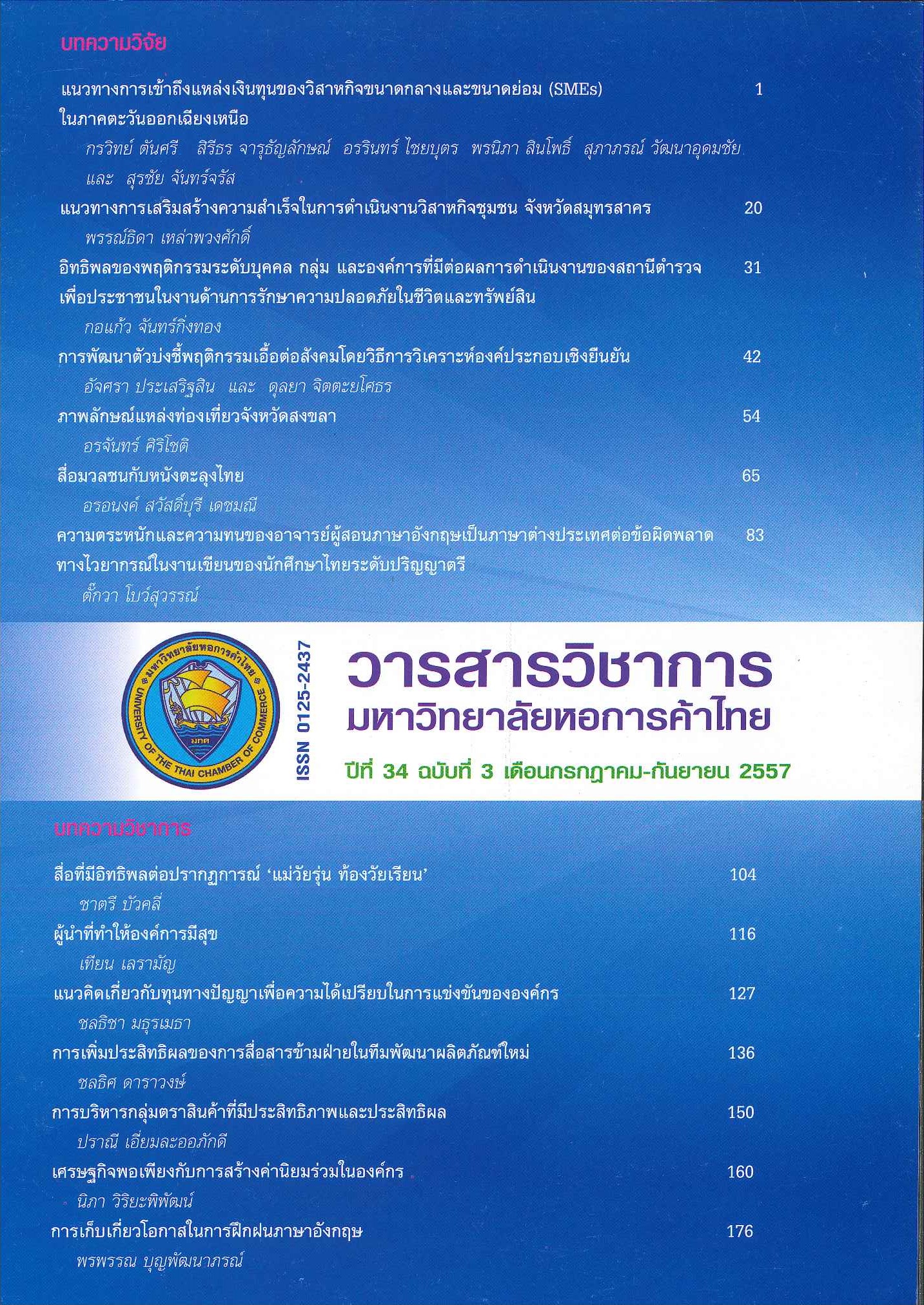
การเพิ่มประสิทธิผลของการสื่อสารข้ามฝ่ายในทีมพัฒนาผลิตภัณฑ์ใหม่
Article Sidebar
Main Article Content
บทคัดย่อ
ปัจจุบัน บริษัทผู้ผลิตหลายแห่งมีความจำเป็นต่อการสร้างทีมพัฒนาผลิตภัณฑ์ในการสร้างจุดแข็งทางการตลาดให้กับสินค้าทั้งที่มีอยู่เดิมหรือที่กำลังจะพัฒนาขึ้นมาใหม่ ซึ่งเป็นการสร้างข้อได้เปรียบทางการแข่งขันเพื่อต่อสู้กับบริษัทคู่แข่งจากทั้งในและต่างประเทศ แต่เนื่องจากทีมประเภทนี้ประกอบด้วยสมาชิกจากหลากหลายฝ่ายซึ่งมีพื้นฐานทางการศึกษาและประสบการณ์การทำงานที่แตกต่างกัน อาจทำให้เกิดความไม่เข้าใจในเนื้อหาระหว่างการสื่อสารอยู่บ่อยครั้ง ดังนั้น การเพิ่มประสิทธิผลของการสื่อสารข้ามฝ่ายจึงเป็นความท้าทายสำหรับนักบริหารของบริษัทอย่างหลีกเลี่ยงไม่ได้ วัตถุประสงค์ของบทความนี้คือ เพื่อสร้างความตระหนักในความสำคัญของการสื่อสารข้ามฝ่ายระหว่างสมาชิกในทีมพัฒนาผลิตภัณฑ์ โดยเนื้อหาจะประกอบด้วยคำอธิบายของคุณลักษณะของทีมพัฒนาผลิตภัณฑ์ ความหมายและประโยชน์ของการสื่อสารข้ามฝ่าย คุณสมบัติของการสื่อสารข้ามฝ่าย และปัจจัยที่มีต่อประสิทธิภาพของการสื่อสารข้ามฝ่าย นอกจากนี้ ผู้แต่งยังเสนอข้อเสนอแนะสำหรับธุรกิจไทยเพื่อให้สามารถพัฒนาประสิทธิภาพของการทำงานของทีมพัฒนาผลิตภัณฑ์และเพิ่มโอกาสในความสำเร็จของสินค้าใหม่ทั้งด้านยอดขายและตำแหน่งของผลิตภัณฑ์
Article Details

อนุญาตภายใต้เงื่อนไข Creative Commons Attribution-NonCommercial-NoDerivatives 4.0 International License.
ลิขสิทธิ์ของบทความ
ผลงานที่ได้รับการตีพิมพ์ถือเป็นลิขสิทธิ์ของมหาวิทยาลัยหอการค้าไทย ห้ามมิให้นำเนื้อหา ทัศนะ หรือข้อคิดเห็นใด ๆ ของผลงานไปทำซ้ำ ดัดแปลง หรือเผยแพร่ ไม่ว่าทั้งหมดหรือบางส่วนโดยไม่ได้รับอนุญาตเป็นลายลักษณ์อักษรจากมหาวิทยาลัยหอการค้าไทยก่อน
เอกสารอ้างอิง
Cooper, Robert G., and Kleinschmidt, Elko J. 1994. “Determinants of Timeliness in Product Development.” Journal of Product Innovation Management 11, 5: 381 - 396.
Darawong, Chonlatis. 2013a. “Key Success Factors of New Product Development to Cope with AEC.” BEC Journal 8, 1: 39-50. (in Thai).
ชลธิศ ดาราวงษ์. 2555ก. “ปัจจัยความสำเร็จในการพัฒนาผลิตภัณฑ์ใหม่เพื่อตอบรับ AEC.” วารสารบริหารธุรกิจ เศรษฐศาสตร์และการสื่อสาร 8, 1: 39-50.
Darawong, Chonlatis. 2013b. “New Products and Business Strategy.” Sripatum Chonburi Journal 9, 2: 44-52. (in Thai).
ชลธิศ ดาราวงษ์. 2555ข. “ผลิตภัณฑ์ใหม่และกลยุทธ์ทางธุรกิจ.” วารสารวิชาการศรีปทุมชลบุรี 9, 2: 44-52.
Darawong, Chonlatis. 2013c. “The Mediating Effect of Cross-Functional Communication on the Relationship between Task Interdependence and New Product Development Speed: A Proposed Model.” Stamford Journal 5, 1: 119-126.
Darawong, Chonlatis, and Igel, Barbara. 2012. “Acculturation of Local New Product Development Team Members in MNC Subsidiaries in Thailand.” Asia Pacific Journal of Marketing and Logistics 24, 3: 351-371.
Fisher, Robert J., Maltz, Elliot, and Jaworski, Bernard J. 1997. “Enhancing Communication between Marketing and Engineering: The Moderating Role of Relative Functional Identification.” Journal of Marketing 61, 3: 54-70.
Fredericks, Elisa. 2005. “Cross-Functional Involvement in New Product Development: A Resource Dependency and Human Capital Perspective.” Qualitative Market Research: An International Journal 8, 3: 1352-2752.
Ganesan, Shankar, Matter, Alan J., and Rindfleisch, Aric. 2005. “Does Distance Still Matter? Geographic Proximity and New Product Development.” American Marketing Association 69, 4: 44-60.
Griffin, Abbie, and Hauser, John R. 1996. “Integrating R&D and Marketing: A Review and Analysis of the Literature.” Journal of Product Innovation Management 13, 3: 191-215.
Hart, Susan J., and Baker, Michael J. 1994. “The Multiple Convergent Processing Model of New Product Development.” International Marketing Review 11, 1: 77-92.
HIrst, G., and Mann, L. 2004. “A Model of R&D Leadership and Team Communication: The Relationship with Project Performance.” R&D Management 34, 2: 147-160.
Hoegl, Martin. 2005. “Smaller Teams - Better Teamwork: How to Keep Project Teams Small.” Business Horizons 48, 3: 209-214.
Holland, S., Gaston, K., and Gomes, J. 2000. “Critical Success Factors for Cross-Functional Teamwork in New Product Development.” International Journal of Management Review 2, 3: 231-259.
Kananurak, Napawan. 2009. “Leadership for Efficiency Organization.” University of the Thai Chamber of Commerce Journal 29, 4: 136 – 146. (in Thai).
นภวรรณ คณานุรักษ์. 2552. “ภาวะผู้นำเพื่อองค์กรที่มีประสิทธิภาพ.” วารสารวิชาการ มหาวิทยาลัยหอการค้าไทย 29, 4: 136 – 146.
Kichuk, Susan L., and Wiesner, Willi H. 1997. “The Big Five Personality Dimensions and Team Performance: Implications for Selecting Successful Product Design Teams.” Journal of Engineering and Technology Management 14, 3: 195-221.
Kraut, Robert E., et al. 1990. “Informal Communication in Organizations: Form, Function, and Technology.” In I. S. Oskamp and S. Spacapan, (eds.), Human Reactions to Technology: The Claremont Symposium on Applies Social Psychology. pp. 1-55. Beverly Hills, CA: Sage.
Leenders, Roger Th. A. J., Engelen, Jo M. L. van, and Kratzer, Jan. 2003. “Virtuality, Communication, and New Product Team Creativity: A Social Network Perspective.” Journal of Engineering and Technology Management 20, 1-2: 69-92.
Lewis, K. 2003. “Knowledge and Performance in Knowledge-Worker Teams: A Longitudinal Study of Transactive Memory Systems.” Management Science 50, 11: 1519-1533.
Lovelace, K., Shapiro, D. L., and Weingart, L. R. 2001. “Maximizing Cross-Funtional New Product Teams' Innovativeness and Constraint Adherence: A Conflict Communications Perspective.” Academy of Management Journal 44, 4: 779-793.
Maltz, Elliot, and Kohli, Ajay K. 1996. “Market Intelligence Dissemination across Functional Boundaries.” Journal of Marketing Research 33, 1: 47-61.
McDonough, Edward F., III. 2000. “Investigation of Factors Contributing to the Success of Cross-Functional Teams.” Journal of Product Innovation Management 17, 3: 221-235.
Moenaert, Rudy K., et al. 1994. “R&D-Marketing Integration Mechanisms, Communication Flows, and Innovation Success.” Journal of Product Innovation Management 11, 1: 31 - 45.
Patrashkova-Volzdoska, et al. 2003. “Examing a Curvilinear Relationship between Communication Frequency and Team Performance in Cross-Functional Project Teams.” IEEE Transactions on Engineering Management 50, 3: 262-269.
Pinto, Mary Beth, and Pinto, Jeffrey K. 1990. “Project Team Communication and Cross-Functional Cooperation in New Program Development.” Journal of Product Innovation Management 7, 3: 200 - 212.
Pinto, Mary Beth, Pinto, Jeffrey K., and Prescott, John E. 1993. “Antecedents and Consequences of Project Team Cross-Functional Cooperation.” Management Science 39, 10: 1281 - 1297.
