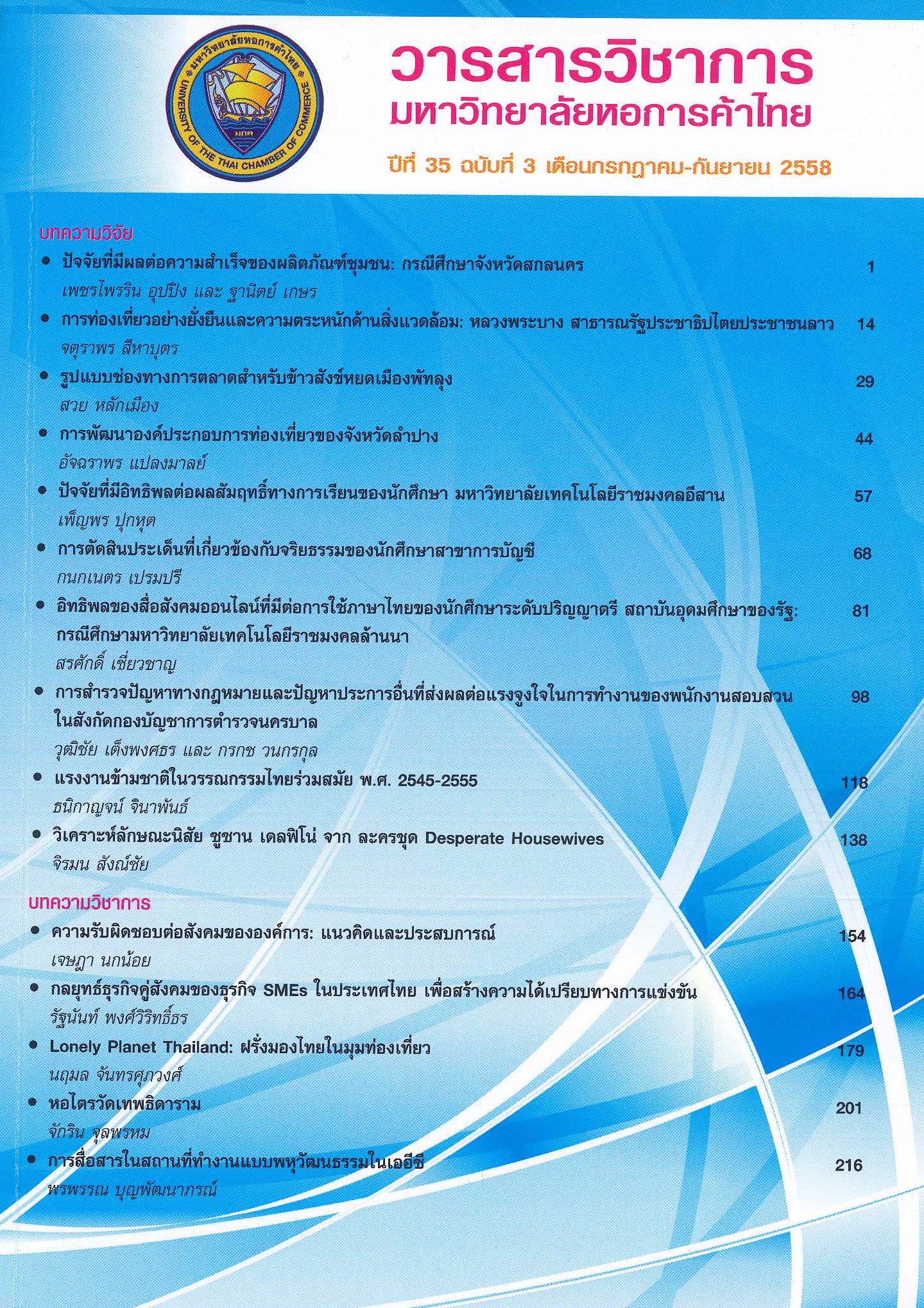
การพัฒนาองค์ประกอบการท่องเที่ยวของจังหวัดลำปาง
Article Sidebar
Main Article Content
บทคัดย่อ
การศึกษาครั้งนี้มีวัตถุประสงค์เพื่อหาแนวทางในการพัฒนาองค์ประกอบการท่องเที่ยวของจังหวัดลำปาง 6 ด้าน คือ ด้านที่พัก ด้านร้านอาหาร ด้านสถานที่ขายของฝาก ด้านการเดินทาง ด้านสภาพแวดล้อม และด้านความปลอดภัย และด้านสิ่งอำนวยความสะดวก โดยกลุ่มตัวอย่างที่ตอบแบบสอบถามเป็นนักท่องเที่ยวที่เดินทางเข้ามาเที่ยวในสถานที่ท่องเที่ยวหลักของจังหวัดลำปาง เก็บข้อมูลทั้งหมด 384 ชุด ด้วยแบบสอบถามที่มีค่าความเชื่อมั่นแยกรายด้านตามองค์ประกอบ อยู่ที่ .740-.903 วิเคราะห์ข้อมูลนักท่องเที่ยวด้วยโปรแกรมทางสถิติ ผลการศึกษา พบว่า ที่ระดับค่าความเชื่อมั่นทางสถิติ .05 ความพึงพอใจของนักท่องเที่ยวต่อองค์ประกอบการท่องเที่ยวโดยรวมของจังหวัดลำปางอยู่ในระดับมาก โดยนักท่องเที่ยวมีความพึงพอใจองค์ประกอบการท่องเที่ยวในสถานที่ท่องเที่ยวหลักของจังหวัดลำปางแตกต่างกัน โดยมีอายุ สถานภาพ การศึกษา จังหวัดที่อาศัย ความถี่ในการเที่ยว ช่วงโอกาสในการเที่ยว และจำนวนสมาชิกที่มาเที่ยวด้วยกันเป็นปัจจัยที่มีความสัมพันธ์กับระดับความพึงพอใจ ดังนั้นการพัฒนาองค์ประกอบการท่องเที่ยวของแต่ละแห่งควรมีการพัฒนาองค์ประกอบในด้านที่แตกต่างกันโดยให้ความสำคัญในการพัฒนาองค์ประกอบที่มีผลต่อการกลับมาเที่ยวซ้ำ แต่มีความพึงพอใจน้อยก่อนเป็นอันดับแรก
Article Details

อนุญาตภายใต้เงื่อนไข Creative Commons Attribution-NonCommercial-NoDerivatives 4.0 International License.
ลิขสิทธิ์ของบทความ
ผลงานที่ได้รับการตีพิมพ์ถือเป็นลิขสิทธิ์ของมหาวิทยาลัยหอการค้าไทย ห้ามมิให้นำเนื้อหา ทัศนะ หรือข้อคิดเห็นใด ๆ ของผลงานไปทำซ้ำ ดัดแปลง หรือเผยแพร่ ไม่ว่าทั้งหมดหรือบางส่วนโดยไม่ได้รับอนุญาตเป็นลายลักษณ์อักษรจากมหาวิทยาลัยหอการค้าไทยก่อน
เอกสารอ้างอิง
Budinoski, M. 2011. “Opportunity for Increasing Revenue in Tourism with Optimal Structure of the Tourism Offer.” UTMS Journal of Economics 2, 2: 163-170.
Chantaranamchoo, Nopporn, Rattanapongpinyo, Taninrat, and Ratsasanasart, Dechaphan. 2014. “Developing Strategies for Cultural Tourism Relevant to the ASEAN Community Based on the Creative Economy of Four Dvaravati Provinces.” University of Thai Chamber of Commerce Journal 34, 4: 1-15. (in Thai)
นพพร จันทรนำชู,ธนินทร์รัฐ รัตนพงศ์ภิญโญ,และ เดชาพันธ์ รัฐศาสนศาสตร์. 2557. “การพัฒนายุทธศาสตร์การท่องเที่ยวเชิงวัฒนธรรมกลุ่มทวารวดี 4 จังหวัด ตามแนวทางเศรษฐกิจสร้างสรรค์เพื่อรองรับประชาคมอาเซียน.” วารสารวิชาการ มหาวิทยาลัยหอการค้าไทย 34, 4: 1-15.
Chen, J.S., and Gursoy, D. 2001. “An Investigation of Tourists’ Destination Loyalty and Preferences.” International Journal of Contemporary Hospitality Management 13, 2: 79-85.
Costa, J., and Ferrone, L. 1995. “Socio-cultural Perspectives on Tourism Planning and Development.” International Journal of Contemporary Hospitality Management 7: 27-35.
Cronbach, L.J. 1951. “Coefficient Alpha and the Internal Structure of Test.” Pyschometrika 16: 297-334.
Darnell, A.C., and Johnson, P.S. 2001. “Repeat Visits to Attractions: A Preliminary Economic Analysis.” Tourism Management 22: 119-126.
Engel, J.F., Blackwell, R.D., and Miniard, P.W. 1990. Consumer Behavior. 6th ed. Chicago, IL: Dryden Press.
Erdogan, H.E. 2006. ''Some Determinants of Destination Satisfaction in North Cyprus: Perceptions of International Travelers. n.p.
Field, A. 2006. Discovering Statistics Using SPSS. 2nd ed. London: SAGE.
Hankinson, G. 2004. ''The Brand Images of Tourism Destinations: A Study of the Saliency of Organic Images.'' Journal of Product and Brand Management 13, 1: 6-14.
Ibrahim, E.E., and Gill, J. 2005. ''A Positioning Strategy for a Tourist Destination, Based on Analysis of Customers' Perceptions and Satisfactions.'' Marketing Intelligence and Planning 23, 2: 172-188.
Kandampully, J., and Suhartanto, D. 2000. ''Customer Loyalty in the Hotel Industry: The Role of Customer Satisfaction and Image.'' International Journal of Contemporary Hospitality Management 12, 6: 346-351.
Kaynak, E., Bloom, J., and Leibold, M. 1994. ''Using the Delphi Technique to Predict Future Tourism Potential.'' Marketing Intelligence and Planning 12, 7: 18-29.
Kotler, P., and Keller, K.L. 2009. Marketing Management. 13th ed. Upper Saddle River, NJ: Prentice-Hall.
Krejcie, R.V., and Morgan, D.W. 1970. "Determining Sample Size for Research Activities." Educational and Psychological Measurement 30: 607-610.
Lampang Provincial Office of Tourism and Sports. 2010. Province Information [Online]. Available: https://www.lampang.mots.go.th/index.php (in Thai).
สำนักงานการท่องเที่ยวและกีฬาจังหวัดลำปาง. 2553. ข้อมูลจังหวัด [ออนไลน์]. เข้าถึงจาก https://www.lampang.mots.go.th/index.php
Oliver, R.L. 1997. "Satisfaction: A Behavioral Perspective on the Consumer." New York: McGraw-Hill.
Oppermann, M. 1999. "Destination Threshold Potential and the Law of Repeat Visitation." Journal of Travel Research 37, 2: 131-137.
Poon, W.C., and Low, K.L.T. 2005. "Are Travellers Satisfied with Malaysian Hotels?" International Journal of Contemporary Hospitality Management 17, 3: 217-227.
Reisinger, Y., and Waryszak, R.Z. 1994. "Tourists' Perceptions of Service in Shops Japanese Tourists in Australis." International of Retail and Distribution Management 22, 5: 20-28.
Sarikaya, E., and Woodside, A.G. 2005. "Building and Testing Theories of Decision Making by Travelers." Tourism Management 26, 6: 815-832.
Thangchan, Wittika. 2006. "Integrated Tourism Marketing Strategies for Ubon Ratchathani Province." Master's thesis, Naresuan University. (in Thai).
วิตติกา ทางชั้น. 2550. ''กลยุทธ์การตลาดการท่องเที่ยวของจังหวัดอุบลราชธานีในเชิงบูรณาการ." วิทยานิพนธ์ปริญญามหาบัณฑิตมหาวิทยาลัยนเรศวร.
Thepwal, Waranya. 2002. "Causal Factors Affecting Tourists' Decision to Visit Doi Tung,Chiang Rai Province." Master's thesis, Chiang Mai University. (in Thai).
วรัญญา เทพวัลย์. 2545. "ปัจจัยสาเหตุที่ทำให้นักท่องเที่ยวชาวไทยตัดสินใจเลือกมาดอยตุงจังหวัดเชียงราย." วิทยานิพนธ์ปริญญามหาบัณฑิต มหาวิทยาลัยเชียงใหม่.
